

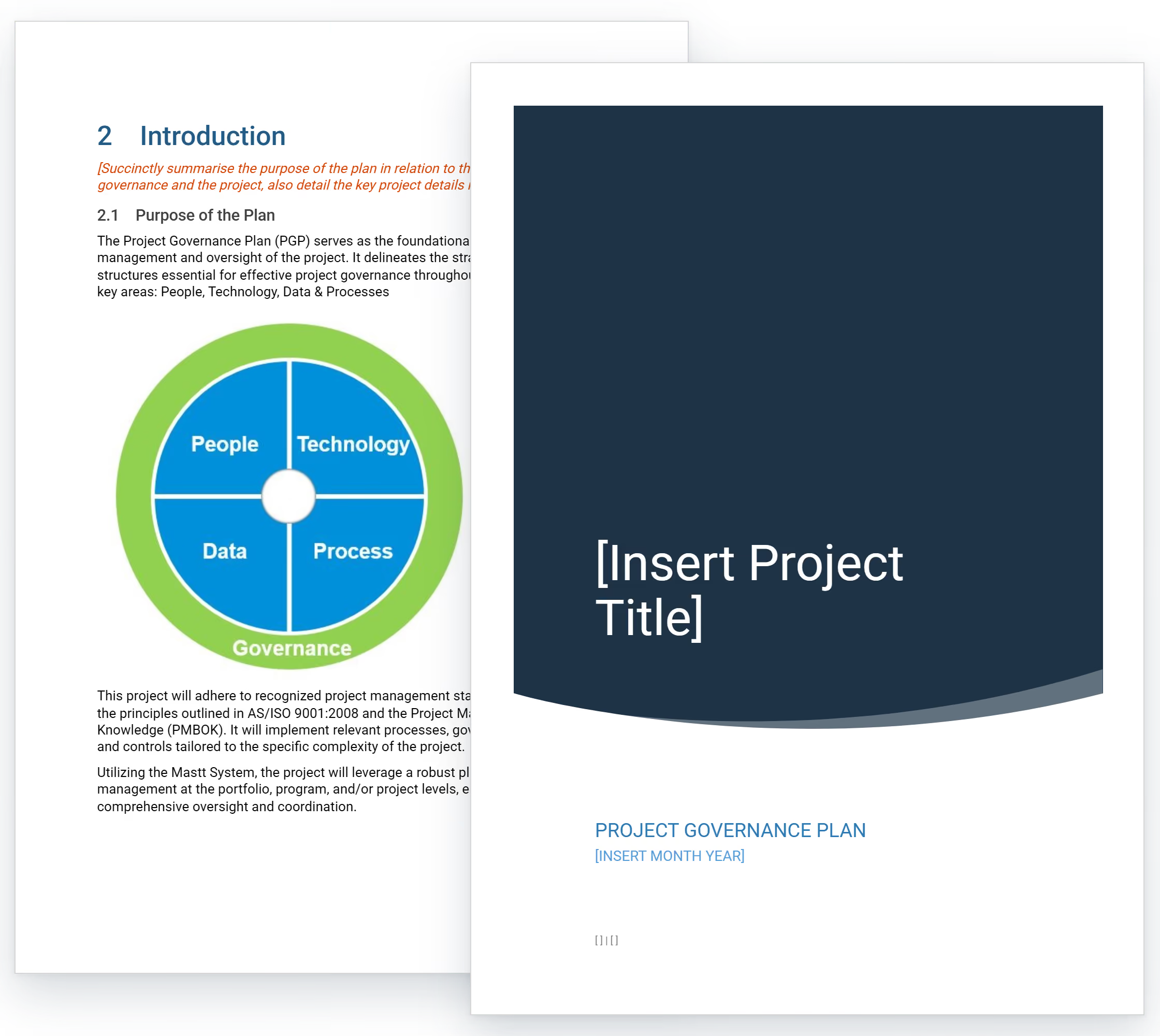

What is a Project Governance Plan?
A project governance plan is a document that establishes decision-making authority and oversight structures for project delivery. It defines approval hierarchies, escalation procedures, and stakeholder roles before work begins.
The project governance plan specifies who makes decisions, how conflicts escalate, and when executive intervention becomes necessary. It documents approval thresholds, communication protocols, and accountability measures that control project execution.
Organizations use a project governance template to prevent authority confusion. This confusion causes project delays, budget overruns, and stakeholder conflicts throughout delivery.
Components of a Project Governance Template
A project governance framework template contains the authorization fields and oversight structures needed to control decision-making throughout delivery. Each component establishes clear boundaries for authority, escalation, and accountability.
Essential components in a project governance template include:
- Decision Authority Matrix: Spending limits, approval thresholds, and authorization levels by role showing who decides what independently.
- Escalation Procedures: Conflict resolution pathways, response timeframes, and responsible executives at each intervention level.
- Stakeholder Roles: Project Sponsor, Steering Committee, PMO Director, and team responsibilities with RACI accountability assignments.
- Approval Gates: Stage reviews at initiation, planning, execution, and closure with progression criteria and deliverable requirements.
- Communication Protocols: Meeting frequency, report formats, distribution lists, and update timing for stakeholder coordination.
- Change Control Process: Submission procedures, evaluation criteria, and approval workflows for scope, budget, and timeline modifications.
- Risk Management Framework: Identification methods, assessment criteria, escalation thresholds, response strategies, and ownership by authority level.
- Performance Metrics: Key indicators measuring progress, budget variance, quality standards, and success criteria defining program outcomes.
💡 Pro Tip: Include a "veto authority" section explicitly stating which decisions only the Project Sponsor can override. Teams waste days arguing about authority when this simple clause would have prevented disputes entirely.
Why Use Templates for Project Governance?
Using a project governance template ensures consistent authorization structures across programs while reducing setup time. Standardized documentation prevents the authority gaps and approval confusion that cause delivery delays.
Project templates strengthen governance implementation through:
- Saves setup time: Pre-formatted structures eliminate hours building authority matrices and approval workflows from scratch.
- Ensures completeness: Standardized sections prevent omitting critical governance elements like escalation procedures or decision thresholds.
- Accelerates stakeholder approval: Professional formats signal credibility, speeding executive sign-off on governance frameworks.
- Maintains consistency: Portfolio-wide template adoption creates comparable governance across programs simplifying oversight.
- Reduces implementation errors: Proven structures prevent authority gaps that cause approval bottlenecks during execution.
- Enables rapid customization: Starting with templates allows tailoring for organizational needs without rebuilding entire frameworks.
- Supports compliance demonstration: Structured documentation satisfies audit requirements showing systematic governance implementation.
- Facilitates knowledge transfer: Templates capture institutional governance practices preventing loss when personnel change.
Without templates, project teams build governance from scratch each time. This repetition wastes effort and creates inconsistent structures.
💡 Pro Tip: Add a "silence means approval" clause with 72-hour response windows. Steering Committees delay decisions indefinitely without this forcing mechanism, while the clause protects you when approvals get ignored.
How to Develop a Project Governance Framework
Developing a project governance plan requires gathering stakeholder requirements first. Then document agreed authority structures, approval thresholds, and escalation procedures.
Start by interviewing the executive sponsor to understand organizational priorities and decision-making preferences. Follow these steps for governance plan development:
- Conduct stakeholder analysis: Interview executives, department heads, and leads understanding authority concerns.
- Map existing approval structures: Document current organizational hierarchies, spending authorities, and pathways.
- Define decision authority levels: Establish thresholds for manager approvals, sponsor sign-offs, reviews.
- Design escalation pathways: Create conflict procedures specifying timeframes and intervention triggers.
- Establish meeting cadences: Schedule Steering Committee sessions, status reviews, and checkpoints.
- Document communication protocols: Specify report formats, distribution lists, update frequency, and methods.
- Create change control procedures: Define evaluation criteria, approval workflows, and documentation requirements.
- Validate with stakeholders: Circulate draft governance plans, incorporate feedback, and resolve conflicts.
- Secure executive authorization: Present finalized governance frameworks to sponsors obtaining formal sign-off.
💡 Pro Tip: Front-load governance setup before teams mobilize. Retrofitting authority structures after work starts creates political fights over established practices that governance should have prevented entirely.
Who Should Use a Project Governance Framework Template?
A project governance template serves any professional responsible for authorization, oversight, and delivery coordination across organizational initiatives. Governance templates are valuable for anyone establishing decision structures that control execution.
✅ Project Owners: Define decision rights, approval authorities, and escalation protocols protecting capital investments throughout delivery.
✅ Program Managers: Coordinate multiple projects with consistent governance structures ensuring clear decision authority across initiatives.
✅ Project Managers: Use a project management governance framework to secure formal authorization, clarify escalation paths, and protect against unauthorized stakeholder demands.
✅ PMO Directors: Standardize governance across portfolios, creating repeatable frameworks that accelerate authorization and improve predictability.
✅ Project Sponsors: Establish oversight mechanisms, define intervention triggers, and clarify accountability before committing resources.
✅ Executive Steering Committee Members: Define collective decision authority, establish meeting protocols, and document approval thresholds.
✅ Portfolio Managers: Implement governance standards across initiatives, ensuring consistent decision-making and resource allocation.
✅ Business Analysts: Translate organizational requirements into governance structures securing stakeholder agreement on authority protocols.
✅ Department Heads: Establish cross-functional governance for initiatives requiring coordination across organizational boundaries and competing priorities.
When to Implement Project Governance Structures
Governance structures should be implemented during initial authorization before project budgets get approved or resources mobilize. Documentation establishes decision authority as a prerequisite for formal commencement.
Critical moments requiring project governance plan include:
- Executive approval stage: After leadership interest but before planning, governance formalizes commitment.
- Portfolio planning cycles: Before budgeting or reviews, governance justifies resource requests with oversight.
- Multi-project program launches: When coordinating initiatives, governance establishes decision hierarchies preventing conflicts.
- Strategic initiative kickoff: For significant investments, governance provides oversight protecting against failures.
- Organizational restructuring: When shifts create priorities, governance aligns initiatives with objectives.
- Cross-functional coordination: Before engaging departments, governance establishes authority structures preventing disputes.
- Large capital investments: When commitments exceed thresholds, governance documents approval requirements.
- Regulatory compliance requirements: For initiatives subject to audits, governance demonstrates systematic oversight.
Governance timing matters more than perfection. Better to implement documented structures that evolve than to delay authorization seeking ideal frameworks.
💡 Pro Tip: Schedule monthly "governance check" meetings separate from status reviews. Dedicated sessions prevent urgent operational issues from consuming time needed for authority conflicts and escalation path validation.
Problems with Generic Governance Templates in Word, Excel, and PDF
Generic governance templates downloaded in Word, Excel, or PDF formats online create authorization problems undermining delivery success. Free governance template downloads lack customization and guidance needed for effective governance implementation.
⚠️ Vague authority definitions: Generic templates lack specific spending thresholds or approval criteria.
⚠️ Incomplete escalation procedures: Downloaded templates omit timeframes, responsible parties, and intervention triggers.
⚠️ Missing stakeholder analysis: Simple templates list names without defining roles or authority levels.
⚠️ Inadequate approval gates: Governance template word documents often fail documenting review criteria or progression requirements.
⚠️ Outdated governance approaches: A project governance template free download reflects old methodologies missing agile governance structures.
⚠️ No customization guidance: Static templates provide no instructions adapting authority matrices organizationally.
⚠️ Version control challenges: Teams download separate copies losing track of approved versions.
⚠️ Weak change control: Excel spreadsheets with generic categories miss project-specific change triggers, creating unrealistic evaluation processes causing bottlenecks.
Even a project governance framework pdf or PowerPoint requires substantial customization. They need adaptation before becoming useful for organizational requirements.
💡 Pro Tip: If using Word templates, add a "last modified" timestamp to the header and track version numbers manually. This simple discipline prevents the chaos of multiple teams working from different governance copies.
Best Practices for Governance Implementation
Effective governance implementation requires disciplined execution following practices that prevent authorization failures. Experienced program leaders apply these principles systematically:
☑️ Pilot governance on non-critical projects first: Test approval workflows and escalation paths on lower-risk initiatives.
☑️ Document all verbal authority agreements immediately: Capture informal decisions within 24 hours preventing authorization disputes.
☑️ Require signature tracking on approval matrices: Use signatures confirming each authority level understands thresholds.
☑️ Establish "decision by date" deadlines: Set explicit response windows triggering automatic escalation when expired.
☑️ Create authority delegation protocols: Document temporary transfers ensuring decisions don't stall during absences.
☑️ Audit governance compliance quarterly: Review random decisions against authority matrices confirming practices match structures.
☑️ Update templates after every major dispute: Revise governance immediately when conflicts reveal missing clauses or thresholds.
☑️ Archive all governance versions with dates: Maintain complete history supporting dispute resolution and audit defense.
☑️ Train new stakeholders on governance within 48 hours: Brief incoming Committee members immediately preventing authority confusion from changes.
Control Project Governance with Mastt
Every successful program starts with clear authorization that aligns stakeholders on decision rights, approval thresholds, and escalation procedures. The difference between initiatives that deliver value and those that fail often traces back to project governance quality.
With Mastt's AI, you generate complete, customized governance frameworks in minutes rather than hours. Describe your initiative or upload existing policies.
👉 Try Mastt's AI Assistant today and create your project governance template that establishes authority before conflicts emerge.
.avif)
Written by
Jamie Cerexhe
A Forbes 30 Under 30 and PMI Future 50 honoree, Jamie Cerexhe is Mastt's co-founder and Chief Technology Officer. He leads the company's AI engineering, agentic pipelines, and security work, and earlier taught software development and contributed to the UNESCO Digital Skills Toolkit. At Mastt, Jamie contributes articles on AI, agentic workflows, and technology adoption in construction.

Use this FREE project governance template to establish decision authority and prevent scope disputes. Define approval hierarchies, escalation paths, and stakeholder roles before execution begins.

Top Performers Don’t Guess. They Deliver.
Cut the stress of showing up unprepared
Start for FreeTrusted by the bold, the brave, and the brilliant to deliver the future