What is a Stakeholder Register?
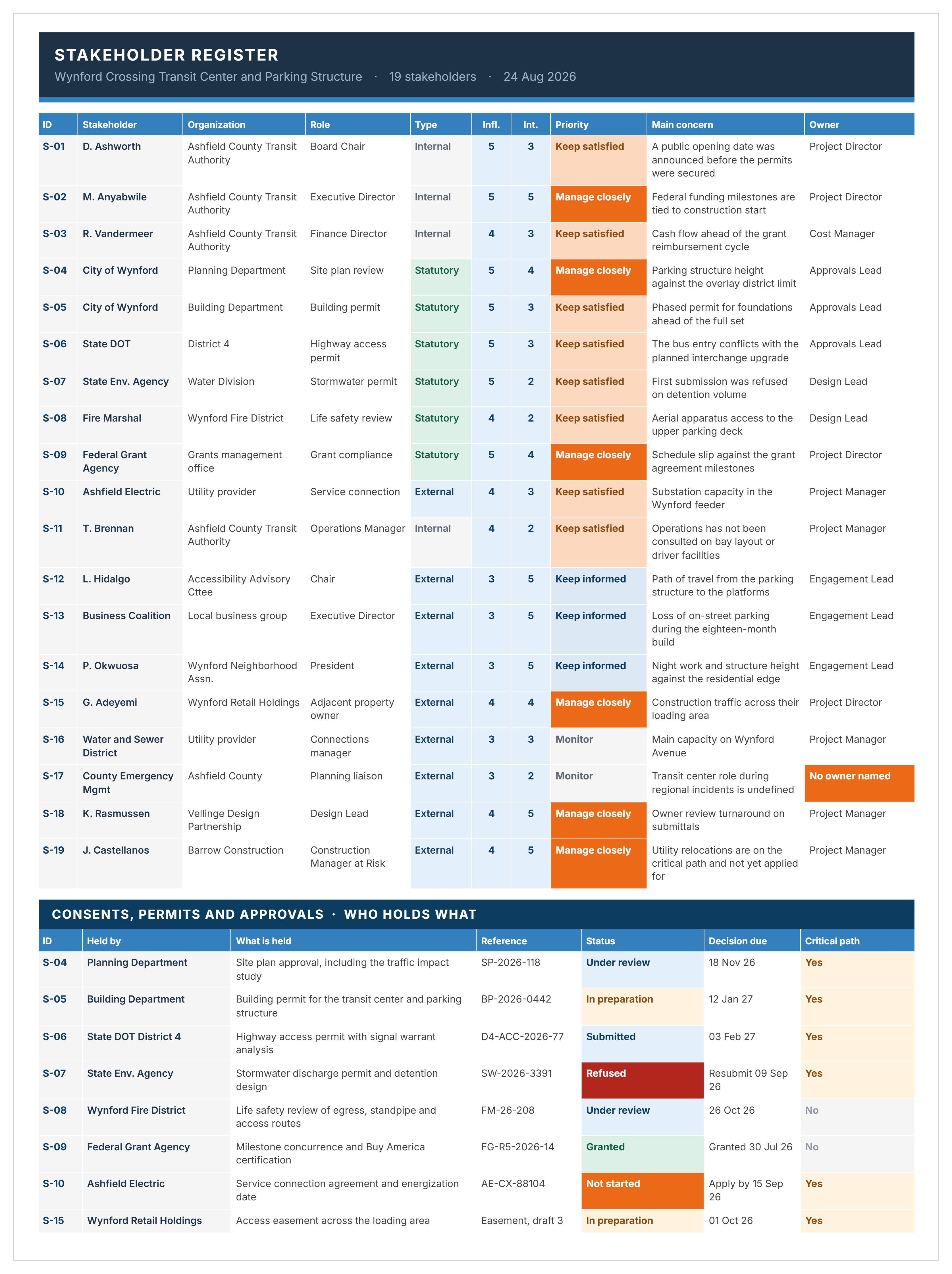
A stakeholder register is a project management document identifying individuals, groups, or organizations affected by project activities. It captures essential information about each stakeholder including contact details, influence levels, and communication preferences.
The register serves as the central repository for stakeholder data throughout the project lifecycle. Project teams reference it when planning communications, managing expectations, and securing stakeholder buy-in for critical decisions.
According to the PMBOK Guide, stakeholder identification happens during project initiation. The register evolves as new stakeholders emerge and relationships change across project phases. This living document helps project managers track who matters most to delivery success.
What's Included in a Stakeholder Register Template?
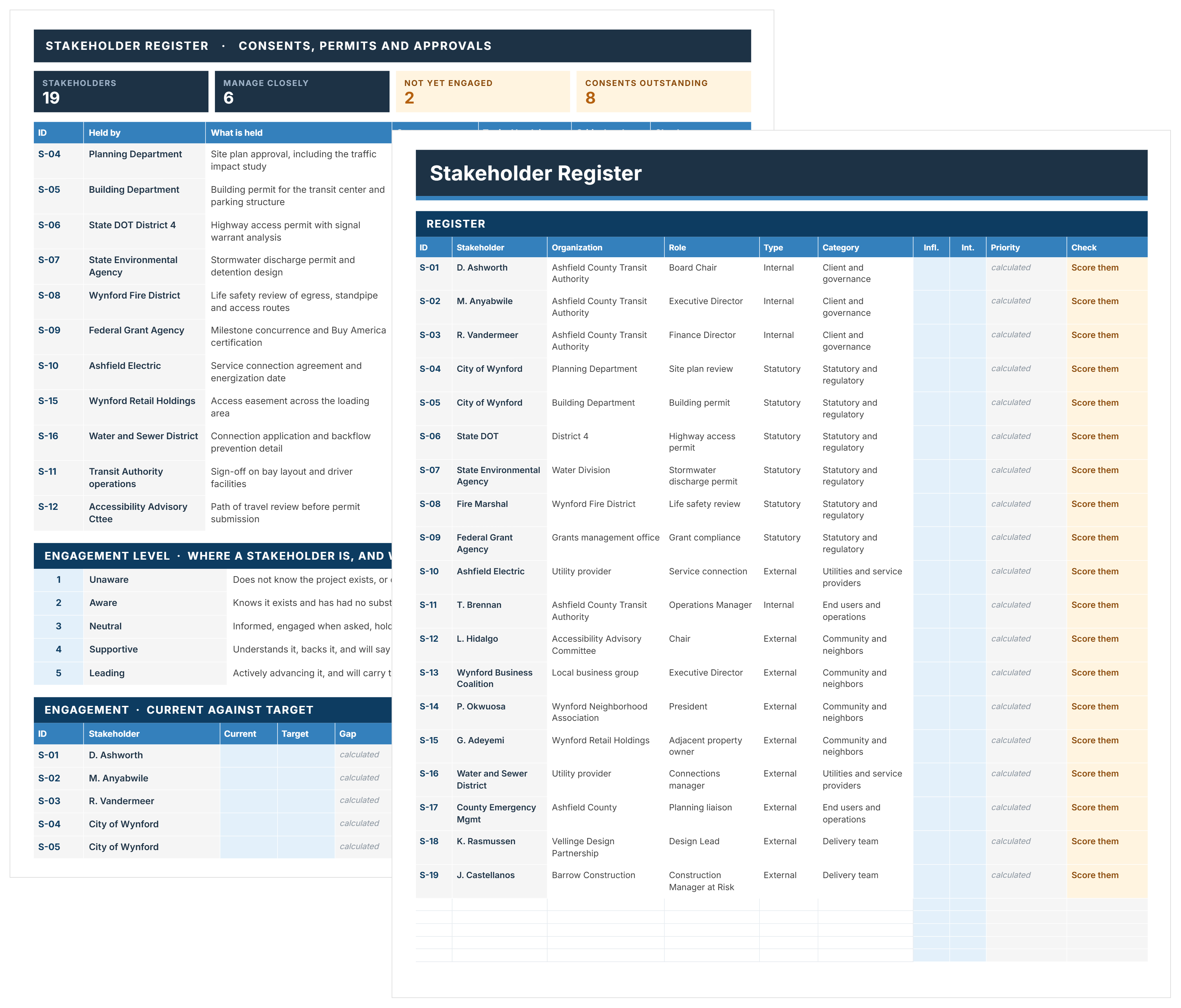
The template contains essential fields that capture complete stakeholder information for engagement planning. The structure ensures project teams document every detail needed for effective stakeholder management throughout delivery.
Standard components of a stakeholder register typically include:
- Identification details: Stakeholder name, title, organization, department, and unique ID for tracking across project documentation.
- Contact information: Email address, phone number, physical location, and preferred communication channels for timely outreach.
- Role and relationship: Position within organizational hierarchy, authority level, and connection to project scope or deliverables.
- Assessment criteria: Interest level, influence capacity, power to approve decisions, and potential impact on project outcomes.
- Classification data: Internal versus external designation, supportive versus resistant stance, and stakeholder type categorization.
- Requirements and expectations: Documented needs, anticipated benefits, success criteria, and specific concerns about project delivery.
- Communication preferences: Frequency of updates, preferred formats, meeting participation expectations, and escalation protocols.
- Engagement strategy: Tailored approach for managing relationship, securing support, addressing resistance, and maintaining alignment.
💡 Pro Tip: Add a "last contacted" date field to your register. Tracking outreach timing prevents stakeholder neglect that turns supporters into blockers.
Why Use a Stakeholders Register?
Using a stakeholder register prevents the communication breakdowns and missed expectations that derail projects. Documented stakeholder information creates accountability for engagement activities that keep projects aligned with stakeholder needs throughout delivery.
Stakeholder registers strengthen projects through:
- Prevents key stakeholder omission: Systematic identification catches decision-makers often overlooked during informal stakeholder assessment, avoiding late-stage surprises.
- Enables prioritization: Classification by influence and interest helps teams focus limited time on stakeholders who matter most to delivery.
- Improves communication planning: Documented preferences guide outreach frequency, update formats, and escalation paths that match stakeholder expectations.
- Reduces project resistance: Early identification allows teams to address concerns before opposition solidifies, turning potential blockers into supporters.
- Supports change management: Knowing who influences outcomes helps teams build coalitions, secure approvals, and navigate organizational politics effectively.
- Creates engagement accountability: Assigned ownership per stakeholder ensures someone monitors each relationship rather than assuming collective responsibility.
- Facilitates knowledge transfer: New team members quickly understand stakeholder landscape without relying on tribal knowledge trapped in email threads.
Teams managing stakeholders without registers discover critical decision-makers mid-project when changing course becomes expensive. Documentation transforms reactive stakeholder scrambling into proactive relationship management.
How to Use a Stakeholder Register for Project Management
Using a stakeholder register effectively requires systematic processes for identification, assessment, and ongoing updates. Project managers integrate stakeholder information into communication plans, risk assessments, and change management activities.
Apply these practices for maximum effectiveness:
- Conduct comprehensive stakeholder identification: Interview project sponsors, review organization charts, analyze project scope, and examine similar past projects.
- Assess influence and interest systematically: Use power/interest grids plotting each stakeholder's authority against their concern about outcomes.
- Document communication requirements: Record preferred update frequency, meeting participation expectations, escalation triggers, and information format preferences.
- Classify stakeholders for engagement planning: Group stakeholders using categories like manage closely, keep satisfied, keep informed, and monitor only.
- Assign relationship ownership: Designate specific team members responsible for maintaining each stakeholder relationship and tracking engagement activities.
- Update registers throughout project phases: Add newly identified stakeholders, revise classifications as relationships change, and document engagement outcomes.
- Link to other project artifacts: Reference stakeholder register when creating communication plans, conducting risk assessments, and managing change requests.
- Review regularly in team meetings: Discuss stakeholder status, identify emerging concerns, adjust engagement strategies, and coordinate outreach activities.
💡 Pro Tip: Schedule monthly stakeholder review sessions separate from regular status meetings. Dedicated time prevents urgent operational issues from consuming stakeholder relationship discussions.
Generate PMBOK-Compliant Stakeholder Registers with Mastt AI
Mastt's AI Assistant eliminates the manual formatting work that delays stakeholder documentation in project management. Instead of building registers from scratch in Excel or Word, generate tailored stakeholder templates in seconds.
Here's what Mastt's AI delivers for stakeholder identification:
🚀 Create templates instantly from descriptions: Describe your project type and AI generates complete registers. Fields include identification, assessment, classification, and engagement.
📂 Build registers from existing documents: Upload stakeholder lists, organization charts, or project charters as PDFs, and AI extracts relevant stakeholder information automatically.
📄 Generate both register and reusable template: Upload your stakeholder documentation PDFs and AI creates a populated register for immediate use. AI also builds a customized template for future projects.
⚡ Customize for specific methodologies: Adjust fields for PMI standards, Agile frameworks, or organizational requirements through natural conversation with AI.
📑 Export in preferred formats: Download completed registers in Excel for calculations, Word for documentation, then convert to PDF online for stakeholder distribution.
Getting started takes three approaches depending on your needs:
Scenario 1 - Starting fresh: Type requests like "create stakeholder register for construction project" and AI generates complete structure with all necessary fields.
Scenario 2 - Guided creation: Upload project documentation PDFs showing scope, team structure, or organizational charts. AI uses context to suggest relevant stakeholders and appropriate classifications.
Scenario 3 - Automated extraction: Upload existing stakeholder documents or meeting notes. AI extracts stakeholder names, roles, and relationships, creating both populated register and reusable template simultaneously.
Every conversation stays private in your secure workspace. Project information remains under your control with customization, storage, and sharing decisions entirely yours.
👉 Visit the Mastt Help Center to explore stakeholder documentation creation and start building professional registers today.

Who Should Use a Stakeholder List Template?
Stakeholder templates serve project professionals managing relationships across complex organizational landscapes. They provide standardized formats ensuring consistent stakeholder identification regardless of project type or industry.
✅ Project Managers and Team Leads: Coordinate stakeholder engagement, secure approvals, manage expectations, and navigate organizational politics throughout delivery.
✅ Program Managers and PMO Directors: Standardize stakeholder processes across portfolios, track executive relationships, and maintain consistency in engagement approaches.
✅ Business Analysts and Requirements Specialists: Document stakeholder needs, validate requirements, manage expectation alignment, and trace decisions to specific stakeholder inputs.
✅ Project Coordinators and Administrators: Support project managers by maintaining stakeholder records, scheduling communications, tracking engagement activities, and updating contact information.
✅ Construction Project Managers: Manage contractor, subcontractor, consultant, regulatory authority, and community stakeholder relationships across building projects.
✅ Change Management Professionals: Identify impacted parties, assess change readiness, plan engagement strategies, and monitor adoption across organizational transitions.
✅ Product Managers and Owners: Track customer segments, internal stakeholders, development team members, and executive sponsors throughout product development.
✅ PMP Certification Candidates: Study PMBOK processes, understand stakeholder management principles, and prepare exam questions using practical template examples.
When to Deploy a Project Stakeholder Register
Project stakeholder registers should be created during initial planning before detailed work begins. Early identification enables teams to build engagement strategies into plans rather than reacting to relationship problems.
Use stakeholder registers at these critical moments:
- Project initiation phase: Identify stakeholders immediately after project charter approval, capturing initial assessment before formal planning begins.
- Planning and requirement gathering: Update registers when conducting stakeholder interviews, documenting newly discovered decision-makers and their specific requirements.
- Risk identification workshops: Cross-reference stakeholder information against identified risks, assessing which parties could amplify or mitigate specific threats.
- Communication planning activities: Use stakeholder classifications to design communication strategies, matching outreach frequency to influence and interest levels.
- Change request evaluation: Reference stakeholder register when assessing proposed changes, identifying who must approve modifications and who gets impacted.
- Phase gate reviews: Update stakeholder information before major decision points, confirming assessment accuracy as relationships evolve throughout delivery.
- Project closeout preparation: Validate stakeholder contact information for final communications, satisfaction surveys, and lessons learned documentation.
💡 Pro Tip: Treat your first register as a draft. Schedule a validation workshop where team members challenge each entry, often revealing hidden stakeholders missed in solo identification.
Challenges with Free Stakeholder Registers in Excel and Word Files
Free downloadable stakeholder registers in Excel or Word formats provide basic structure but quickly become limiting. Static files create collaboration difficulties and version control problems that undermine stakeholder management effectiveness.
⚠️ Incomplete field structures: Generic templates miss critical assessment criteria like stakeholder stance, engagement history, or relationship dynamics specific to project contexts.
⚠️ Version control nightmares: Multiple team members editing separate Excel copies creates conflicting stakeholder data nobody can reconcile during critical meetings.
⚠️ Lost update tracking: Word documents don't capture who changed stakeholder assessments or when classifications shifted, destroying audit trails compliance requires.
⚠️ Poor collaboration support: Static files prevent simultaneous editing, forcing sequential updates that delay stakeholder information availability when teams need it.
⚠️ Limited analysis capabilities: Excel templates require manual formulas and pivot tables to analyze stakeholder distributions, consuming time better spent managing relationships.
⚠️ No integration with workflows: Standalone templates don't connect to communication plans, risk registers, or change logs where stakeholder information drives decisions.
⚠️ Inadequate security controls: Email-circulated templates expose sensitive stakeholder assessments to unauthorized recipients, creating organizational risk.
⚠️ Scalability problems: Managing stakeholder registers across multiple projects using separate files prevents portfolio-level analysis of relationship patterns.
Build Better Stakeholder Documentation with Mastt AI
Every project succeeds or fails based on stakeholder relationships. The difference between delivery and disaster often traces back to stakeholder identification quality during planning phases.
With Mastt's AI, you don't need to build stakeholder registers from scratch or struggle with inadequate templates. Describe your project and upload existing documentation. AI generates comprehensive registers tailored to your specific delivery context.
👉 Try Mastt's AI Assistant today and create stakeholder registers that prevent communication failures before they derail your projects.


.avif)