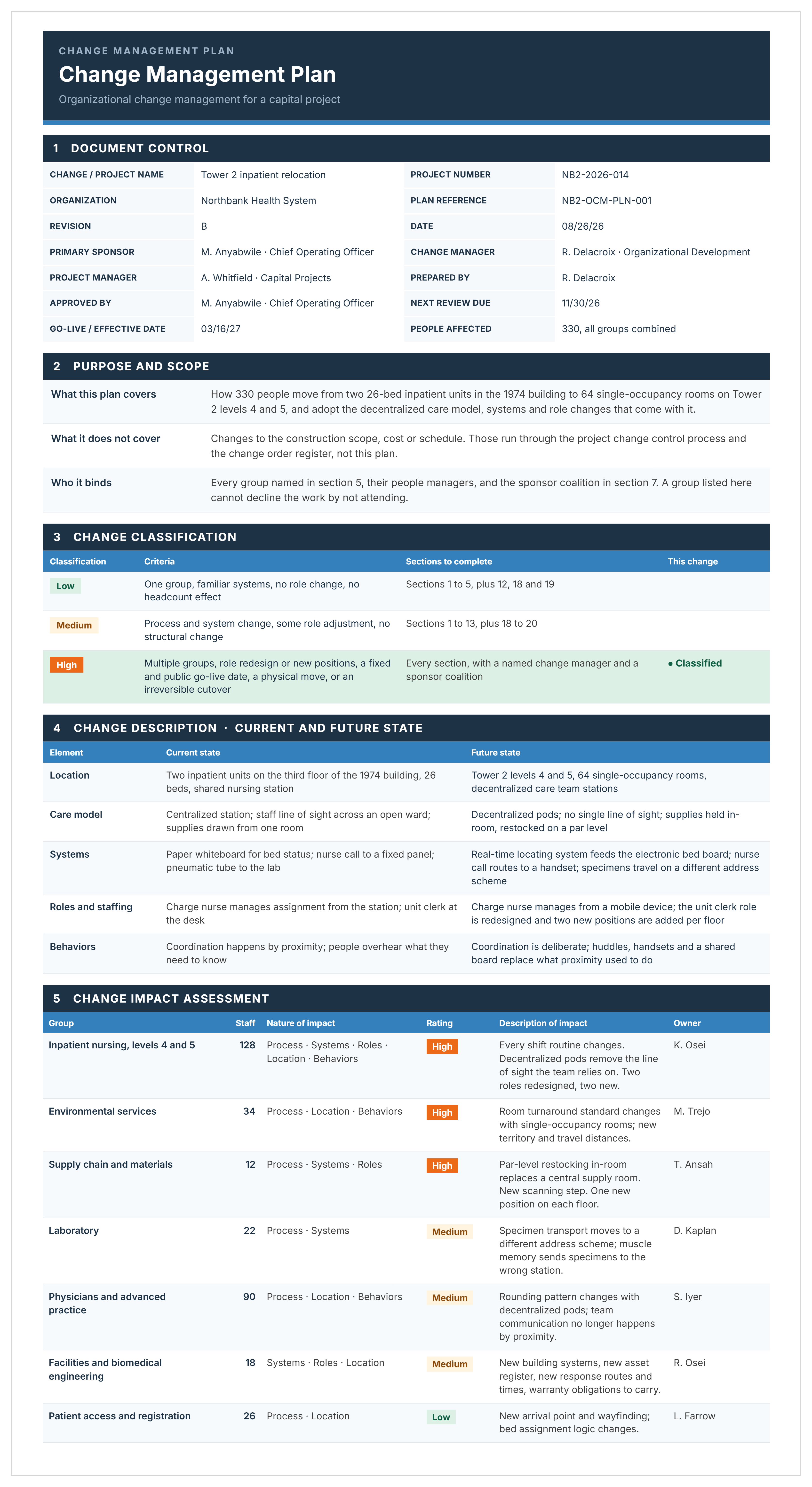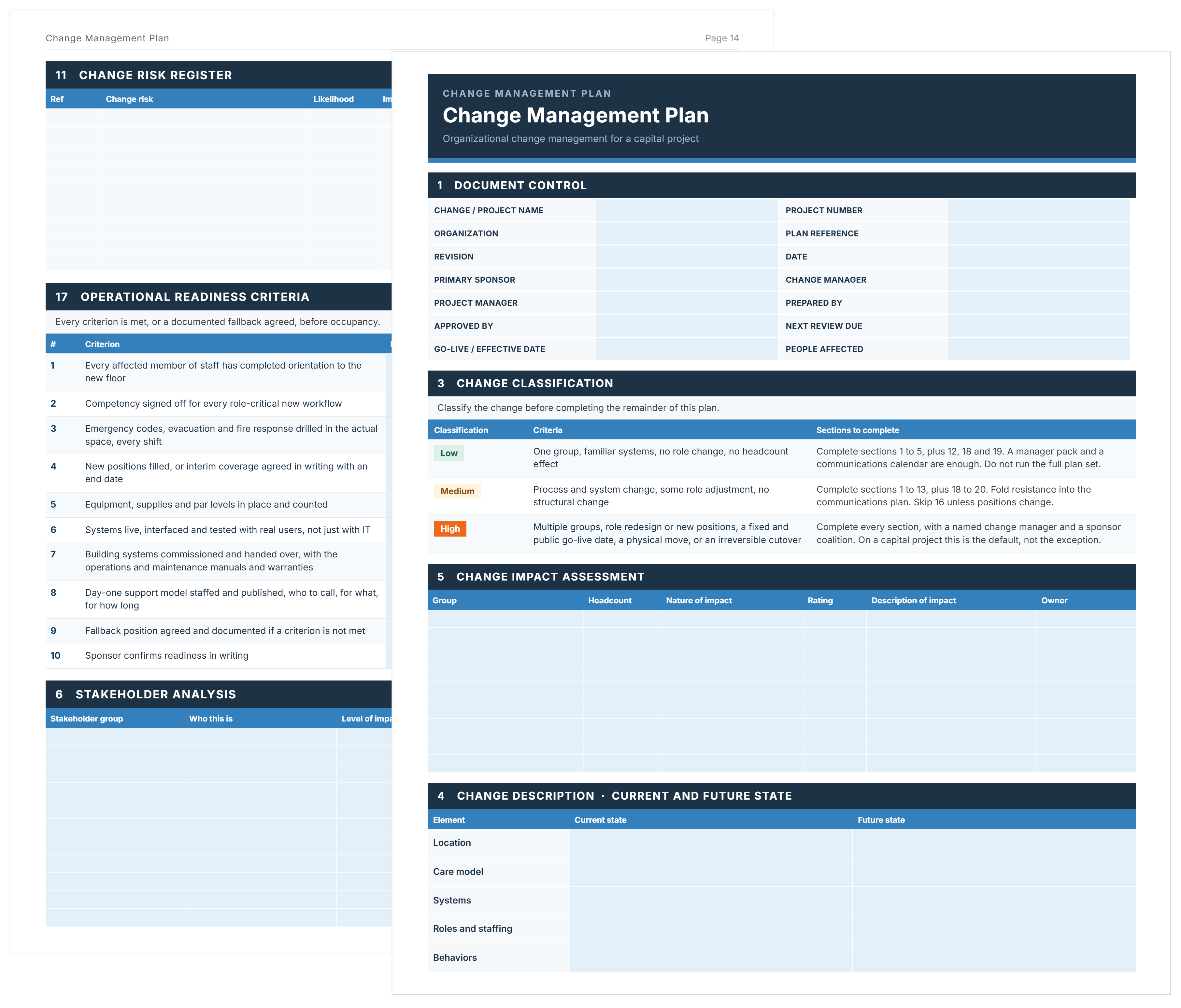
Construction change management plan example showing project details, approval process, and change request workflow.
Free Template

Change Management Plan

Use this FREE change management plan template to define how a construction project identifies, reviews, approves, and documents changes.

Templates
Word Template
Excel Template
Powerpoint Template
Change Management Plan
Template by
Anna Marie Goco
Published:
May 19, 2022

What is a Change Management Plan

A change management plan is a standardized document that defines how project changes are controlled throughout a construction project. The plan outlines how changes are identified, evaluated, approved, communicated, and documented throughout the project lifecycle.

The construction change management plan acts as a control framework that connects change requests to impact analysis, approvals, communication, and recordkeeping. A well-defined plan helps teams respond to change without losing visibility, accountability, or alignment between owners, contractors, and delivery teams.

What are the Components of a Change Management Plan Template

A template for a construction change management plan outlines the rules and controls teams follow when project conditions change. The template defines who can raise a change, how impacts are assessed, and how decisions are approved, communicated, and recorded.

Most change management plan templates include the following components:

  • Change identification process: Defines who can raise a change and the minimum information required before review begins.
  • Impact assessment requirements: Sets rules for evaluating cost, schedule, project risks, and operational impacts before approval.
  • Approval authority and thresholds: Establishes who can approve changes based on value, risk, or scope significance.
  • Documentation and record-keeping standards: Specifies how changes are documented, stored, and referenced across contracts and reports.
  • Communication and notification rules: Defines who must be informed when a change is approved or rejected.
  • Integration with schedule and cost controls: Describes how approved changes update budgets, forecasts, schedules, and contract values.
  • Change log or register structure: Outlines how changes are tracked from request through final resolution.
  • Escalation and dispute handling process: Sets a clear path for resolving disagreements when the scope or impact cannot be agreed upon.

The most effective change management plan templates are built as an integrated workflow. Each component should link directly to the next so that a change moves cleanly from identification to impact review, approval, and updates to cost, schedule, and contracts without gaps or rework.

Why Construction Needs Change Management Plans

Construction projects face constant pressure from design development, site conditions, procurement shifts, and stakeholder decisions. A defined change management plan gives teams a controlled way to respond without losing cost, schedule, or decision clarity.

Common problems that change management plans are designed to prevent include:

  • Uncontrolled scope growth: Informal changes accumulate and quietly expand the project scope without visibility or approval.
  • Cost exposure without early warning: Missing impact reviews allow changes to move forward before cost implications are understood.
  • Schedule slippage from late decisions: Unclear approval paths delay responses and disrupt sequencing on site.
  • Conflicting instructions: Verbal direction and informal emails create confusion about what work is authorized.
  • Disputes over responsibility: Poor documentation makes it hard to confirm who approved a change and under what conditions.
  • Inconsistent decision-making: Different standards applied by different teams lead to uneven outcomes and governance gaps.
💡 Pro Tip: Treat every change as a decision with downstream consequences. Requiring a brief impact summary before approval forces better judgment and prevents small changes from turning into major cost or schedule issues later.

How to Use a Change Management Project Plan Template

Utilizing a project change management plan starts with setting clear rules before change pressure hits the project. The goal is to define decision paths, documentation standards, and controls that work under real site conditions.

Follow these steps to utilize a practical change management plan:

  1. Define what qualifies as a change: Clearly state which scope, cost, schedule, or role adjustments require formal review and approval.
  2. Set change initiation rules: Identify who can request a change and require written descriptions before any review begins.
  3. Establish impact assessment requirements: Require cost, schedule, and risk impacts to be reviewed together to avoid partial decisions.
  4. Assign approval authority and limits: Define approval levels based on value and risk to prevent decisions from stalling or bypassing governance.
  5. Standardize documentation and tracking: Use consistent formats, numbering, and registers to maintain traceability across the project.
  6. Define communication and notification steps: Specify when field teams, owners, and contractors are formally notified of approved or rejected changes.
  7. Link changes to project controls: Require approved changes to update budgets, forecasts, schedules, and contracts immediately.

The most effective plans are tested against realistic scenarios before construction begins. Walking through sample changes often reveals gaps in authority, timing, or documentation that are easy to fix early and costly to fix later.

Generate a Change Management Plan Template Using Mastt AI

Mastt AI Assistant removes the manual work involved in drafting and maintaining change management documentation. Instead of adapting generic files or reworking past plans, project teams can generate a construction-ready change management plan aligned to contract structure, approval rules, and governance requirements.

Here’s how Mastt's AI supports change management planning in construction:

🚀 Generate plan template through AI chat: Describe the project context and governance needs, and the AI generates a change management plan with clear roles, approvals, and controls.

Refine plans through natural conversation: Update language, adjust approval thresholds, or clarify responsibilities by interacting with the AI instead of editing long documents manually.

📂 Maintain consistency across projects: Reuse and adapt plan structures for new projects while keeping terminology and governance aligned with internal standards.

📑 Export in editable formats: Download the change management plan in Word or Excel for review, approval, and inclusion in project control documentation.

Creating a change management plan with Mastt AI follows a simple workflow:

  1. Describe the project need: Enter requests like “create a construction change management plan for a commercial project” in the chat.
  2. Refine through conversation: Adjust approval thresholds, roles, documentation rules, and escalation paths until the plan matches project governance.
  3. Export and apply: Download the finished template in a Word or Excel format, ready for distribution and enforcement across the project team.

Every interaction stays within a secure workspace. Project data remains under your control, and templates can be reused or adjusted as project conditions change.

👉 Visit the Mastt Help Center for guidance on creating construction change management plans with AI.

Mastt's AI Assistant chat interface used to generate a construction change management plan template.

Who Should Use Project Change Management Plan Templates

Any construction role responsible for approving, implementing, or communicating project changes benefits from a shared change management plan. The template clarifies authority, responsibilities, and expectations before change pressures appear on site.

The change management project plan template is most relevant for the following roles:

Project owners: Use the plan to maintain control over scope growth, funding exposure, and approval authority across the project lifecycle.

Project managers: Rely on the plan to manage change requests, coordinate reviews, and keep cost and schedule impacts visible.

General contractors: Apply the plan to control change flow from subcontractors and prevent informal site instructions from becoming cost disputes.

Subcontractors: Use the plan to understand submission requirements, review timelines, and approval conditions before performing changed work.

✅ Cost managers and contract administrators: Follow the plan to enforce documentation standards and maintain clean audit trails.

💡 Pro Tip: Change management plans work best when everyone follows the same rules. Require contractors and subcontractors to acknowledge the plan during onboarding to reduce disputed work done before approval.

When to Implement a Change Management Project Plan

A change management plan should be in place before decisions start affecting scope, cost, or delivery methods. Early implementation creates clear rules for handling change when pressure increases later in the project.

A project change management plan is most critical at the following points:

  • Project setup and governance definition: Establishing the plan during early project planning prevents informal decision-making once construction begins.
  • Contract execution and onboarding: Aligning the plan with contract terms and onboarding processes ensures all parties follow the same approval rules.
  • Scope definition and design development: Design refinement often triggers early change discussions that require structured evaluation.
  • Procurement and subcontract award: Contract values and scopes harden during procurement, making change control essential.
  • Construction phase activities: Site conditions, sequencing issues, and coordination challenges increase the frequency and impact of change.
  • Budget updates and forecast reviews: Change management supports accurate financial visibility during reporting cycles.
  • Owner-driven scope adjustments: Late scope decisions require disciplined controls to avoid cost and schedule surprises.

Using the change management project plan template at these stages helps teams manage change consistently and set clear approval rules before informal practices take hold. Once informal approvals become the norm, reversing behavior is difficult and often leads to disputes.

Common Problems with Generic Change Management Plan Templates

The main risk with a free change management plan template in Word or Excel is misplaced confidence. Teams assume control exists, only to discover approvals and records were never clearly defined.

Common challenges with free, generic change management plan templates downloadable online include:

⚠️ Generic approval structures: Many change management plan templates in Excel use fixed approval paths that do not match real project authority.

⚠️ Poor alignment with construction contracts: Free construction change management plan templates often ignore contract clauses, creating compliance gaps.

⚠️ Unclear impact assessment requirements: Weak project change management plan templates allow changes without defined cost or schedule review.

⚠️ Disconnected documentation and tracking: Simple change management plan templates do not link approvals to budgets, schedules, or contract values.

⚠️ Overly complex workflows: Some change management plan templates try to cover every scenario and become hard to use on-site.

⚠️ No enforcement guidance: Free templates describe steps but do not explain how teams apply the change management plan in practice.

💡 Pro Tip: Stress-test any free template using a high-risk change scenario before adopting it. If the template does not clearly show who decides, how impacts are measured, and how records are updated, revise it or replace it before construction begins.

Best Practices for Using a Change Management Plan

A change management plan needs consistent use and clear enforcement to work under real project conditions. Construction teams that rely on defined controls make faster decisions and avoid informal workarounds.

The practices below help teams manage changes without slowing delivery:

☑️ Apply the plan to every change: Use the same review and approval steps for minor adjustments and major scope shifts.

☑️ Require approval before work starts: Do not allow field teams to proceed until the change is formally approved.

☑️ Review cost, schedule, and risk together: Assess impacts as a group to avoid one-sided decisions.

☑️ Maintain a single change record: Track all changes in one place to support reporting and audits.

☑️ Escalate stalled decisions early: Move unresolved changes up the approval chain before delays affect progress.

☑️ Train teams on stop points: Make it clear when work must pause and follow the change process.

💡 Pro Tip: Build a formal “approval gate” into the daily work plan. Require supervisors to confirm change approval status before issuing tasks tied to the altered scope. This single control prevents crews from starting unapproved work and eliminates after-the-fact pricing disputes that are difficult to unwind.

Manage Project Change With Confidence Using Mastt AI

Change is unavoidable in construction. What determines project outcomes is how change is controlled, approved, and recorded as the work progresses. Without a clear change management plan, teams rely on judgment calls, informal approvals, and after-the-fact documentation that increases cost risk and disputes.

Mastt AI helps teams generate change management plans that reflect real project governance, approval limits, and reporting requirements. The plan becomes a working control tied to project cost, contracts, and decision authority rather than a static document stored away after kickoff.

👉 Create your change management plan with Mastt's AI Assistant and manage project change with clarity and control.

FAQs About Change Management Plans

Many owner agreements and internal governance frameworks require a documented change management plan. Even when not mandatory, using a plan reduces cost risk, delays, and disputes caused by informal change decisions.
A change management plan defines the rules and processes for handling change. A change log records individual changes as they move through that process.
A base template can be reused, but approval limits, roles, and contract references should be adjusted for each project. Reusing a template without tailoring often creates governance gaps.
Yes. Design-bid-build, design-build, and construction management models require different approval structures and risk controls, which the plan should reflect.
No. The plan supports contract clauses by defining how change requirements are applied in practice. Contracts establish rights and obligations, while the plan governs execution.
Topic: 
Change Management Plan

Written by

Anna Marie Goco

Anna is a seasoned Senior Content Writer at Mastt, specialising in project management and the construction industry. She leverages her in-depth knowledge to create valuable content that helps professionals in these fields. Through her writing, she contributes to the company's mission of empowering project managers and construction professionals with practical insights and solutions.

LinkedIn Icon
Back to top

Frequently Asked Questions

More Templates

Supercharging Construction Project Management with AI Powered Tools