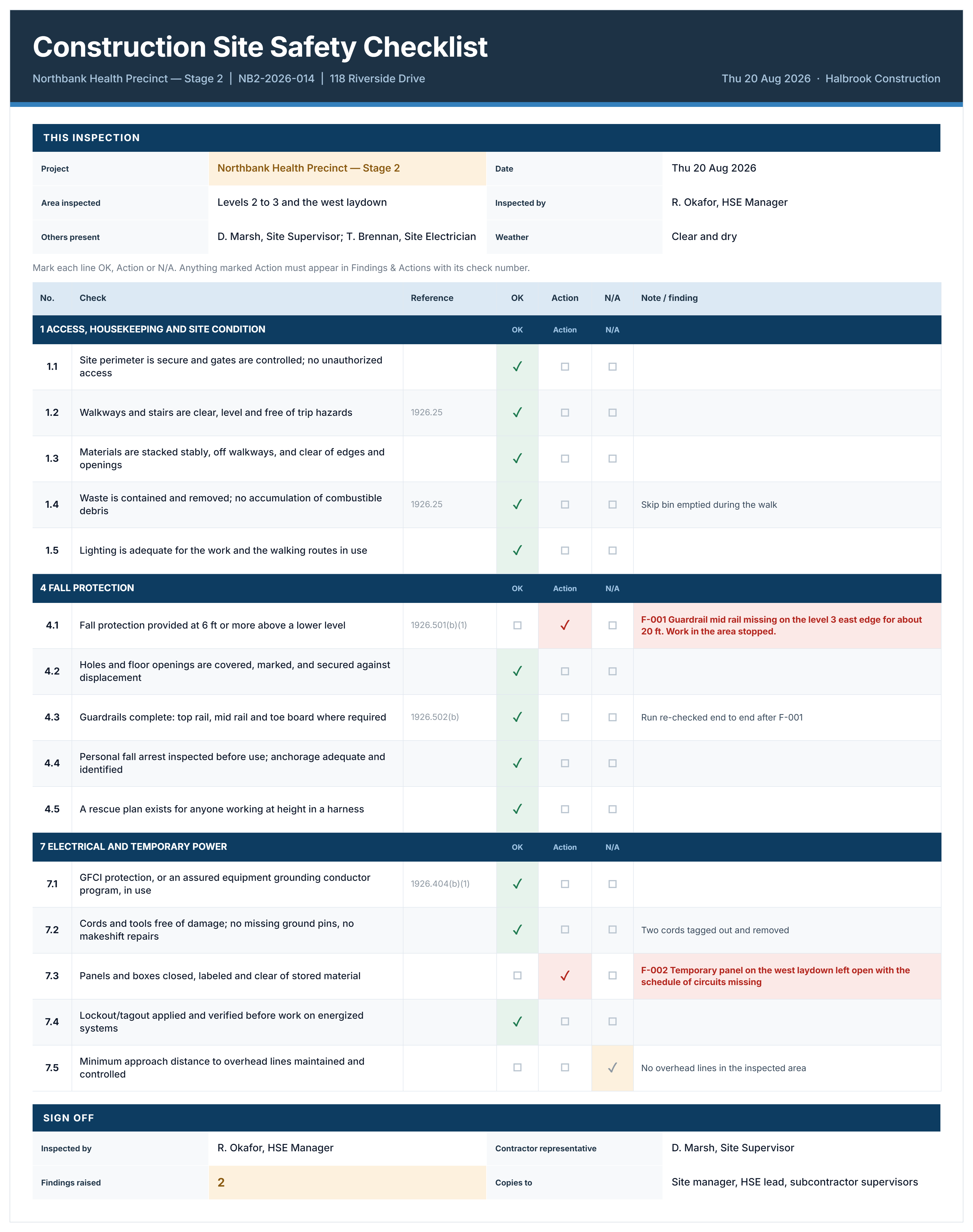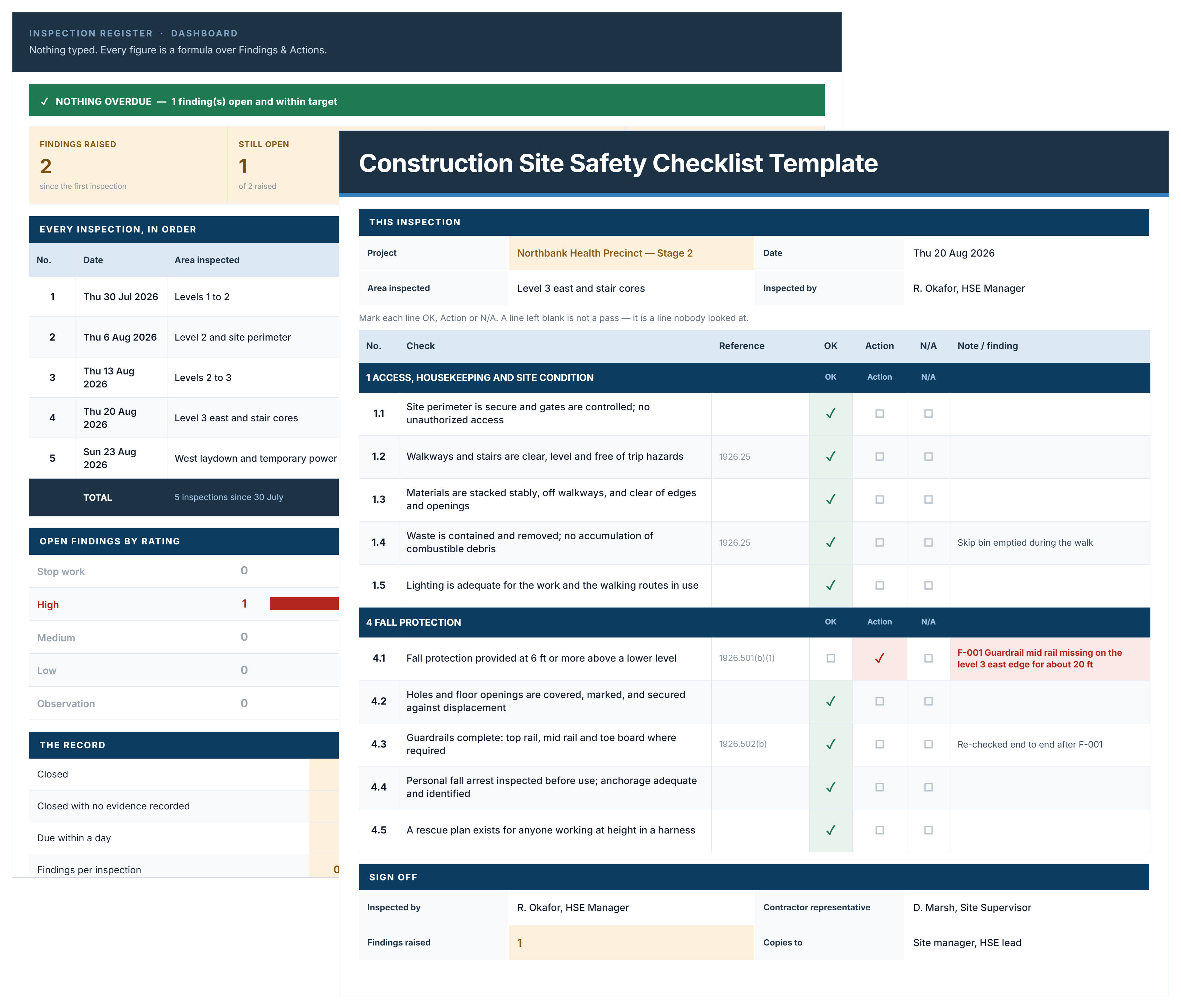
Construction site safety checklist covering mobilization, daily inspections, and hazard-specific checks
Free Template

Construction Site Safety Checklist

Use this FREE construction site safety checklist to prevent OSHA violations and catch hazards before incidents occur. Pre-formatted points ensure you never miss critical fall protection, PPE, or equipment deficiencies.

Checklists
Word Template
Excel Template
Powerpoint Template
Construction Site Safety Checklist
Template by
Jefbeck Eje
Published:
Dec 16, 2025

What is a Construction Site Safety Checklist?

A construction site safety checklist is a structured document supervisors use to systematically inspect job sites for hazards. Inspections occur before work begins each day. It provides consistent verification points for fall protection systems, personal protective equipment compliance, and equipment safety across all trades.

The construction site safety inspection checklist includes pre-formatted sections for walking-working surfaces, scaffold inspections, ladder safety, excavation hazards, electrical grounding, and emergency preparedness. Whether using a digital format or printed forms, the structure ensures competent persons document every required inspection point.

Project teams across US construction use site safety checklists to satisfy OSHA inspection requirements. The format addresses the frequent jobsite inspection mandate under 29 CFR 1926.20(b). The documented record proves due diligence during compliance audits and incident investigations.

What's Included in Safety Inspection Checklists for Construction Sites?

Safety inspection checklists contain critical verification points that supervisors complete during daily walkthroughs. The structure captures required observations while remaining straightforward enough for quick morning inspections across varying site conditions.

Standard components in effective construction job site safety checklists include essential inspection categories:

  • Fall protection verification: Guardrail systems, personal fall arrest equipment, warning lines, and skylight covers inspected for 6-foot protection thresholds.
  • PPE compliance checks: Hard hats, safety glasses, steel-toed boots, high-visibility vests, and hearing protection worn correctly by all workers.
  • Scaffold safety inspection: Platform conditions, access ladders, guardrails, toe boards, and load capacity placards meeting OSHA 1926.451 requirements.
  • Ladder and access points: Extension ladders secured properly, step ladders opened fully, and access routes clear of tripping hazards.
  • Electrical safety conditions: Ground-fault circuit interrupters (GFCIs) operational, extension cords undamaged, and equipment properly grounded throughout the site.
  • Excavation and trench safety: Protective systems installed, competent person inspections completed daily, and spoil piles positioned away from trench edges.
  • Housekeeping standards: Material storage organized, debris removed promptly, and walkways clear of obstacles creating slip and trip hazards.
  • Emergency preparedness: First aid kits stocked, fire extinguishers accessible, evacuation routes posted, and emergency contact numbers displayed visibly.
  • Corrective action tracking: Space recording identified hazards, responsible parties assigned, and completion dates verified before work proceeds.
💡 Pro Tip: Add a "previous inspection findings" section to your checklist. Many serious violations stem from recurring hazards supervisors flagged yesterday but didn't verify got fixed today before crews returned.

Why Job Sites Need Daily Safety Verification

Job sites require daily safety inspection because conditions change overnight. Equipment moves, weather shifts, and new trades arrive. Systematic inspection prevents hazard blindness causing falls, struck-by incidents, and caught-between accidents.

Daily construction site safety checklists deliver these critical protections:

  • Prevents OSHA's top violation: Fall protection deficiencies caused 6,000+ citations in 2024, remaining the #1 violation for 14 consecutive years.
  • Catches equipment failures early: Daily inspections identify worn fall arrest lanyards, damaged scaffold planks, and frayed extension cords before they fail.
  • Stops hazard creep: Yesterday's organized site becomes today's tripping hazard when materials pile up and debris accumulates between formal inspections.
  • Validates subcontractor compliance: Multiple trades working simultaneously require verification that each crew maintains OSHA compliance and safety standards throughout their scope.
  • Creates defensible documentation: Completed checklists prove competent person inspections occurred, protecting against willful violation penalties reaching $165,514 per citation.
  • Reduces insurance premiums: Documented safety programs lower Experience Modification Rates (EMR), directly cutting workers' compensation and liability insurance costs.
  • Prevents incident escalation: Near-miss identification through systematic observation stops minor hazards before they cause recordable injuries or fatalities.

Consider a site where scaffold access changes daily as work progresses vertically. Without systematic verification, yesterday's compliant access becomes today's 12-foot unprotected leading edge when planks get removed overnight.

How to Complete a Construction Safety Inspection Checklist

Using a construction safety audit checklist requires walking the entire site methodically while documenting observations in each category. Effective completion means verifying actual conditions against standards. Flag deficiencies immediately. Confirm corrections before workers enter hazard areas.

Follow these steps to complete safety checklist for construction site:

  1. Arrive before crews start: Conduct inspections 30 minutes before shift begins, catching overnight changes before workers encounter hazards.
  2. Walk systematic routes: Follow the same inspection path daily, moving from site entrance through work zones to ensure nothing gets missed.
  3. Verify fall protection first: Check guardrails, hole covers, personal fall arrest equipment, and warning line systems before workers access elevated areas.
  4. Inspect access and egress: Validate ladders, stairways, ramps, and walkways provide safe passage with proper handrails and clear pathways.
  5. Document specific deficiencies: Write exact locations and conditions rather than checking boxes, creating records investigators can understand later.
  6. Photograph critical hazards: Capture images of serious violations like unprotected leading edges or damaged equipment for documentation and training purposes.
  7. Issue corrective actions immediately: Stop work in affected areas, assign responsible parties, and set completion deadlines before workers proceed.
  8. Verify corrections before resuming: Re-inspect hazard areas after corrections, confirming deficiencies are actually fixed before authorizing work to continue.
  9. File completed checklists systematically: Store documentation chronologically in project safety files, maintaining records for OSHA's five-year retention requirement.
💡 Pro Tip: Complete your checklist before the pre-shift safety meeting, not during. This gives you specific hazards to discuss in toolbox talks. Generic reminders workers tend to ignore.

Generate Tailored Construction Site Safety Checklists with Mastt AI

Mastt AI eliminates the formatting work that delays safety documentation on construction projects. Instead of adapting generic downloads or building checklists from blank documents, generate site-specific inspection structures. These match your site's unique hazards and scope.

Here's what Mastt AI delivers for construction site safety inspections:

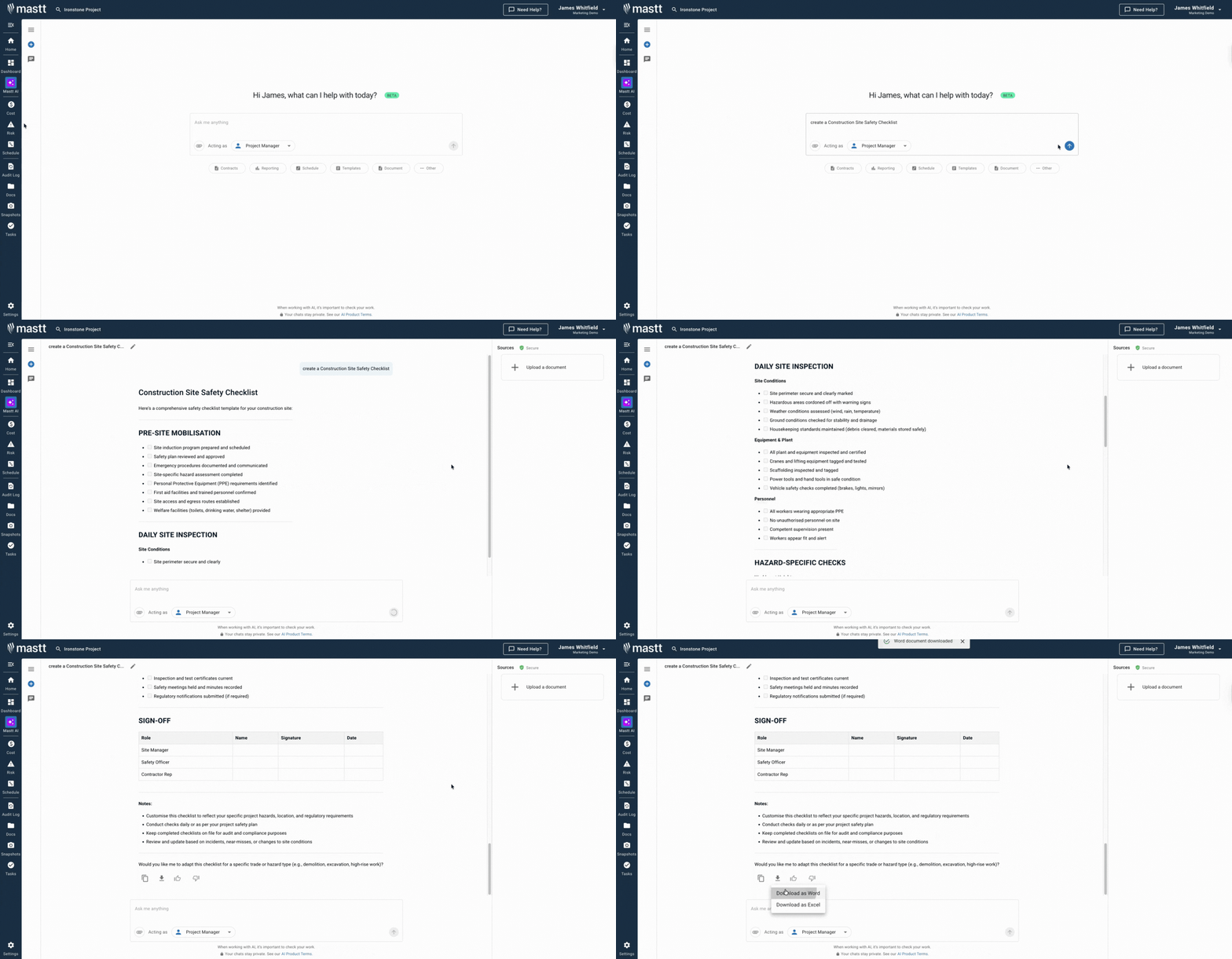
🚀 Create formats instantly: Generate complete structures with all required categories, from fall protection verification through emergency preparedness sections.

📄 Optional document upload: Upload existing PDFs like company-specific safety programs, and AI can help extract or integrate inspection requirements.

📂 Customize for site hazards: Describe your activities like steel erection, concrete pours, or electrical rough-in, and AI structures checklists around those specific risks.

📑 Export ready-to-use formats: Download editable versions in Word for customization or Excel for tracking, then convert to PDF for printing.

Getting started takes straightforward steps:

  1. Describe your site requirements: Type requests like "create safety checklist for commercial concrete construction" or "generate inspection form for steel erection project".
  2. Upload existing documents (optional): Attach your current safety procedures or project-specific hazard analysis for AI to reference.
  3. Refine through chat: Adjust inspection categories for your trades, add company branding, or modify sections through back-and-forth dialogue.
  4. Export and deploy: Download the finished checklist in Excel or Word format, then print or distribute to competent persons.

Mastt AI applies construction safety knowledge to recommend structures satisfying OSHA inspection requirements under the General Duty Clause. Formats include the verification points compliance officers expect without unnecessary complexity.

👉 Visit the Mastt Help Center to explore checklist creation and start generating professional safety inspection formats today.

Who Should Use a Job Site Safety Checklist?

Site supervisors and competent persons are the primary users of safety checklists. They're not the only ones though. Safety managers, project managers, general contractors, and subcontractors all rely on systematic inspection formats. Each role has specific compliance needs.

✅ Site Supervisors and Foremen: Lead daily pre-start inspections using efficient formats that document compliance with OSHA 1926.20(b) inspection requirements.

✅ Safety Managers and HSE Coordinators: Audit completed inspection records across multiple sites to verify hazards are identified consistently with corrective actions tracked.

Project Managers: Review weekly batches of safety documentation to identify recurring hazards and ensure subcontractor inspections maintain quality standards.

General Contractors and Construction Managers: Fulfill safety obligations by implementing formats demonstrating systematic risk management to owners and regulatory inspectors.

Subcontractors and Specialty Trades: Demonstrate safety competence to general contractors by using professional inspection formats matching head contractor standards.

Construction Superintendents: Oversee job sites and ensure supervisors deliver consistent hazard identification using approved documentation structures.

✅ Competent Persons: Complete required inspections for excavations, scaffolds, fall protection systems, and other specialized equipment requiring designated competent person verification.

✅ OSHA 10-Hour and 30-Hour Cardholders: Apply training knowledge through structured checklists that reinforce recognition of electrical hazards, struck-by risks, and caught-between dangers.

When to Use Safety Checklists on Construction Sites

Safety checklists should be deployed at specific moments throughout project delivery when hazard verification prevents incidents. These moments range from daily routines to event-driven triggers. Site activities and changing conditions determine timing.

Deploy structured construction site safety checklists at these critical moments:

  • Daily pre-start inspections: Brief all crews each morning on identified hazards after completing systematic site walkthroughs before work authorization.
  • New activity commencement: Inspect work areas when unfamiliar tasks begin, like first-time excavation or initial scaffold erection requiring fresh hazard assessment.
  • Weather condition changes: Verify fall protection systems, electrical grounding, and access routes after rain, snow, high winds, or temperature extremes affect site safety.
  • After incidents or near misses: Conduct thorough inspections following any accident, gathering evidence and identifying contributing factors missed during routine checks.
  • Subcontractor mobilization: Inspect areas where new subcontractors arrive, ensuring their equipment, PPE standards, and work methods meet project safety requirements.
  • Multi-trade coordination points: Verify safety when activities overlap, such as electrical rough-in beneath active concrete formwork creating struck-by and caught-between exposure.
  • Post-maintenance verification: Re-inspect equipment, fall protection systems, and scaffolds after repairs or modifications before authorizing workers to resume using them.
  • Regulatory inspection preparation: Complete comprehensive checklists before scheduled OSHA visits, identifying and correcting deficiencies that would generate citations.

The structure adapts to inspection frequency rather than dictating rigid schedules. Some sites inspect twice daily during peak activity phases. Others maintain morning inspections with additional checks when high-risk work proceeds.

💡 Pro Tip: Schedule inspections immediately after lunch breaks, not just mornings. Crews move materials, remove guardrails, and create new hazards during work. Morning checklists miss these changes.

Challenges with Free Downloadable Safety Checklist PDFs and Paper Forms

Free downloads of construction site safety checklists in PDF and paper formats create documentation problems undermining promised efficiency. Generic files require significant customization before they address site-specific hazards. Project safety requirements demand tailoring.

Common issues arising with free PDF and paper safety downloads include:

⚠️ Generic categories missing site hazards: Free templates cover broad topics without addressing actual risks like crane operations, confined space entry, or hot work permits present today.

⚠️ Outdated OSHA references: Templates downloaded years ago cite superseded regulations, creating liability when compliance officers find non-compliant inspection documentation.

⚠️ Illegible handwritten entries: Paper forms filled on-site produce records investigators struggle to read after exposure to weather, dirt, and multiple photocopies.

⚠️ Lost documentation during incidents: Blank forms stored in trailers go missing when OSHA arrives, leaving no proof that competent person inspections actually occurred.

⚠️ No corrective action tracking: Basic downloads omit follow-up sections, forcing supervisors to maintain separate lists of identified hazards needing resolution.

⚠️ Version control confusion: Multiple supervisors downloading separate copies create inconsistent formats, complicating project-wide safety record compilation.

⚠️ Difficulty proving inspection timing: Paper checklists lack timestamps showing inspections occurred before incidents, weakening defense against willful violation allegations.

⚠️ Storage and retrieval problems: Completed paper documentation filed in folders becomes impossible to locate during investigations or when compiling annual safety statistics.

Even editable PDF documents require reformatting for project identification, site-specific hazards, and company branding. The "free" download costs significant time in customization across project teams.

Construction Site Safety Audit Checklist Management Best Practices

Effective safety inspection checklist for construction sites requires smart management alongside skilled completion that transforms compliance exercises into genuine hazard prevention. Key practices improve both documentation quality and inspection effectiveness.

☑️ Train competent persons properly: Ensure inspectors understand what deficiencies look like, not just how to check boxes on forms.

☑️ Photograph serious hazards immediately: Capture images of unprotected edges, damaged equipment, and electrical violations for documentation and crew training.

☑️ Verify corrections same-day: Re-inspect hazard areas after corrections, confirming deficiencies are fixed before authorizing affected work to proceed.

☑️ Audit random checklists weekly: Review completed documentation to ensure supervisors actually walk sites rather than completing forms from memory.

☑️ Track recurring hazards systematically: Compile patterns from daily checklists, identifying root causes requiring engineering controls rather than repeated warnings.

☑️ Link inspections to permits: Require current checklist completion before issuing hot work permits, confined space entries, or excavation authorizations.

☑️ Update after scope changes: Revise checklist categories when new trades mobilize, work phases shift, or equipment changes introduce different hazard exposures.

☑️ Maintain five-year retention: Store completed checklists electronically or in protected files, satisfying OSHA recordkeeping requirements for inspection documentation.
Create OSHA-Compliant Construction Safety Checklists with Mastt

Moving from scattered documentation to systematic inspection records transforms reactive compliance into proactive risk management. Mastt AI generates tailored safety checklists in seconds. All required categories are included. Customization happens through natural conversation. Export formats include Word, Excel, and PDF.

👉 Start creating construction site safety checklist with Mastt AI today. Build inspection programs that prevent incidents before they happen.

FAQs About Construction Site Safety Checklists

Yes, OSHA requires frequent and regular inspections by competent persons under 29 CFR 1926.20(b). While "frequent" isn't defined, the industry standard is daily pre-shift inspections. Failure to conduct and document inspections can result in serious OSHA violations and penalties.
Checklists must cover all hazards present on your specific site. At a minimum, include fall protection, scaffolding, ladders, electrical safety, PPE compliance, housekeeping, and emergency procedures. Add specialized categories like excavation, crane operations, or confined spaces based on your work scope.
Use a master template as your foundation, then customize for each project. A commercial office build requires different inspection points than highway work. Tailor checklists to match site layout, equipment types, trade activities, and proximity hazards.
OSHA requires retaining inspection records for five years from the completion date. These documents prove due diligence during investigations and defend against citations. Many contractors keep records longer for litigation protection.
OSHA defines competent persons as individuals who can identify hazards and are authorized to correct them promptly. Site supervisors, safety managers, and experienced foremen typically qualify. The designation requires formal documentation of hazard recognition training and experience.
Topic: 
Construction Site Safety Checklist

Written by

Jefbeck Eje

Jefbeck is an SEO Specialist at Mastt who creates optimised content for the construction project management industry. Focused on delivering accurate and actionable insights, Jef combines SEO expertise with industry knowledge to enhance visibility, build authority, and drive engagement. His work ensures Mastt remains a trusted resource for construction professionals seeking reliable information.

LinkedIn Icon
Back to top

Frequently Asked Questions

More Templates

Supercharging Construction Project Management with AI Powered Tools