


What is a Contract Review Checklist?
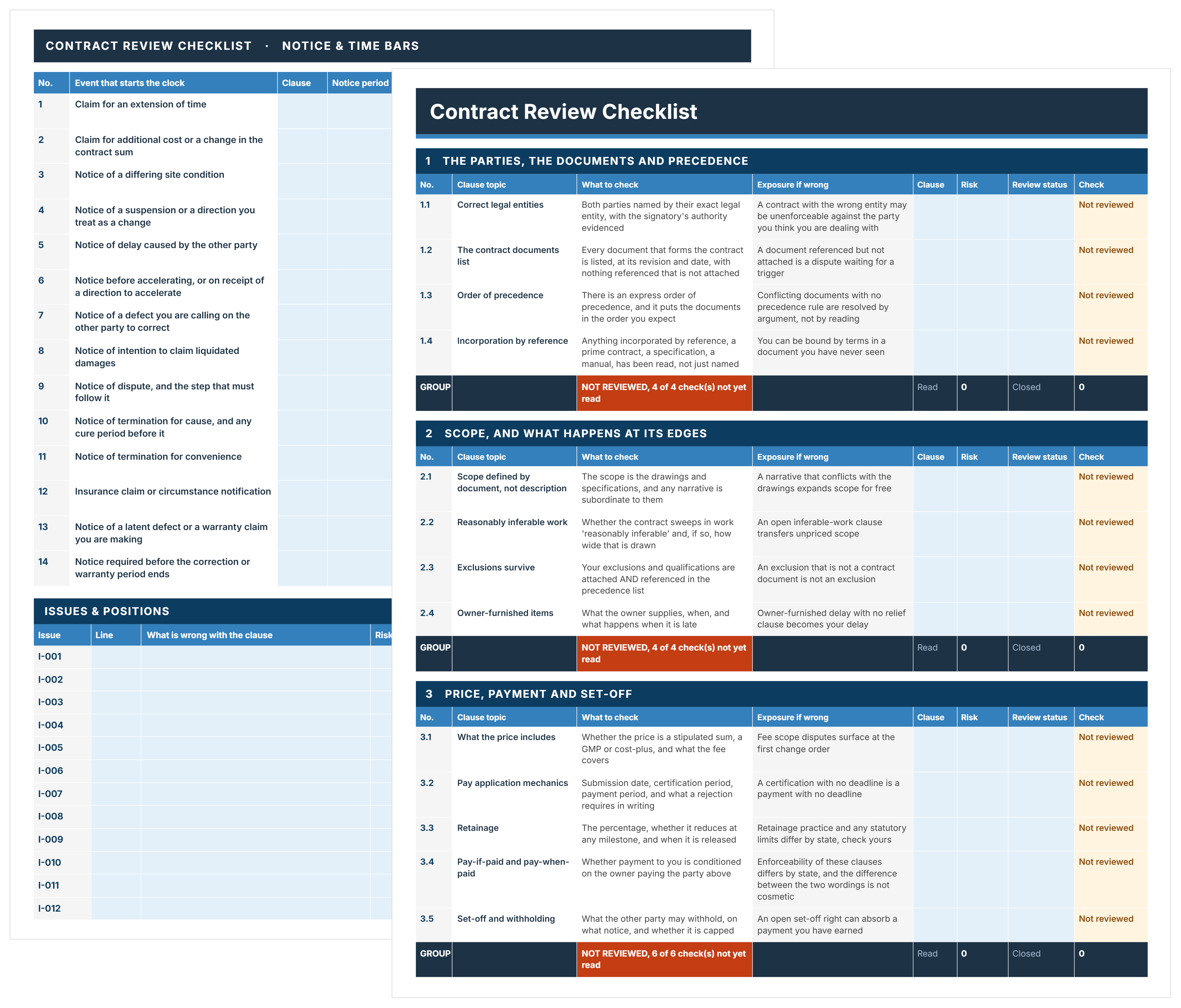
A contract review checklist is a structured set of questions you ask about a contract before signing it, covering scope, price, time, risk transfer, insurance and liability. Each line records what the contract says, what it exposes you to, and what position you took.
A checklist is not a template contract and it is not legal advice. It is the record that somebody read the document, what they found, and what happened to each issue they raised. Used on a construction contract, it is what stops an uncapped indemnity or a seven-day notice period being discovered after execution rather than before.
Contract Review Checklist Example
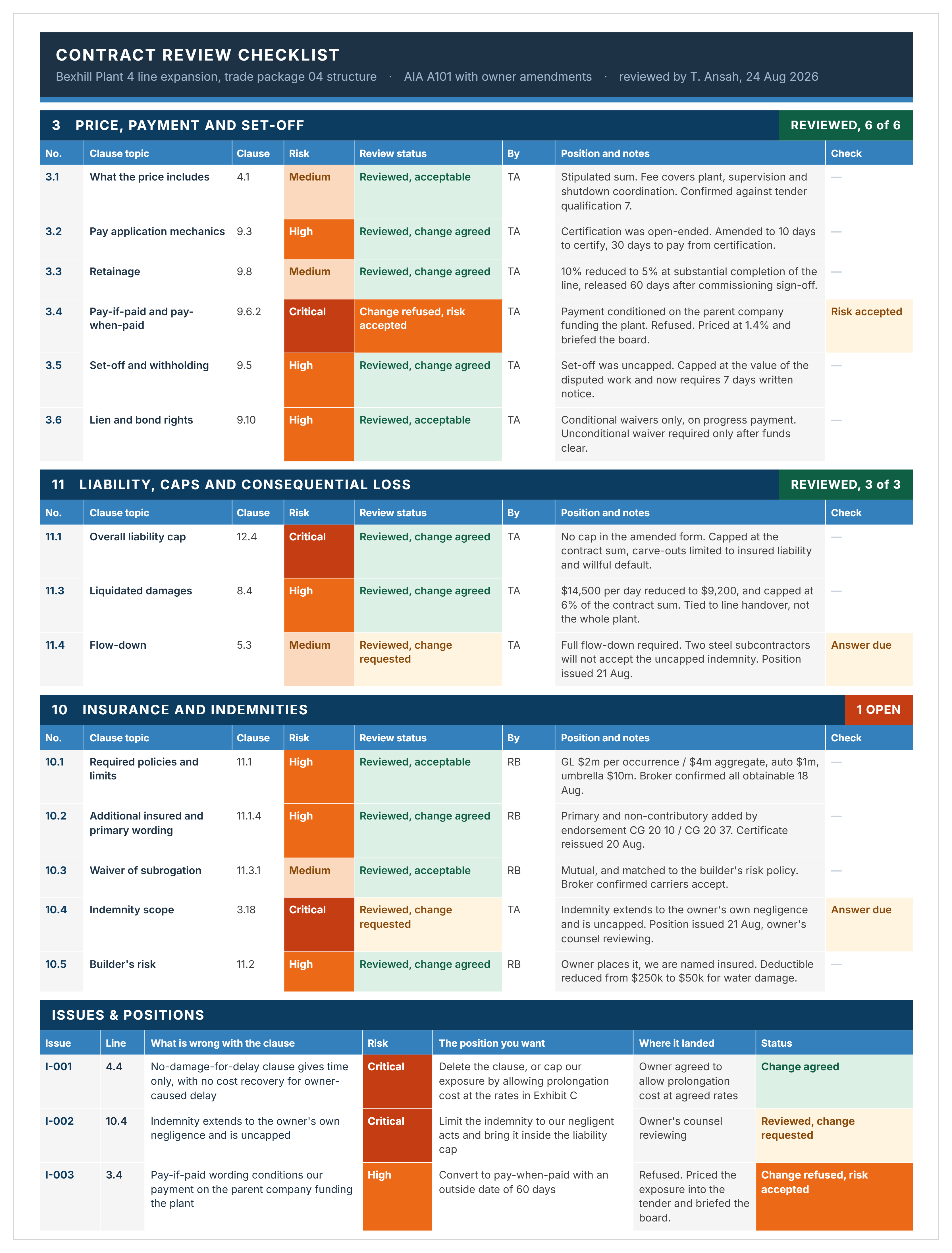
Here's a good example of a completed contract review checklist, covering a trade package on a plant expansion under AIA A101 with owner amendments.
How to Use This Contract Review Checklist Template in Excel
Finish the review before you sign, not after. A contract review completed post-execution has no leverage behind it.
- Complete the Cover with the project, the package, the other party, the contract form and the governing law.
- Work through the checks in order, answering each one against the document in front of you.
- Write the clause number against every line, so a later reader can find it without re-reading the contract.
- Mark a line not applicable with a reason rather than deleting it, since a deleted line is a record of nothing.
- Turn every failed check into a numbered issue with the position you want.
- Send the insurance and indemnity lines to your broker, since those answers come from outside your company.
- Record what the other side said, including a refusal.
- Fill in the notice table before you finish, collecting every notice period in the contract into one place.
- Read the summary for what is still unreviewed and what is critical and open.
- If time is short, do price and payment, time and delay, insurance, and liability, then say in writing that the rest was not reviewed.
Reviewing a contract by hand is slow work, and most of it goes on finding the clause rather than deciding what to do about it. Mastt's AI contract review feature reads the contract for you, scanned or digital, and answers questions with the exact clause reference attached.
What to Check in a Construction Contract Review Checklist
Check the four things that carry the money first: what the price includes, how time and delay are handled, what insurance and indemnities you are agreeing to, and whether your liability is capped. After those, work outward through scope, changes, site conditions, quality, completion, warranty, termination, disputes, compliance and intellectual property.
The order matters because most contracts are signed under time pressure. A review that runs out of time having covered the first four groups has protected most of the exposure.
This free checklist covers all of it, across fifteen groups.
Contract Risk Assessment: Rating What You Found
A contract risk assessment rates what each clause could cost you on this project, not in the abstract. The same uncapped indemnity is a different risk on a small fit-out and on a hospital, so a rating copied from another job tells you nothing.
Five questions produce a rating:
- What could this clause cost in money, time or lost rights if the event happens?
- How likely is that event on this project, given its scope, site and program?
- Is the exposure capped, and if so does the cap have carve-outs that swallow it?
- Is it insurable, and has your broker confirmed the policy actually responds?
- Does the amount sit inside what your business can carry without escalation?
Once rated, a contract risk has four outcomes and only four: negotiate the clause, price it into the bid, transfer it through insurance or flow-down, or accept it knowingly. Record which one, and by whom.
Related Articles and Templates
Explore these resources for contract review, analysis, compliance, variations, and ongoing contract management:
.avif)
Written by
Doug Vincent
Doug Vincent is the co-founder and CEO of Mastt, the AI capital-project management platform used by governments, Fortune 500 companies, and consultancies across APAC, North America, and MENA. Before founding Mastt in 2019, he spent a decade at RPS delivering more than $2 billion in capital works, including the $2.1B Defence Navy Infrastructure program, and holds a CPSPM certification with the AIPM. He contributes content and speaks on AI in capital project delivery at Mastt.

Know what you are signing before you sign it. This FREE contract review checklist asks 67 questions about the contract in front of you, and records what you found, what you asked for, and what the other side refused.

Top Performers Don’t Guess. They Deliver.
Cut the stress of showing up unprepared
Start for FreeTrusted by the bold, the brave, and the brilliant to deliver the future