


What is a Contractor Termination Letter?
A contractor termination letter is a formal notice used to end a construction contract between a project owner and a contractor. It communicates the termination decision, explains the reason, and specifies the effective date, ensuring all parties understand their remaining obligations.
In construction, the termination letter is often a contractual requirement. The document serves as official evidence that the contract was ended correctly and that the termination aligns with the terms set out in the agreement. This protects both the project owner and the contractor from potential disputes later in the project life cycle.
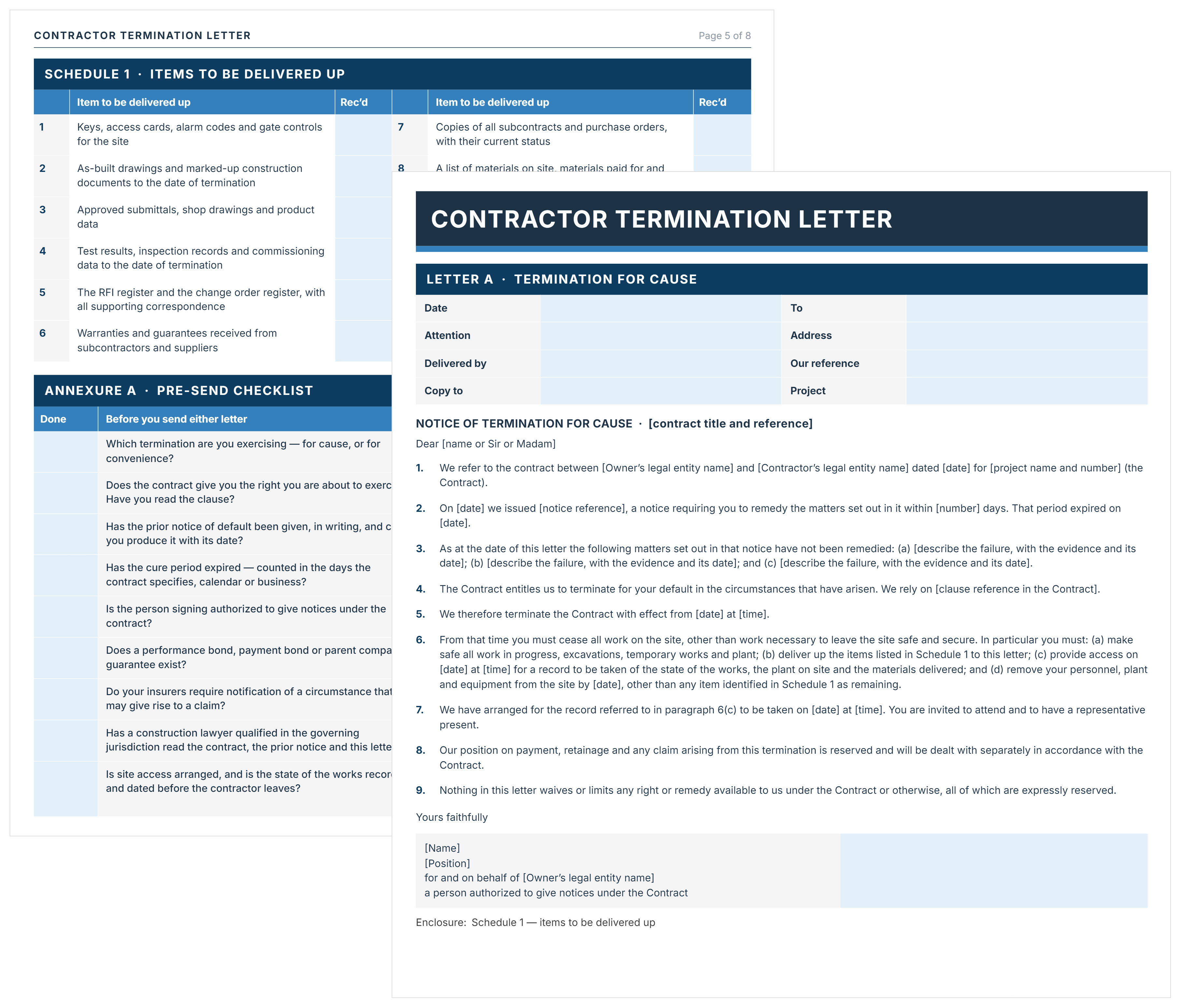
What’s Included in a Contractor Termination Letter Template
A contractor termination letter template includes all the essential sections needed to end a contract professionally and lawfully. Each part ensures your termination notice meets contractual, legal, and communication standards.
Here’s what’s typically included in a well-structured template:
- Project and Contractor Information: Names, addresses, contract reference numbers, and project details to clearly identify the agreement being terminated.
- Termination Reason: A clear explanation of why the contract is ending, such as non-performance, breach, safety violations, or termination for convenience.
- Effective Termination Date: The exact date the termination takes effect, ensuring both parties understand their timelines and responsibilities.
- Outstanding Obligations: A list of items like final payments, deliverables, or material returns still required after termination.
- Supporting Clauses: References to contract terms and conditions or sections that justify the termination and ensure compliance.
- Next Steps and Instructions: Details about project handover, documentation submission, or site access after termination.
- Contact Information and Signatures: Names, titles, and signatures of authorized representatives from both parties to validate the notice.
💡Pro Tip: Keep your termination letter short and factual. Avoid emotional language or unnecessary detail that could complicate legal discussions later.
Contractor Termination Letter Example
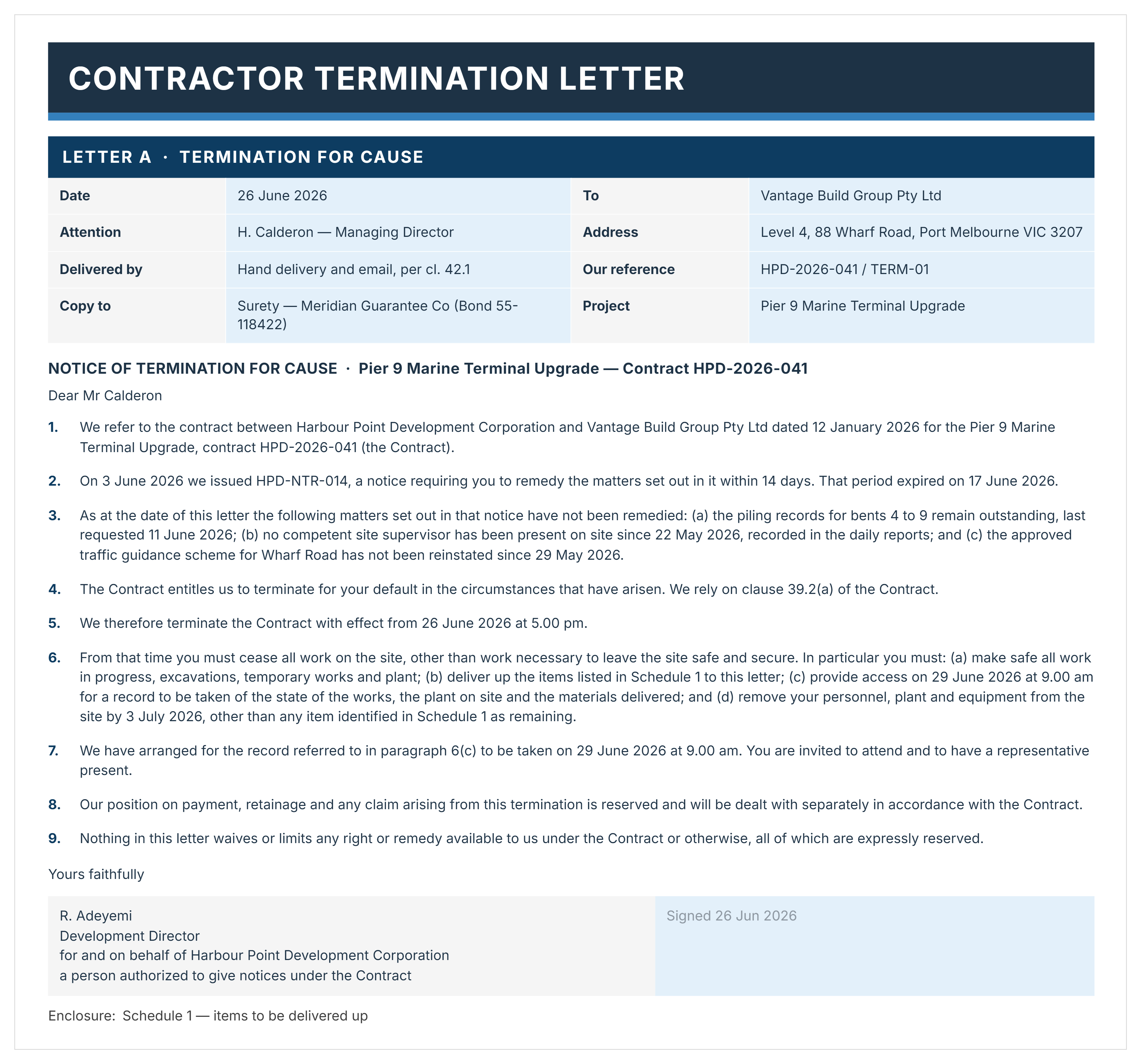
Here's an example of a contractor termination letter, Letter A for cause, issued on a marine terminal project.
Before You Send a Termination Notice
Annexure A is fourteen questions in the order they have to be answered. The first five are gates: if any has no answer, stop, because sending early is the risk rather than waiting.
- Which termination are you exercising? Cause and convenience have different notices, different compensation and different consequences.
- Does the contract give you the right, and have you read the clause? A termination the contract does not permit is a breach by you, whatever the contractor has done.
- Has the prior notice to remedy been given in writing, and can you produce it with its date? Most cause clauses are conditional on it. A notice of defective work is often that earlier letter.
- Has the cure period expired, counted in the days the contract specifies? A day early is a termination that failed its own clause.
- Is the failure still continuing, and can you evidence it as at the date of the letter? A default cured inside the period removes the ground.
Then service and security. Is the signatory authorized to give notices. Are you serving it by every method the contract requires, at the address it names. And does a bond or parent company guarantee exist, since late notice to a surety can extinguish a claim worth more than the rest of the dispute.
Establish the four payment numbers before you send: certified, paid, retainage held, and claimed but not certified. Have a construction lawyer in the governing jurisdiction read all of it. Contract termination covers what happens after.
How to Use This Contractor Termination Letter Template
Complete Annexure A before you draft either letter. Then delete the checklist, the drafting notes and the letter you are not sending.
- Work through Annexure A and stop if any of the first five questions has no answer.
- Choose Letter A for cause or Letter B for convenience, and delete the other entirely.
- Fill in the header block: date, addressee, delivery method, your reference, project and copies.
- Insert the clause number from your executed contract rather than paraphrasing the right.
- For Letter A, name the prior notice by reference and date, and state the date the cure period expired.
- List each unremedied failure separately, with its evidence and its date, rather than one paragraph asserting non-performance.
- Give an effective date and a time, since "with immediate effect" is ambiguous on a site running two shifts.
- For Letter B, direct the mitigation and ask for the contractor's statement of amounts, without stating a figure yourself.
- Strike out any Schedule 1 item that does not apply, then attach it to the letter you are sending.
- Have it signed by a person authorized to give notices, and serve it by every method the contract requires.
Keep the reservation of rights paragraph exactly as drafted. It is the last paragraph in both letters and it preserves every remedy you have not yet decided whether to use.
Termination for Cause vs Termination for Convenience
Two routes, two different letters, and picking the wrong one is expensive in opposite directions.
Termination for cause relies on the contractor having failed and on you having already told them so in writing. The letter has to name the prior notice, the date the cure period expired, and each failure that remains unremedied with its evidence.
Termination for convenience alleges nothing. It is the owner ending the contract because circumstances changed, and it costs money precisely because the contractor did nothing wrong. The letter should state expressly that no default is alleged, or it invites an argument about which route you actually took.
Who Should Use a Termination Letter for a Contractor
A contractor termination letter is essential for anyone involved in managing or supervising construction contracts. It helps ensure that every contract termination is handled professionally, accurately, and in accordance with legal and contractual obligations.
Here are the key users who benefit most from a structured template:
✅ Project Owners: Use the letter to formally end a contractor’s engagement while protecting project interests and ensuring proper documentation.
✅ Project Managers: Issue clear and consistent notices when addressing performance issues, delays, or contract breaches.
✅ Contract Administrators: Manage the termination process in line with contract clauses and maintain accurate records for audits and reporting.
✅ Procurement Officers: Standardize communication across all contractor relationships and maintain uniform documentation across projects.
✅ Legal Teams: Review the letter’s wording to confirm compliance with laws and minimize the risk of disputes or claims.
✅ Consultants or Client Representatives: Coordinate contract terminations across multiple projects or contractors to maintain clarity and accountability.
💡Pro Tip: Keep a record of all related communication, including notices, meeting minutes, and supporting documentation, to provide clear evidence of the decision-making process.
When to Use Contractor Termination Letters
A letter for contractor termination should be used whenever a construction contract needs to be formally and lawfully ended. The template ensures the communication is clear, compliant, and consistent with contract terms.
Here are the most common situations to use one:
- Termination for Cause: Used when a contractor breaches the contract, underperforms, or fails to meet safety and quality standards.
- Termination for Convenience: Applied when the project owner chooses to end the contract voluntarily due to changes in scope, budget, or priorities.
- Contract Expiry or Completion: Issued when the project has finished, and formal closure of the contractor’s engagement is required.
- Health, Safety, or Legal Violations: Necessary when a contractor’s actions breach regulations or compromise site safety.
- Persistent Delays or Non-Compliance: Used when ongoing delays, missed milestones, or repeated non-conformance make continuation impractical.
💡Pro Tip: Always issue the termination letter as soon as the decision is finalized. Delays between verbal notice and formal documentation can create uncertainty and increase legal risk.
Common Problems with Generic Contractor Termination Letters in Word or PDFs
Generic downloadable contractor termination letter templates in Word, Excel, or PDF formats can be convenient, but they often lack the structure and accuracy needed for real construction contracts. Many of these templates are too generic, missing critical sections or legal references required for a compliant contract termination.
Here are some of the most common problems:
⚠️ Incomplete or outdated content: Many free templates overlook essential details such as contract clause references, effective termination dates, or obligations after termination.
⚠️ Lack of customization: Termination letter templates in Word or Spreadsheets often require manual editing, increasing the risk of errors or inconsistencies across projects.
⚠️ Non-compliance with contract types: Generic letters may not align with standard contract forms like AS 4000, GC21, or FIDIC, making them risky to use.
⚠️ Formatting and version issues: Excel or PDF templates may not display properly across devices, creating confusion during review or approval.
⚠️ Limited legal protection: Poorly worded letters can create ambiguity and weaken your project’s position in case of disputes.
Related Articles and Templates
Explore these resources for contractor performance, contract notices, claims, and closeout:
.avif)
Written by
Doug Vincent
Doug Vincent is the co-founder and CEO of Mastt, the AI capital-project management platform used by governments, Fortune 500 companies, and consultancies across APAC, North America, and MENA. Before founding Mastt in 2019, he spent a decade at RPS delivering more than $2 billion in capital works, including the $2.1B Defence Navy Infrastructure program, and holds a CPSPM certification with the AIPM. He contributes content and speaks on AI in capital project delivery at Mastt.

FREE contractor termination letter template in Word. Two letters, one for cause and one for convenience, plus the checklist to work through before you send either.

Top Performers Don’t Guess. They Deliver.
Cut the stress of showing up unprepared
Start for FreeTrusted by the bold, the brave, and the brilliant to deliver the future