

A commercial project manager keeps a construction project financially predictable by staying ahead of cost movements, scope change exposure, and the records needed to support decision-making.
This guide explains the role of commercial PMs and what their day-to-day work looks like. It also covers core skills, salary benchmarks by region, and the typical career path in construction.
What is a Commercial Project Manager?
A commercial project manager is responsible for the profit outcomes of a construction project. The role protects profitability and cash flow by keeping contract position, cost forecasts, and change orders aligned with what is happening on site.
Commercial PM focuses on the decisions and records that determine what the project can recover, pay, and report with confidence. They keep the financial picture accurate as the scope shifts, costs move, and risk changes.

Commercial Project Manager vs. Project Manager: What’s the Difference?
A PM for commercial construction protects the project’s outcomes by controlling contract position, cost forecasts, and changes. A project manager delivers the work by coordinating scope, schedule, and safety. The roles work closely, but they make different decisions and produce different outputs.
For example, a scope gap shows up during construction. The project manager implements the practical fix on site and keeps work moving safely, while the commercial PM confirms entitlement, gathers the required records, and turns the change into a priced change order.
Core Responsibilities of a Commercial Construction Project Manager
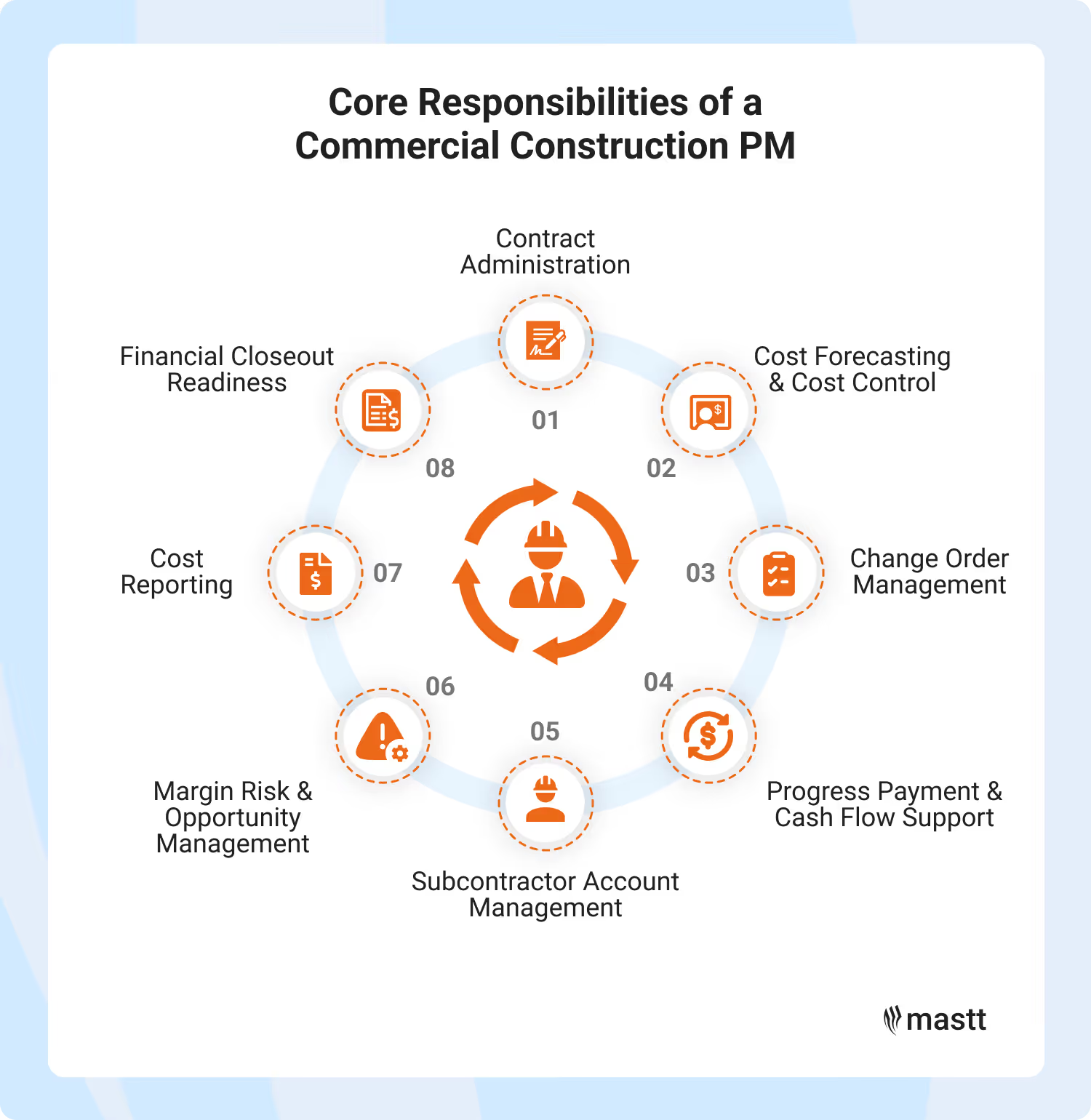
The commercial construction project manager’s role is to manage project controls, keep them current, and drive actions that protect recovery and reduce avoidable costs. These responsibilities stay consistent across most project teams:
- Contract administration: Maintain contract compliance through timely notices, consistent correspondence, and substantiating records that support entitlement.
- Cost forecasting and cost control: Build and defend cost-to-complete forecasts, track key cost drivers, and document assumptions behind every variance.
- Change order management: Convert scope changes into priced, substantiated requests that follow the required approval path.
- Progress payment and cash flow support: Keep payment submissions clean by matching claimed value to evidence, contract rules, and agreed valuation methods.
- Subcontractor account management: Review valuations, manage contract performance issues, and keep subcontract payments aligned to scope and measurable progress.
- Margin risk and opportunity management: Quantify exposure, keep a live risk register, and drive actions that reduce downside or improve recovery.
- Cost reporting: Provide decision-ready updates that link forecast movement to facts, evidence, and the current financial position.
- Financial closeout readiness: Keep reconciliation current and documentation complete so closeout does not rely on last-minute rework.
For example, a subcontractor submits a progress payment request with values and delay costs. The commercial PM is responsible for testing the request against the subcontract terms, progress, and site records, then documenting a valuation basis for what gets paid. Any disputed items move into a formal claim with defined evidence requirements.

What Does a Commercial Lead Do Day to Day?
The day-to-day work of a commercial lead keeps three things current: the cost forecast, the change account, and the records that support payment and recovery. Some days follow a steady cycle, while others shift fast when scope changes, approvals stall, or costs move.
Morning: Review cost and set priorities
Most mornings start with a quick scan of what changed since yesterday and what can hurt the forecast if it sits too long.
- Cost-to-complete check: Review new site updates, delivery slips, and emerging rework so the forecast reflects reality.
- High-impact issue triage: Rank today’s tasks by financial impact, such as unpriced extras, pending approvals, and cost overruns that need a decision.
- Records health check: Confirm key instructions, emails, and site notes are captured, dated, and easy to trace back later.
💡 Pro Tip: Put a dollar value next to your top five risks before 9:30 a.m., even if it is a rough range. If you cannot price it, you cannot prioritize it, and it will usually hit the forecast late.
Late Morning: Push approvals and contract decisions
This period usually goes to protecting entitlement and moving changes through the approval path.
- Change control: Turn scope gaps and instructions into clear change descriptions, pricing requests, and a tracked status in the register.
- Contract administration actions: Issue or coordinate notices when needed, and keep records consistent with contract timeframes and requirements.
- Evidence and substantiation: Pull together scope markups, photos, site diaries, and RFIs so pricing and recovery rest on facts.
💡 Pro Tip: Use a “48-hour evidence rule” for changes. If a change is real, collect photos, dates, and who instructed it within two working days, while the site conditions are still visible and the team remembers what happened.
Midday: Align with site and subcontractors
Midday is for alignment with site and subcontractors, walk the site or meet with contractors to verify that physical progress matches the paperwork.
- Subcontractor pay app review: Check claimed progress against scope, agreed rates, and measurable quantities before values harden into disputes.
- Scope and interface checks: Confirm who owns what work across trades so gaps do not quietly become cost growth.
- Quick contract check-ins: Get quick decisions on approvals, instructions, and missing evidence to keep registers moving.
💡 Pro Tip: When valuations get messy, force a “measure-first” reset. Pick one area on site, measure it together, agree on the quantity, then apply the rate. This single reset meeting can stop weeks of argument built on assumptions.
Afternoon: Prepare for payment and reporting cycles
Afternoons often focus on getting the project ready for cut-offs, reporting, and upcoming cost commitments.
- Progress payment request readiness: Confirm backup aligns with contract requirements and site evidence, so payment does not stall on avoidable queries.
- Forecast updates and variance notes: Update the month’s key movements and document assumptions so the forecast is defensible.
- Financial risk update: Refresh exposure on major issues and line up the next action that reduces cost or improves recovery.
💡 Pro Tip: Do a three-way check before sign-off: the change order register, the forecast movements, and the progress payment request backup should tell the same story. If they do not align, fix the story before you submit anything, or the reviewer will find the gap for you.
Day-to-day cost control stays effective when it runs on short cycles and clear “next actions.” This daily discipline prevents small disputes from turning into late surprises at payment time.

Skills That Make a Successful Commercial PM
To do well in commercial project management, focus on three skills first: contract clause interpretation, forecasting judgment, and valuation of changes. Then add the supporting skills that make those three work in real projects. The table below lists the core skills and practical ways to build them quickly.
A commercial project manager earns credibility by making decisions easy to review. These skills help you present a clear basis, show the numbers behind it, and point to the exact records that support it, so approvals do not depend on who is in the room.
How to Become a Commercial Manager in the Construction Industry
Anyone who wants to be a commercial manager in the construction industry should start by becoming the person who can turn a messy site issue into a clean financial decision. Learn to link one event to four things: what the contract says, what it will cost, what should be recovered, and what evidence proves it.
Build your experience by practicing that link on real project work, using these steps.
1. Build contract awareness in your current role
Own one financial control, such as a change order log, a valuation review, or a forecast movement note. Learn the contract basics that drive decisions, including notice timeframes, payment rules, and the valuation method used on your job.
2. Move into an entry role close to contracts and cost
Target roles that handle commercial documents daily, such as contracts administrator, assistant quantity surveyor, cost engineer, or procurement support. These roles give you repeated exposure to changes, valuations, and payment processes.
3. Collect proof you can do the job
Keep a simple portfolio of outcomes you can explain clearly, such as a forecast you improved, a cost impact you helped substantiate, or a valuation dispute you helped resolve. Remove sensitive details, but keep the problem, the action you took, and the measurable result.
4. Learn through real project documents
Use your project contract, cost-to-complete reports, change order register, and payment submissions as your study material. Practice writing a short position for each issue: what happened, what the contract allows, what it costs, and what evidence supports it.
💡 Pro Tip: Treat LinkedIn as a competency file. Update your experience with 3 to 5 margin-impact bullets, then post one short “commercial basis” story a month: trigger, contract hook, impact, evidence, result.
Commercial Project Manager Career Path in Construction
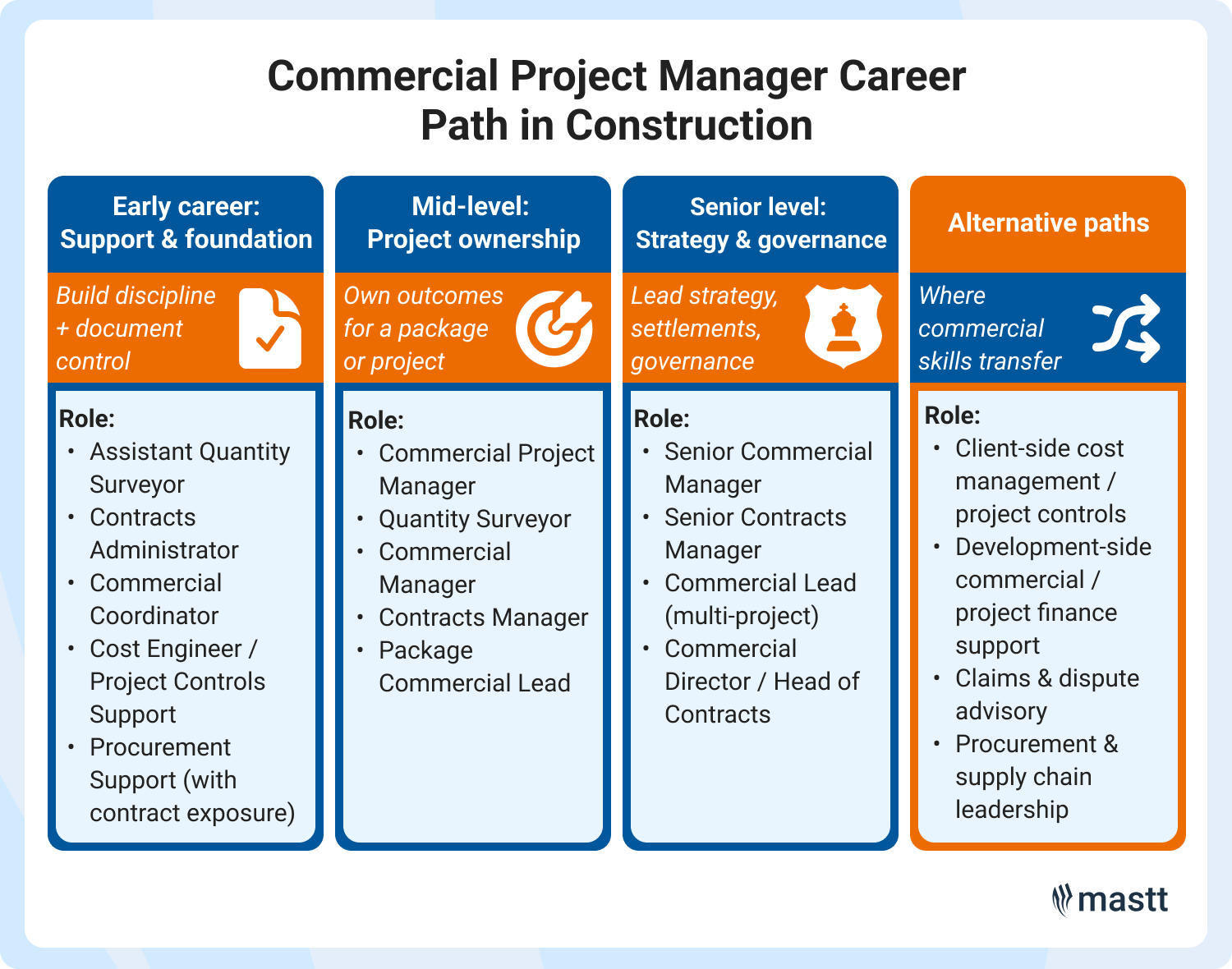
A career in commercial project management usually starts in contract-facing support roles, then grows into full ownership of project financials. As you move up, the work shifts from processing documents to leading commercial strategy, negotiation, and risk decisions.
Early career roles: Support and foundation
Entry roles build contract discipline, valuation logic, and record control. These roles give you repeated exposure to the documents and decisions that shape profit margins.
- Assistant quantity surveyor: Builds measurement, valuation, and cost reporting habits.
- Contracts administrator: Learns contract administration, notices, and document control.
- Commercial coordinator: Supports registers, reporting, and financial workflows.
- Cost engineer or project controls support: Develops forecasting inputs, tracking, and variance thinking.
- Procurement support with contract exposure: Builds scope clarity and awareness of commercial terms.
Mid-level roles: Project ownership
Mid-level roles own day-to-day cost control for a package, trade group, or full project. The work becomes more outcome-driven, with direct accountability for forecasts, approvals, and negotiations.
- Commercial project manager: Owns forecast, change management, and contract administration on a job.
- Quantity surveyor: Runs valuations and cost control with project ownership.
- Commercial manager: Leads the finance function and key negotiations on a project.
- Contracts manager: Owns contract risk and contract processes, often across packages or projects.
- Package commercial lead: Manages budget control for a major trade package or scope.
Senior-level roles: Strategy and governance
Senior manager roles shift toward strategy, governance, mentoring, and settlement decisions. You spend less time producing documents and more time shaping commercial outcomes across complex risk and stakeholder pressure.
- Senior commercial manager: Leads complex project profit strategies and major risk decisions.
- Senior contracts manager: Leads contract position and contract risk across large scopes.
- Commercial lead across multiple projects: Sets consistency across jobs and supports escalations.
- Commercial director or head of Contracts: Owns profit governance and portfolio performance.
Alternative paths: Specialization and consultancy
Commercial lead skills transfer well into roles that reward contract clarity and financial control. These paths often suit people who prefer portfolio-level work, dispute-focused work, or deeper specialization.
- Client-side cost management or project controls: Supports project budget predictability and reporting.
- Development-side commercial or project finance support: Links cost, risk, and funding decisions.
- Claims and dispute advisory: Focuses on entitlement, evidence, and resolution.
- Procurement and supply chain leadership: Leads commercial terms and supplier performance.
Commercial career progression usually comes from a wider contract scope, not just a new title. You build momentum when you move from a single trade or package to whole-of-project financial control, especially on larger, higher-risk work.
Commercial Project Manager Salary by Region
Commercial project manager pay in the United States typically ranges from about USD $90,702 to $135,644 per year, depending on location, experience, and employer. The figures below are reported averages from major salary aggregators. Treat them as a benchmark, then check against the exact scope in the job ad.
Some roles are closer to commercial manager/QS ownership, while others sit closer to project controls or project delivery. Use salary benchmarks that align with the job’s core outputs.
Tools and Software Commercial Project Managers Use
Commercial project managers use a mix of construction project cost management software, document control systems, and simple registers to keep cost control tight. They typically rely on the following tools:
💡 Pro Tip: Use reliable capital project and program management software like Mastt as your single source of truth for cost reporting by standardizing your cost-to-complete updates, change tracking, and progress payment request status in one place. Link each register line to the supporting evidence in your document control system, and review exceptions weekly.
Build a Successful Career as a Commercial Lead
Think like a commercial lead, even before you hold the title. Protect forecast credibility, keep change orders moving, and make your evidence trail easy to audit. As you take ownership of bigger controls, your scope will grow naturally.

Written by
Kristel Sapungan
Kristel Sapungan is a licensed architect and Content Writer at Mastt, combining her technical background with expertise in SEO and digital strategy. With experience in architectural design, construction documentation, and on-site coordination, she delivers precise, high-quality content for the construction and capital works sector. Her work enhances industry communication by translating complex concepts into clear, professional narratives.


Contributions by

Anticipated Cost Report Template
Use this FREE Anticipated Cost Report Template to track forecasted costs against budget. Maintain clear visibility of committed, incurred, and estimated-to-complete expenses to avoid overruns.

Walk Into Every Meeting With Confidence, Clarity, and Control
No one wants to look unprepared, blindsided, or uncertain in front of stakeholders — but that’s exactly what happens without Mastt.
Start for FreeTrusted by the bold, the brave, and the brilliant across governments, Fortune 500s, and the world’s best in delivering the future