



.avif)
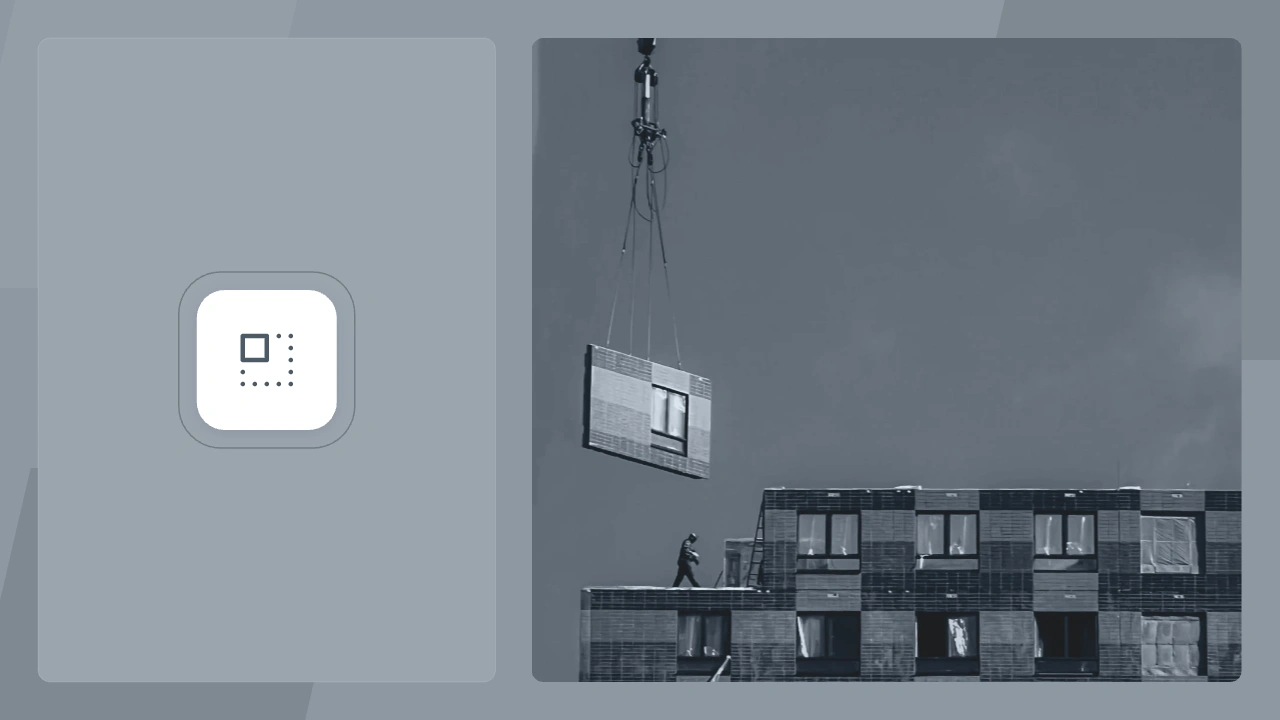
Industrialized construction applies manufacturing methods to building, with components made in a factory and assembled on site. Done well, it compresses the schedule by running factory and site work in parallel, without cutting quality. This article explains what it is, the methods behind it, and how prefabrication, takt production, and just-in-time logistics shorten the build.
What Is Industrialized Construction?
Industrialized construction is a way of building that applies manufacturing methods to construction. The building is broken into standardized parts, engineered so a factory can produce them in volume, and the site becomes a place of assembly rather than construction. It moves building from a one-off, project-by-project craft toward a repeatable, product-based process.
The core idea is a shift from thinking in projects to thinking in products. A traditional project designs and builds almost everything on site, once. An industrialized approach designs a component once, then produces it many times to the same specification, the way a factory turns out a product.
Industrialized construction is not the same as industrial construction. Industrial construction is a sector like the plants and warehouses built for industry. Industrialized construction is the manufacturing-led method described here, and it works on almost any building type.
Industrialized vs Traditional Construction
Traditional construction and the industrialized model start from opposite instincts: build it on site as you go, or make it in a factory and assemble it. That difference shapes cost and schedule more than any material choice. The table sets the two side by side so the trade-offs are visible at a glance.
Industrialized Construction Methods
How far you industrialize a build depends on how much is moved off-site as part of a project's means and methods. The methods below are the most widely used approaches:
- Prefabrication: Components such as wall panels, structural frames, plant rooms, and bathroom pods are made off-site and assembled on site.
- Modular construction: Complete 3D units, such as hotel rooms or apartments, are built off-site, transported to site, and installed.
- Panelized systems: Factory-made wall, floor, and roof panels are shipped flat and assembled on site.
- DfMA: Design for manufacture and assembly simplifies parts so they can be made and installed with fewer steps, less waste, and less rework.
These methods can be used alone or together, depending on the project, design, logistics, and supply chain.
Steps to Compress Build Time With Industrialized Construction
The build compresses as factory and site work run in parallel. That removes the buffer most schedules carry, where a five-day task is often worked on barely a third of the time. Components arrive just in time and are assembled in order, so nothing waits.
These three steps keep the overlap intact:
Step 1: Lock the design and engineer it for manufacture
Freeze the design at a formal gate before anything goes into production, and run it through design for manufacture and assembly so every part can be made and fitted without on-site rework. A factory cannot absorb a late change the way a site can, so this gate is what lets the rest of the schedule hold. Treat any change after it as a costed change order, not a quick tweak.
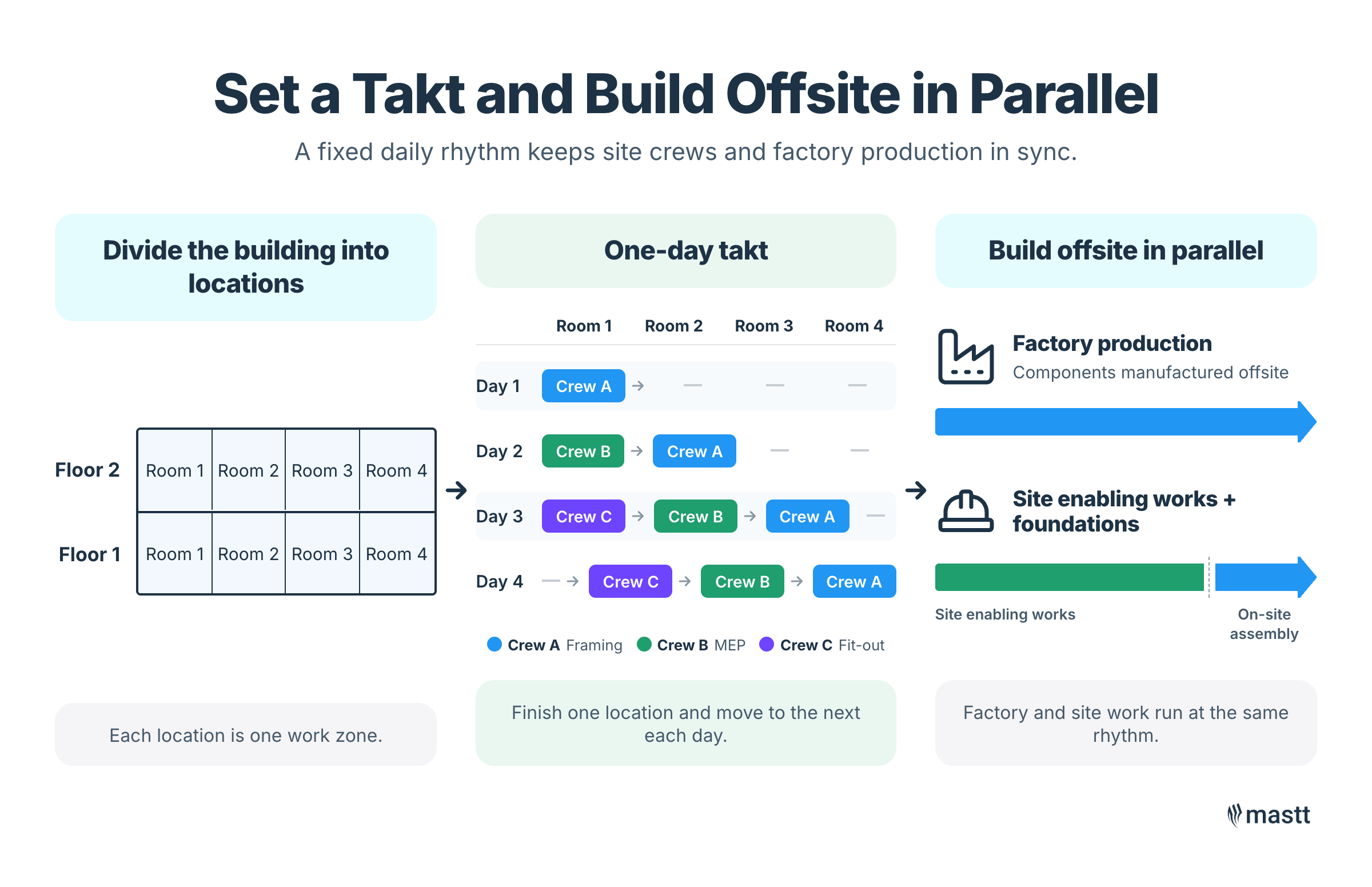
Step 2: Set a takt and build offsite in parallel
Divide the building into locations, an apartment or even a single room, and give every crew a fixed rhythm called the takt. If the takt is one day, each crew finishes its location and moves to the next one daily, so the whole job moves at one beat. Run factory production against that same rhythm while site enabling works and foundations go ahead, so the two never wait on each other.
Balanced this way, you avoid the traditional end-of-project crush, where floors sit half-empty for weeks then fill with crews fixing mistakes in the final months. That is how you get roughly half the duration and better quality at once.
Step 3: Deliver in kits, just in time
Stop each subcontractor bringing its own materials. Take detailed quantity take-offs from the BIM model, route everything through a consolidation center, and deliver in kits, so each crew gets exactly what one location needs on the day it needs it. This clears laydown areas, cuts double-handling, and keeps a congested site moving. Speed to market is why sectors like data center construction lean heavily on this approach.
💡 Pro tip: The owner and general contractor should own the delivery plan. Material logistics now drives the schedule, so treat it as a main contract responsibility and sequence it from the BIM take-off.
Do not expect every task to be quicker. Individual tasks often take the same time. The build shortens because the work runs in parallel and the site never waits on a missing part.

Benefits of Industrializing Construction
The benefit a project manager feels first is a build that finishes on schedule and arrives as designed, with no end-of-job scramble. Controlled factory production, not on-site improvisation, is what delivers it:
- A shorter build. Factory and site work run in parallel, so the overall program compresses without rushing any single task. On one of our projects, that meant six months instead of twelve, at better quality.
- A more predictable schedule. Controlled production removes much of the weather and site-labor risk that derails traditional timelines.
- More consistent quality. Parts are made to tight tolerances in a factory, so defects and on-site rework drop.
- Fewer late change orders. With the design fixed and the parts pre-made, there is far less to renegotiate once work starts.
- Safer, less crowded sites. More work happens offsite, so fewer trades stack on top of each other and there is less work at height.
- Less waste. Factory production orders to the model and reuses offcuts, instead of skipping material into a site dumpster.
How much of this you capture depends on the project. The more repetitive and well-defined the building, the steadier you can feed the factory, and the larger every one of these gains becomes.
When Is Industrialized Build Not the Right Fit?
Industrialized construction works best on repetitive, standardized projects, but it is not suitable for every build. Its advantages depend on a few conditions that some projects simply do not have. It is usually the wrong choice in these situations:
- Low repetition. A one-off building with little repeated geometry rarely earns back the factory setup cost.
- Unsettled design. If the design cannot be fixed early, or the client keeps changing it, the method fights you the whole way.
- Small or bespoke work. At low volumes, a good traditional crew usually beats a factory on cost.
- Hard site access. If modules cannot be trucked in or craned into place, the offsite advantage disappears.
- Thin supply chain. Without capable manufacturers nearby, lead times and quality are hard to control.
A simple test helps: if you cannot picture building the same thing several times over, this is probably not the project to start on. Prove the method on a simpler, repetitive job first, and let the results make the case for the next one.
Challenges of Industrialized Construction and How to Manage Them
Industrialized construction trades familiar site risks for a different set, most of them tied to fixing decisions early and coordinating deliveries. None is hard to manage once you know it is coming. The table pairs each common problem with its fix.

Best Practices for Industrializing Construction Projects
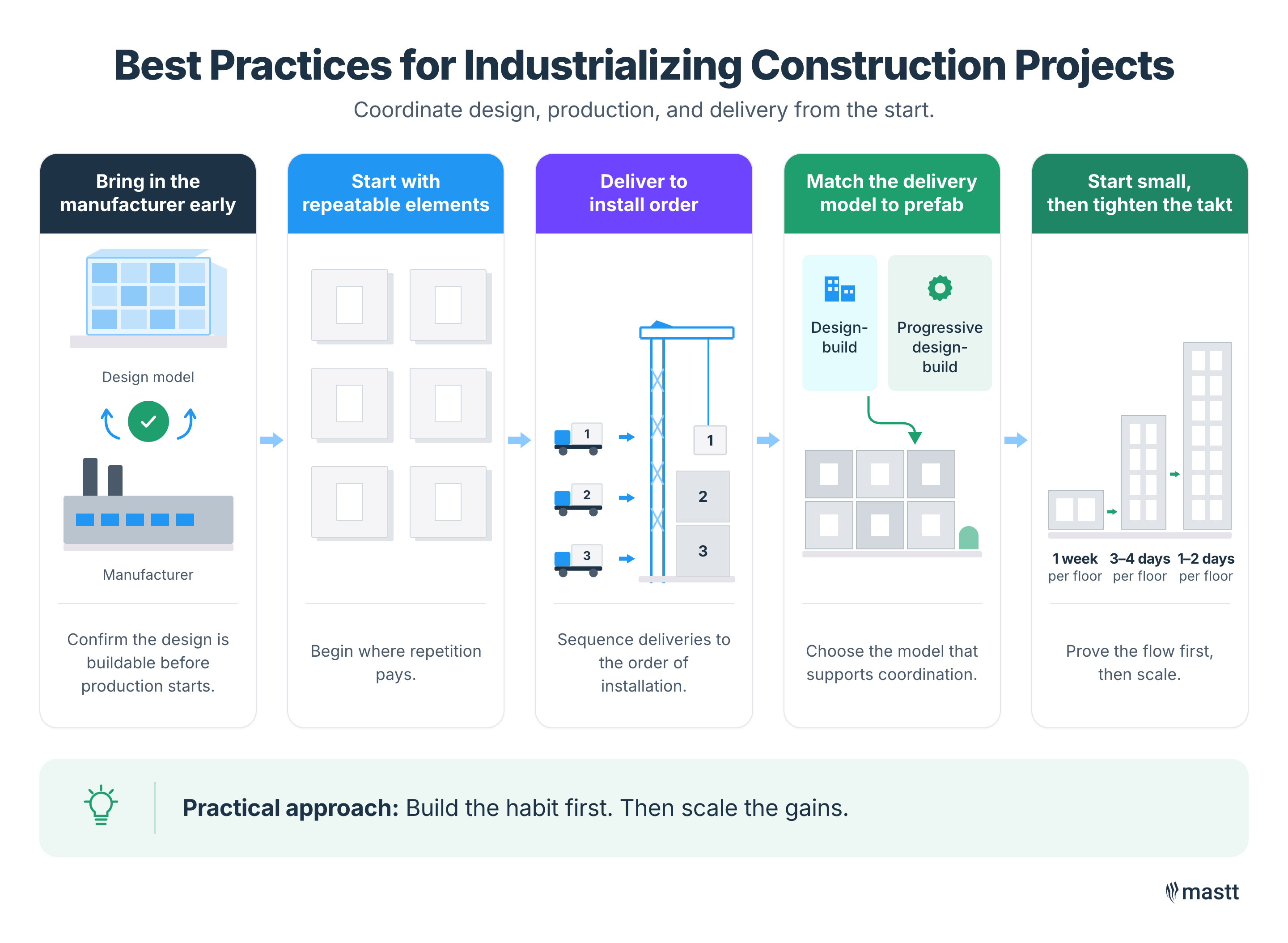
Industrialized construction rewards disciplined construction management of locking in key decisions early and coordinating design, production, and delivery from the start. That shows up in a few specific ways:
- Involve the manufacturer early to confirm the design is actually buildable.
- Prefabricate repeatable, high-volume elements first, where repetition pays.
- Sequence deliveries to the install order, not to whatever is ready.
- Match the delivery model to prefab, weighing design-build vs progressive design-build.
Do not overreach on your first project. Start with a gentle takt, take one week per floor, and prove the flow works before tightening toward smaller locations and shorter takt times. Build the habit first, then push for bigger gains.
Tools That Support Industrialized Construction Work
To get the most out of industrialized construction, you need tools that keep design, production, and delivery in step. Get that chain running and the process holds together. The tools below are the ones that matter most:
- BIM (e.g., Revit): the coordinated model that drives fabrication, clash detection, and material take-offs.
- Robotic total stations: set out points directly from the model, so work is built to design without tape measures.
- Scheduling and logistics tools: sequence kitted deliveries to the takt on site.
- Project controls and PMIS: Mastt tracks cost, payment application, and schedule across offsite and onsite work in one place.
Most of the newer site technology is still promise, not proof. Too many apps each need their own data entry and do not talk to each other, which drains the management time they were meant to save. Choose tools that share data before chasing the newest one.
Better Preparation, Faster Industrialized Construction
Industrialized construction goes beyond prefabrication by coordinating how a building is designed, produced, delivered, and assembled. It combines manufacturing methods, takt production, and just-in-time logistics so factory and site work run in parallel and the build shortens.
Start with a few well-chosen elements, prove the flow works, then expand as your supply chain and contracts mature. Done consistently, the reliability compounds. Our consortium recently went a full year without a single delayed project, which a traditional program rarely manages.

Written by
Olli Seppänen
Olli Seppänen is a tenured Associate Professor of Operations Management in Construction at Aalto University in Finland, and co-author of the foundational text on location-based management for construction. He co-founded the construction software company Vico Software, chairs the board of site-intelligence firm Aiforsite, and initiated the Aalto Building 2030 research consortium. At Mastt, he contributes content on construction productivity, lean, and digital delivery.


Contributions by
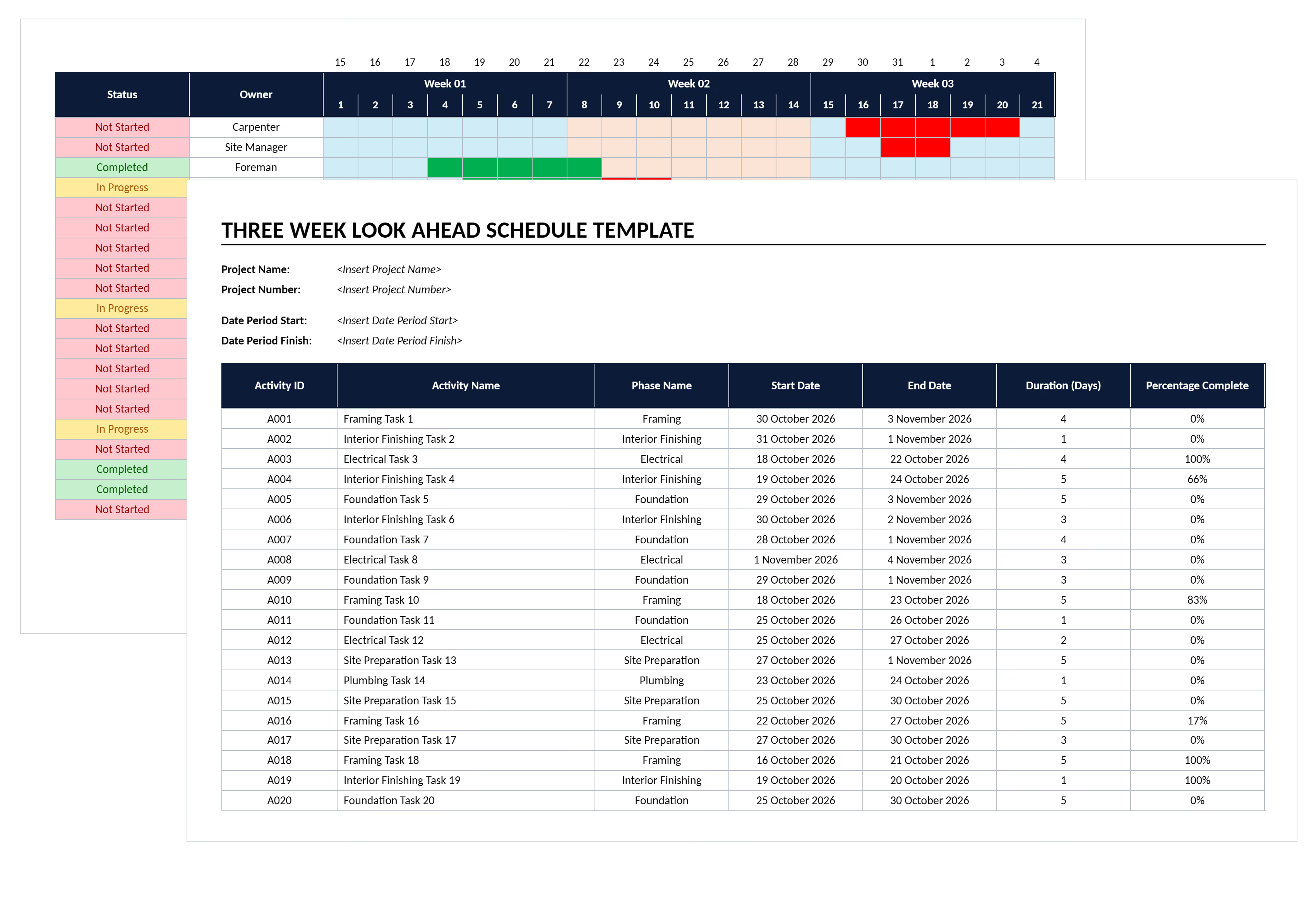
3 Week Look Ahead Template
Use this FREE 3-week look-ahead template to bridge master schedules and daily work. Coordinate trades, sequence subcontractors, and identify constraints three weeks ahead.

Walk Into Every Meeting With Confidence, Clarity, and Control
No one wants to look unprepared, blindsided, or uncertain in front of stakeholders — but that’s exactly what happens without Mastt.
Start for FreeTrusted by the bold, the brave, and the brilliant across governments, Fortune 500s, and the world’s best in delivering the future