





Measuring project success in construction starts with understanding what the owner needs the completed asset to achieve. A project can finish within its approved budget and schedule while leaving the client disappointed with the result. This article explains how to measure the success of a construction project, using research-based criteria and a practical assessment process.
What Does Project Success Mean in Construction?
Project success in construction means achieving the project’s agreed objectives, including delivery requirements and the benefits expected from the completed asset. It covers how well the team delivers the work and whether the result meets the needs it was built to serve.
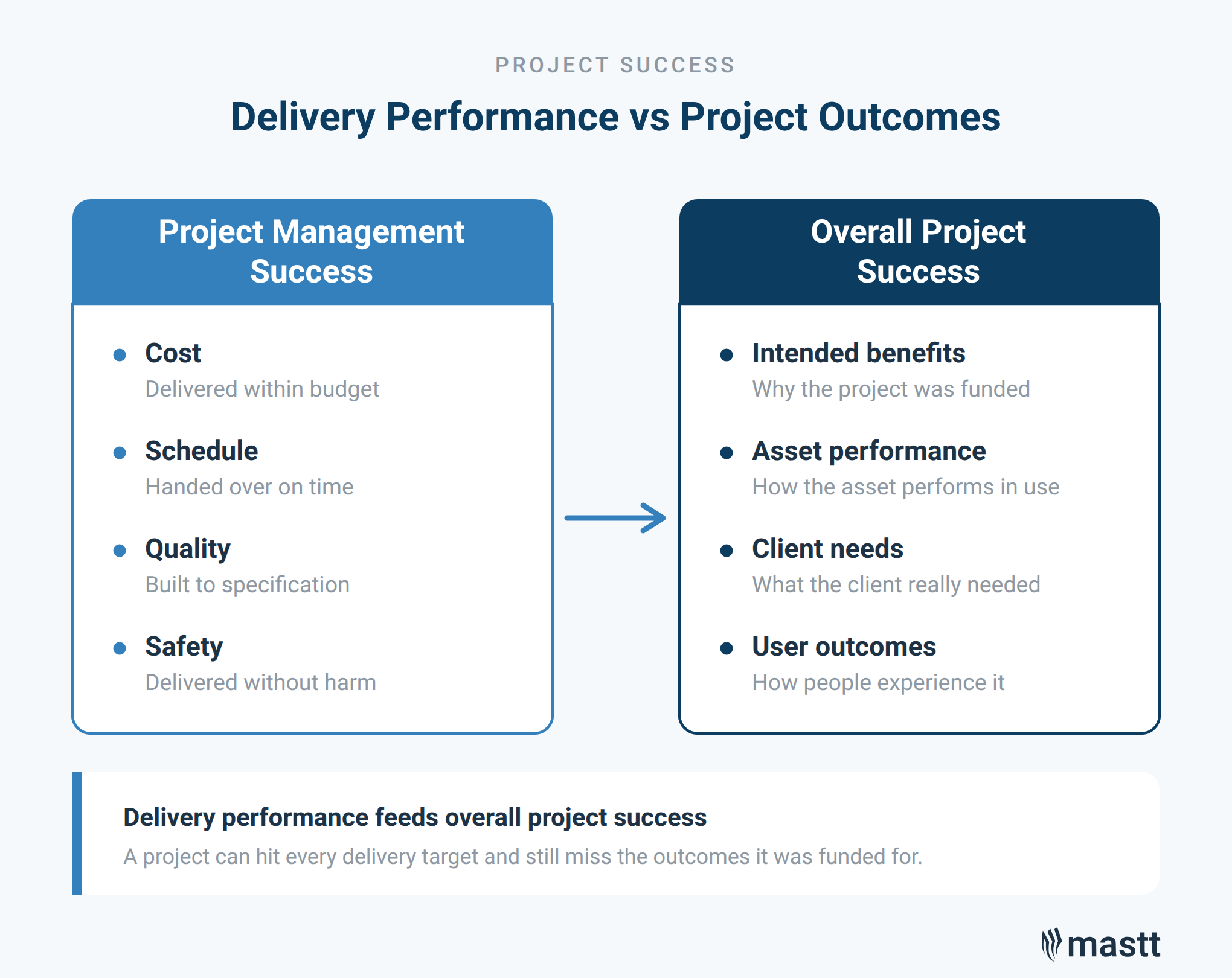
To assess both delivery and outcomes, researchers distinguish between project management success and overall project success. Success in project management asks whether the team met its budget, schedule, and quality requirements. Overall project success also asks whether the completed facility achieves its intended purpose.
The people involved may also have different expectations of that outcome. Owners look for the benefits that justified their investment. Contractors consider profitability, while users judge how well the facility supports their daily activities. Agreed success criteria establish which expectations the project must meet.
Which KPIs Measure Construction Project Success?
Construction project success KPIs measure performance against agreed delivery targets and the owner’s expected outcomes. Useful measures include budget variance, milestone delays, rework costs, and client satisfaction. These project success evaluation metrics and criteria should connect directly to what the project needs to achieve.
How Do You Measure the Success of a Construction Project?
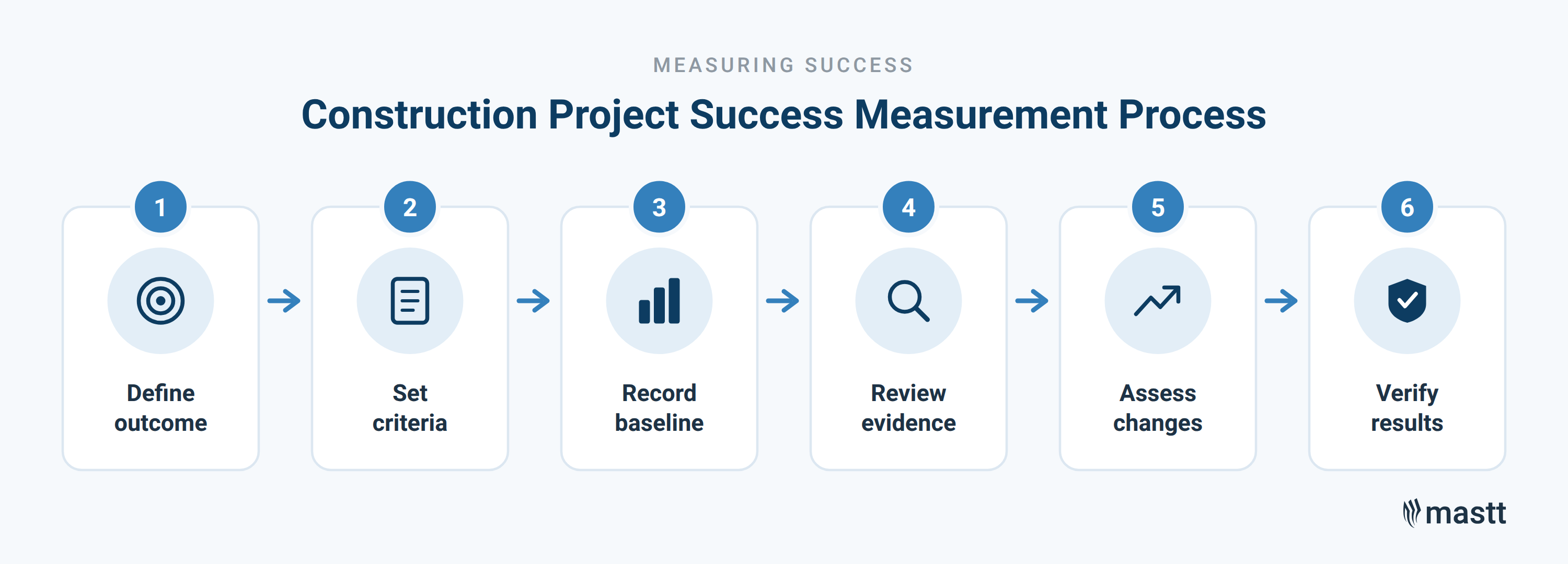
To measure the success of a construction project, compare verified results with agreed objectives and performance targets. Define what a successful outcome requires, then collect evidence showing whether the project meets those requirements.
Step 1: Define the outcome with the owner
Review the business case and project brief with the project owner. Ask what problem the project must solve and what the completed facility needs to make possible. Include operators and users to confirm the requirements that affect everyday use.
For example, a client requesting a pipeline needs to move water or oil between locations. Record that purpose in the brief, then agree on the required capacity and reliability. This gives the team a specific outcome to assess when the pipeline is complete.
Step 2: Turn objectives into measurable success criteria
Project success criteria in construction turn broad objectives into results the team can assess. For each objective, agree on a construction project success criterion and choose a KPI that provides evidence against it. Record the target, measurement method, and person responsible for accepting the result.
For example, a school extension intended to provide more teaching space needs a capacity requirement and an availability date. The team could measure the number of additional usable student places available by the start of term. Keep essential acceptance conditions visible individually so a favorable overall score cannot hide an unmet requirement.
Step 3: Record the baseline and measurement rules
Save the original approved scope, budget, and schedule as the project baseline. Define each calculation and its data source so the team measures performance consistently. For cost reporting, specify whether the figure represents expenditure to date, forecast final cost, or final cost.
Improvement targets also need a starting point. For example, a target to reduce energy use needs existing consumption data for a comparable period. Account for differences in occupancy and operating hours so the comparison reflects the improvement being assessed.
Step 4: Assign responsibility and review the evidence
Name someone responsible for maintaining each KPI and agree on reporting dates. Use traceable records, including cost reports, schedule updates, and commissioning results. Check that the information is current and covers the relevant reporting period. A project controls software can help keep cost, schedule, risk, and reporting data connected as teams review performance against agreed targets.
We have been entrusted with people's money and time. And we need to be able to report on that very, very clearly. Explain where results differ from targets, what remains uncertain, and which decisions need the client’s attention. For satisfaction measures, ask consistent questions and record the reasons behind the responses.
Step 5: Assess changes before revising targets
When a proposed change order affects an objective, show the owner its consequences before seeking approval. Compare the available options against cost and schedule commitments, including their effect on the intended benefits.
What I need to deliver is what they need at the end, even if they didn't know what it was at the start. Involve the client in choosing the revised outcome and record their decision. Update approved targets while retaining the original baseline. Explain any benefits reduced or removed, so meeting revised targets does not conceal what the project has lost.
Step 6: Verify results and assign follow-up
Compare each target with the final evidence and record whether it was achieved, partly achieved, unmet, or awaiting verification. Explain the judgment and link it to the supporting record. Assign corrective actions for unresolved requirements, with a responsible person and due date.
Some benefits require operating data before they can be confirmed. Assign someone within the owner’s organization to collect that data and agree on a review date. Record whether each benefit is awaiting assessment, delayed, or no longer expected.
When Should You Measure Construction Project Success?
Begin defining success during planning, review progress throughout project delivery, and verify outcomes at handover and during operation. Each stage provides different evidence, so the assessment should reflect what can reasonably be confirmed at that point.
Schedule reviews early enough for their findings to influence the next decision. For example, assess readiness before confirming an opening date, while there is still time to address outstanding work. If evidence is incomplete, record what remains unverified and when it will be checked again.
What Does a Construction Project Success Scorecard Look Like?
A construction project success scorecard places agreed targets beside actual results, supporting evidence, and an assessment of each outcome. It shows which requirements were met and which need further action or verification.
The scorecard below illustrates a hypothetical $4 million school extension providing 120 additional student places. Reviewed three months after opening, it compares agreed targets with delivery results and early feedback from staff. All figures are illustrative.
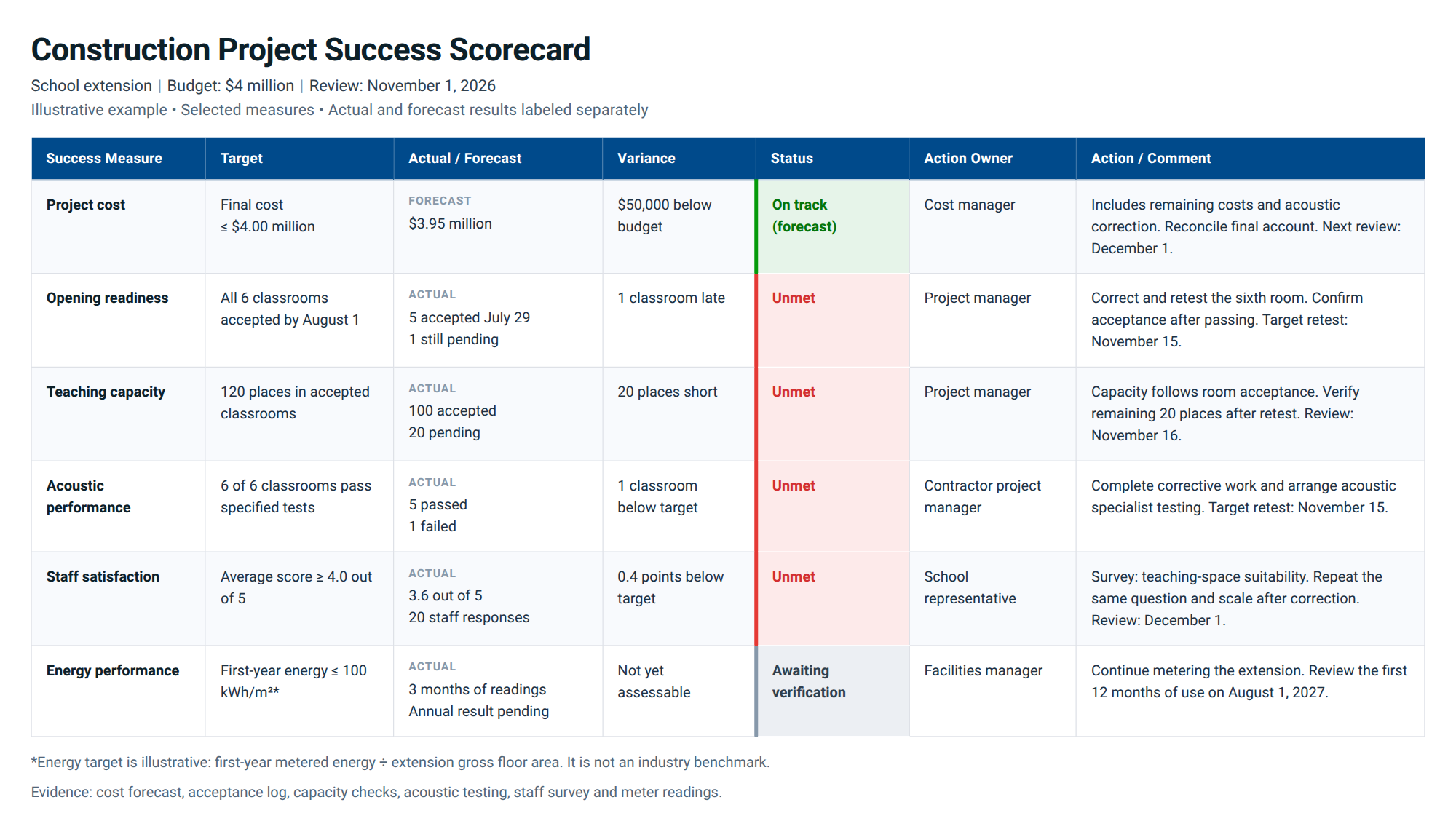
Use the action column to explain what must happen before an unmet requirement can be accepted. Update each status when new evidence becomes available, keeping forecasts clearly labeled until results are confirmed.
Mastt’s project performance dashboard template provides a starting point for organizing these measures and reporting progress to the owner.

Why Can a Project Meet Its Targets and Still Disappoint the Client?
A project can meet its budget and schedule targets yet still disappoint the client. This happens when the completed asset delivers fewer benefits than the owner originally expected.
I call this a “disappointing success.” On one defense project, our budget fell from about $12.5 million to $8 million while construction was underway. The team finished under the revised budget and ahead of the revised schedule. However, stakeholders felt the completed project no longer delivered what they originally needed.
Two issues commonly cause this gap:
- Revised targets can reduce expected benefits. Scope, budget, or schedule changes may make delivery targets easier to achieve. Yet the finished asset may provide less value than originally planned.
- Clients may not understand the trade-offs. Explain how proposed changes affect the finished outcome before approval. This helps the owner understand what they are accepting and what benefits may be lost.
Measuring project success should therefore consider the completed outcome, not delivery targets alone.
Put Project Success Into Measurable Terms
Measuring project success starts with a shared understanding of what the owner needs the investment to achieve. Turn those expectations into clear targets, and keep the client involved when decisions change the expected outcome. Build your scorecard around those outcomes, with evidence for each assessment and someone responsible for checking benefits after handover.

Written by
Dr. Greg Usher
Dr. Greg Usher is a company manager at Beca and an Adjunct Research Fellow at the University of Southern Queensland, holding a PhD in project management and a Fellowship of the Australian Institute of Project Management. Over a 20-year executive career, he has led major construction and defense programs, including a $1.96 billion naval capability infrastructure sub-program, and has authored a book and peer-reviewed research on project complexity and resilience. At Mastt, he contributes content on project management and client-side project delivery.

.avif)
Contributions by
Doug Vincent
Doug Vincent is the co-founder and CEO of Mastt, the AI capital-project management platform used by governments, Fortune 500 companies, and consultancies across APAC, North America, and MENA. Before founding Mastt in 2019, he spent a decade at RPS delivering more than $2 billion in capital works, including the $2.1B Defence Navy Infrastructure program, and holds a CPSPM certification with the AIPM. He contributes content and speaks on AI in capital project delivery at Mastt.
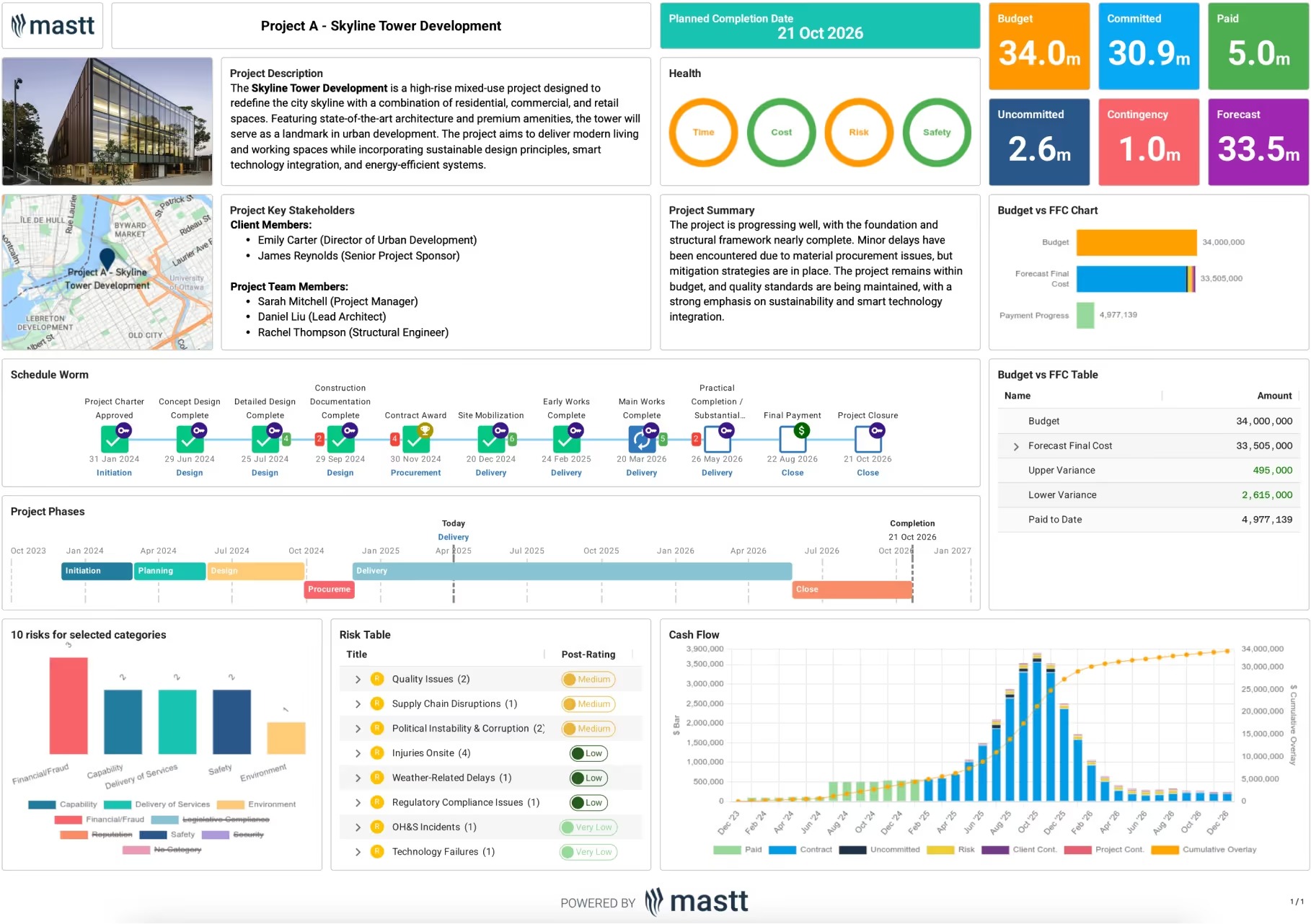
Project Performance Dashboard
Use this FREE project performance dashboard template to monitor project health, track KPIs, and make data-driven decisions across your portfolio. Transform scattered metrics into unified visibility for better project outcomes.

Walk Into Every Meeting With Confidence, Clarity, and Control
No one wants to look unprepared, blindsided, or uncertain in front of stakeholders — but that’s exactly what happens without Mastt.
Start for FreeTrusted by the bold, the brave, and the brilliant across governments, Fortune 500s, and the world’s best in delivering the future
%2520on%2520Construction%2520Sites%2520_%2520Australia%2520(1).avif)
.avif)


