Post author:
Anna Marie Goco

AI project management helps construction teams plan, track, and decide better. Learn how it works, risks to avoid, and what changes next for projects.
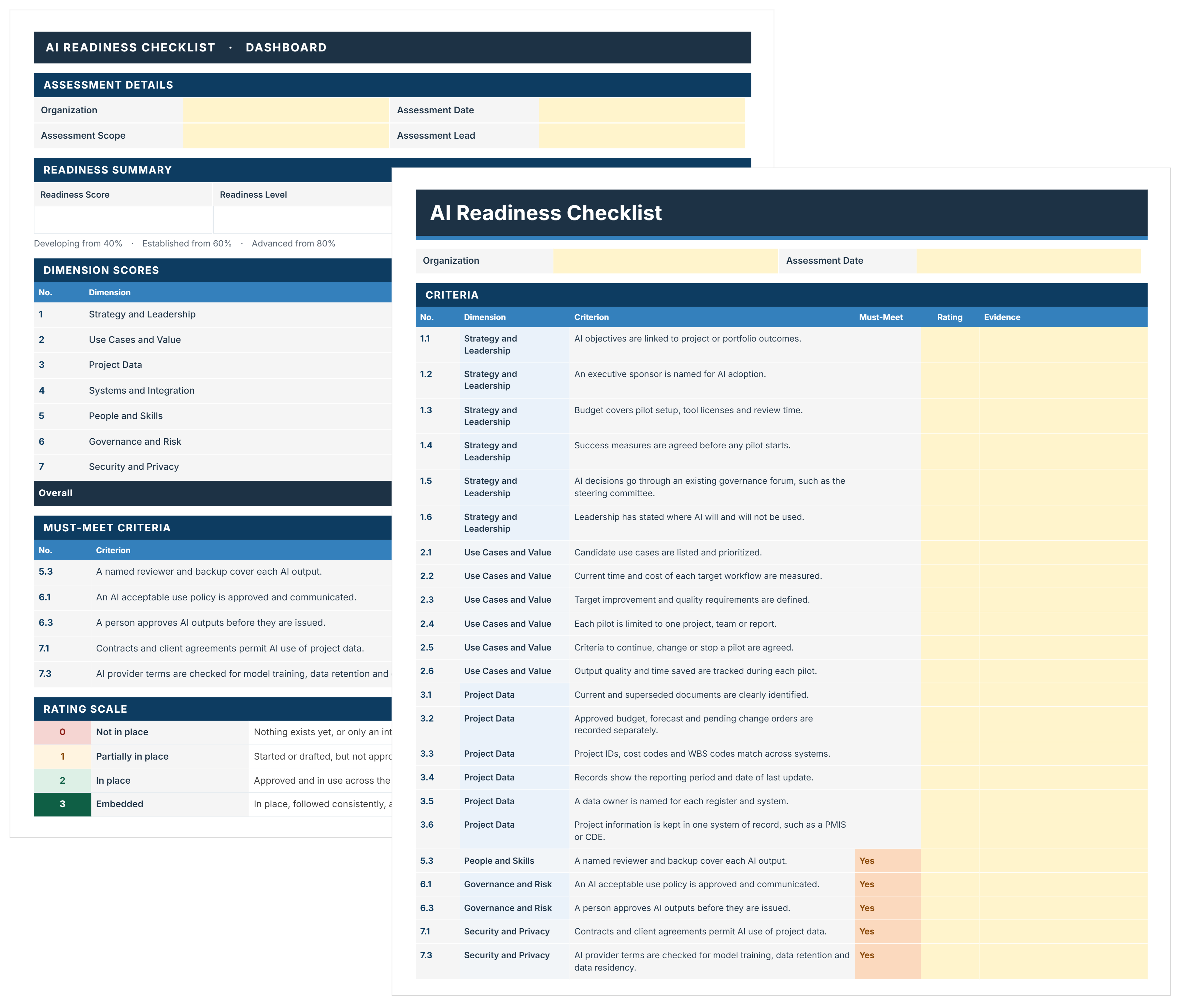
FREE AI readiness checklist to assess and decide where AI starts on your projects. Score 44 criteria, close must-meet gaps, and pick a pilot with evidence.

AI in project management is gaining traction in construction as traditional approaches struggle to keep pace with project complexity. Cost visibility lags, schedules hide emerging risks, and project managers are often forced to act with incomplete information. As projects grow in scale, manual controls alone no longer provide reliable oversight.
So what role can AI realistically play in construction project management? Can it support better decisions, or will it replace project managers altogether? This article explains what AI project management means, how it is being used today, and where its limits remain.
AI project management refers to the use of artificial intelligence to support all phases of the project lifecycle. It analyzes project data to surface patterns, trends, and early warning signals that are difficult to identify through manual review.
In construction, AI is used to augment existing project controls rather than replace them. It works alongside schedules, cost reports, contract data, and site inputs to provide forward-looking insight. These systems depend on structured project data and operate within the limits of how construction projects are planned, governed, and delivered.
AI in project management is not a single tool or feature. It includes capabilities ranging from predictive forecasting and AI document analysis to pattern recognition across portfolios of past projects. In all cases, AI provides decision support, while accountability, context, and final judgment remain with project teams.

AI project management shifts project control from manual tracking and hindsight reporting to pattern detection and forward-looking insight. Traditional project management relies on people to compile data, interpret reports, and spot issues after they appear.
Traditional project management still plays a critical role. Judgment, leadership, and commercial decisions remain human-led. AI does not fully replace planning, cost management, or contract administration. It supports them by reducing blind spots and surfacing patterns that are hard to detect across complex construction data.
AI is now essential in construction project management because it addresses gaps that traditional controls struggle to close. It helps project teams see risk sooner, understand likely outcomes, and act before issues become contractual or financial problems.
In practice, AI grows in importance because it enables project managers to do the following:
None of these removes the need for judgment. Project managers still weigh tradeoffs, manage people, and own decisions. Earlier insight simply shifts conversations from damage control to deliberate action.

AI is already used across core project management functions where data volume and complexity exceed manual control. AI use cases in construction focus on improving visibility, strengthening forecasts, and supporting decisions before issues become costly.
These applications work best when AI feeds directly into existing project management routines such as forecast reviews, planning sessions, and project meetings. AI strengthens decisions when it informs discussions teams already have, rather than creating additional layers of reporting.
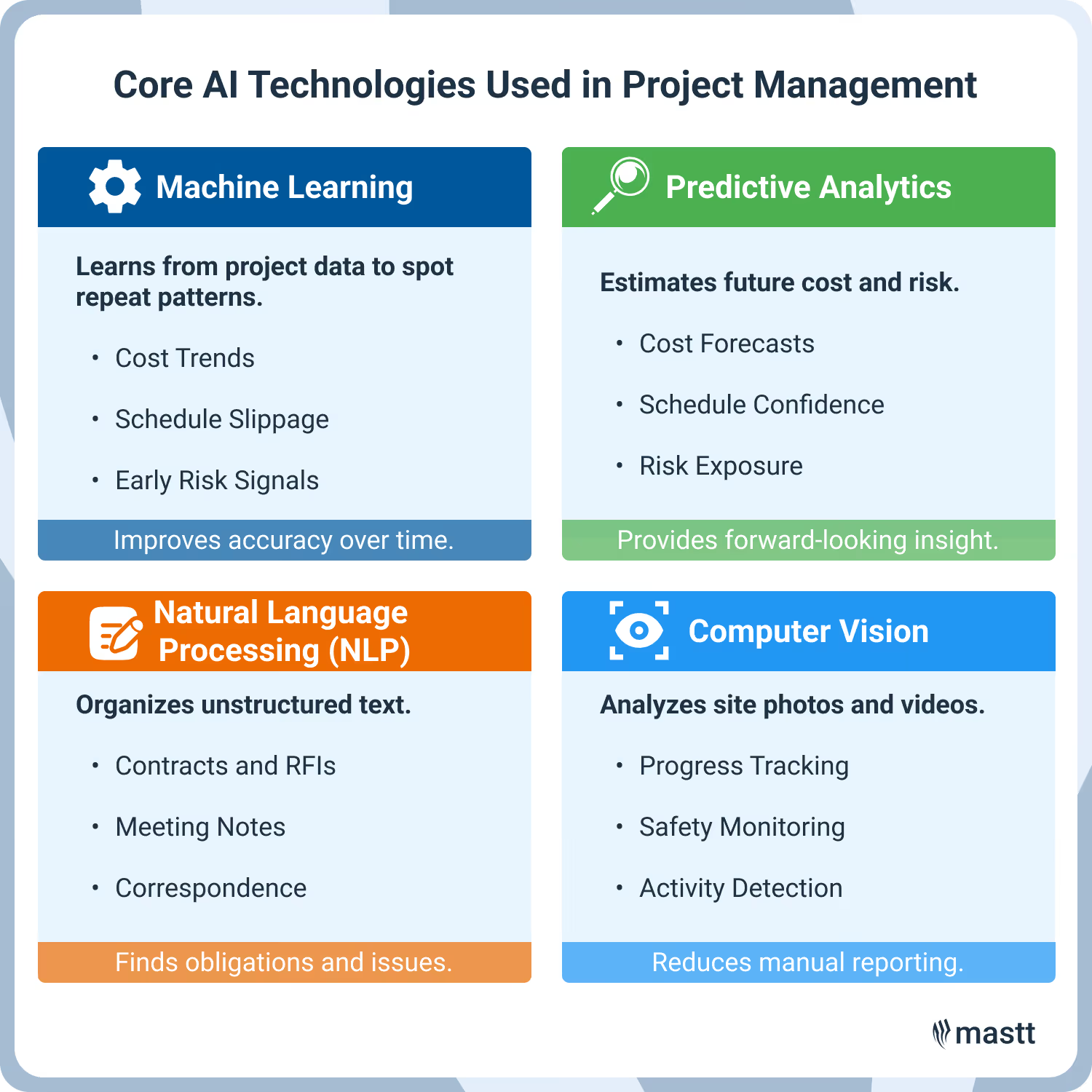
AI tools for construction project management are built on a small group of technologies that help teams interpret data, forecast outcomes, and manage uncertainty. Each one supports a different part of the project manager’s job, from planning and forecasting to risk and information control.
Here are the key AI technologies used to support modern project management:
For project management, these technologies matter because they shift the focus from recording what happened to understanding what is likely to happen next. When connected to project controls, AI helps project managers spend less time assembling information and more time interpreting it.
💡Pro tip: AI delivers the most value when it sits inside the same system teams already use to manage cost, forecasts, and approvals. Using AI-powered capital project and program management software, like Mastt, reduces data fragmentation and avoids the common failure of AI tools operating outside core project controls.
Based on Mastt’s research on AI in construction, many project teams are already using AI across active project management workflows. In practice, AI is supporting projects from early planning through closeout by improving foresight, coordination, and control.
AI’s role changes as the project progresses, shifting from testing assumptions to monitoring execution and validating outcomes. AI adds the most value when it informs decisions already being made rather than creating new processes. Project teams remain responsible for judgment and action, while AI improves timing and clarity.
The most effective way to bring AI into project management is to embed it into existing planning, forecasting, and governance routines. Teams start with one decision that matters, stabilize the data behind it, and use AI alongside current controls until the insight proves reliable.
AI delivers value when it targets recurring problems that affect commercial outcomes. Look for patterns like late cost visibility, schedule drift, or risk emerging too close to decision points. If the issue comes from missing insight rather than weak process discipline, AI is likely a good fit.
AI works with the data structure already in place, so consistency matters more than volume. Cost codes, work breakdown structures, schedules, and reporting periods need to line up well enough to tell a coherent story. Clear data ownership and update cadence prevent conflicting signals and loss of trust.
Limiting scope reduces disruption and builds confidence. Start with a single application, such as construction cost forecasting or schedule risk analysis, where outcomes can be measured against known benchmarks. Expanding too early across multiple controls dilutes value and confuses teams.
Parallel use allows teams to compare AI insight with current assessments without changing accountability. Differences between outputs highlight data gaps, blind spots, or contexts that the system does not yet understand. This comparison phase is where trust is earned, not assumed.
AI changes how information is consumed, not who makes decisions. Project teams need to understand probability ranges, trend direction, and confidence levels rather than focus on single numbers. Questioning outputs strengthens judgment and prevents overreliance.
AI signals need ownership to be useful. Define who reviews them, what triggers escalation, and how actions are documented. Transparency ensures AI-informed decisions can be explained to executives, auditors, and owners.
Scaling works best across projects with comparable scope, delivery models, and reporting structures. Lessons from early use should improve data quality and workflows before broader rollout. Portfolio-level insight only adds value once project teams trust the signals.
AI capability evolves with the project environment. Track forecast accuracy, signal timing, and decision impact, then adjust inputs and thresholds as conditions change. Treat AI as an ongoing management capability, not a one-time deployment.
AI adds value when it becomes part of how projects are reviewed and steered. Over time, consistent use sharpens judgment and improves confidence in both the data and the decisions that follow.
AI is shifting project management from retrospective control to forward-looking decision-making. As predictive insight becomes standard, decisions will be made earlier and with clearer tradeoffs. The biggest change is how confidently teams can act before issues become locked in.
These changes depend on how well AI is tied into governance and decision-making. When insight feeds directly into forecast reviews, planning cycles, and executive conversations, teams act sooner and with more confidence. Over time, this raises the baseline for what “good project management” looks like across the industry.

AI can strengthen project management, but it also introduces new risks when applied without discipline. Most failures come from poor data, weak governance, or misplaced trust in outputs. The safest approach treats AI as decision support with clear limits and ownership.
The most effective use of AI in project management follows a clear set of practical practices. These focus on how AI insight is applied in decisions, how it is challenged, and how accountability is maintained. Teams that follow these practices get value without losing control of the project.
✅ Anchor AI insight to specific project management decisions: Use AI to support defined decisions such as forecast revisions, recovery planning, or scope prioritization. Insight without a decision context quickly becomes noise.
✅ Preserve the project manager’s narrative: AI should inform the story of the project, not replace it. Project managers should translate AI signals into clear explanations that connect cost, schedule, risk, and scope for stakeholders.
✅ Use AI to test assumptions, not confirm comfort: Treat AI as a way to challenge optimistic plans or long-held beliefs. Its value often shows up when it disagrees with the team’s initial view.
✅ Balance AI insight with field intelligence: Project management decisions improve when AI signals are weighed alongside superintendent input and site observations. Neither should stand alone.
✅ Focus AI attention on turning points, not steady state: AI adds the most value when projects are changing direction, entering new phases, or absorbing disruption. Avoid overusing it when conditions are stable.
✅ Keep AI discussions forward-looking: Frame conversations around what may happen next and what options remain, rather than why past performance missed targets. This keeps AI aligned with management, not explanation.
✅ Build AI into leadership routines, not technical reviews: AI insight should appear in cost meetings, schedule reviews, and governance forums, not separate analytics sessions. Project managers lead the conversation, not the system.
✅ Revisit AI relevance as project priorities shift: As scope, risk profile, or commercial exposure changes, reassess whether AI focus areas still match what matters most to the project.
These practices help project managers stay firmly in control as AI becomes more embedded. When AI strengthens clarity and timing without weakening accountability, it becomes a reliable management capability rather than a distraction.
In 2026, AI project management is maturing from experimentation into operational infrastructure. The shift is driven by owner pressure for predictability, better data availability, and hard lessons from early AI pilots that failed without governance. The real shift is in how AI is built into project work and trusted in decision-making.
Key developments that will shape AI project management in 2026 include:
1. Construction-specific AI models will replace generic project tools
Vendors and internal teams are training models on construction schedules, cost structures, delivery methods, and contract behavior rather than adapting AI built for other industries. This improves relevance and reduces false signals caused by assumptions that don’t hold on jobsites.
2. Explainability will become a baseline requirement
Research and adoption trends show that AI systems gain traction only when teams can see what drives a forecast or alert. Models increasingly surface contributing factors such as schedule logic changes, cost commitment trends, or scope movement, so decisions can be defended commercially and contractually.
3. Forecasting will overtake retrospective reporting
AI use is shifting away from summarizing past performance toward estimating likely future outcomes. This aligns with owner and lender expectations for earlier warning signals and reduces reliance on lagging indicators that limit recovery options.
4. Portfolio-level intelligence will move from optional to expected
Organizations are using AI to compare live performance across projects, regions, and delivery models. This allows leaders to identify systemic risk, weak assumptions, and recurring failure patterns while projects are still active.
5. AI will be embedded into daily project routines
Instead of standalone pilots, AI insights are feeding into regular forecast reviews, look-ahead planning, and governance meetings. This reflects a broader move toward operational use rather than innovation showcases.
6. Configuration effort will decrease as tools adapt to existing data
Newer AI systems require less manual tuning and custom rule-building. They rely more on learning from existing cost, schedule, and document structures, reducing setup friction for project teams.
7. Insight will influence decisions earlier in the lifecycle
AI signals are increasingly used during planning, sequencing, procurement strategy, and early commercial decisions rather than only during delivery. This shift has a larger impact on outcomes than late-stage intervention.
8. Governance and accountability structures will tighten
As AI influences higher-stakes decisions, organizations are formalizing ownership, escalation thresholds, and audit trails. This reflects regulatory, contractual, and executive scrutiny rather than technical necessity alone.
These changes point to a more disciplined phase of AI adoption. The emphasis is less on novelty and more on reliability, explainability, and alignment with how construction projects are governed. As a result, AI is becoming a project management capability rather than a standalone technology.

AI will not replace human project managers in construction. AI will change what the role focuses on, how decisions are made, and what skills matter most. The impact is a shift from manual control and reporting toward judgment, leadership, and accountability supported by better insight.
AI is well-suited to analytical and repeatable work that slows project teams down. It can process large volumes of data, spot patterns across cost and schedule, and surface risk earlier than manual review. These capabilities reduce time spent compiling reports, reconciling data, and chasing status updates.
Construction projects operate in imperfect conditions shaped by people, contracts, and site realities. AI cannot negotiate tradeoffs, manage stakeholders, lead teams through conflict, or take responsibility for outcomes. Judgment, context, and accountability remain human responsibilities, especially when decisions carry commercial or legal consequences.
The role is moving away from information gathering toward decision leadership. Project managers are spending less time producing reports and more time interpreting signals, testing assumptions, and acting earlier. Those who can combine domain knowledge with data-driven insight will have a clear advantage.
As AI becomes embedded in project controls, expectations around transparency and foresight will rise. Owners and executives will expect earlier warnings and clearer forecasts, not post-facto explanations. Organizations that adapt will deliver more predictable outcomes, while those that rely on reactive controls will fall behind.
🤖 AI changes the pace and quality of decision-making, not the need for leadership. Construction will continue to rely on experienced project managers who can balance data, risk, and human factors under pressure.
AI supports better decisions without replacing human accountability. It brings risk forward and sharpens forecasts, while project managers retain judgment and control. Used this way, AI strengthens existing controls instead of competing with them.
Construction project management needs AI that understands cost structures, schedules, contracts, and site realities. Generic tools miss those nuances. Grounded, industry-aware AI aligns with how construction projects actually run.
Written by
Anna Marie Goco is a Senior Content Producer at Mastt, writing for cost estimators, cost engineers, project managers, and owner's representatives. She has completed TAFE NSW short courses in construction contract administration and project management, and holds Google's Foundations of Digital Marketing and E-commerce certificate.


Contributions from

Cut the stress of showing up unprepared
Start for FreeTrusted by the bold, the brave, and the brilliant to deliver the future