.avif)
Post author:
Doug Vincent
Contributor:
Jamil Molinaro
Reviewed by:
Jackson Row

Construction portfolio management is how owners fund, rank and report capital projects as one set. How many projects a manager can run, and when to skip it.
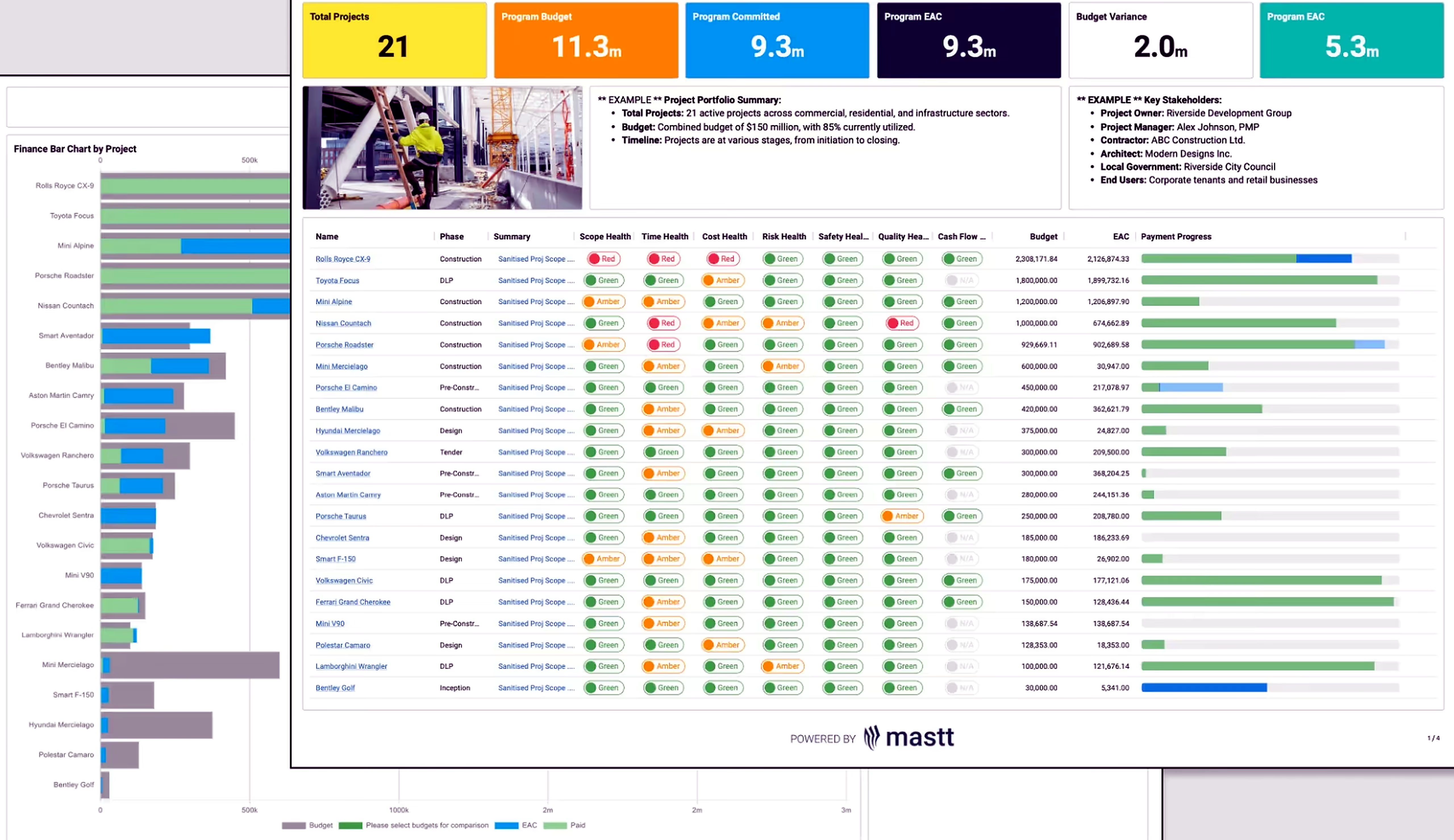
A free project portfolio management template to track budget, schedule, risk and status across every project in your program, or build it live in Mastt.

Construction portfolio management is what lets you answer "how is the whole program tracking" without building a spreadsheet first. Most organizations cannot. With five projects you get five reporting formats, and the numbers are a month old by the time the board sees them.
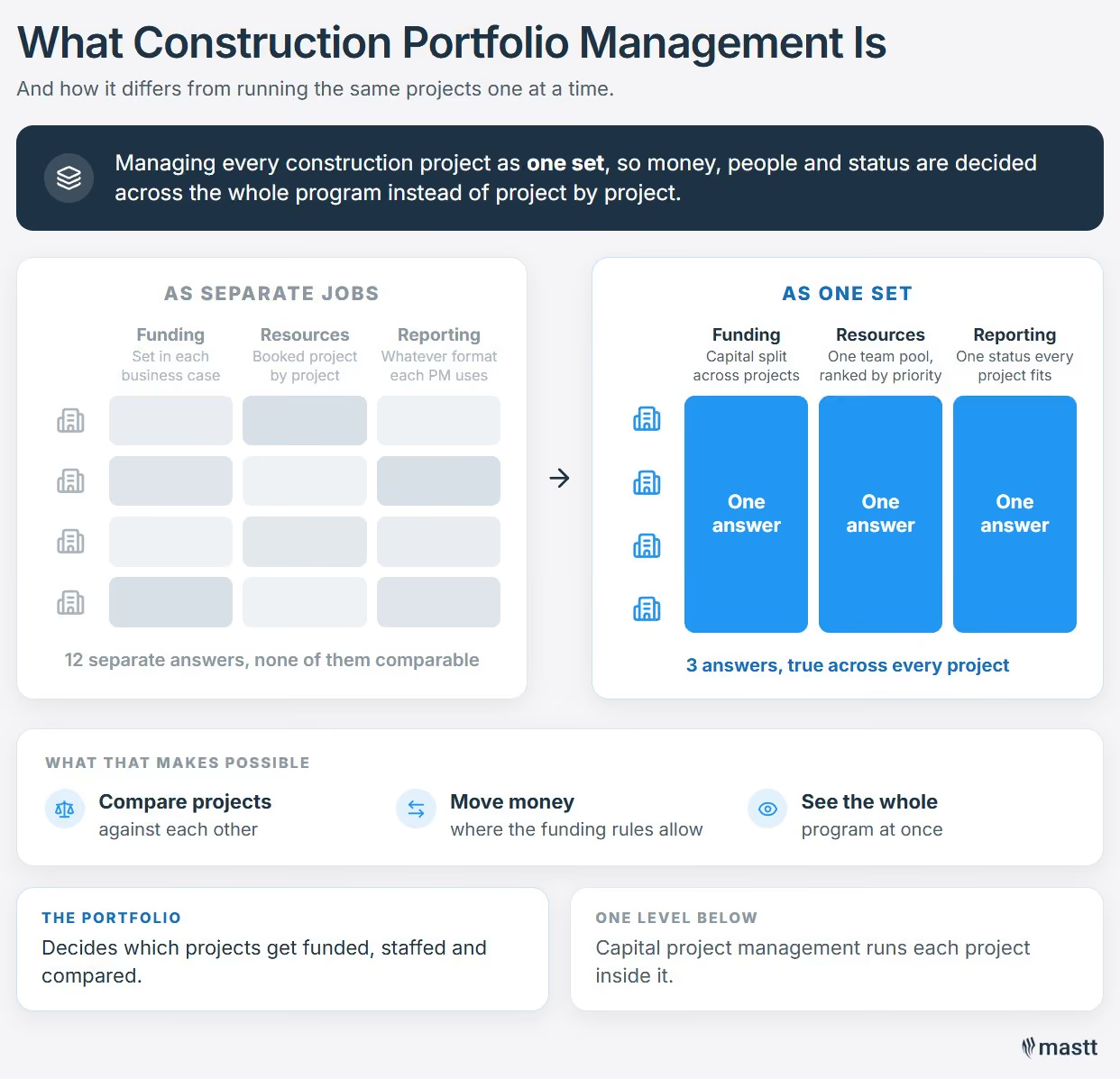
Construction portfolio management is the practice of running your construction and capital projects as one set rather than as separate jobs. Funding, resources, and reporting get decided across the whole group, so you can compare projects, move money where the rules allow, and see the whole program at once.
The portfolio is a group of buildings, renovations, tenant improvements, and capital projects that one organization owns or is delivering. It sits one level above capital project management, which runs the individual projects inside it.
Capital project portfolio management is the same discipline under a different name. Public agencies usually call it a capital improvement program (CIP), universities and health systems tend to say capital planning, and corporates say portfolio or program. The vocabulary changes by sector but the decisions do not.
Project management delivers one project to time, cost, and quality. Program management coordinates related projects toward a single outcome. The portfolio layer above them decides which projects exist at all.
A program delivers one outcome through several projects, such as a hospital campus built in four packages, and the project manager and program manager roles split along the same line. A portfolio is everything you are funding, related or not. For the day-to-day layer beneath both, see our guide to multiple project management.
A construction portfolio manager decides which construction and capital projects run, in what order, and funded to what level. The role does not deliver the work. It owns these decisions:
A project manager optimizes inside a fixed scope and budget. A portfolio manager, sometimes titled project portfolio manager, director of capital projects or capital programs manager, changes the scope and budget of the whole set. Outside construction the same title means an investment role managing financial assets, and the two jobs share little beyond the word.

You need portfolio management once your construction projects compete for the same money, people, or approvals and nobody owns the trade-off. Running several projects at once does not create a portfolio on its own.
Each of these means portfolio decisions are already being made, just not by anyone who owns them:
Construction portfolio management costs more than it returns when there is nothing to trade off. That is the case when several of these hold at once:
Lorne McClurg directs Moto Projects and spent six years chairing a school's capital works subcommittee. On software specifically, he does not think most owners clear the bar:
"Really big, complex programs of projects, maybe, but you know, individual standalone projects, not so sure that the value is there in it."
- Lorne McClurg, Director, Moto Projects
He is talking about software, and the same arithmetic governs the process around it. On a single project the overhead has nowhere to amortize. The reporting format, the definitions, and the tooling all get built once and used once. Across a program where two projects want the same quarter's cash, that overhead spreads across every project and starts to pay.
The order below matters. Start with a reconciled list of what you have already committed to, because every decision after it depends on that list being right.
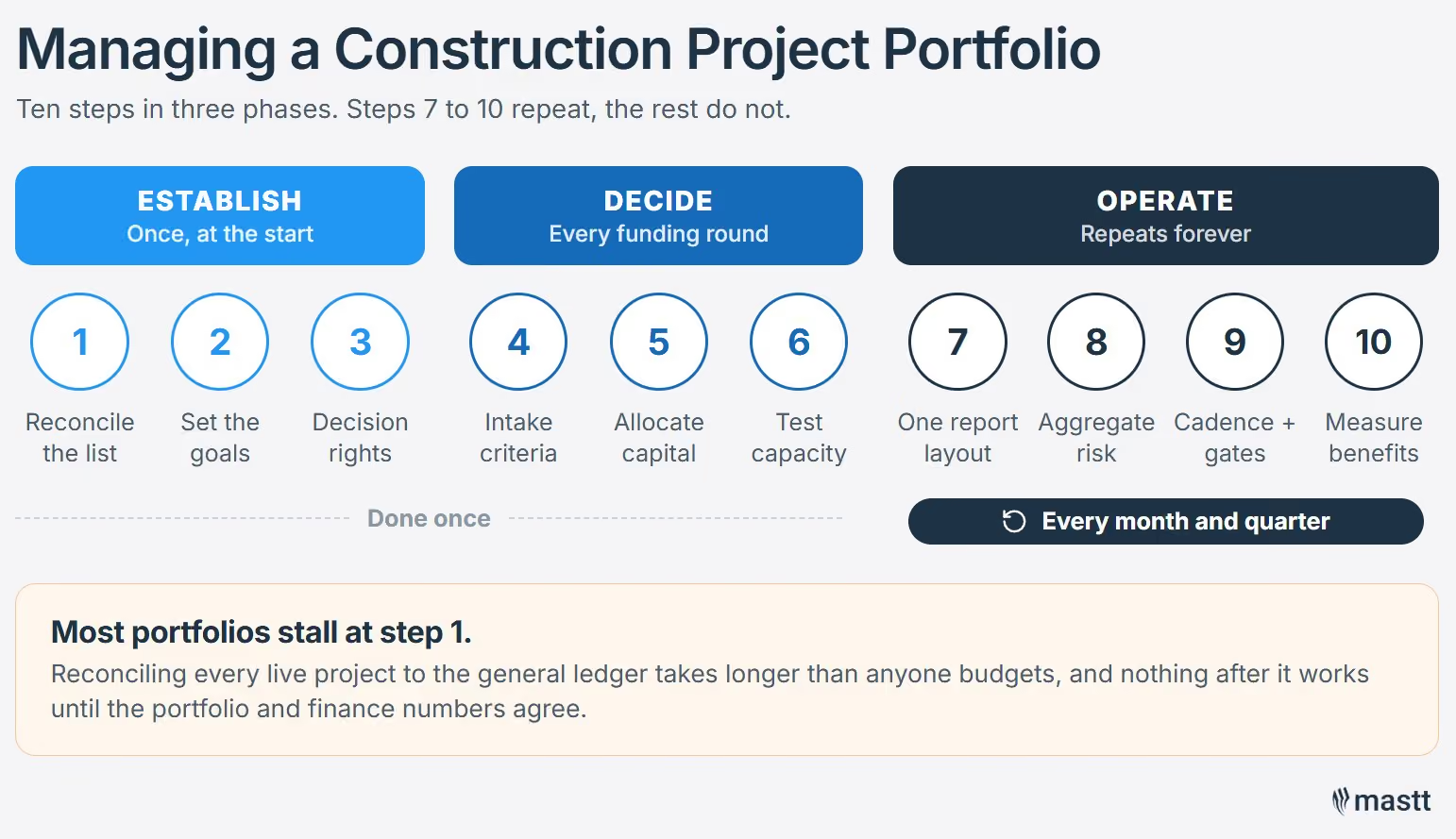
Produce one list of every live project with approved budget, commitment, spend to date, and forecast final cost, reconciled to the general ledger. Most organizations discover they cannot, and that discovery is the real first week of work.
Expect the reconciliation to disagree with finance, and chase down why. Until the portfolio number and the finance number agree, neither gets believed, and nothing in the following nine steps works on a project list you cannot vouch for.
Write down three to five objectives for the portfolio, each with a measure and a target date, signed by whoever owns the capital budget. Growth, regulatory compliance, asset renewal, decarbonization and service capacity are the usual candidates.
Objectives come before criteria, because without them every scoring argument becomes a preference argument. Test each one by asking whether it can separate two projects. If every project scores the same against an objective, it will not help you choose between them.
Set the horizon long. The Government Finance Officers Association (GFOA) recommends a capital plan covering five to 25 years or more.
Someone has to be able to approve each recurring capital decision alone, someone else has to be told, and something has to force a decision upward. Write down which is which, because that is what portfolio governance means.
A monthly meeting on its own gives nobody the authority to decide anything. And criteria written by someone without the authority to apply them get overridden by month two, which is why decision rights come before intake. Our project governance guide covers how to document them.
Map this onto whatever delegation instrument already exists. In government, health, and education those limits are set by statute or by the board's own delegation policy. A parallel capital ladder that conflicts with them will get picked up in audit.
Write the escalation triggers as tolerance breaches, not dollar limits alone:
A capital committee oversees and tests work against the plan. Once it starts directing the work it cannot hold anyone to account for it, because it has become part of the decision.
Publish the test a project must pass before entering the portfolio, and publish what it has to submit:
Legally mandated work does not get scored. Code compliance, consent decrees, Americans with Disabilities Act (ADA) transition obligations and court orders get funded first. The remainder gets ranked on GFOA's hierarchy: health and safety, then asset preservation, then service or asset expansion.
Committed projects consume next year's envelope first, often 80% or more of it, so the discretionary money you are ranking is a fraction of the headline number. And dividing benefit by cost starves large strategic projects, which is why Virginia's SMART SCALE scores within separate funding buckets rather than across one list.
A project portfolio management example, on a small municipal portfolio, with illustrative numbers:
The depot roof and the fire system score identically until cost enters. Health warnings on any scoring model:
Build one view of the whole envelope, meaning every dollar the portfolio can spend this period, then tag each one to its funding source and the restrictions that source carries. Those restrictions are legal, not administrative preferences:
Restricted money also carries an evidence burden. The Association of Independent Schools of New South Wales administers state and federal capital grants for more than 200 independent schools. It cannot release the next tranche to any of them without current data on commitments and payments.
So maintain a funding-source matrix recording which money can move where, at what approval level, and what happens to unspent balances at year end. Hold an unallocated line inside each restricted source, plus a discretionary pot in unrestricted money that can absorb surprises without a budget amendment.
Holding contingency at portfolio level is the part a CFO will ask you to justify. Because project risks are only partly correlated, the portfolio needs less contingency than the sum of the projects. Escalation, single-contractor concentration and single-funder dependency are the exceptions, and those add up rather than offset.
Give the portfolio owner authority to draw on the pot through change control, require project contingency to fall as risk retires, and hold escalation separately.

Owners test the money hard and the capacity barely at all. The budget is rarely what stops a capital program. The team, the market and the possession windows are. Approving 40 projects into a year when your team can run 25 and the local market can bid 30 produces underspend, rushed awards, and a price premium.
Test each year's program against the things that actually run out: internal project management capacity, consultant availability, contractor market depth, decant and possession windows, and user-group availability. In health and education the binding constraint is usually possession. Whether the ward can be emptied or the building vacated in the window available is what sets the year's program.
An underspent capital program is a governance failure as much as an overspent one, and nobody writes a report about it.
Every project reports the same fields, on the same cut-off date, using the same definitions. Fix those definitions in writing before anyone reports anything, because these five are where portfolios lose comparability:
Standardize only what has to be compared. Put a $200,000 tenant improvement through the same reporting pack as a $40 million build and people will fill it in badly. They are right that it does not matter.
Build every layer from one data set, and give each audience only what it decides on. A project portfolio dashboard is the usual top layer:
Add a grouping layer wherever money is actually controlled. Carrollton-Farmers Branch Independent School District in Texas runs a $716.4 million bond program across four voter-approved categories, and reports at that category level as well as by project. Its director of facilities and project management, Lelia Goehring, puts the value of the middle layer simply:
"Being able to look at how we're spending within a package, instead of just at individual projects, has been very beneficial."
- Lelia Goehring, Carrollton-Farmers Branch ISD, a Mastt customer
Consultancies do the same by region or by client. Whatever the grouping, the top layer carries finances, schedule and risk, and it has to work for a director who has never been to the site. Our construction reporting guide covers how to build each layer.
The worst exposures only exist above the project line, so risk gets tracked across the whole set. None of these appear on an individual project register:
Aggregation depends on the reporting standard you set in Step 7. Registers scored on different scales cannot be added together, and a portfolio risk view built from incompatible inputs will mislead you. Interdependency between projects only becomes visible above the project line.
The cadence is monthly, quarterly and annually, with a gate wherever the next tranche of money is committed.
Each one has to produce a decision:
Gates are the part most portfolios skip. At feasibility, design, procurement and construction award, the stage gate process re-tests the project against the criteria that admitted it. Cost, benefit and risk are all better understood by then, and any of them may now fail.
Above a value or risk threshold, have someone independent of the delivery team run the review. Without gates, all you get is a monthly report telling you a project is going wrong after it already has.
Hold a small set of delivery measures across every project. CII recommends fixing the result areas first and hanging metrics beneath each. Cover cost and cash flow, schedule, safety and environment, change and scope, procurement and resourcing, and quality and risk.
Then read the spread, not just the portfolio total. The Government Accountability Office (GAO) assessed NASA's major projects in July 2026. Three of the eighteen projects in development reported an overrun that year, totaling $501 million. Cumulative overruns across the portfolio stand at nearly $4.7 billion, and the Orion crew capsule alone carries almost 75% of that.
Those are spacecraft, but the shape is the same on a school building program. Report your outliers by name next to the total.
Delivery measures only tell you how well you built things. Twelve months after handover, test each completed project against the objective that funded it. Without that check nobody ever establishes whether the money bought what it was approved to buy.
Published owner-side loads run from 13 to 26 projects per manager, and every organization that reported one also said it was too high. The only targets anyone publishes are 12, and seven to 10. Nobody publishes a defensible number, so that gap is what you have to work with.
No construction-sector benchmark exists, and the three published figures do not measure the same thing as each other.
Washington State DES publishes its figure because a statute requires it to, and assessed its own position bluntly. Project managers averaged "less than two hours per project per week, which is not enough to ensure project success." None of the three sources counts a project the same way, so do not average them.
Project count on its own is a poor unit of workload. Track these alongside it:
Supervision is the variable that explains the high figures. Owners carrying more than 15 per head are typically running client representatives overseeing external project management firms, not managers delivering the work themselves. CARAS reports on more than 70 projects on that model.
Most of the damage is done at approval, before anyone has poured concrete, and the reasons capital projects fail repeat across portfolios. Optimism bias has the most evidence behind it.
Projects enter understated because understating them is how they clear the approval threshold, and then they grow, with cost overruns running to nine megaprojects in ten. Fund on a risk-adjusted number, and check new estimates against what comparable completed projects actually cost.
The rest shows up in the reporting. Status labels drift green because nobody wants their project to be the red one. Reviewing major programmes, Britain's National Audit Office warned that pressure on sponsor and delivery bodies can "allow a 'good news' culture to develop."
Stale data does the same damage more quietly. Jacobs delivers roughly $4.7 billion of capital works across more than 40 Australian defence projects. Its reports were routinely 60 to 90 days old by the time they reached portfolio executives.
The last row is where most portfolios go wrong.
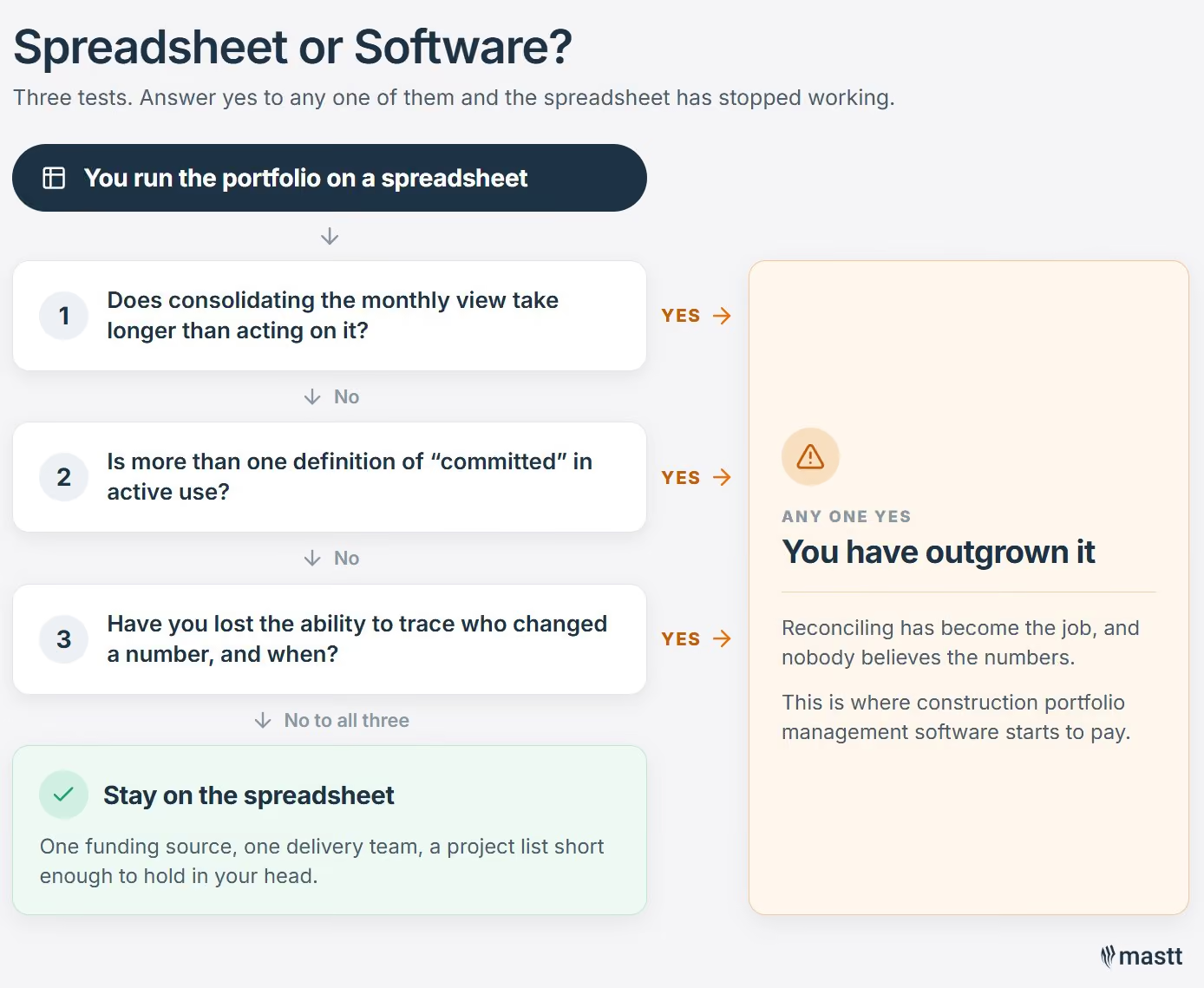
Spreadsheets hold up longer than software vendors will tell you, though spreadsheets do put a portfolio at risk past a certain size. You have crossed the line when any of these is true:
The spreadsheet loses credibility before it loses function. Once everyone can edit it and nobody can see who changed what, people start keeping their own version. Jamil Molinaro of ARO Group, a Mastt customer, described where that leads:
"That's where the trust breakdown is and it's like, well, and everyone's scrambling all the time. And so you end up living in this world of reactionary management rather than proactive."
- Jamil Molinaro, ARO Group
Past that point, portfolio management software has to do things a spreadsheet cannot:
Below that point the answer is no. One funding source, one delivery team, and a project list short enough to hold in your head does not justify a platform. Mastt sells software in this category, and that is still the honest answer.
Build the dashboards last. Our free project portfolio management template sets out the fields to standardize first, and capital project management software is where those fields end up once the definitions hold.
Start with the list. In your first month, reconcile every live project to the general ledger. Agree three to five objectives with whoever owns the capital budget, and write down who approves what. You do not need to buy anything to do any of that.
Month two is the intake test and the funding-source matrix. Month three is the reporting format and your first honest portfolio report. Gates and benefits tracking follow once the basics hold. The PPM report template gives you a structure for that first report, and capital program management software automates it once the definitions are agreed.
The practitioners quoted in this article spoke to Mastt on the record. Each conversation is available in full.
Written by
Doug Vincent is the co-founder and CEO of Mastt, the AI capital-project management platform used by governments, Fortune 500 companies, and consultancies across APAC, North America, and MENA. Before founding Mastt in 2019, he spent a decade at RPS delivering more than $2 billion in capital works, including the $2.1B Defence Navy Infrastructure program, and holds a CPSPM certification with the AIPM. He contributes content and speaks on AI in capital project delivery at Mastt.

Contributions from
Jamil Molinaro leads ARO Group as its founder and director, bringing an owner's representative approach to complex industrial and infrastructure delivery across Australia. The firm acts as Client Project Manager on major builds for Nutrien Ag Solutions, including the $70 million East Rockingham fertilizer facility in Western Australia and a new manufacturing plant in Laverton, Victoria. Jamil is featured in Mastt's ARO Group case study.

Cut the stress of showing up unprepared
Start for FreeTrusted by the bold, the brave, and the brilliant to deliver the future