

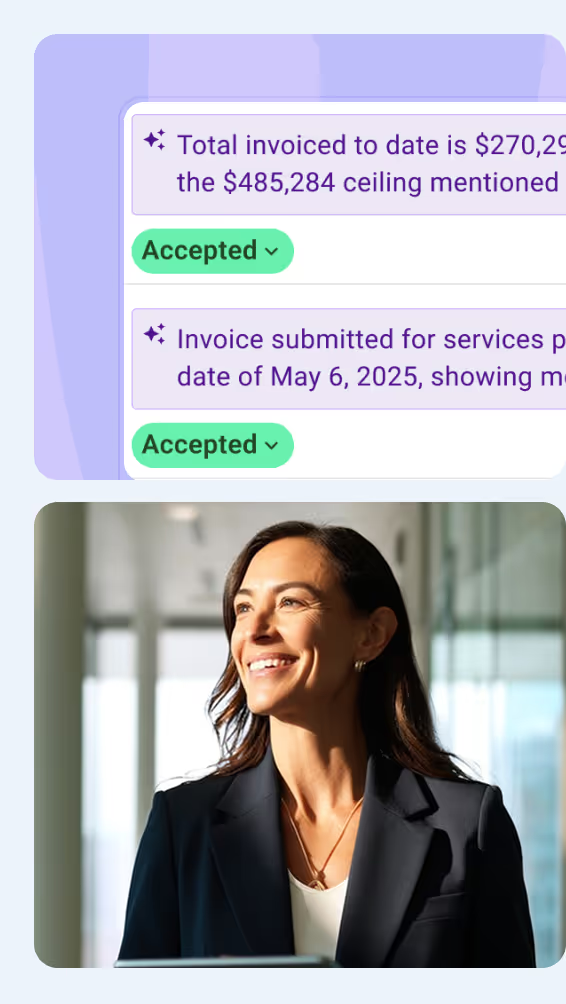



Andrew Bowden is the Auckland Regional Manager at Colliers Project Leaders with over 12 years of development experience. He oversees active developments, including 1,200 apartments and Queenstown hotel refurbishments.
In this interview, Doug Vincent (Co-founder, CEO of Mastt) asks Bowden a series of questions about how he maintains financial accuracy and controls construction costs.
How Do You Define Cost Control?
According to Bowden, project managers use cost control to ensure project expenditures stay within the authorized budget. They track actual costs against planned baselines to identify variances and mitigate financial risks. This process keeps the project viable through completion. Bowden explains:
"I think cost control is about understanding where you're at and being in your current position at all times so that you finish the project. It allows us to catch problems early and draw our attention to the things that matter so we can fix things before they become massive issues."
How Do Project Managers and Quantity Surveyors Share Cost Control?
Bowden notes that project managers and quantity surveyors divide cost management into two distinct functions. Contractual authority and financial valuation determine this split. The following table outlines their specific responsibilities.
When a contractor submits a variation/change order claim, these roles are clearly separated. The project manager reviews historical agreements to verify valid entitlement. The quantity surveyor then performs the takeoff and assigns the financial rates.
"The QS will do the value on it, the measure, and the rates, and we'll look at entitlement," Bowden explains. "It's a completely different skill set. Our role is more coordinating and making sure that there's a running history and record of what's being instructed."
Foundational Rules for Cost Control in Construction Projects
Bowden outlines specific principles that define project costs. Project managers follow these foundational rules to keep their financial tracking realistic.
1. Estimates are not budgets
An estimate is a loose prediction of building costs. A budget is a definitive baseline for tracking expenses. Project managers break budgets into distinct disciplines instead of accepting lump sums.
2. Control declines over time
The ability to influence project costs peaks during preliminary design. This leverage drops significantly once detailed design begins. Changing structural systems or facades later is rarely cost-effective.
3. Scope defines cost
Financial data requires a direct connection to physical work. Every budget line item relates to a specific site activity. Adjusting this physical scope is the primary method to generate major cost savings. Bowden emphasizes that early decisions dictate the final financial outcome. He explains:
"The influencing factors are at the very front end of design. That's the prelim design. That's when the key decisions are made."
5 Methods for Controlling Construction Project Costs
Bowden explains that construction cost control is a systematic process. It maintains project margins through financial oversight and data accuracy. These five strategies provide a framework for managing variables from procurement to project completion.
1. Establish firm baselines using budgets and contracts
Cost control starts with the transition from an estimate to a budget. An estimate predicts total spend, but a project budget tracks actual cash flow. This baseline defines how a project manager allocates funds across various disciplines.
- Defining Cost Codes: Managers break the total budget into trade-specific accounts. This prevents funds from being moved between unrelated categories like earthworks and electrical systems.
- Direct and Indirect Expenses: Direct costs represent physical materials and labor. Indirect costs include site establishment and project management salaries.
- Procurement as a Lever: Selecting contractors and signing fixed-scope agreements is the primary method for controlling costs. This stage turns an estimated price into a legal commitment.
Establishing granular budgets is the primary defense against financial overruns. Bowden observes that many projects fail to define costs by specific discipline before work begins.
"Budgets are your pre-contract value," Bowden says. "Too often, people have a lump sum for construction but haven't broken it down into the disciplines that feed the budget. Cost control starts at procurement by locking down a fixed cost for an open cost".
2. Manage scope changes through real-time forecasting
Construction is a fluid process where scope adjustments are inevitable. Maintaining an accurate view of project health requires tracking these financial shifts in real-time to prevent budget overruns.
Real-time cost forecasting eliminates financial surprises. If a forecast exceeds the budget, managers analyze uncommitted costs for savings. These future phases represent the only remaining leverage to adjust the final spend.
Undiscoverable site conditions often cause these financial shifts. Bowden points to environmental contaminants and Auckland's volcanic crevasses known as "tomos." These specific ground risks require separate contingency pools.
"The danger is the lag between the instruction and the contractor's claim being received, which can be months," Bowden explains. "Construction and changes are quite fluid, and you have to be in your current position at all times to ensure you finish the project. We use forecasting to assign budgets to instructions so decisions are not made without knowledge of the true financial extent".
3. Synchronize cash flow with operational schedules
Cash flow timing determines the viability of a construction project. Many profitable developments fail because expenses occur before the client pays for the completed work.
Project managers use cash flow forecasting to identify when the bank account requires funding. This foresight prevents the need for high-interest loans or emergency capital contributions during the construction phase.
"Cash is king in construction," Bowden states. "Lots of contractors have run into serious problems on profitable jobs because they are incurring their costs way before they are billing their clients for the work. Understanding when you are actually paying your bills is absolutely essential to tracking your costs incurred."
4. Use data visualization to drive financial accountability
Reporting is necessary for cost control in construction projects. Raw spreadsheets often hide the core financial message. Visual tools allow teams to identify variances before they escalate.
Integrated systems automate data transfers from contract schedules to reports. This creates a unified project record and removes manual entry errors. Visualizations drive accountability by showing the financial impact of site decisions.
"I've found nothing drives accountability in your team like budgets," Bowden explains. "If your team members have budgets they're working to, they'll fundamentally make decisions that benefit the project overall budget. They'll start carefully paying attention to what they're spending."
5. Automate administrative workflows with artificial intelligence
Contract administration requires the consolidation of data from emails and isolated software platforms. Bowden uses Gemini Enterprise to surface relevant information from these fragmented systems.
- Extracts baseline documents from project archives.
- Identifies historical agreements and contractual tags.
- Matches contractor questions with consultant advice.
- Generates formal instructions using this collected context.
This automation removes manual data entry and tedious schedule updates. Teams redirect this saved time toward direct client interaction. Bowden states:
"If people can focus their time on that human input phase... the whole saving PDFs and reconciling information on schedules... should be redundant process."
How Mastt Simplifies Construction Cost Control
Bowden relies on a unified platform to manage project finances. Mastt’s construction project cost management software consolidates data to maintain an accurate financial record.
- Single Source of Truth: Mastt stores change instructions and payment claims in one central location. This setup eliminates disconnected spreadsheets.
- Data Integrity: Users cannot easily manipulate data in Mastt. The software displays the actual cost rather than an adjusted reporting figure.
- Pre-emptive Budgeting: Project managers assign temporary budgets to instructions immediately. This action occurs before the contractor submits a formal claim/payment application.
- Consultant Management: The software tracks agreements for project consultants alongside the main contractor. This keeps all expenses in the same view.
Centralization reduces the risk of fragmented records. Oversight ensures that decisions are based on verified, real-time information.
"For us, Mastt allows us to have a single source of truth as all the costs of instructions are one centralized location," Bowden explains. "Because it is not an Excel file, it can't be manipulated to make a number. It pulls through the true cost."
Achieving Efficiency in Construction Cost Optimization
Cost optimization requires the continuous alignment of site activities with financial baselines. By maintaining a connection between the budget and the physical build, project managers shift to proactive leadership. This discipline creates a culture of accountability where teams weigh every decision against its financial impact.
Bowden concludes that the primary goal of this system is to ensure the final spend remains under the original plan. He states:
"At its simplest, construction cost control is about making sure we spend less than what we plan to. It allows us to catch problems early and draw our attention to the things that matter so we can fix things before they become massive issues."
.avif)
Written by
Doug Vincent
Doug Vincent is the co-founder and CEO of Mastt, the AI capital-project management platform used by governments, Fortune 500 companies, and consultancies across APAC, North America, and MENA. Before founding Mastt in 2019, he spent a decade at RPS delivering more than $2 billion in capital works, including the $2.1B Defence Navy Infrastructure program, and holds a CPSPM certification with the AIPM. He contributes content and speaks on AI in capital project delivery at Mastt.


Contributions by
Andrew Bowden
Andrew Bowden is Auckland Regional Manager at Colliers Project Leaders, with 18 years delivering residential and commercial projects across Auckland. He led the project management team on the award-winning Hiwa Recreation Center, which won the 2025 Property Council NZ Supreme Excellence Award. He contributes to Mastt content with his expertise in project delivery, procurement, and contract management.
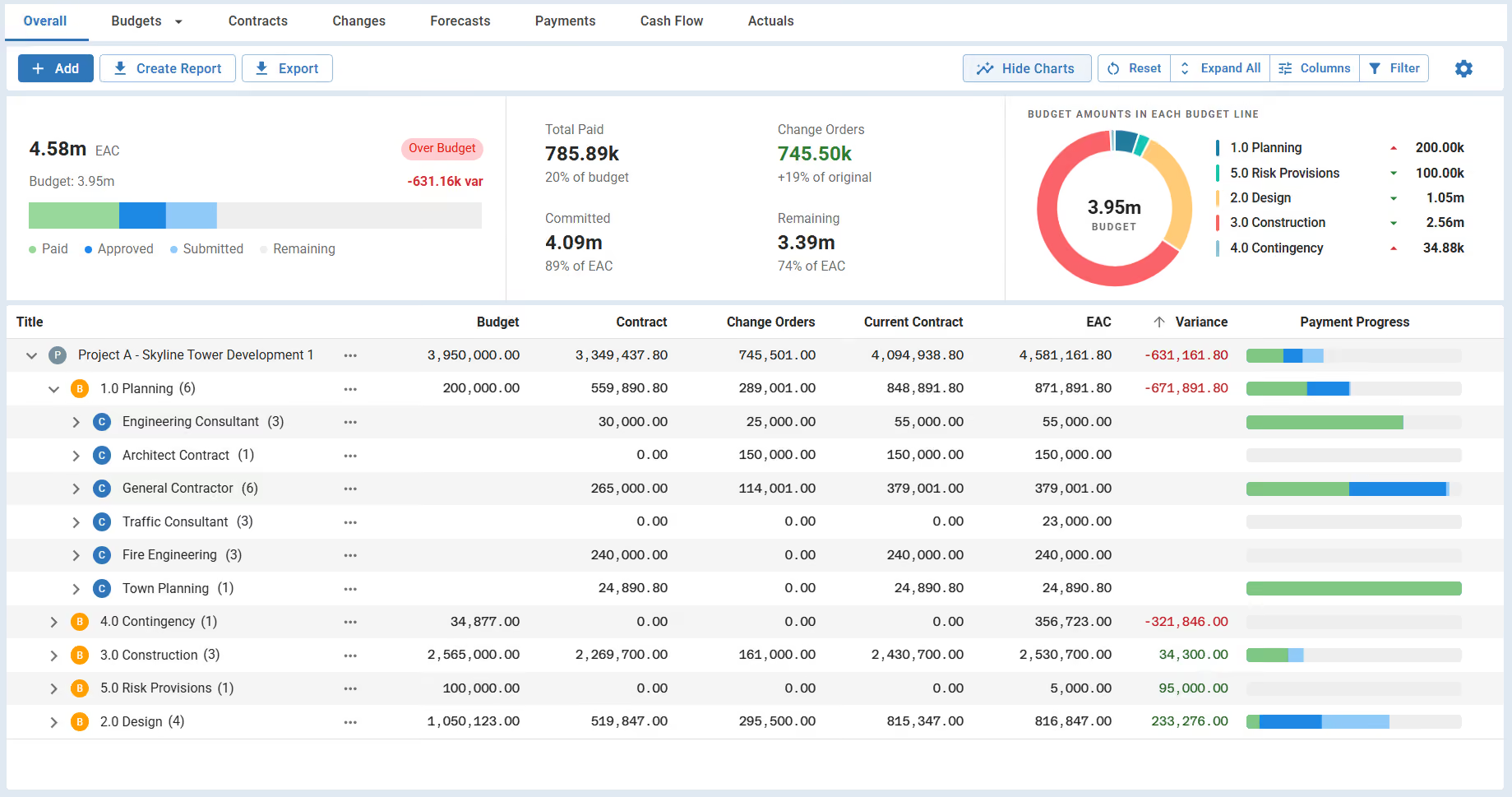
Construction Cost Tracker
Use this FREE Construction Cost Tracker Template to monitor budgets, actuals, and cost variances. Track contracts, change orders, EAC, and payment progress for better cost control across your project.

Walk Into Every Meeting With Confidence, Clarity, and Control
No one wants to look unprepared, blindsided, or uncertain in front of stakeholders — but that’s exactly what happens without Mastt.
Start for FreeTrusted by the bold, the brave, and the brilliant across governments, Fortune 500s, and the world’s best in delivering the future

![Variance Analysis: Calculate, Track, Report [Free Calculator]](https://cdn.prod.website-files.com/607f739c92f9cf647516b37b/6791d8c7fe4182e7da5d7143_variance-analysis-calculate-track-report.avif)
