
Post author:
Jackson Row

Cost control in construction is the practice of keeping project costs within budget. Learn key strategies, KPIs, roles, challenges, and tools.
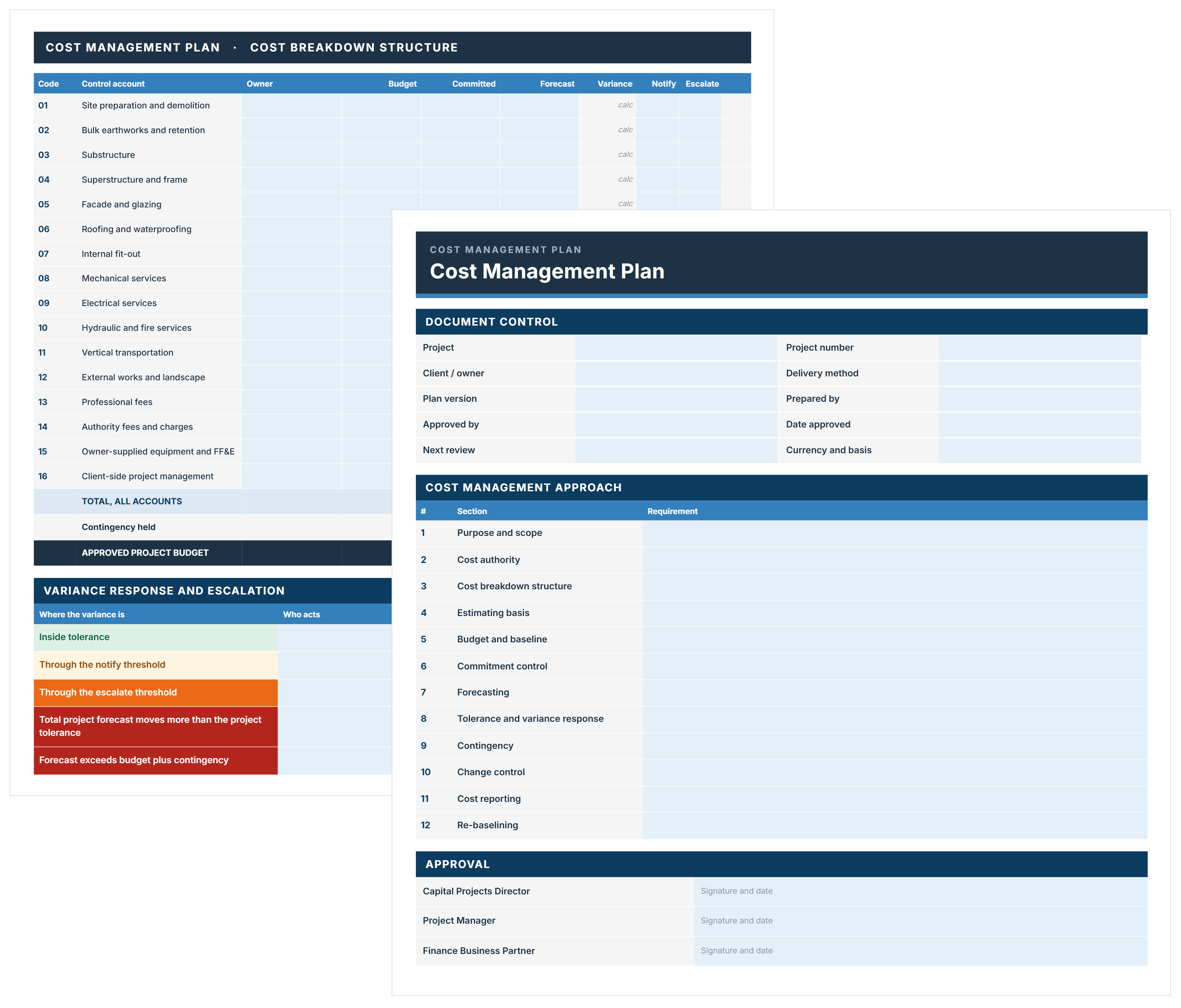
FREE project cost management template in Excel. Set the cost management plan, the control accounts, and the tolerances that trigger escalation, then track against it.
Cost control in construction is the method of tracking, managing, and adjusting project expenses to stay within an approved budget. It is a critical function for project managers and financial teams who need to protect profit margins and ensure project viability.
This guide will walk you through the end-to-end process of controlling costs. You will learn how to set a baseline budget, manage change orders, and track key performance indicators effectively.
Cost control in construction is the active management of project expenses against a baseline budget to ensure financial viability. It involves forecasting, tracking real-time costs, and taking corrective action when project variances occur. This ongoing practice prevents budget overruns and protects project profit margins.
The process applies across the entire project lifecycle. It requires strict monitoring of labor, materials, subcontractor payouts, and equipment costs. To be effective, teams must bridge the gap between field operations and back-office accounting.

Cost control protects project profit margins and ensures financial viability. It provides real-time visibility into spending, so managers can correct cost deviations early. Active management limits overall financial exposure.
Implementing a strict cost framework delivers four primary benefits.
Transparent cost reporting builds direct trust with project owners. Stakeholders receive accurate predictions of final costs instead of late financial surprises. This operational visibility drives daily accountability across the project team.
Cost tracking is the reactive process of gathering and recording financial data. Cost control is the proactive process of acting on that data to keep the project on budget. Tracking creates an accurate historical record, while control dictates future spending decisions.
For example, a concrete pour requires more material than initially planned. Cost tracking simply logs the extra supplier invoice. Cost control analyzes the recorded variance immediately. A project manager then adjusts the remaining material forecast and tightens purchase approvals to prevent further overruns.
The four fundamentals of cost control are the budget, commitments, forecasting, and cash flow. Managing these elements shifts financial tracking from a passive accounting task to an active management strategy.
These four pillars function as a connected system. A breakdown in one area exposes the project to immediate financial risk. Strict contract enforcement fails to protect the project if poor cash flow stops site operations.
Control costs by moving from passive tracking to active management. The best strategies involve restructuring estimates, securing tight procurement terms, and forecasting with probability.
Applying these cost control technique below protects your profit margin from early procurement through project closeout:
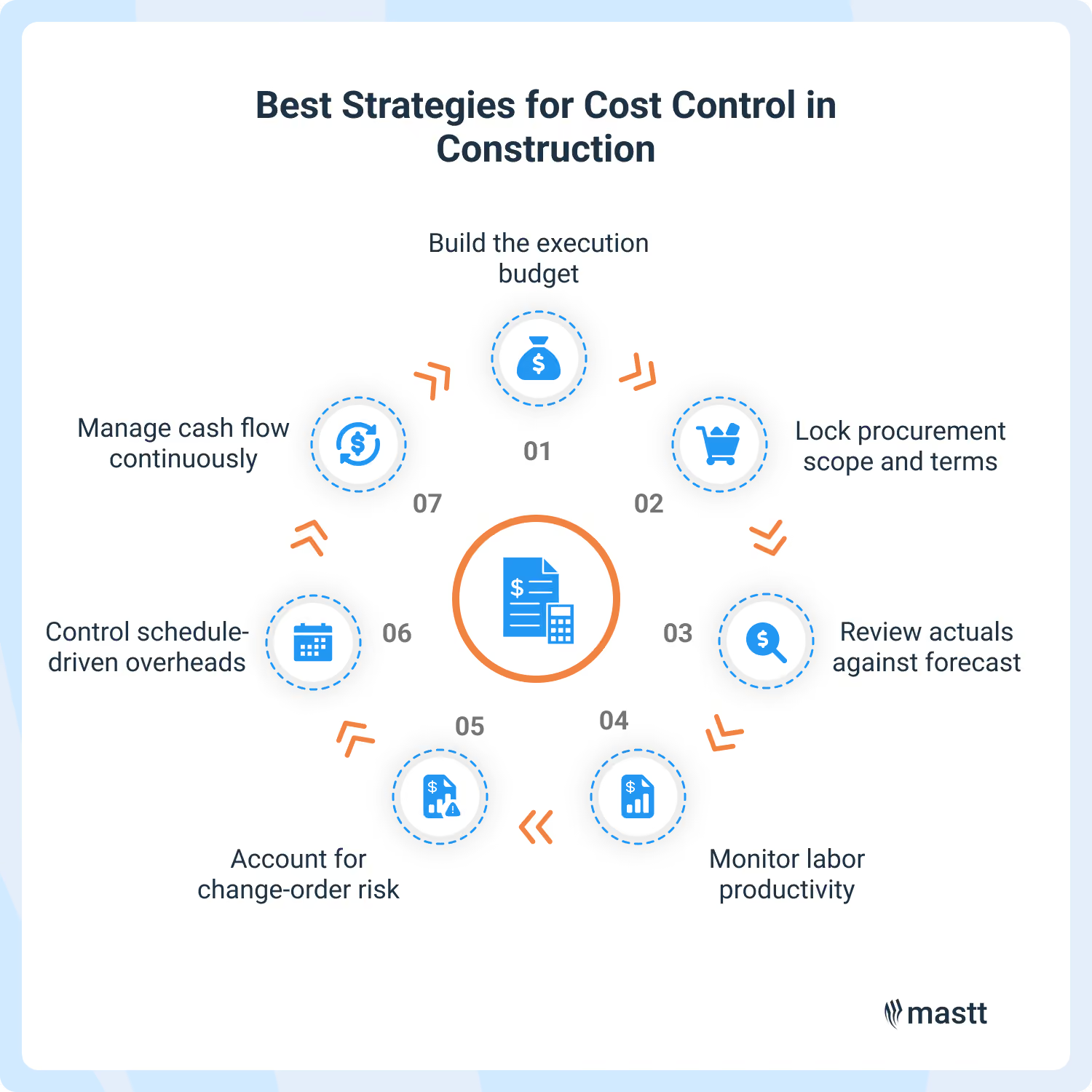
Do not simply import the estimator's baseline numbers into your tracking system. An estimate is built to predict what the project will cost, but a budget fundamentally dictates exactly how you will spend the money. Reorganize the initial estimate into specific cost codes based on how you procure subcontracts.
Procurement management is the single biggest driver you have to control project costs. Turn your project budget into binding commitments early by clearly defining the scope of work and contract terms. Eliminating scope gaps before construction begins is the most reliable way to prevent expensive change orders later.
Update the forecast monthly, or more often on complex projects, and compare actual costs, commitments, and upcoming risks against the budget. Regular review meetings help project managers catch billing errors, supply issues, scope drift, and field-driven changes before they turn into cost overruns.
Tracking labor hours against budget, progress, and output helps teams spot productivity issues early and respond before margin erodes. This is especially important when added scope, overtime, rework, or supervision changes begin to push labor costs beyond the original plan.
Refuse to authorize out-of-scope work without a priced and signed change order. Record pending change orders and likely risks in your monthly forecast using a probability percentage. This calculates an accurate FFC and exposes margin risks long before the extra work is actually complete.
Connect your project timeline directly to your indirect overhead tracking. The duration of the project directly dictates preliminary costs like project management salaries and site facility rentals. If the job runs two months late, your indirect costs will inevitably rise and burn through your contingency, even if direct construction costs remain steady.
Track exactly when you incur bills versus when you receive client payments. Profitable projects can still go bankrupt if contractors incur massive costs before billing the project owner. Map your projected spending on an S-curve template to visualize your cash position and avoid relying on expensive bank loans to fund daily operations.
💡 Pro Tip: Transfer any buyout savings into a central project contingency pool immediately. Do not leave those saved funds hidden within a specific trade's cost code, or field teams will inevitably spend them to cover minor inefficiencies.
You must track specific Key Performance Indicators (KPIs) like actual versus forecasted costs, schedule accuracy, and labor productivity to identify financial trends early. Reviewing these metrics exposes risks before they drain contingency reserves.
💡 Pro Tip: Include pending change orders in your monthly forecast at a reduced probability rate. Ignoring unapproved work artificially inflates your projected profit margin and hides immediate financial risk.
The biggest cost control challenges stem from disconnected financial data, schedule delays, and poorly defined trade boundaries. Use the table below to identify the root causes of these bottlenecks and the expert solutions required to prevent them.
You cannot prevent cost overruns if you manage active projects with outdated financial data. Eliminating these bottlenecks requires moving away from fragmented spreadsheets and adopting a unified project dashboard that links site progress directly to your financial commitments.

Project Manager is usually the main person responsible for cost control in construction. Still, it only works when project teams contribute accurate, timely data. Other roles that support cost control in construction are:
Although the project manager leads cost control, budget performance is shaped by more than the core team alone. Procurement teams and design leads can all affect cost through schedule changes, package decisions, and design development. A shared view of project data helps the team respond early and keep forecasts credible.
Construction professionals use estimating software, project management platforms, accounting systems, and financial dashboards to control project costs. Review the table below to see how different tools can help in controlling project cost.
Relying on disconnected systems forces project managers to chase data instead of managing the build. Mastt’s construction project cost management software eliminates this bottleneck by centralizing your field commitments and baseline budgets into a single live dashboard. This link gives you the visibility needed to actively control cost in your construction project.
Successful project management relies on the speed and accuracy of your financial data. You can eliminate the lag between the job site and the back office by using a single source of truth for all project commitments. Start auditing your current cost control process today to identify where manual tasks are delaying your ability to forecast accurately.
Written by
Jackson Row joined Mastt's founding North American team in 2023, implementing the platform for US government agencies and Fortune 500 organizations. He holds a Bachelor of Engineering in civil and mining engineering from UNSW and began his career as a construction cadet on civil projects in Sydney. At Mastt, he contributes articles on payment and client-side project management.


Contributions from

Cut the stress of showing up unprepared
Start for FreeTrusted by the bold, the brave, and the brilliant to deliver the future

.avif)

![Variance Analysis: Calculate, Track, Report [Free Calculator]](https://cdn.prod.website-files.com/607f739c92f9cf647516b37b/6791d8c7fe4182e7da5d7143_variance-analysis-calculate-track-report.avif)


.avif)