.avif)
Post author:
Doug Vincent
Contributor:
William Hodge
Reviewed by:
Jackson Row

Variation in construction covers contractor vs client-driven changes, AS4902 design liability, the four-implications check, and how to avoid costly redesigns.
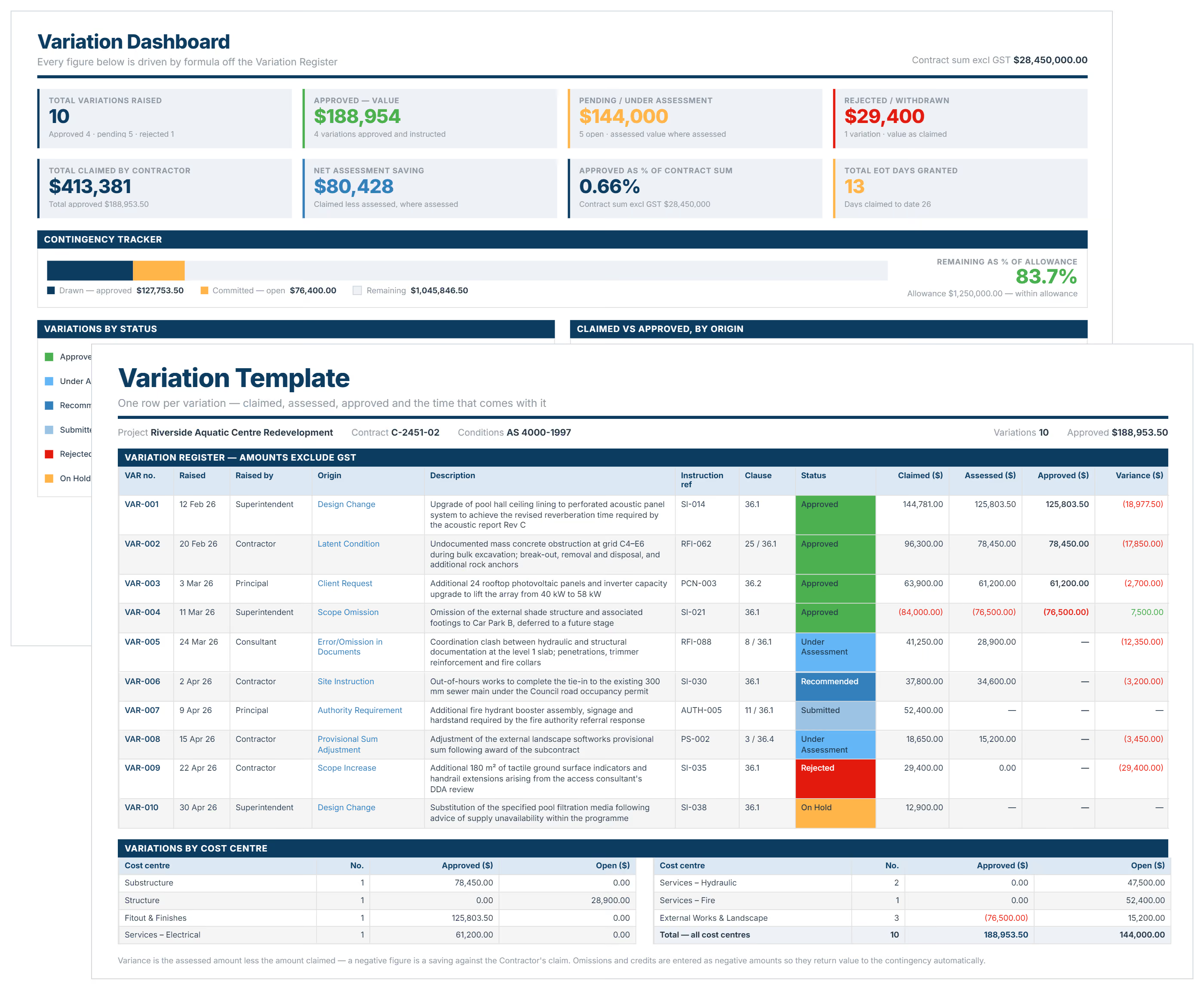
Use this variation template to standardise how contract changes are documented and approved, ensuring every adjustment to the contract sum is tracked and compliant.

No construction project runs exactly as planned. Designs change, site conditions cause surprises, and clients rethink their choices. In Australia, these contract changes are known as variations in construction.
A variation isn’t just a change to the work itself. It also includes the contractual clause that governs variations, the formal approvals, records, and supporting documents that make it official. Whether it’s a design tweak, a scope adjustment, or an unforeseen site issue, every variation must follow a structured process to keep projects on track. Effective variation management is crucial to ensuring these changes do not disrupt project timelines and budgets.
In this guide, we’ll cover:
Let’s get started.
A variation in construction refers to any alteration to the original scope of work specified in a construction contract. This includes additions, omissions, or modifications to the agreed-upon tasks or methodologies. Such changes can significantly impact the project's cost, timeline, and quality.
In Australia, the contract variation meaning doesn’t just refer to the change itself. It also includes all the approvals, paperwork, and formal processes needed to make it official.
Variations typically arise when clients request design changes, unexpected site conditions are discovered, or new regulations require adjustments. Managing them properly ensures projects stay on track and disputes are avoided.
A contract variation clause is the section of the contract that defines how scope changes get raised, priced, and approved. Every standard-form construction contract includes one, and the clause sets the rules every party has to follow when a variation comes up.
The variation clause sits in a different section depending on the contract form, but the four most common Australian standard contracts and international standards put it in predictable places.
Read the variation clause for every project before construction starts. The wording dictates pricing, approval authority, and dispute outcomes for every change that follows.
A standard variation clause covers five elements that together control how scope changes move through the project.
AS4902 design-and-construct contracts include a clause that puts design liability on the contractor once they sign. This is one of the most consequential rules in Australian construction, and it shapes how every contractor-driven variation gets resolved on a D&C job.
The principle is direct. Once the contractor signs an AS4902 contract, they own the design. If a design element is not compliant with codes, standards, or regulations, the contractor has to fix it and absorb the cost. They cannot raise it as a variation against the principal.
"This is one of the AS4902 points that frustrates contractors the most. If a design is not compliant when you sign, it is on the builder to make it work, even if the original design was provided by the principal's consultant. That can lead to some pretty significant costs."
- William Hodge, Senior Project Manager at Essence Project Management
D&C contractors price their own design contingency into lump-sum bids for this reason. They are pricing the risk that something in the design will not be compliant and they will have to fix it on their own dollar.
For owners and principals, the design-liability clause is a powerful protection. For builders, it is a reason to review every line of the design brief before signing.

Variations generally fall into two main categories: positive variations and negative variations.
Positive variations add to the original project scope, increasing cost and potentially extending timelines. They usually occur when additional tasks or upgrades become necessary or when the client requests changes after construction starts.
Examples include adding an extra bedroom, upgrading kitchen fittings, or changes needed because of unexpected site conditions. Builders price positive variations based on the extra labour, materials, and subcontractor costs involved.
Negative variations involve reducing the project scope, resulting in lower overall project costs. These happen when certain parts of the planned work become unnecessary or simplified due to budget adjustments or design changes.
Common examples include removing a planned extension, choosing cheaper flooring, or simplifying architectural features. When these occur, the cost savings (labour, materials, etc.) are deducted from the contract price. Clear agreement and documentation between builder and client help avoid misunderstandings and disputes.
No matter how well a project is planned, changes happen. Some are unavoidable, like discovering unexpected site conditions. Others result from design updates or client requests. Regardless of the cause, every variation in construction affects cost, time, or both.
Here are the most common reasons variations occur in Australian construction projects:
Every construction variation is either contractor-driven or client-driven, and the distinction changes how the variation gets assessed, priced, and approved. The binary sits above the procedural mechanism because it sets the assessment process before anyone touches a number.
"There's two kinds of variations. There's contractor-driven, where they've found something they believe wasn't captured in the contract and that they need to build. The other variations are client-driven ones, which step through the process."
- William Hodge
The binary maps to four formal procedural routes. One belongs to contractor-driven variations. Three belong to client-driven variations.
A notice of variation is the contractor-driven procedural route. The contractor formally raises it when they believe work outside the contract scope has been identified. The notice includes the proposed change, the reason it is being raised, the estimated cost and time impact, and the supporting evidence.
The first question is always entitlement. Was the work already in a drawing? Was it in the design brief the contractor reviewed before signing? Did the contract specify it as a compliance item? Each answer points to a different outcome.
Under AS4902 design-and-construct contracts, the entitlement question gets sharper because the contractor owns the design once they sign. A non-compliant design is the builder's cost to fix, not a variation against the principal.
💡 Example: A contractor strikes unexpected rock during excavation that was not shown in the geotechnical report. They submit a notice of variation requesting additional time and cost to manage the unforeseen ground condition.
A variation request is the most common client-driven route. The owner issues a request when they want to change something but want pricing and impact before committing. The request asks the contractor to quote the change and confirm the time and cost effect. The owner can accept, reject, or negotiate before any work begins.
💡Example: A developer decides mid-construction to upgrade the lobby finishes from porcelain tile to natural stone. The contractor returns a quote covering material cost, additional installation hours, and a four-week stone lead time. The owner reviews the full price and program impact before any stone is ordered.
A variation order is a direct client-driven instruction to proceed. Unlike a variation request, which is optional and negotiable, a variation order is mandatory. The contractor must follow it.
Owners use variation orders when the change cannot wait for a pricing back-and-forth, usually for urgent design clarifications or compliance fixes. Cost and time impact get reconciled afterward through a separate process.
💡 Example: A site survey reveals a stormwater easement that was missed in the contract drawings. The owner issues a variation order directing the contractor to reroute the basement drainage immediately to avoid a downstream delay. Pricing and time impact get reconciled afterward under the contract's valuation provisions.
Owner-provided new information is a client-driven trigger that catches late documentation changes. A variation can be raised when the owner provides updated drawings, specifications, or site information after the contract has been signed.
If the new information changes the scope, the contractor is entitled to raise a variation. This route is common on fast-track projects where construction starts before drawings are 100% complete.
💡 Example: The council requires an updated BASIX certificate halfway through construction, adding a heat-recovery ventilation system to the design. The owner issues the revised drawings to the contractor, who then raises a variation covering the new ductwork, equipment, and re-certification work.
Variations in construction follow a structured process. This ensures that all changes are properly reviewed, approved, and documented before any work begins.
The first step is recognizing that a variation is needed. This could happen because of an unexpected site condition, a client request, a regulatory change, or a mistake in the plans. At this stage, it’s important to clearly define what is changing, why it’s necessary, and how it will impact the project.
Example: During construction, the contractor discovers that the specified flooring material is no longer available. A substitution must be made, leading to a variation.
Once a variation is identified, the responsible party must issue a formal notice. This could be a variation notice from the contractor or a variation request from the owner. The notice should outline:
Most contracts require variations to be submitted in writing within a set timeframe. Delays in notification can lead to disputes or rejection of the variation.
Next, the variation is reviewed to determine its financial and scheduling impact. The contractor typically prepares a cost estimate, breaking down material, labor, and time adjustments.
The project owner or contract administrator will then assess:
At this stage, negotiations may take place to agree on fair pricing and timeline adjustments.
Once the variation has been reviewed, the project owner or contract administrator must approve or reject it.
A clear decision at this stage helps avoid delays and uncertainty.
Proper documentation is critical to avoid disputes later. Every approved variation should be recorded in writing and stored with the contract records.
Key documents include:
Once approved and documented, the variation can be implemented. This means adjusting work schedules, material orders, and subcontractor tasks as needed.
It’s important to keep all stakeholders informed so the changes are smoothly integrated into the ongoing work.
If the variation affects the contract price, payment adjustments need to be made. This could mean:
The contract should specify how and when payment for variations is handled. Delays in processing variations can cause disputes, so it’s best to settle costs promptly.

Variation assessment runs through five sequential checks before any work proceeds. Each check exists to catch a different failure mode, and skipping any of them is how a $2,000 construction saving turns into a $90,000 redesign bill.
Confirm the variation is genuinely required before pricing it. For contractor-driven variations, run the entitlement check. Was the work already in a drawing, in the design brief, or specified in the contract? If yes, it is not a variation, it is contract scope.
For client-driven variations, confirm the change still aligns with project objectives, the program, and the budget envelope. If the answer is no, kill the variation before it gets priced.
Review the proposed change against the original scope, drawings, and specifications. The scope check answers three questions. What exactly is changing? What is staying the same? What flows on from the change into other trades, packages, or consultant inputs?
Most variation blowouts trace back to a scope check that missed a flow-on into structural, services, or compliance work.
Run every client-driven variation through the four-implications check before it gets priced. The four are cost, time, quality, and approvals. If the answer to any of them is non-trivial, the variation needs full pricing and stakeholder review before approval.
"Always ask the builder for the implications before approving a client-driven change. Even something as small as swapping a washing machine spec can affect your sustainability certification and trigger a return to council."
- William Hodge
Get the contractor to price the variation against the contract's pricing methodology, whether that is schedule of rates, fair valuation, or a pre-priced lump sum. The pricing has to cover direct construction cost, contractor overhead and margin, consultant fees for redesign, and any program delay cost.
The cost assessment needs supporting documentation. For materials and equipment, that is subcontractor quotes and supplier confirmations. For labour, it is hours and rates against the contract's preliminary breakdown. For consultant fees, it is fee proposals from the affected designers.
Variations priced without supporting evidence are the easiest to challenge at closeout, and the most likely to end in a construction payment dispute.
The time impact gets assessed separately under the contract's extension of time provisions. The test is whether the variation work sits on the critical path. If it does not, no EOT is granted, even if the work itself takes time. If it does sit on the critical path, the EOT is granted for the actual delay caused, no more.
A variation that looks like a small site change often carries a redesign bill many times larger than the construction saving. This is the most expensive blind spot for owners approving variations.
One Essence Project Management client decided late in a project to remove an internal wall. The construction saving from removing the wall was about $2,000. The structural redesign required to remove the wall safely cost $90,000.
"It ended up saving about $2,000 worth of construction costs, but it cost $90,000 to do the redesign. Those are the flow and effects of changes."
- William Hodge
The pattern repeats across project types. A change to one element cascades into structural reviews, services coordination, BCA compliance, and revised approvals. The construction cost is usually the smallest line in the variation. This is why the cost impact assessment has to capture redesign and consultant fees, not just the on-site labour and materials.
Once the cost and time impact are assessed and agreed, the variation gets formally approved by the owner or the construction superintendent under the contract. The superintendent's role on contested variations is to play it straight, holding both the builder and the owner to the contract terms regardless of pressure.
Documentation is non-negotiable. Approved variations need to be logged in the variation register with the variation number, description, agreed cost, agreed time impact, approval date, and the signature of the authorised party.
The register sits alongside the formal variation orders, the supporting cost evidence, and the EOT determinations. Variations approved by email or verbal direction without formal documentation are the single most common source of payment disputes at project closeout.
Delays are common in construction projects, and when they happen due to variations, they often lead to an Extension of Time (EOT) claim. An EOT allows a contractor more time to complete the project without facing penalties for late delivery.
An Extension of Time (EOT) is an official adjustment to the construction schedule, granting additional days or weeks beyond the original completion date. EOTs are typically allowed when delays occur due to circumstances beyond the contractor’s control.
If approved, an EOT prevents liquidated damages or penalties for late completion, ensuring the contractor is not unfairly penalised for delays caused by variations or other unforeseen issues.
Not every variation results in a time extension, but some changes have a direct impact on project timelines. EOTs are usually required when:
For example, if an owner requests a change in flooring material that takes six weeks to arrive instead of the originally planned three weeks, this could justify an EOT. Without an extension, the contractor would be unfairly held responsible for a delay caused by a variation beyond their control.
Variations are inevitable, but they don’t have to disrupt a project. A structured approach keeps costs under control, minimizes delays, and prevents disputes.
💡 Pro Tip: Stop drowning in paperwork! Mastt automates variation tracking, approvals, and documentation so you can focus on project success!
Handling variations in construction doesn’t have to be a time-consuming, paperwork-heavy process. Mastt simplifies contract variation management, making it easier to track, approve, and document changes, all in one place.
✅ Effortless Variation Management
Mastt provides a seamless way to create, track, and approve contract variations in just a few clicks. No more chasing emails or sifting through spreadsheets. Everything is stored in a centralised platform, ensuring transparency and efficiency.
✅ Automated Variation Certificates
Generating variation certificates manually can be tedious and prone to errors. With Mastt, certificates are automatically created with a single click, reducing admin work and ensuring documentation stays consistent and compliant.
✅ Integrated Tracking for Budget and Contracts
Variations can significantly impact project costs and timelines. Mastt links all variations directly to contract budgets, providing a clear view of financial changes and ensuring cost control throughout the project lifecycle.
✅ Real-Time Insights with Visual Analytics
Understanding how variations affect a project is critical for decision-making. Mastt offers automated charts and visual reports that display the financial and schedule impacts of variations, helping project teams make data-driven decisions.
Mastt transforms variation management from a manual, time-intensive task into a streamlined, automated process. Learn more at Mastt’s contract variation software.
Written by
Doug Vincent is the co-founder and CEO of Mastt, the AI capital-project management platform used by governments, Fortune 500 companies, and consultancies across APAC, North America, and MENA. Before founding Mastt in 2019, he spent a decade at RPS delivering more than $2 billion in capital works, including the $2.1B Defence Navy Infrastructure program, and holds a CPSPM certification with the AIPM. He contributes content and speaks on AI in capital project delivery at Mastt.

Contributions from
William Hodge is a Senior Project Manager at Essence Project Management with 6 years in client-side construction PM across hospitality, commercial, and build-to-rent in Sydney. He holds a Bachelor of Civil Engineering Honours Class 1 from the University of Sydney and guest lectures in UTS's Master of Project Management program. At Mastt, William contributes content on construction project management and contract administration.

Cut the stress of showing up unprepared
Start for FreeTrusted by the bold, the brave, and the brilliant to deliver the future


![What is a Variation Register? [Advanced Tips]](https://cdn.prod.website-files.com/607f739c92f9cf647516b37b/6733261c800fff249badc8f2_670dd26b12cf86723d8b78a4_What%2520is%2520a%2520Variation%2520Register_%2520%255BFree%2520template%2520%252B%2520tips%255D.avif)
![How to Track Contract Variations in Construction Projects [AUS]](https://cdn.prod.website-files.com/607f739c92f9cf647516b37b/673325d65a583e9aabf1d025_66fe0817a3d4d88d9139e2a8_How%2520to%2520track%2520Contract%2520Variations%2520like%2520a%2520pro%2520%255BExamples%2520%252B%2520Free%2520Template%255D%2520_%2520AUS.avif)