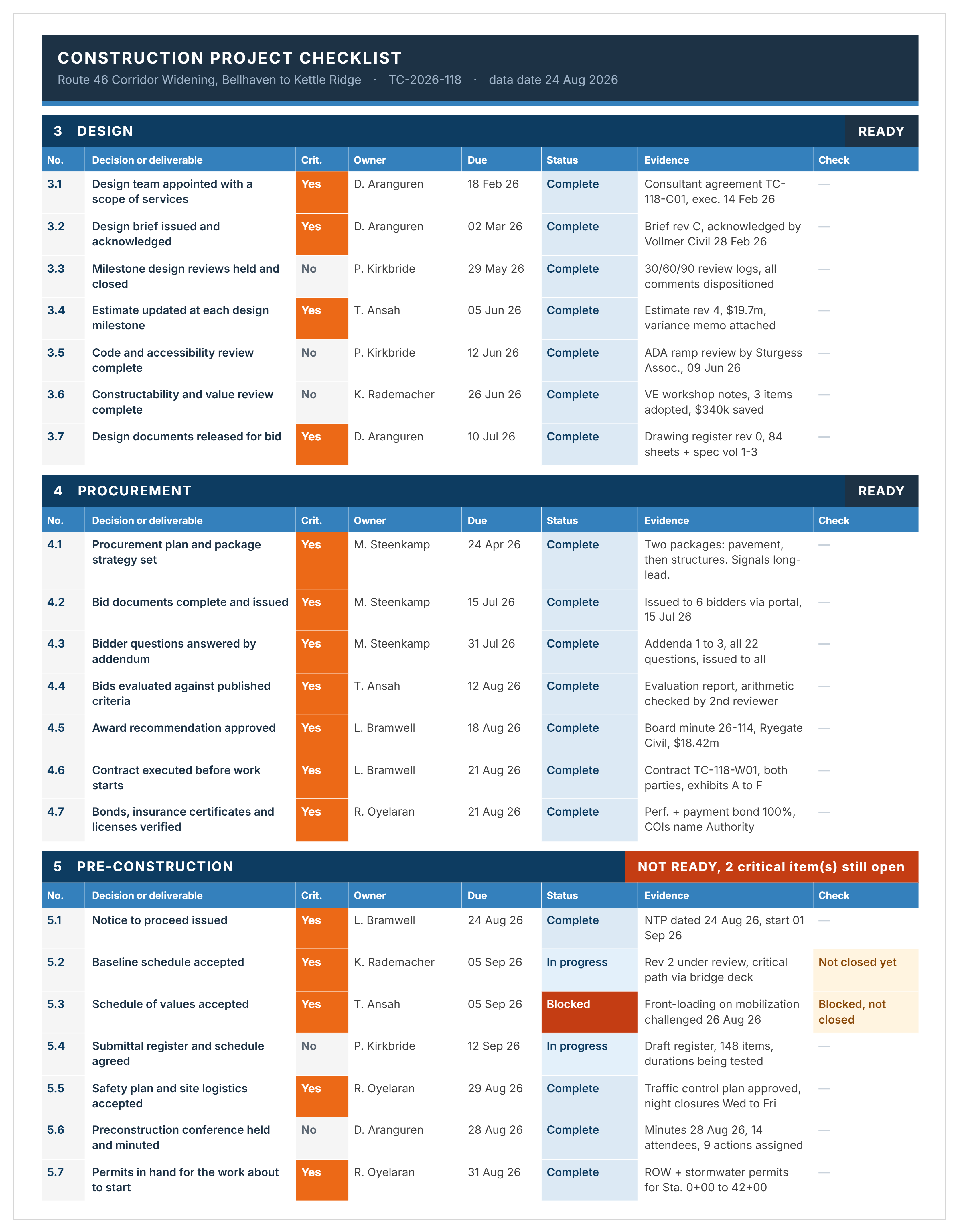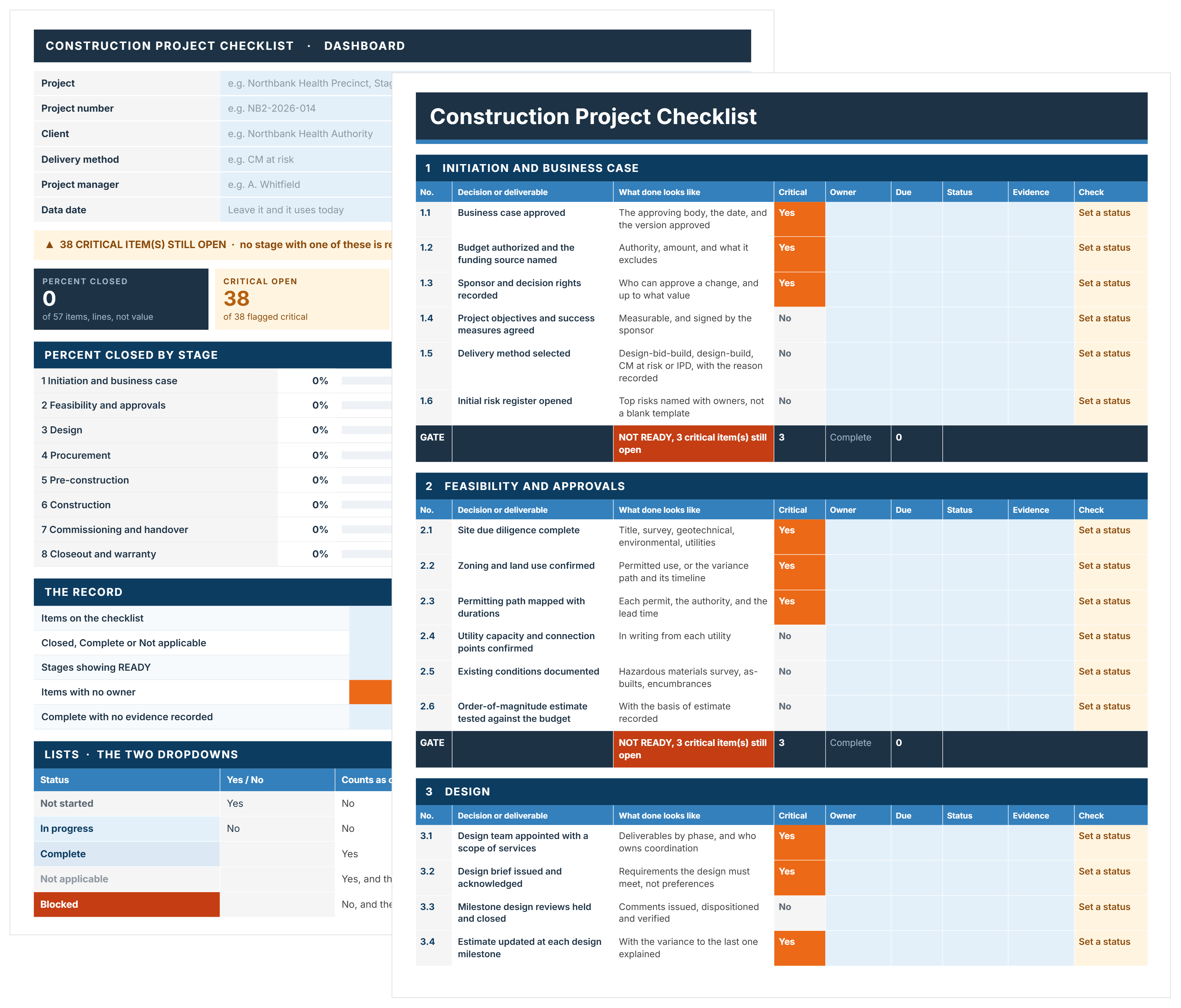
Construction project checklist template showing initiation, planning, design, and pre-construction phase task tracking
Free Template

Construction Project Checklist Template

Use this construction project checklist template to prevent costly oversights and keep teams aligned. Track critical tasks, deliverables, and approvals from planning through closeout with structured checklists.

Checklists
Word Template
Excel Template
Powerpoint Template
Construction Project Checklist Template
Template by
Jackson Row
Published:
Dec 4, 2025

What is a Construction Project Checklist Template?

A construction project checklist template is a pre-structured document listing critical tasks, deliverables, and verification points throughout project delivery. It provides consistent formatting with categories, milestones, and completion tracking fields that teams customize for specific projects.

The template organizes responsibilities across construction project planning, execution, and closeout phases. Standard sections include pre-construction requirements, procurement milestones, quality control inspections, and handover documentation.

Project managers adapt project planning frameworks to match contract requirements and delivery methods like design-build or construction management.

What's Included in Construction Project Checklist Templates?

Effective project planning checklists for construction contain comprehensive task categories spanning the complete project life cycle. The template structures accountability while maintaining flexibility for project-specific adjustments across different delivery phases.

Essential components typically found in construction project planning checklists include:

  • Project Initiation Items: Permits secured, insurance certificates verified, contract execution completed, and site access arrangements confirmed.
  • Pre-Construction Requirements: Submittals approved, materials ordered, subcontractor mobilization scheduled, and safety plans reviewed by supervisors.
  • Quality Control Points: Inspection schedules defined, testing protocols established, acceptance criteria documented, and non-conformance procedures clarified.
  • Procurement Milestones: Long-lead items identified, supplier contracts executed, delivery schedules coordinated, and material storage arranged.
  • Safety Compliance Tasks: Toolbox talks delivered, hazard assessments completed, PPE requirements communicated, and incident reporting procedures established.
  • Progress Monitoring Fields: Milestone completion dates, percentage complete tracking, schedule variance documentation, and delay cause identification.
  • Closeout Documentation: Warranty information collected, as-built drawings submitted, equipment manuals delivered, and deficiency lists resolved.
  • Financial Controls: Change order approvals tracked, payment applications verified, retainage release documented, and final account reconciliation completed.
💡 Pro Tip: Add a "Who Verified" column to your checklist instead of just checkboxes. When disputes arise later, knowing who approved that permit separates your liability from theirs.

Why Construction Projects Need Checklists

Construction project checklist prevent the coordination failures and documentation gaps that cause budget overruns and schedule delays. Systematic task tracking ensures critical requirements don't get overlooked during the complexity of multi-phase delivery.

Structured planning checklists protect project success through:

  • Prevents costly rework: Early identification of missing permits, approvals, or inspections stops work before expensive corrections become necessary.
  • Reduces schedule delays: Tracking long-lead procurement and submittal approvals ensures materials arrive when needed, preventing crew downtime.
  • Improves safety compliance: Documented verification of safety requirements demonstrates due diligence and reduces incident rates across construction activities.
  • Strengthens quality control: Systematic inspection tracking catches defects early when corrections cost labor hours instead of complete system replacements.
  • Eliminates communication gaps: Shared checklists keep owners, architects, contractors, and subcontractors aligned on progress and outstanding requirements.
  • Supports payment processing: Complete documentation of work milestones accelerates payment application reviews and reduces disputes over completed scope.
  • Facilitates handover preparation: Early tracking of warranty information and operating manuals prevents frantic closeout scrambles delaying occupancy.
  • Maintains regulatory compliance: Audit trails demonstrate systematic oversight for OSHA inspections, building department reviews, and lender requirements.

Project teams using structured checklists complete projects significantly faster than those managing tasks through scattered emails and memory.

How to Use a Checklist for Construction Project Planning

Using construction project checklists effectively requires customization before deployment and disciplined maintenance throughout delivery. Teams adapt templates to match contract requirements, then update completion status systematically as work progresses.

Follow these steps to implement checklist management:

  1. Download and customize the template: Access your blank checklist and add project-specific requirements like permits, deliverables, and owner expectations.
  2. Assign task ownership clearly: Designate responsible parties for each item, whether superintendent, project manager, subcontractor, or design consultant.
  3. Establish verification standards: Define what "complete" means for each task, including inspection criteria, documentation requirements, and approval authority.
  4. Integrate with project schedules: Link checklist milestones to critical path activities, ensuring task completion aligns with construction sequencing.
  5. Distribute to all stakeholders: Share checklists with subcontractors, consultants, and owners so everyone understands outstanding requirements and interdependencies.
  6. Update completion status weekly: Review progress during coordination meetings, documenting completed items and flagging delays requiring management attention.
  7. Track documentation attachments: Link supporting files like approved submittals, inspection reports, and certificates of compliance to relevant checklist items.
  8. Escalate incomplete items promptly: Flag overdue tasks to project leadership before they impact critical paths or create payment disputes.
  9. Archive completed checklists systematically: Store final versions with closeout documentation for warranty claims, dispute resolution, and lessons learned.
💡 Pro Tip: Color-code your checklist by responsible party, not by status. Red for GC, blue for owner, green for subs. In coordination meetings, you instantly see who's holding up progress without reading every line.

Create Customized Project Checklists with Mastt AI

Mastt AI eliminates the formatting work that slows down project setup across construction delivery. Instead of downloading generic checklists or building templates in Excel, generate tailored documentation matching your specific project type, delivery method, and compliance requirements.

Here's what you can do with Mastt AI:

🚀 Generate customized checklists instantly: Create structured frameworks with sections for scope verification, contract compliance, safety requirements, and quality control.

📄 Upload existing documents (optional): Attach PDFs like specifications or requirements. AI can help integrate content into new checklists.

📂 Tailor to your project context: Describe things like your delivery method, contract type, or project phase. AI structures checklists around your actual requirements.

Refine through AI chat: Adjust categories, add project-specific items, or modify workflows until the checklist fits perfectly.

📑 Export in multiple formats: Download in Word for editing or Excel for task tracking.

Getting started takes three straightforward steps:

  1. Describe your project needs: Type requests like "create construction checklist for commercial fit-out" or "generate preconstruction checklist".
  2. Refine with AI: Work in a secure chat to adjust sections, add compliance items, or customize workflows.
  3. Export and deploy: Download the finished checklist in Word or Excel format.

Every conversation stays private in your secure workspace. You control how checklists are customized and shared.

👉 Visit the Mastt Help Center to learn more about generating professional checklists with AI.

Mastt AI generating construction project checklist template through conversational interface with role-based customization

Who Should Use a Project Planning Checklist for Construction?

Construction project planning checklists benefit anyone managing tasks, approvals, or documentation across project delivery. Structured tracking prevents oversights that cause delays regardless of your role in the construction process.

Project Managers: Monitor milestones, maintain documentation compliance, and escalate risks to stakeholders.

Construction Superintendents: Verify daily quality control, confirm safety compliance, and coordinate field activities.

General Contractors: Coordinate trades, track submittals, and manage inspection schedules across concurrent work packages.

Client-Side Project Managers: Validate progress claims, confirm compliance requirements, and monitor closeout preparation.

Construction Managers: Oversee multiple projects, standardize task tracking, and maintain consistent quality standards.

Project Owners and Developers: Ensure contract obligations are met and audit trails remain complete.

Contract Administrators: Track contractual obligations, verify documentation compliance, and prepare audit trails for claims.

Quality Managers: Conduct systematic inspections, verify material compliance, and document testing results.

Safety Officers and HSE Managers: Complete daily inspections, verify permit compliance, and maintain regulatory documentation.

Subcontractors: Meet general contractor requirements, demonstrate work completion, and support payment verification.

When to Develop and Use Construction Project Checklists

Deploy a construction project checklist template during critical phases where task coordination and documentation verification prevent delays. Systematic tracking becomes essential when multiple parties must complete interdependent requirements before work proceeds.

Key moments requiring structured checklist deployment include:

  • Project initiation: Verify contracts executed, insurance certificates secured, permits obtained, and site access arranged before mobilization begins.
  • Pre-construction planning: Track submittal approvals, material procurement, subcontractor mobilization schedules, and safety plan reviews before field work starts.
  • Procurement milestones: Coordinate long-lead equipment orders, supplier contract execution, delivery schedules, and material storage arrangements.
  • Quality control inspections: Schedule foundation inspections, framing reviews, MEP rough-ins, and final walkthroughs at defined completion points.
  • Safety compliance reviews: Document toolbox talks, hazard assessments, PPE requirements, and incident response procedures throughout active construction.
  • Change order processing: Track scope modifications, cost impacts, schedule adjustments, and approval documentation when changes arise.
  • Payment application preparation: Verify work completion, gather supporting documentation, confirm subcontractor releases, and validate billing accuracy.
  • Project closeout: Collect warranties, submit as-built drawings, deliver equipment manuals, resolve punch lists, and complete final inspections.
💡 Pro Tip: Create phase-specific checklists two weeks before milestones begin, not during execution. Front-loading catches missing requirements before they delay work. Lost coordination time during active phases can't be recovered.

Best Practices for Construction Checklist Execution

Effective checklist implementation requires disciplined updating and clear ownership that transforms static lists into dynamic coordination tools. Experienced project teams apply best practices that make checklists reliable references rather than neglected documents.

☑️ Review checklists during every coordination meeting: Walk through outstanding items with all trades, documenting completion and identifying requirements.

☑️ Link tasks to responsible parties explicitly: Assign specific individuals or companies to each item, never leaving ownership ambiguous.

☑️ Define completion criteria objectively: Specify what documentation, inspection, or approval constitutes "done" for each task before disputes arise.

☑️ Update status within 24 hours: Record completed items immediately after verification, maintaining accuracy while details remain fresh.

☑️ Escalate overdue items systematically: Flag delayed tasks to project leadership when they approach critical path or payment deadlines.

☑️ Attach supporting documentation: Link inspection reports, approved submittals, certificates, and photos directly to relevant checklist items.

☑️ Archive completed checklists permanently: Store final versions with closeout files for warranty claims, dispute resolution, and future references.

💡 Pro Tip: Keep your checklist visible on the wall in the site trailer, not buried in SharePoint. When subs see their name next to overdue items during every visit, tasks get completed.

Common Problems with Construction Project Checklist Templates in Excel

Manual construction project checklist templates in Excel create version control issues and coordination failures as projects scale. Spreadsheet limitations prevent the real-time collaboration and documentation integration that complex construction delivery requires.

⚠️ Version confusion proliferates: Multiple team members maintain separate Excel files, creating conflicting task statuses nobody reconciles.

⚠️ Generic downloads miss requirements: Free templates from non-construction websites lack jurisdiction-specific permits, deliverables, and compliance your project needs.

⚠️ No documentation linkage exists: Excel can't attach inspection reports, submittals, or certificates directly to completed tasks.

⚠️ Outdated information spreads: Static spreadsheets shared via email become obsolete within days, leaving teams with superseded task lists.

⚠️ Limited stakeholder visibility: Subcontractors and consultants can't access current Excel files, preventing them from tracking their requirements.

⚠️ Poor mobile accessibility: Superintendents can't update completion status from the field when Excel formatting breaks on mobile devices.

⚠️ Integration failures occur: Spreadsheets don't connect to project schedules, payment applications, or document systems where information lives.

💡 Pro Tip: If you must use Excel, add a "Last Updated" timestamp at the top in huge red font. People know they're looking at stale data.

Plan Construction Projects with Confidence in Mastt AI

Every construction project faces complexity that challenges even experienced teams. Successful delivery requires systematic task tracking that prevents oversights before they impact schedules or budgets.

With Mastt AI, you don't need to build coordination frameworks from scratch or struggle with inadequate spreadsheets. Describe your project, and AI generates comprehensive checklists tailored to your delivery method and contract requirements.

👉 Start creating professional construction project checklists with Mastt AI today and prevent the coordination failures that derail project delivery.

FAQs About Construction Project Checklist Templates

Every template needs contract execution, insurance certificates, permits, site access, safety plan approval, and final inspection completion. Add project-specific items like submittal tracking, material procurement, and quality control inspections based on scope.
Yes. Preconstruction, construction, and closeout require different checklists with phase-specific tasks. Combining everything into one master list creates confusion about current priorities. Phase-based checklists keep teams focused on immediate requirements.
Link checklist completion to payment approvals. Include checklist verification as a line item in progress payment applications. Subcontractors prioritize tasks blocking their invoices. Review outstanding items weekly in coordination meetings.
Yes. Start with a base template, then customize for delivery method and scope. Design-build projects need design approval items absent from traditional delivery. Renovation projects require existing condition verification missing from new construction.
Project checklists track tasks throughout delivery from contracts through closeout. Punch lists document deficiencies requiring correction after substantial completion. Checklists prevent problems. Punch lists fix problems discovered late.
Topic: 
Construction Project Checklist Template

Written by

Jackson Row

Jackson Row is the Growth & North American Market Lead at Mastt. With a background in risk modeling, cost forecasting, and integrated project delivery, he helps capital project owners work smarter and faster. Jackson’s work supports better tools, better data, and better outcomes across the construction industry.

LinkedIn Icon
Back to top

Frequently Asked Questions

More Templates

Supercharging Construction Project Management with AI Powered Tools