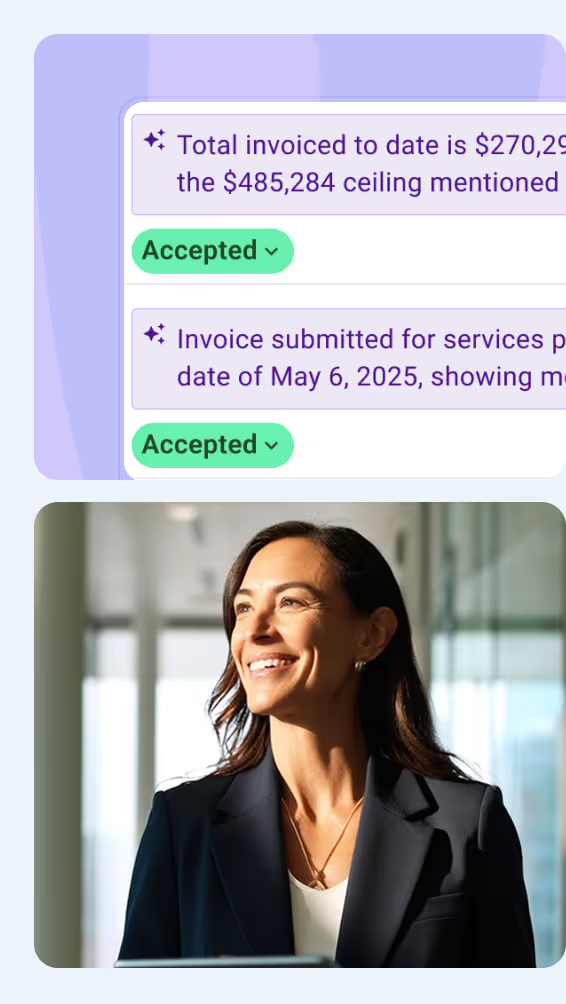



Erin Khan is the founder and senior consultant at Erin Khan Consulting, helping contractors and built-world startups work together to build better. She studied civil engineering, worked as a project engineer, and became national director of construction solutions at Suffolk Construction before starting her firm.
We asked Erin how a construction company should actually adopt AI. Her strategy covers how to run a pilot people want, the shadow AI risks nobody talks about, and how to scale from one user to an enterprise.
From Suffolk Construction to Consulting on Construction Technology
Erin's path into construction technology consulting started on-site, with a project engineer's frustration at stacks of paper. That first-hand field experience shapes how she advises companies today.
Q: Can you introduce yourself and explain how you got into construction technology?
A: My name's Erin Khan. I'm the founder and senior consultant at Erin Khan Consulting, where we work with contractors as well as tech providers to connect with each other and help us build better.
Contractors need a little help with getting technology, implementing it, and making it effective. Startups need a bit more insight into the AEC world, so I help with each of those.
My background definitely was not a linear journey. I studied civil engineering, and in my senior year, I interned as a project engineer, renovating one of the buildings on my college campus.
I loved the team and loved the construction industry. But I kept asking why there were stacks of paper everywhere and why the iPads weren't being used as well as they could be.
I got a few more project experiences in the field, but kept coming back to the tech. That eventually led me to Suffolk Construction, where I started as a regional and later became the national director of construction solutions, focusing on technology and innovation for operations. I also worked with the Suffolk Tech team, coaching startups through their Boost program.
Eventually, I got tired of big corporate and started consulting. It's been a fun run working with different contractors, startups, and a lot of different projects.
Where to Start With AI Adoption in Construction
Nearly every construction company now says the same thing. They know AI in construction is no longer optional, but they don't know where to begin. Erin's answer starts with a question most leaders don't want to hear.
Q: When a construction company says, "We need to start using AI," where do you even start? Who should be in the room?
A: I usually respond with a question that they don't like, but it's very insightful.
"What problem do you want to solve and why? If you don't have the answer to that question, you can't get to the next step of even starting to look at solutions."
- Erin Khan
Many times, teams and leadership have already started looking at solutions because, quite frankly, that's where the inspiration and excitement come from. That's good, we want that motivation. But if you dive into solutions right away because you're excited, there's going to be some strategic misalignment.
What teams and leadership really should do is sit down with department heads at a minimum, and get input from field users or whoever your main end user is. Ask them about their pain points, and where we should be taking away processes or making them more efficient.
That surfaces the true pain, what people care about, and what will drive value.
Once you complete what is honestly a listening exercise to the organization, you take that back and map it with the business objectives and priorities. An easy one for construction is safety. Maybe a digital safety paperwork process instead of manual physical paper means more time spent in the field on quality control for safety.
You understand the field experience and the business objective, see how those align, and then say here's the problem we want to solve and why.
That makes it much easier to define which solutions to look at and which ones to exclude. The exclusion piece is huge because the market is so saturated that there are literally hundreds and thousands of solutions in the space. Your impact and feasibility analysis will tie heavily into this as well.
Q: Is there a framework for identifying which tasks to hand to AI first?
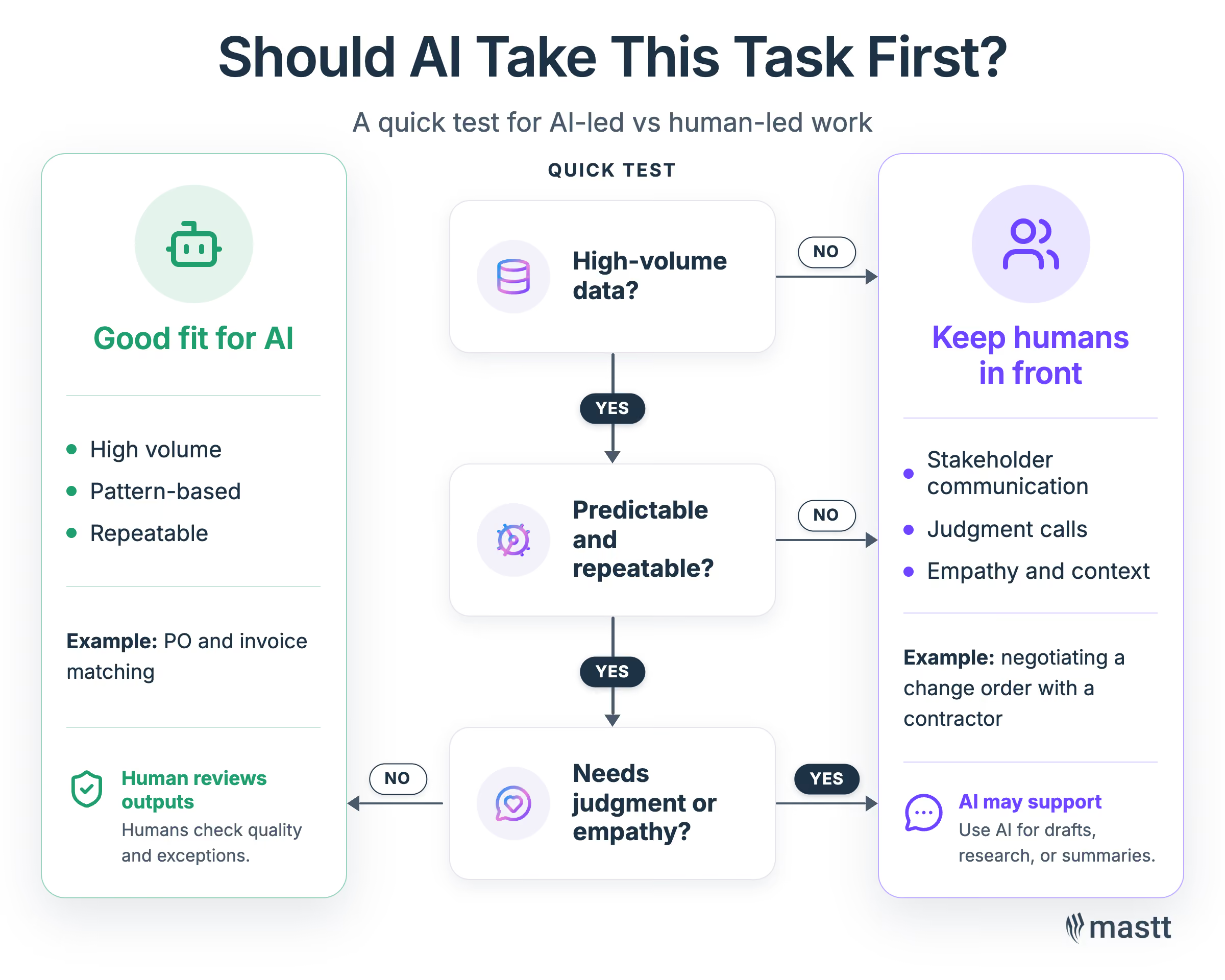
A: There are a few frameworks out there and a lot of good resources. But by and large, something really critical with AI is understanding what AI is good at and valuable for, and then what humans are good at and valuable for. When we see conflation of the two, that's when we get really poor outcomes.
AI is good at processing huge data sets, identifying trends, automating things that are very predictable and consistent, and bringing a bunch of different information sources into one place. So ask whether the problem fits those strengths. If yes, it's probably going to be a pretty good application.
A good example is accounting and billing, matching PO numbers to invoice numbers. We're matching numbers all the time, and there's a ton of data. That's probably not the best use of a human's time, but a great use of a tool that can automate the matching exercise, with a human overseeing it.
On the flip side, take anything customer service or communication related, where we need judgment and a human feel. That's where humans should be in the forefront.
We have to be careful of putting AI in the driver's seat when it should be a human, and putting a human in the driver's seat when it's much better off being an AI. I think we're going to see a bit of a rebalancing over time.
Q: Estimating is the use case everyone asks for. Should companies hand that to AI?
A: At least not yet. Even if it was handed off to AI, you would still need human judgment to gut-check it.
You know very specific details about the project. Maybe there was just a conversation, and a certain part of the building is no longer in the estimate. AI can't know that magically, so you need that human input.
The other thing I don't think is talked about enough is that even where AI is really good at a process, we still need people to do that process in some aspect. That's how a lot of early-career professionals learn, by doing these more time-intensive, tedious tasks.
If you haven't at least done an estimate yourself, how can you know how to check one?
We need to maintain some level of human doing of these tasks so we're not just relying on AI. We're also retaining the knowledge, the talent, and the skills within our industry, our companies, and our people.

How to Run a Successful AI Pilot in Construction
Headlines say corporate AI pilots are failing. Erin's view is that the failures are rarely about the technology and almost always about cost surprises, culture, and picking something nobody asked for.
Q: What does a good AI pilot look like?
A: There are a lot of factors, especially in construction, on what makes a good AI pilot and how to scale it.
One thing to keep in mind is cost. What often happens is that costs through initial pilots quickly add up, running up those token consumption costs, and the team says we didn't realize this would be out of budget so quickly. So project that out as accurately as you can, and depending on the use case, use a sandbox environment to de-risk the rest of the organization.
Then it comes back to the listening exercise. Are you rolling out something that people actually want? You'll be more successful if it's genuinely of interest to your end users.
That means finding innovation champions, individuals who are already open-minded. It doesn't matter how techie they are. They just have to be gung-ho about trying the new thing, and if it works great, they'll tell everybody about it.
Do your homework, get something with a high likelihood of working well, and strategically work with those champions on the earlier pilots to build that coalition.
There's a lot of culture building that goes into it. We're people at the end of the day, and people need to speak to people. It takes time, and it's not easy by any means.
"It's not a technical thing at all. It's more of a psychological, cultural change management thing."
- Erin Khan
This all assumes leadership is supporting the initiative, there are good communications going, and the solutions you're piloting are helping with those communications too. A high level of engagement and a good first-time experience are really key.
Q: Should you include naysayers in a pilot group, or just champions?
A: I would even go back and challenge, limiting it to innovation champions. Yes, find your champions, get them in, engage them. It'll be very helpful to running the pilot. But also have it be open to anybody to sign up and self-volunteer if they're interested.
Sometimes, the most interesting feedback and top engagement come from somebody who just self-signs up. They don't need to be identified by a specific process. That open funnel is part of bringing in a quality team to help process these early pilots.
With naysayers, it'll probably be pretty tough to get them to want to try something. But let's say somebody is willing to participate who may not be the best fit. Include them and see what they have to say. It'll almost be a bit of a pressure test.
And at some point in the pilot, there should be a real pressure test, like putting it on an actual project while controlling for certain risk variables.
In construction, you're going to have naysayers no matter what. There will always be somebody who will not use a perfectly great solution and will say everything terrible about it. Just be prepared for that.
Usually, once there's enough adoption, they'll start to look around and notice a colleague leaving the office right on time while they're still stuck doing paperwork. It's a matter of getting them curious about the capabilities at the end of the day.
Q: When should a pilot use real project data versus a sandbox?
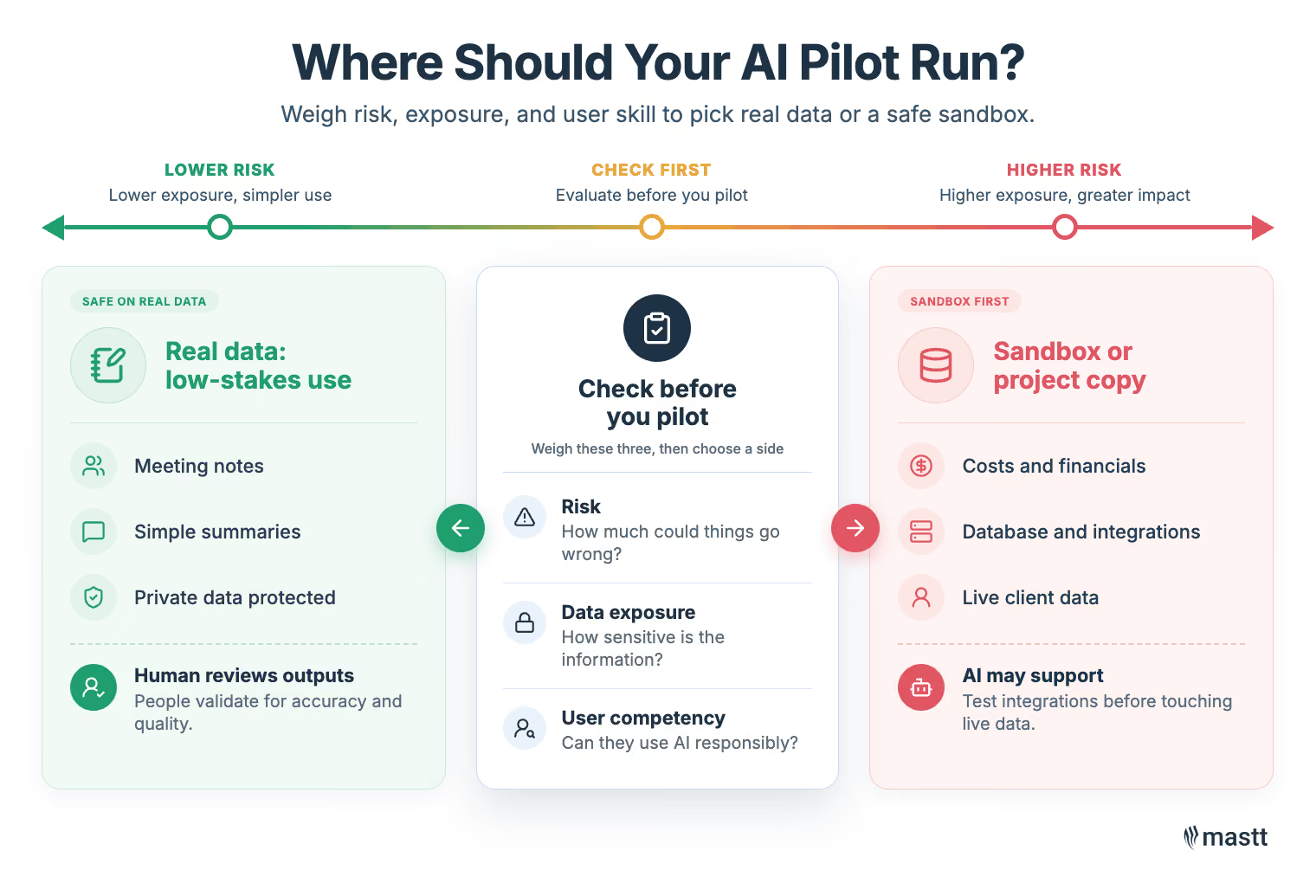
A: It's so highly dependent on the use case. Something low stakes, like putting together meeting notes, is probably fine to use in your day-to-day. If it's private information, make sure you keep it private.
But you went to an actual meeting, here are the notes from the AI tool, here's what it did well and what it didn't. Evaluate the risk, the exposure, and whether the person using the tool knows how to use it responsibly.
If it's cost information and financials, where the AI needs a connection to your database, maybe don't do that on a live project right out of the gate. Do it on a copy of a live project.
The team learns how the integrations and connections work. And if there's a bug or an issue, you can vet it and fix it without worrying that your client's live financial data is being modified. I have seen bugs happen and have been very happy it was in a copy of a production environment.
So it's a scale of risk level, plus the training and competency of the person using the tool. That's something we need to start thinking about as part of our skill sets as AEC professionals.

Shadow AI in Construction and How to Use AI Safely
Handing out AI subscriptions and letting people connect tools sounds like fast adoption. It also creates a web of AI nobody in IT can see, and Erin has heard the horror stories firsthand.
Q: Shadow AI is popping up everywhere. Have you seen it go wrong?
A: There are pros and cons. It's really cool that we're democratizing access to AI. A lot of people are getting into vibe coding and creating great things that help with various workflows. But yes, it is scary, and I have seen some horror stories.
Here's one shared at a past Autodesk University conference. Subcontractor A uses ChatGPT to work on an RFP, putting together a bid. They put their proposal into ChatGPT and don't realize that training is turned on, so that proposal information is just out there.
Subcontractor B is working on the same proposal and searching in ChatGPT. What do you know, they find subcontractor A's full proposal details and everything.
What it boils down to is that we have this new capability, which means we need new skills to adequately learn how to use it. There's internet safety, there's going to be AI safety, and there should be construction AI safety and best practices.
What I would love to see, and if anybody wants to collaborate, please find me, is industry-wide safe AI guidelines. Right now, it's different from org to org. It's kind of the wild west.
Q: What would be on your safe AI guidelines, the one-pager on the office wall?
A: Definitely data privacy and data concerns. Think before you share. Should this be going into AI? Double-check your settings. Are you training it properly? Is it an internal company AI, and are you using it how your company says?
Then there's the how, and there's such a big misuse on the how. We see people using various GPTs, such as Google, as a single source of truth and generating a lot of content, and that's not the best way to use it.
It's a partner, but it's not necessarily telling you truthful things. It's kind of wired to please you and to find stuff just to satisfy whatever you're prompting.
If you're writing something, instead of saying, “Hey AI, write this thing for me,” it should be, “Here's my outline, here's my brainstorm, here are my thoughts on what I want to write about. Help me organize this.”
That preserves your authenticity, because at the end of the day, we're people and we want to interact with authentic people. You can kind of tell when something's a little bit of AI fluff. That how piece is going to matter more and more as we scale our tools.

Scaling AI From Pilot to Enterprise Adoption
Most of the industry is stuck between a working pilot and a full enterprise rollout. Erin's playbook for that jump comes back to the same first question, plus the discipline to kill what isn't working.
Q: Once a pilot works, how do you scale it across a medium to large enterprise?
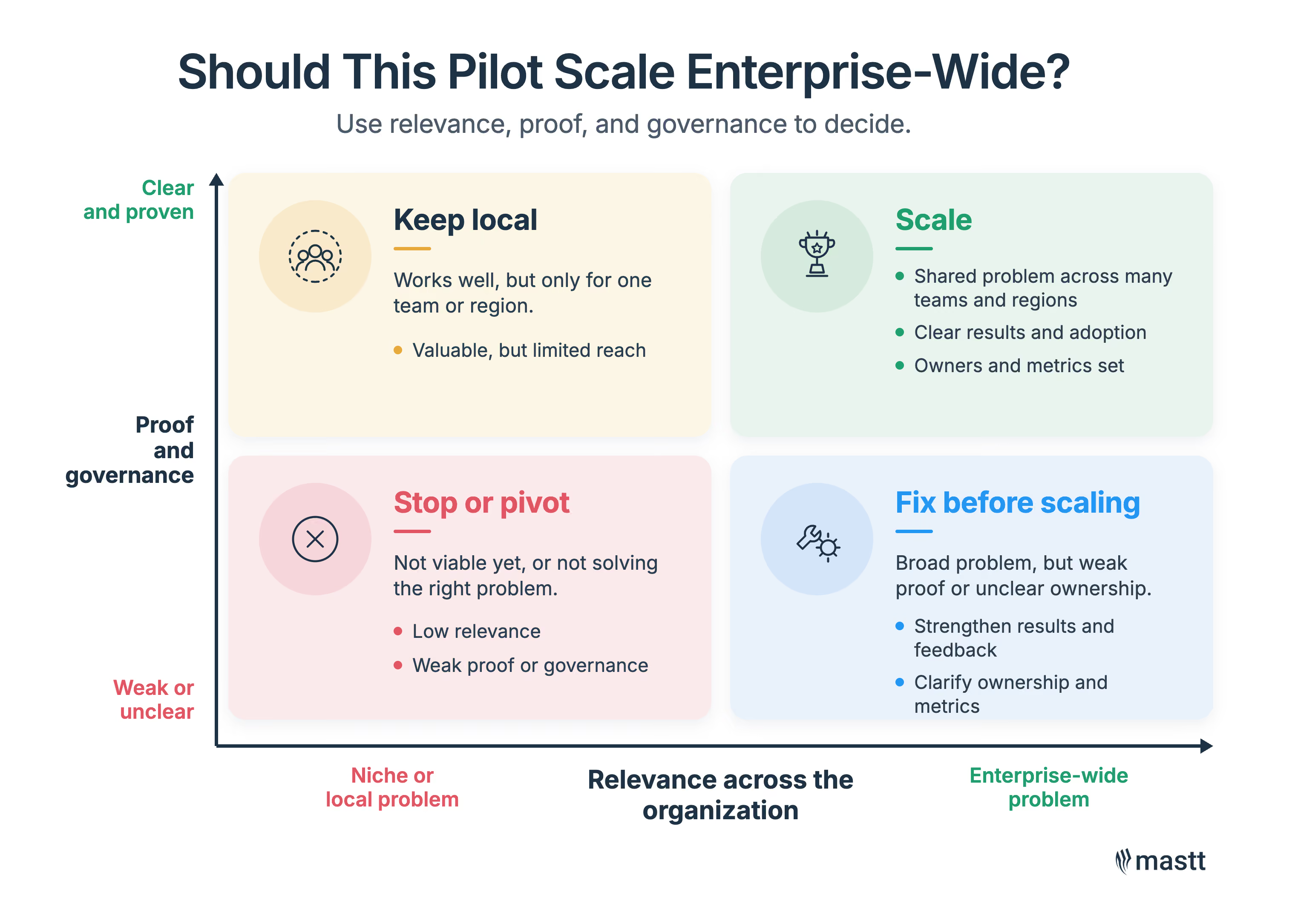
A: It's interesting, all roads lead back to what's the problem you're trying to solve and why. Hopefully, through that initial question, you've landed on something that's broadly applicable and has high value across the organization.
If you're going enterprise-wide, you should have an enterprise problem. If it's not an enterprise problem and you're trying to scale it across all regions or departments, there's nowhere for it to go.
For example, every project has safety on it. If your problem is safety and you're using AI to support that, it's extremely relevant and will capture interest for adoption.
A really key part is being able to identify early on, from early pilots, if it's not viable, and saying no, which is really hard. Don't push something through because it seems exciting, or because leadership still really likes it even though the feedback isn't as good as you thought. There should be governance and mechanisms in place to say this actually isn't a fit, and here's why.
The accountability of how the pilot is managed, who's determining success, and what the metrics of success and failure are needs to be really clear from the beginning. You don't want to spin your wheels down a road that leads nowhere.
The ability to pivot really fast is a key skill, especially with tech that changes what seems like overnight.
Q: Are you recommending that companies build their own AI tools or buy off-the-shelf?
A: I still see a pretty strong lean toward off-the-shelf, because most of the industry is not technical experts. Most orgs are not going to have a bunch of tech wizards sitting in a specific department making these things. So there's still a huge lean toward a company that made the solution and will help us.
What we're starting to appreciate a bit more is being platform agnostic. The more plug-and-play we can have on our base platform, which is our data system, the easier it is to do both. You can get a point solution off the shelf and develop something internally, and just plug it in.
What dictates which way a company shifts comes down to your data environment. Is it set up well so a tool can plug in easily, and you can take it out and plug a different one in, and your data will still be good to go?
Our ERPs back in the day were very difficult to swap out. Good solid systems that got your processes done, but very difficult to update or switch. That's definitely changing.
Q: Are you doomed in the AI era if you're still on-premise?
A: No, you're not doomed. Sure, it's going to hurt to get off one system and go to another. It always does.
But especially in construction, we have this leapfrog effect. Maybe you're on an on-premise system, but there's now a level of cloud and digital transformation expertise that makes that jump a lot easier than moving from one on-premise system to another, then to a hybrid, then to fully cloud.
Instead of going through all of those painful steps, you're getting a chance for a clean slate in a way. It's a chance to bring in a fresh data team and get the best resources on the market to set you up well for a long-term investment. So there are some benefits for sure.
What a Mature AI-Enabled Construction Company Looks Like
Few construction businesses have fully operationalized AI. Erin describes the ones that have, and the markers she looks for before calling an organization ready.
Q: What does a mature business look like in terms of its AI usage?
A: You have a data resource, and you probably have a specific individual. It could be a department in a larger company or one individual if it's smaller, but somebody in a role that's specifically for AI.
It's their job responsibility to oversee these initiatives and work with key stakeholders to make them successful. So you have the data investment, actual AI expertise, and leadership in-house.
Mature organizations also have a lot of governance and checks. You're getting input from risk, legal, finance, insurance, and a couple of other key stakeholders. There are well-established governance processes, and knowing when to say no or when something doesn't pass a check.
Those checks and balances can make things go a little slower, but they're there for good reasons, some of them hard-won over a lot of experience.
Look at the talent, too. Employees are a little further ahead on AI skills. There's data literacy training, training on how to use AI according to company IT policy, and resources to upskill so people use these solutions effectively.
The competency isn't just in leadership roles or the AI department. It's in the individuals using it.
The most mature organizations have been experimenting with technology, not just AI, for quite some time. They invest in innovation, and it shows. They remain competitive, they're industry thought leaders, and they may be producing research in these areas or creating smart partnerships with those who are.
Q: Should companies rule out job candidates who can't demonstrate AI capability?
A: My gut response is that I prefer to look at potential instead of the past, and maybe that's a bit optimistic.
Take me, with an engineering background. I can do some technical stuff if I try. If I were given a competency test, I'd fail it super hard. But if I learned just a tiny bit, I'd probably pass with flying colors.
It goes back to what I touched on with innovation champions. Are they interested? Are they willing to learn? Are they naturally passionate? Is the reason this person breathes every day this topic?
For me, that's construction tech. If it's related to that, they'll go the extra mile, learn how to do something, and figure it out.
When we look at an industry that traditionally does not have this skill set, we have to start looking at potential, because there's no real past performance data to go off.
And I've been surprised seeing newer engineers come into the industry. They're eager and ready for a new and better way of working. There's a lot of interest and talent ready to redefine how we work.
"Potential, not past, tends to be my gut out of the gate."
- Erin Khan
Note: This Q&A article is part of Mastt's interview series featuring construction industry experts. Erin Khan's responses have been lightly edited for readability.
.avif)
Written by
Doug Vincent
Doug Vincent is the co-founder and CEO of Mastt, the AI capital-project management platform used by governments, Fortune 500 companies, and consultancies across APAC, North America, and MENA. Before founding Mastt in 2019, he spent a decade at RPS delivering more than $2 billion in capital works, including the $2.1B Defence Navy Infrastructure program, and holds a CPSPM certification with the AIPM. He contributes content and speaks on AI in capital project delivery at Mastt.


Contributions by
Erin Khan
Erin Khan is a construction technology expert, speaker, and guest lecturer at USC and UCLA Extension, and the founder of Erin Khan Consulting in Los Angeles. A civil engineer, she spent a decade delivering projects at Morley Builders and leading construction innovation at Suffolk Construction, and was named to BuiltWorlds' Adoption Leaders 50. She contributes content on AI and technology adoption in construction at Mastt.
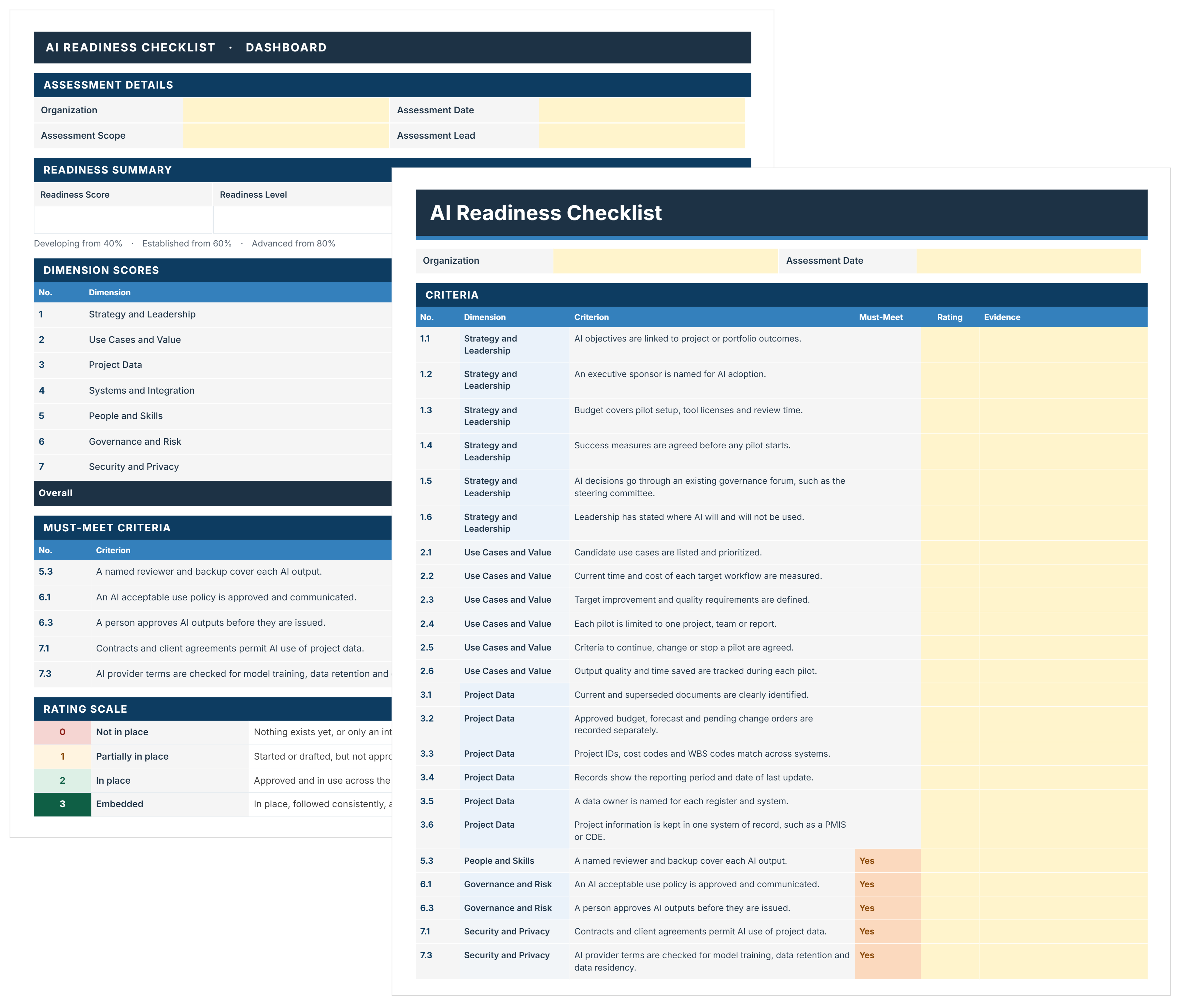
AI Readiness Checklist Template
FREE AI readiness checklist to assess and decide where AI starts on your projects. Score 44 criteria, close must-meet gaps, and pick a pilot with evidence.

Walk Into Every Meeting With Confidence, Clarity, and Control
No one wants to look unprepared, blindsided, or uncertain in front of stakeholders — but that’s exactly what happens without Mastt.
Start for FreeTrusted by the bold, the brave, and the brilliant across governments, Fortune 500s, and the world’s best in delivering the future