
.avif)

After years of building scheduling and risk management software, I have watched every wave of new technology hit the construction industry. A year ago, I tried integrating Cursor with Claude Code on my machine, and it was like having a really bad intern. I re-upped it a month ago, and it was amazing.
In my lifetime, there has not been this big an investment this quickly in any given technology, and I believe AI holds the potential to be more transformational than the internet. The problem is that it is landing in an industry where a new idea is not a good idea. Closing that gap requires real change management in construction.
The Current State of AI Adoption in Construction
A year ago, I tried integrating AI coding tools into my workflow, and it was like having a really bad intern. I went back a month ago, and it was so much better. The models are evolving so quickly that it's genuinely difficult to judge where the technology stands at any given moment.
The most immediate opportunity for AI in construction project management is natural language access to project data. A CFO or contractor could ask "how many activities have less than two days of float right now?" and get a direct answer without needing to be a scheduling expert.
Beyond that, always-on agents could flag near-critical activities before they turn red, rather than waiting for a human to catch them in a bi-weekly review.
The bigger barrier isn't the technology, it's the industry. Construction treats new ideas with suspicion, and that inertia is baked into contracts and reinforced by a forensic scheduling expert witness industry built around the status quo. A lot of the industry isn't even aware they need to change yet.
Awareness will come from economic pressure. Someone will figure this out, start undercutting competitors, and the rest will follow. The fastest path to internal buy-in in the meantime is the WIIFM, or asking ‘What is it for me?’.

Why Construction Teams Resist New Technology
The resistance is not irrational. It comes from real, structural places. Here are the six sources I see most often.
In my experience over many years, a new idea is not a good idea in construction and engineering. Understanding these sources of resistance is the first step to getting past them.
What Is the ADKAR Framework?
ADKAR is a change management model with five sequential stages: Awareness, Desire, Knowledge, Ability, and Reinforcement. It was developed by Prosci founder Jeff Hiatt from research across 1,000+ organizations, focusing on individual change because organizational change only happens when individuals change. It is one of the most effective approaches to change management in construction because it diagnoses exactly where adoption is stuck.
I am a big proponent of organizational change management as an approach to managing change.
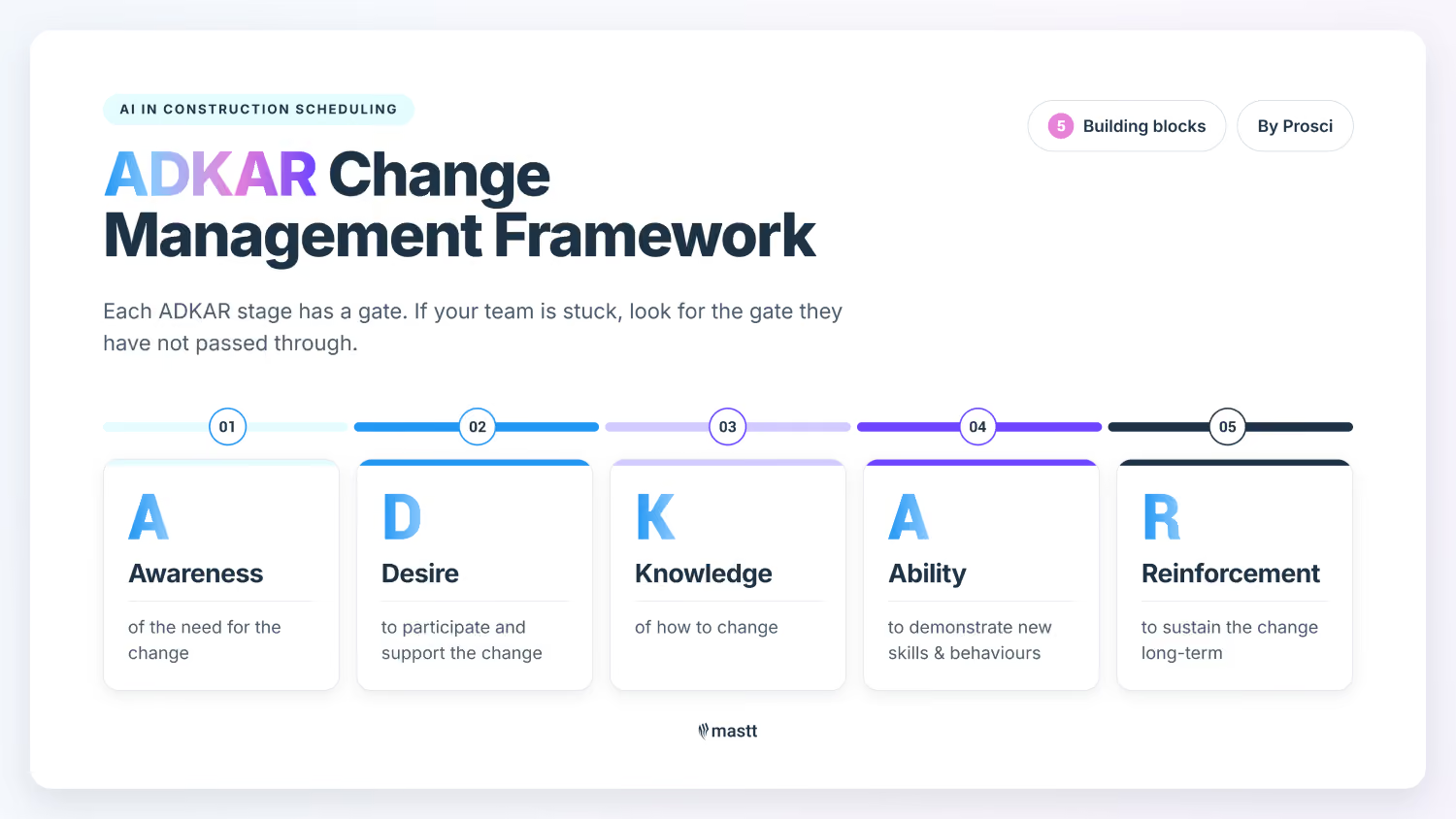
ADKAR stands for: Are you aware that you need to change? Do you have a desire to change? Do you have the knowledge, the ability, and are you being reinforced? You have to get through each stage gate to actually have a successful change.

Applying ADKAR to AI Adoption in Construction
Each ADKAR stage has a gate. If your team is stuck, look for the gate they have not passed through.
Step 1: Awareness
Awareness means your team understands that the current way of working has a measurable cost. A lot of the industry is not even aware that they need to change. Until they are aware, nothing else matters.
Show them the numbers: what duplicate schedules cost, how many hours go to manual updates. Awareness will come from economic pressure. Somebody is going to figure this out and start undercutting other people. You can wait for that pressure or create it internally.
Step 2: Desire
Desire means your team personally wants the change. Find what I call a WIIFM, which is what is in it for me. If a PM's worst nightmare is updating spreadsheets, help them automate that. They will like AI because we have done something for them, versus training AI to take their job. It would emancipate an experienced PM from low-level work and allow them to apply their time to higher-value functions.
Step 3: Knowledge
Knowledge means your team knows how to use AI in their specific workflow. Interrogate the data set, the schedule itself, using AI. Use it to learn more about your own schedule, to instruct yourself. But always verify. Do not just let the agent run wild.
Step 4: Ability
Ability means the tools are accessible enough for non-specialists. Natural language querying is going to level the playing field for all the professionals who have questions, whether it is the CFO, the project sponsor, or the contractor. You do not need to know P6.
Step 5: Reinforcement
Reinforcement means the change sticks. If big contracting organizations were to adopt a platform and a standard, you would see it drive a lot faster. Build it into your project cadence: make AI-generated reports the default, and the old way becomes harder than the new way.
Where AI Delivers the Fastest Wins
The best way to build momentum through the ADKAR stages is to target AI at the work people already hate doing. These use cases generate the fastest adoption because they remove pain and do not add complexity.
If your AI use case adds work for the end user, adoption will fail no matter how good the technology is.
The Future: What Construction Looks Like in 2035
The pace and scale of AI funding are unlike anything construction has seen before. As transformative as the internet has been to the world, I think AI holds the potential to be more transformational, and it is better funded. The question is not whether AI will transform construction. It is how fast.
Communication over data chasing
According to the PMBOK, 90% of a project manager's job is communication. I agree with that. If we could use AI to better inform a project manager as to project status, trends, and change orders, then they can do a better job communicating and executing. Because if the job gets out of sync through lack of communication or lack of data update, then you are driving blind.
Automated progress tracking
Progress is currently a human activity. I do not think it needs to be in 2035. We should be able to progress the project based on sensors, or by 2035 maybe there will be a hundred robots on the site reporting the data back in real time. You could run a digital twin in advance. Build the project and say, on the fifth floor the robots are falling over, so let us fix that before we start actually building anything.
Schedulers as strategists
The real professional schedulers that I have met are craftsmen. They understand what they are trying to accomplish and how to look at the model. They are not just clicking keys. That is where you can get more value out of their experience and their intuition.
Start Driving AI Adoption on Your Projects
Change management in construction comes down to diagnosing where your team is stuck in ADKAR, solving for that specific stage, and building momentum by targeting the work people already hate. They will like AI because we have done something for them versus training AI to take their job from them. Start there.
Explore Mastt's AI in construction research or see how AI project management works in practice.
Written by
Timothy Mather
Tim Mather is a former CTO and COO of PMA Technologies, where he spent 23 years developing construction scheduling and risk analysis software. He co-developed NetPoint® and NetRisk™ and co-authored "Core Traits of a Reliable Schedule." At Mastt, he writes on construction scheduling, project controls, and AI in construction.


Contributions by
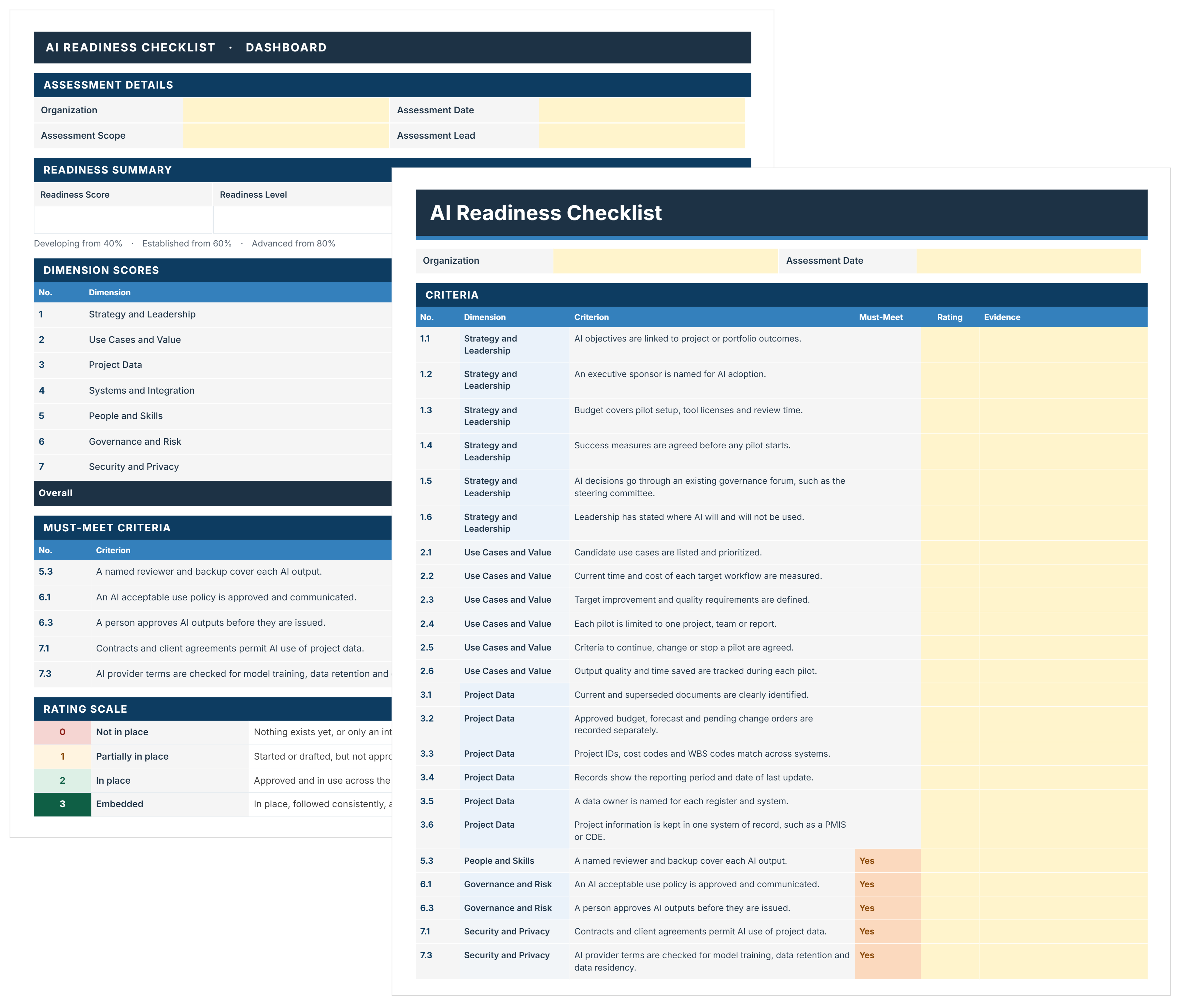
AI Readiness Checklist Template
FREE AI readiness checklist to assess and decide where AI starts on your projects. Score 44 criteria, close must-meet gaps, and pick a pilot with evidence.

Walk Into Every Meeting With Confidence, Clarity, and Control
No one wants to look unprepared, blindsided, or uncertain in front of stakeholders — but that’s exactly what happens without Mastt.
Start for FreeTrusted by the bold, the brave, and the brilliant across governments, Fortune 500s, and the world’s best in delivering the future