


Daniela Gutierrez is a project support officer in AngliSchools’ capital projects team, working between schools, external project managers, and finance. Her role involves turning individual project reports into consistent financial information for head office and senior management.
We spoke with Daniela about managing costs across a school project portfolio. She explains what executives need from a report, why project managers’ approval limits change as contingency is used, and how forecasts give the team time to respond before costs arrive.
From Civil Works to School Capital Project Management
Daniela moved into education after working on civil projects from the contractor side. At AngliSchools, her work brings together the people delivering each project and those overseeing the portfolio.
Q. How did you get into the industry, and what does your role involve?
A. My background is a combination of architecture, civil engineering, and project management. I originally studied architecture in Argentina for four years. I didn’t finish the degree, but it gave me an understanding of design, how people use spaces, and how a project develops from the architectural side.
When I moved to Australia, I transferred my units into civil engineering. I wanted to understand the construction and technical side, how the building works, and the engineering behind it.
Before my current role, I worked in project management on civil works, including roads and subdivisions. I hadn’t worked in education before. Moving from the contractor side to the client side gave me a very different perspective.
I’m now a project officer in AngliSchools’ capital projects team. We manage around 16 to 18 projects across our schools. My role sits between the schools, external project managers, finance, and our internal capital projects team.
A big part of my role is making sure the financial information from those individual projects is consistent and useful at the portfolio level. I’m kind of the filter between the external stakeholders and head office. For more important decisions, I escalate to our head of capital projects.
Construction Cost Reporting for Boards and Finance Teams
AngliSchools tailors its project portfolio reporting to the needs of project teams, senior management, and the board. Daniela adjusts the information to what each audience needs to understand and decide.
Q. What do senior management and the board want to see in a project report?
A. We use Mastt to consolidate project information and give the board and senior management visibility across multiple projects.
Senior management wants a quick view of the important information. Are we within budget? What are we forecasting? What has changed significantly since last month? What are the contingency risks, and what decisions do we need to make?
The dashboard I receive from project managers is more specific. It includes those key indicators, plus the project financial summary, what’s coming next month, the project description, a monthly review, the variation register, the construction program, and progress photos.
“Senior management doesn’t need to go through all that detail. They want the main indicators and to understand whether a decision is needed.”
- Daniela Gutierrez
Q. What makes those reports easier to read?
A. The useful thing about Mastt dashboards is that you can adjust them to the audience. The reports coming to me are mostly charts. There are fewer words and more photos, graphs, charts, and numbers.
We have a project health graph. If a risk is red, that’s something we can turn our attention to. We still have the overall financial report because we want to see that across the projects.
The program is shown in a worm chart. Variations are in a small table, with items we want to flag shown in red. Cash flow has a chart and a supporting table, so we can see the differences month by month.
Q. How is the CFO’s report different?
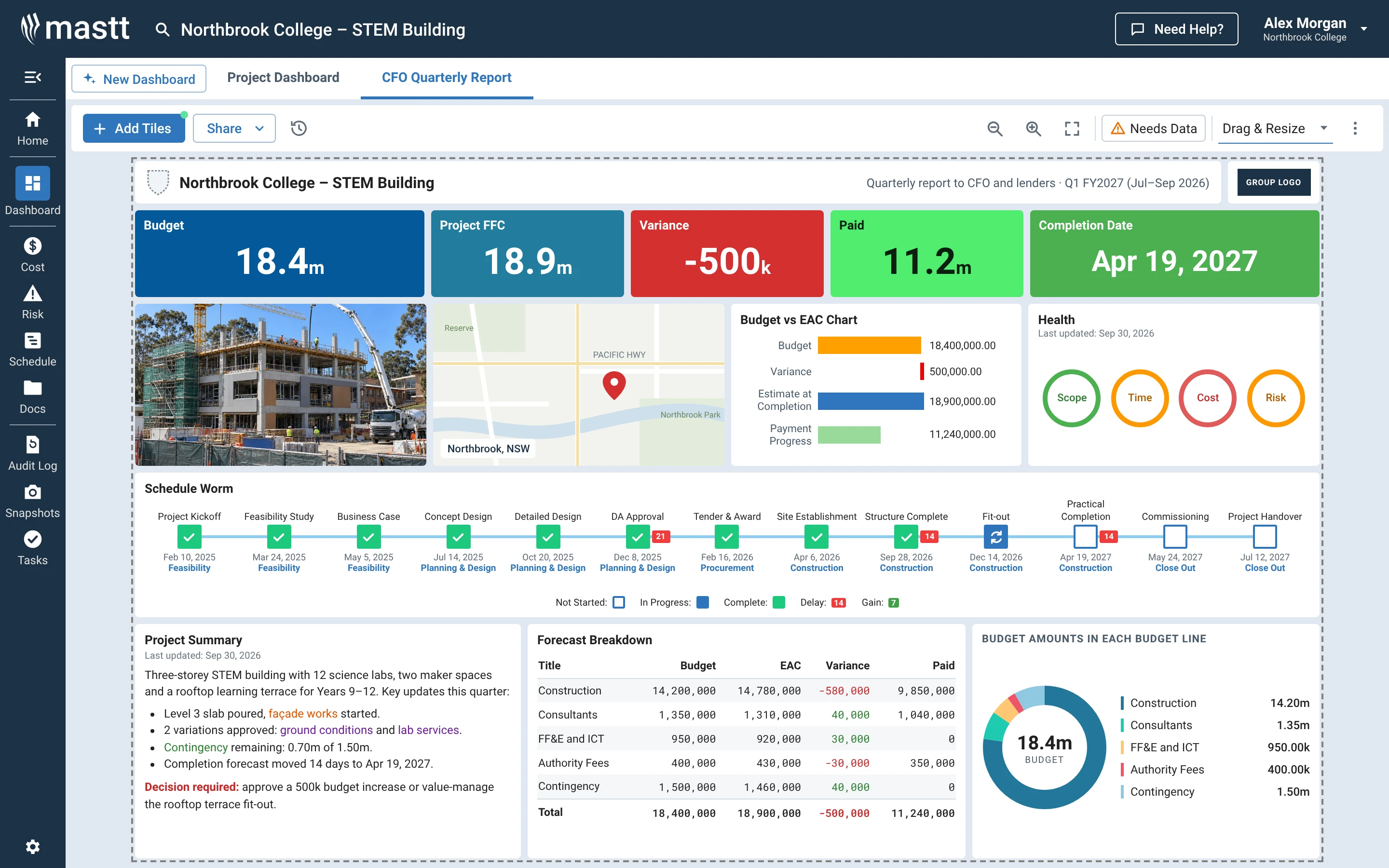
A. I also provide a quarterly report to our CFO (Chief Financial Officer), who needs to report to the banks because we have funding.
For a report I prepared recently, we showed the school name, project name, school crest, and AngliSchools logo clearly. That helps people distinguish between projects.
We included the total budget, forecast final cost, variance, and total paid. We also showed progress photos, the location, and a very short project description. The location might be obvious to me, but people in the banks or looking from outside don’t necessarily know where each project is.
Then there was the budget versus forecast chart, project health, schedule worm chart, and forecast and budget breakdowns.
In that specific case, the report answered the questions they needed answered. They could identify anything they wanted to look into more deeply. If there was nothing wrong, they didn’t need to spend time on it.
Keeping Project Budgets Consistent Across a Portfolio
AngliSchools’ projects move through different stages, from early planning to closeout. An approved budget structure gives the team a consistent basis for reviewing costs across them.
Q. How do you keep different project managers consistent in their cost reporting?
A. We have projects in early planning, design, procurement, construction, and closeout. Having a consistent way of looking at budgets, forecasts, and variations is very important for us.
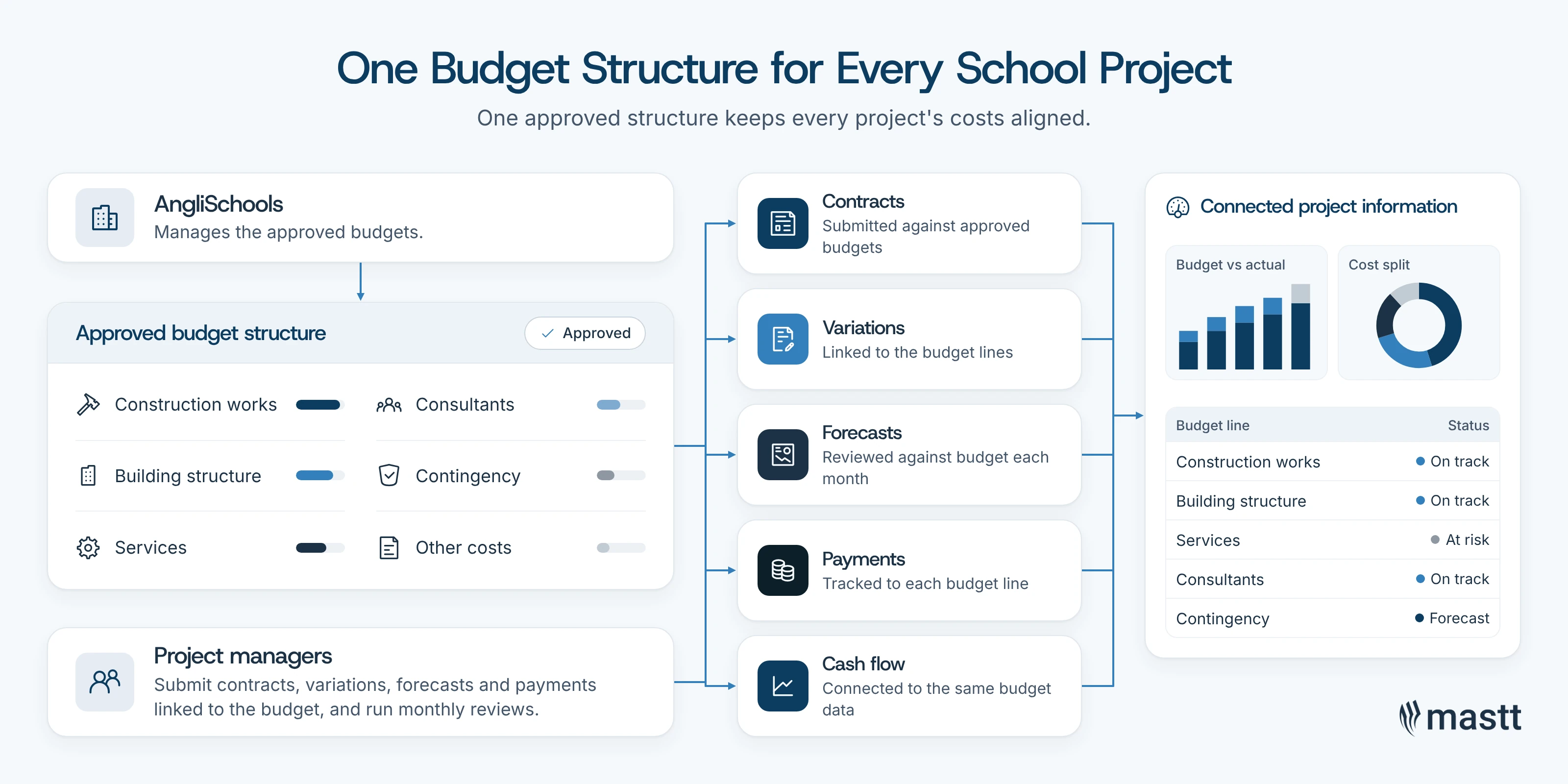
We have a budget line structure in Mastt. The contracts are linked to those budgets, and the payments and variations are linked to the budget lines. Cash flow is related as well, so the information is connected.
Excel is useful, but if I’m doing one spreadsheet, finance is doing another, and a project manager has another, there’s a lot of reconciliation to make sure we end up with the same figure.
“Once our budgets are approved, we put them into Mastt. We require project managers to submit contracts linked to those budgets, with variations, forecasts, and payments linked as well.”
- Daniela Gutierrez
Our main role is to manage the budgets. The project managers maintain the other project information, so we need to make sure they do a good job with the reporting and monthly reviews.
Controlling Construction Contingency and Variation Approvals
AngliSchools retains control of construction contingency at head office. Project managers can approve some variations, with their authority tied to the contingency remaining on the project.
Q. How do you decide who can approve a variation?
A. Our approval process depends on the type and value of the variation. We give project managers some responsibility because we can’t manage everything from head office.
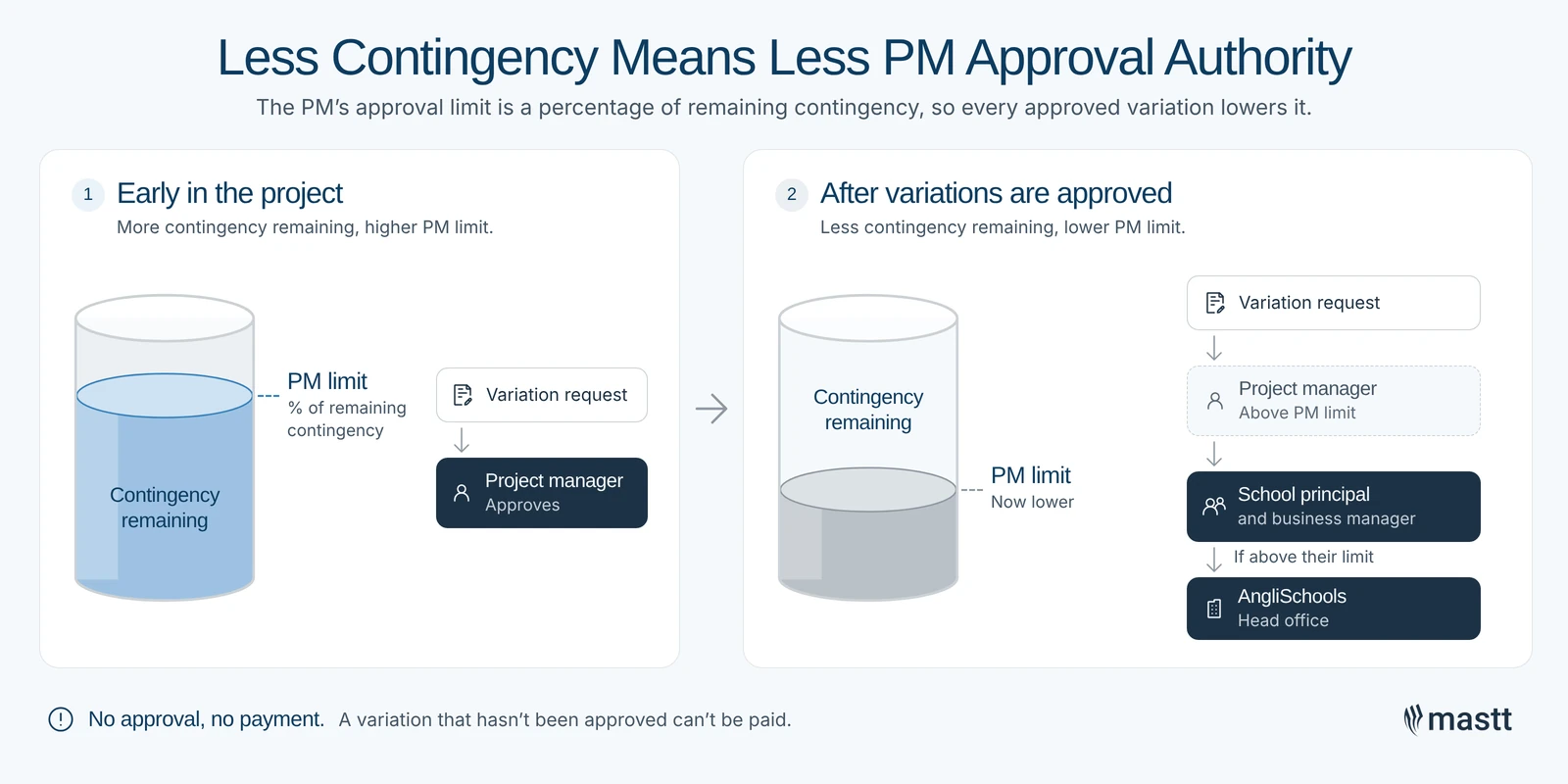
PMs can approve smaller variations within their delegated authority. Larger ones go to the school principal and business manager. If they exceed that approval limit, they go to AngliSchools. If a variation hasn’t been approved, it can’t be paid.
“The PM’s limit is a percentage of the remaining contingency. As approved variations reduce that contingency, the project manager has less and less authority to approve further variations.”
- Daniela Gutierrez
They have to come back to us more often for approval.
Q. Who controls contingency, and how do you review its use?
A. The client owns the contingency. It’s something we watch very closely because it’s not spare money to spend.
In our projects, the combined design, construction, and escalation contingency is typically around 10% of the project. The project manager investigates the risks for their project and reports back to us.
I manage the budget transfers. We use a variation register that lets us filter the month’s variations across all projects and go through them one by one, regardless of the project or school.
Once the variations have been approved and have the required documentation, the project manager updates the status and forecast in Mastt. That’s the process we go through every month.
When the design stage is complete, we also review any unused design contingency against the project manager’s forecast. We can transfer it to construction contingency or main works, use it for future variations, or retain it as savings for that project.
Q. What makes you look more closely at a project’s contingency?
A. The moment a project starts using contingency, we keep an even closer eye on it. We look at the next variation and whether it’s really necessary.
Teachers, business managers, and school teams participate in these projects. They want the project finalised and may support changes that look small individually.
But a combination of small approved variations becomes a bigger change. We need to understand whether the next variation is necessary and whether we need to transfer money and reduce contingency because of it.
Reconciling Construction Cost Reports With Finance Records
Schools pay invoices and send their payment information to the project team. Daniela uses monthly reconciliation to check that these records agree with the project reports.
Q. How do you keep the schools’ finance records aligned with Mastt?
A. We receive a work in progress, or WIP, spreadsheet from each school’s finance team and match that information to Mastt every month.
The schools send the WIP to the project managers and to me on the last day of the month. The project managers then send their monthly financial reports on the third business day of the following month.
Project managers do the reconciliation, and it’s part of my responsibility too. I also reconcile the school’s WIP against the project manager’s report to make sure they match.
“There might be an invoice that hasn’t been entered, a payment status that hasn’t been updated, or a variation entered incorrectly. Those discrepancies can be useful for identifying weaknesses within projects.”
- Daniela Gutierrez
Using Construction Cost Forecasts to Spot Budget Pressure
Daniela looks at construction cost forecasts alongside commitments, variations, and cash flow. Missing forecasts are a warning sign, and getting them completed consistently remains an area the team is working on.
Q. What are the early warning signs that a project needs more attention?
A. For me, the main tool of project management is forecasting.
“If there’s no forecasting, that’s already a red flag.”
- Daniela Gutierrez
I look at the original budget against our current commitments and forecast final cost. Then I break down the variations to see whether they’re client scope changes, design development, escalation, or authority requirements.
I also look at contingency, how much needs to be reduced, and what risks are outstanding. Variations, cash flow, and the forecast are the main things I review.
We’re still working hard to make sure project managers forecast our projects. It seems to be difficult to complete, but it’s our main source of information about what could happen.
Q. What does an early forecast let you do that actual expenditure doesn’t?
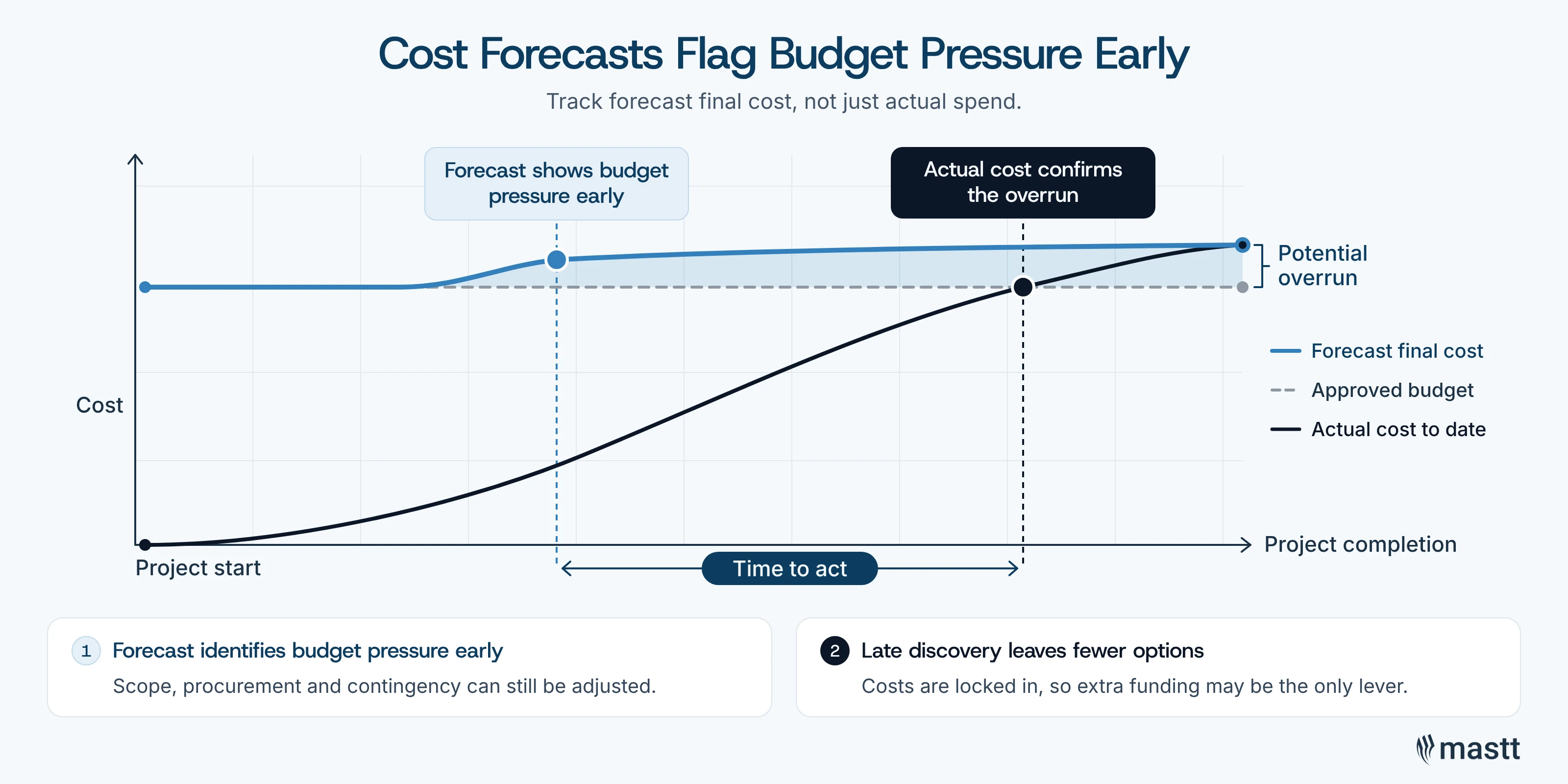
A. Actual expenditure tells me what has already happened. The forecast tells me what’s going to happen in the future.
If I see a project trending over budget, say six months before completion, we still have options. Can we review the scope? Can we save on materials? We can look at procurement, review contingency, or perhaps ask for further funding.
If we discover the problem when the invoice arrives, there’s very little we can do.
Using Completed Project Costs to Plan Future School Developments
School project spending also affects the work that can follow. AngliSchools links projects to campus master plans and uses completed project information to inform future decisions.
Q. How does spending on one project affect the school’s future plans?
A. Each school has several projects. If it overspends on one project, that means the next project has less money available. That’s why the school is involved and very aware of those decisions.
We have a 10-year plan for each school, linked to the master plan for specific campuses. All the changes, stages, and projects are connected to that master plan.
If something isn’t in the master plan, it might not go through the approval process or be required by the school.
Q. What do you learn from completed projects that helps with the next one?
A. When construction is finished, we still have to complete the administrative closeout. We need to resolve variations and close out and capture final invoices and payments. We’ve had invoices arrive months after completion in the past.
Getting the final cost is particularly important from a portfolio perspective because it becomes historical information for future school projects. We can look at costs per square metre and the different spaces we’re delivering, such as classrooms and kitchens.
“If we see the same variation occurring across several projects, it indicates something we need to improve.”
- Daniela Gutierrez
We can also use completed project information to look at consultant costs, contingency, how long projects take, and the common risks we experience in education.
We’ve learned which consultants provide good quality. We have to consider the long-term use of our facilities when selecting them.
Having contractors who are comfortable working in a live school environment is important too. The safety of the children is the most important thing.
Protecting Funding for the Next School Project
Daniela’s work connects the cost position of individual projects with the schools’ longer-term plans. When spending on one project can reduce the funding available for the next, forecasts and approval decisions have consequences across the campus program.
Her emphasis on final costs completes that process. Once a project closes, its cost records and lessons help the team plan the work still to come.
Note: This Q&A is part of Mastt’s interview series featuring construction industry professionals. Daniela Gutierrez’s responses have been lightly edited for grammar, clarity, and readability.

Written by
Doug Vincent
Doug Vincent is the co-founder and CEO of Mastt, the AI capital-project management platform used by governments, Fortune 500 companies, and consultancies across APAC, North America, and MENA. Before founding Mastt in 2019, he spent a decade at RPS delivering more than $2 billion in capital works, including the $2.1B Defence Navy Infrastructure program, and holds a CPSPM certification with the AIPM. He contributes content and speaks on AI in capital project delivery at Mastt.


Contributions by
Daniela Gutierrez
From studying architecture in Argentina to delivering civil works on the contractor side, Daniela Gutierrez now manages capital projects from the client side at AngliSchools. She oversees budgets, contingency, and reporting across a portfolio of school projects. Daniela shares her approach to cost control and forecasting at Mastt.
Project Cost Management Template
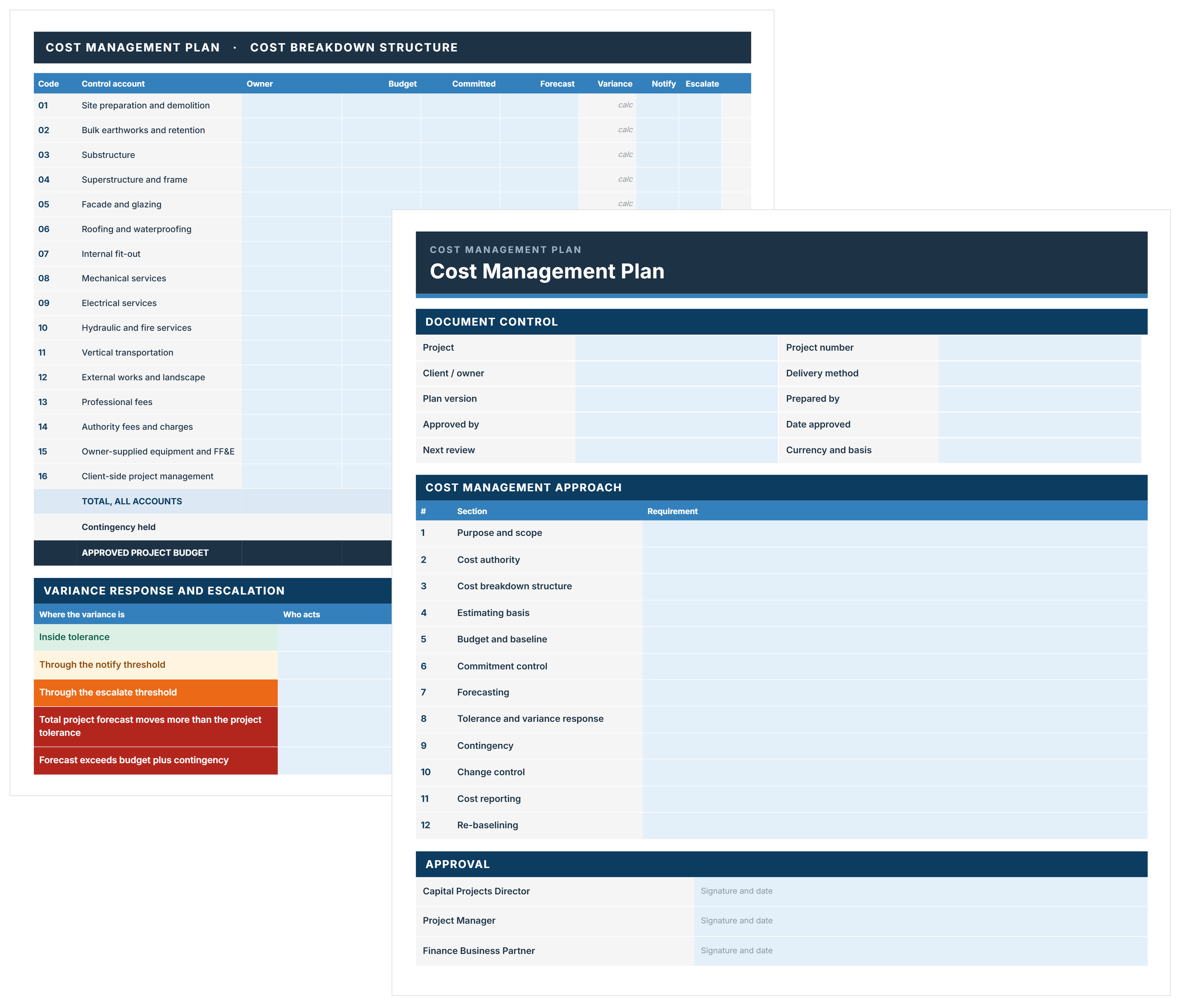
FREE project cost management template in Excel. Set the cost management plan, the control accounts, and the tolerances that trigger escalation, then track against it.

Walk Into Every Meeting With Confidence, Clarity, and Control
No one wants to look unprepared, blindsided, or uncertain in front of stakeholders — but that’s exactly what happens without Mastt.
Start for FreeTrusted by the bold, the brave, and the brilliant across governments, Fortune 500s, and the world’s best in delivering the future