

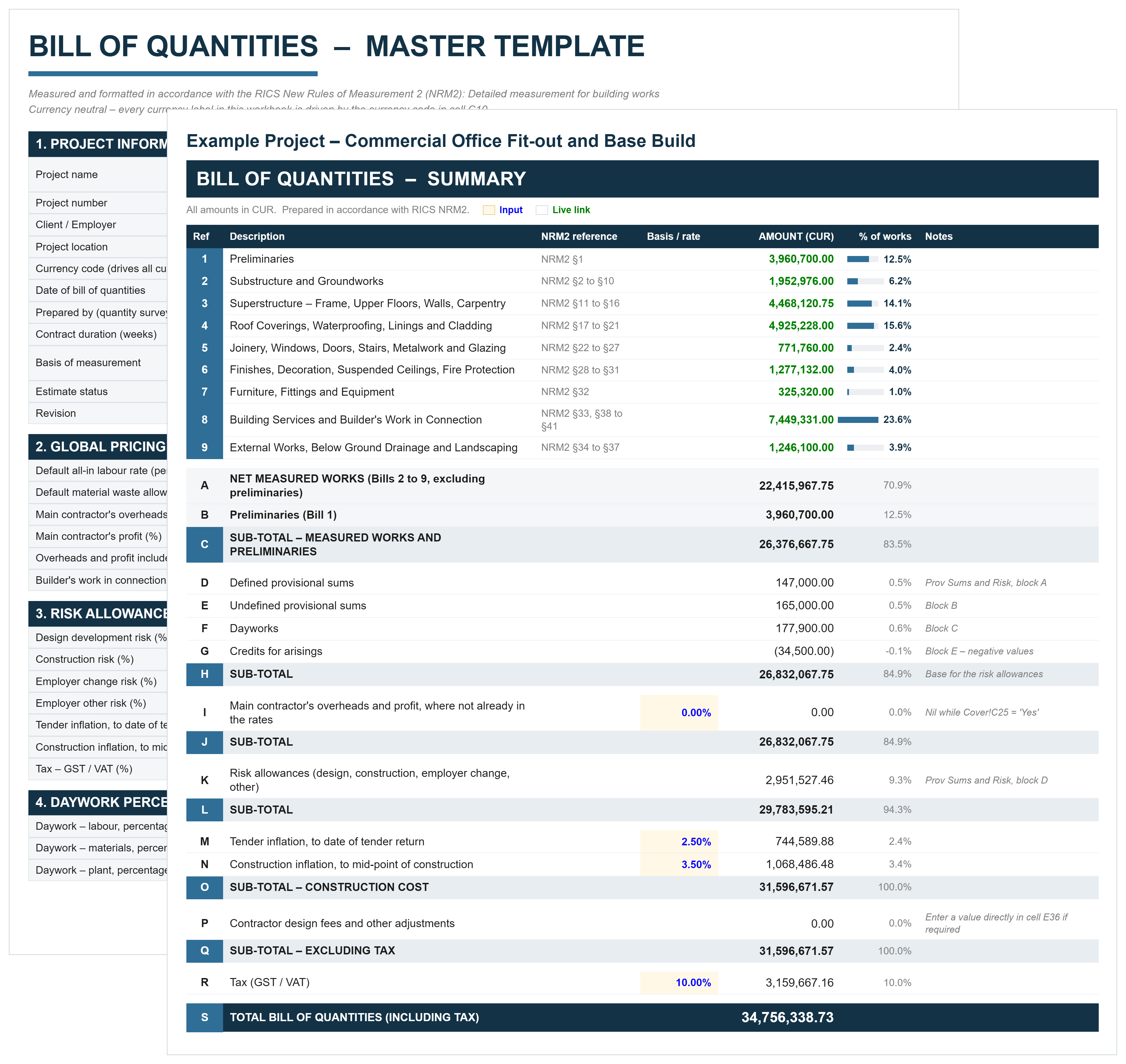

What is a Bill of Quantities Template?
A bill of quantities template is a pre-structured document containing standardised sections for recording measured construction work. It provides ready-made frameworks with work sections, measurement units, item descriptions, and pricing columns organised by NRM2 (New Rules of Measurement) standards.
The template for BoQ includes preliminaries, measured works, provisional sums, and PC (Prime Cost) sums arranged hierarchically. Quantity surveyors customise these formats by adding project-specific items whilst maintaining consistent structure across tender documentation.
What's Included in Construction BoQ Templates?
NRM2-compliant bill of quantities templates contain essential measurement and pricing sections that ensure fair tender comparison. These components provide the complete framework quantity surveyors need for accurate cost estimation.
Standard inclusions in professional BoQ formats are:
- Preliminaries Section: Site establishment costs, insurances, temporary works, supervision, and facilities required before measured works begin.
- Work Section Breakdown: NRM2 categories including substructure, superstructure, internal finishes, external works, and building services installations.
- Item Descriptions: Detailed specifications referencing materials, workmanship standards, dimensions, and performance requirements for each measured element.
- Measurement Units: Standardised units (m², m³, m, nr, kg, t, h, sum) with quantities taken off systematically.
- Unit Rate Columns: Blank pricing fields where contractors insert rates per measurement unit during tender pricing.
- Provisional Sums: Budget allowances for undefined work scopes requiring contractor quotations or future definition before execution.
- PC Sums: Prime cost allowances for specialist work, materials, or equipment to be procured through contractor coordination.
- Daywork Schedule: Hourly labour rates, plant hire, and materials markup percentages for variation pricing outside measured items.
💡 Pro Tip: Always include a separate "Not Included" section listing exclusions. Stating "external works exclude landscaping" prevents contractors claiming these items weren't priced, triggering expensive post-tender variations.
Bill of Quantities Example For Construction Projects
Here is an example of a bill of quantities summary. It shows the nine bills measured to RICS NRM2, then the full cascade from measured works down to the total including tax.
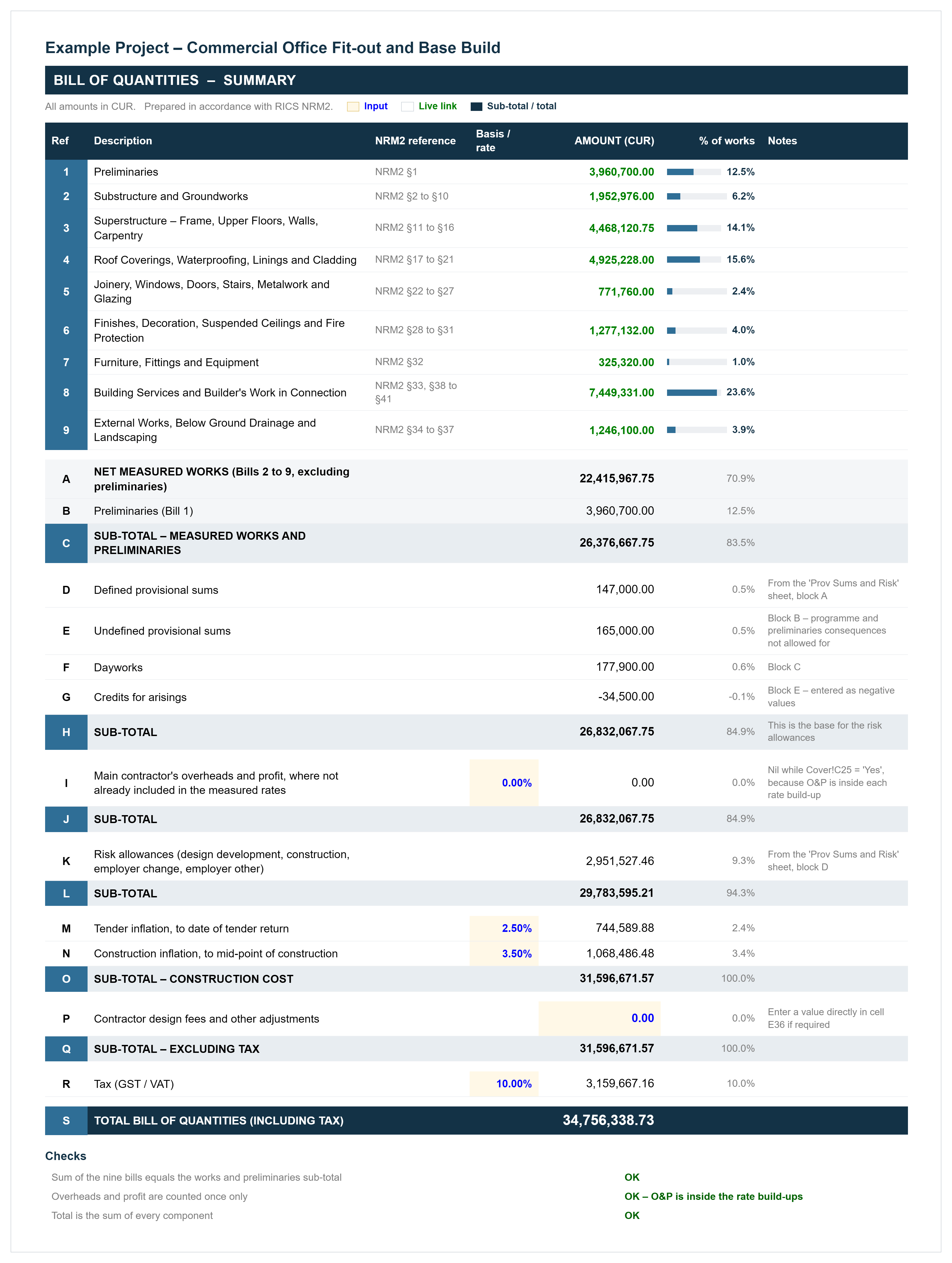
Read it from row A down. Measured works are 70.9% of the construction cost and preliminaries add another 12.5%, with everything below sub-total C an addition rather than measured work. Row H matters most commercially, since it is the base the four risk allowances are calculated on.
How to Use This Bill of Quantities Template in Excel
Set the Cover sheet first, since the currency code, contract duration and global percentages drive every other sheet. Then build your rates before you measure anything, because the bills pick up rates by reference.
Every item beginning EXAMPLE is an illustrative entry with an indicative rate. Delete them all before you issue the bill.
- Set the currency code, contract duration, cost base date and estimate status on the Cover
- Set the global percentages: labour rate, waste allowance, overheads, profit, builder's work in connection, the four risk allowances, both inflation rates and tax
- Decide whether overheads and profit sit inside the rates or as a summary line, using the switch on the Cover
- Build your all-in rates on Rate Build-Up from labour hours, material cost, waste, plant and subcontract, giving each one a BU reference
- Price Bill No. 1 preliminaries as a fixed charge, a time-related charge, or both, with the duration linked to the Cover
- Measure the works across Bills 2 to 9, entering a description, unit and quantity, then either a manual rate or a build-up reference
- Schedule provisional sums, dayworks, risk allowances and credits on Prov Sums and Risk
- Read the cascade on BoQ Summary and confirm all three reconciliation checks pass
- Enter each tenderer's priced summary on Tender Comparison once bids return
Watch the distinction between defined and undefined provisional sums. A defined sum is one the contractor can programme and price preliminaries against. An undefined sum is not, which means its programme and preliminaries consequences are not allowed for and will come back as a claim.
A priced bill becomes the budget the moment a tender is accepted, which is where it stops being a spreadsheet and starts being tracked against contracts and payments in construction cost management software.
Why Quantity Surveyors Use Structured BoQ Formats
Bill of quantities templates prevent the measurement disputes and tender comparison problems that plague ad-hoc spreadsheets. Professional templates transform 40-60 hours of manual BoQ creation into systematic work that maintains RICS compliance throughout procurement.
Here's why structured formats strengthen cost management:
- Accelerates tender preparation: Pre-structured work sections eliminate formatting time, letting quantity surveyors focus on accurate measurement rather than spreadsheet design.
- Ensures fair tender comparison: Identical item descriptions across all construction tenders prevent contractors pricing different scopes then claiming lowest bid.
- Prevents measurement disputes: Standardised units and descriptions eliminate arguments over what was included in original tender pricing.
- Maintains NRM2 compliance: Templates follow current RICS measurement standards, avoiding outdated SMM7 approaches that trigger specification conflicts.
- Reduces variation claims: Complete preliminaries sections prevent contractors claiming "unforeseen" costs that were always site requirements.
- Supports interim valuations: Consistent item breakdown enables accurate progress measurement for monthly payment certificates without reconciliation disputes.
- Facilitates final account settlement: Clear item descriptions with measured quantities create defensible records when contractors challenge final payment reconciliation.
Teams using BoQ templates complete tender preparation faster than those building BoQs from scratch whilst dramatically reducing post-tender clarification queries.
When to Use Bill of Quantities Templates in Projects
Deploy BoQ templates during tender preparation when accurate cost comparison across multiple contractors becomes critical. Key deployment moments for BoQ templates include:
- Tender documentation preparation: Create consistent pricing frameworks before releasing procurement packages to ensure fair contractor comparison.
- Design development completion: Generate preliminary BoQs from design documentation to validate budget alignment before finalising specifications.
- JCT traditional procurement: Deploy full measured BoQs when using JCT Standard Building Contract with Quantities for transparent pricing.
- Two-stage tendering: Issue approximate BoQs during Stage 1 for cost planning, then refined versions at Stage 2 for firm pricing.
- Subcontractor package preparation: Break down specialist work sections into standalone BoQs that integrate into main contract measurement.
- NEC Option B contracts: Prepare priced activity schedules using BoQ structure when NEC3 or NEC4 contracts require bill of quantities.
- Variation pricing frameworks: Establish daywork rates and measurement conventions before contract execution to prevent dispute over change pricing.
💡 Pro Tip: Issue your BoQ structure to design teams during RIBA Stage 3. Early alignment between drawings, specifications, and measurement items prevents the costly rework of realigning documents at tender stage.
Common Problems with Free Excel and PDF BoQ Downloads
Generic downloadable bill of quantities templates create more problems than solutions on complex projects. Generic formats lack project-specific work sections whilst outdated structures reference superseded SMM7 standards rather than current NRM2 requirements.
Typical challenges with free generic downloads include:
⚠️ Outdated measurement standards: Most free templates follow SMM7 from 1998, not current NRM2 standards.
⚠️ Incorrect work section hierarchy: Generic downloads use arbitrary groupings rather than NRM2's systematic structure.
⚠️ Missing preliminaries detail: Basic templates provide single-line items rather than comprehensive site establishment cost breakdowns.
⚠️ Formula errors in Excel: Downloaded spreadsheets contain broken references and incorrect formulas producing wrong totals.
⚠️ Incompatible with quantity take-off: Free formats lack measurement hierarchy required for professional quantity surveying software integration.
⚠️ No provisional sum structure: Templates omit defined/undefined provisional sum distinctions determining contractor design responsibility.
⚠️ Inadequate preamble sections: Generic downloads lack specification detail, forcing manual addition of workmanship standards.
⚠️ Wrong measurement units: International templates mix metric and imperial units, creating tender interpretation confusion.
💡 Pro Tip: If using free templates, check the publication date. Anything before 2012 will use SMM7, requiring complete restructuring to NRM2 anyway - you'll spend more time converting than building from scratch.
Best Practices for Bill of Quantities Preparation
Effective BoQ preparation requires systematic measurement aligned with specifications whilst maintaining clear item descriptions that prevent contractor interpretation disputes. Follow proven practices that reduce tender queries and support accurate contract administration.
☑️ Match drawings and specifications exactly: Every BoQ item must correspond to specific drawing references, preventing "not shown" claims.
☑️ Use consistent item descriptions: Standardise terminology across similar elements so contractors price identical scope, not interpretations.
☑️ Include comprehensive preambles: Define workmanship quality, material standards, and testing requirements before measured items for pricing context.
☑️ Separate provisional from PC sums: Distinguish undefined work from supplier-provided items to allocate design responsibility correctly.
☑️ Establish daywork rates early: Complete labour classifications and material markups before contract execution to prevent variation disputes.
☑️ Cross-reference drawings systematically: Add drawing numbers to item descriptions so contractors identify exact locations during pricing.
☑️ Review for measurement completeness: Check every specification clause appears as measured item to prevent "not included" claims.
Regional Differences: BoQ Standards Across Jurisdictions
Bill of quantities formats vary significantly by region, reflecting different measurement conventions and contract frameworks. Understanding these distinctions prevents confusion when working across jurisdictions or managing international projects.
NRM2 remains the dominant standard for UK building works, whilst CESMM4 (Civil Engineering Standard Method of Measurement) governs infrastructure projects. Australian practices follow similar principles but with terminology differences like "superintendent" rather than "contract administrator" and "practical completion" stages.
Related Articles and Templates
Explore these resources for construction estimating, quantity surveying, tendering, and cost planning:
- Bill of Quantities in Construction: Meaning, Example, and How to Prepare One
- Construction Estimate Template
- Project Cost Plan Template
- Tender Document Template
- Construction Bid Template
- Tender Process in Construction: 10 Key Steps for Project Success
- 9 Proven Construction Estimating Best Practices for Owner’s Reps and PMs
- What is a Quantity Surveyor? Key Roles in Cost Management

Written by
Jackson Row
Jackson Row joined Mastt's founding North American team in 2023, implementing the platform for US government agencies and Fortune 500 organizations. He holds a Bachelor of Engineering in civil and mining engineering from UNSW and began his career as a construction cadet on civil projects in Sydney. At Mastt, he contributes articles on payment and client-side project management.

Use this bill of quantities template to standardise tender pricing and prevent measurement disputes. Pre-structured NRM2 formats eliminate 40+ hours of manual BoQ creation whilst ensuring fair tender comparison.

Top Performers Don’t Guess. They Deliver.
Cut the stress of showing up unprepared
Start for FreeTrusted by the bold, the brave, and the brilliant to deliver the future