

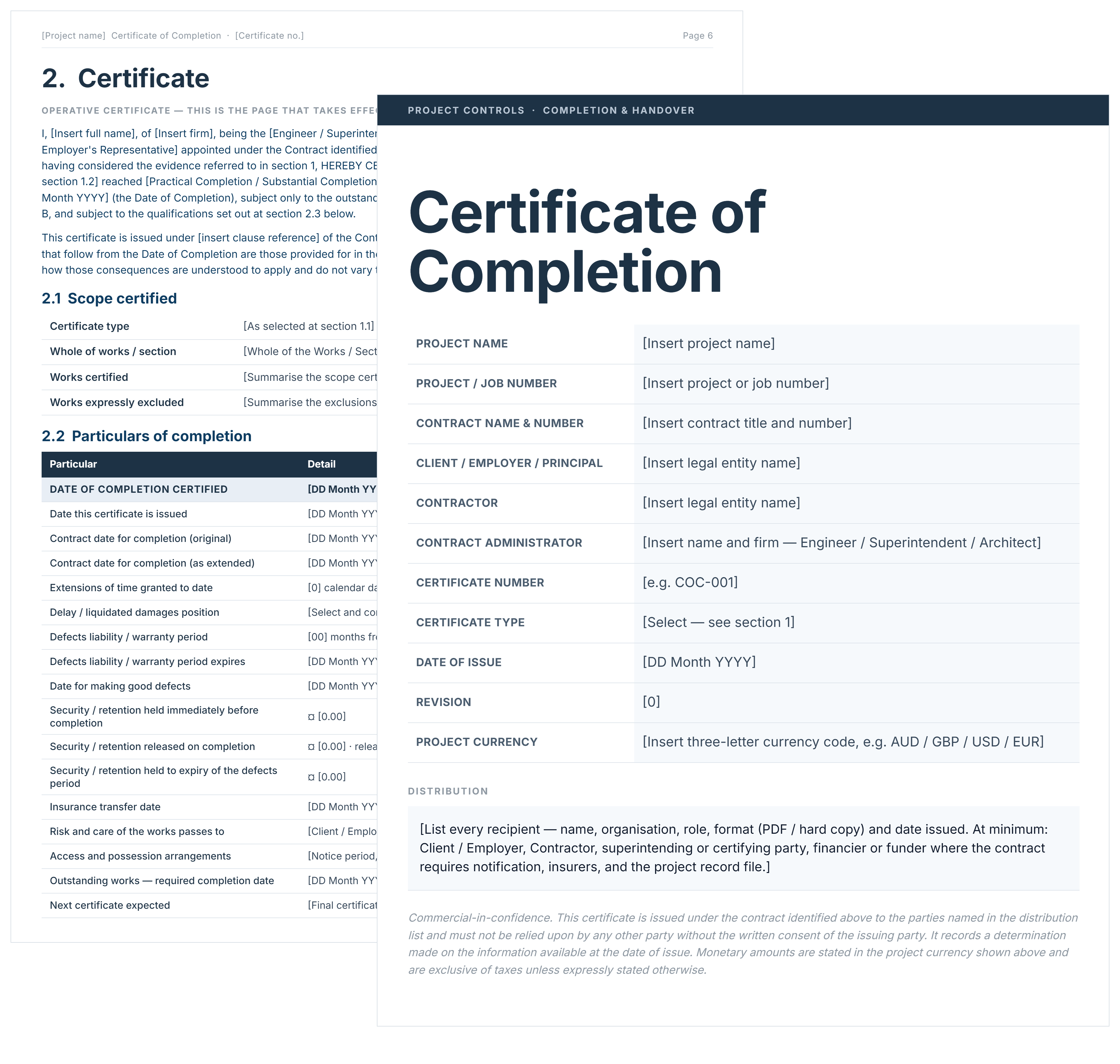

What is a Certificate of Completion for Construction?
A certificate of completion for construction is a formal document confirming that contracted work meets specified requirements and project objectives. The certificate states construction has reached the stage where owners can occupy or use the facility.
This document triggers critical contractual obligations including warranty commencement, retainage release, and final payment processing. Construction teams issue completion certificates after inspecting work, verifying punch items, and confirming compliance with contract documents and codes.
Certificate of Completion for Construction Template Key Components
A certificate of completion for construction work contains essential verification fields documenting project handover and contractual obligations. Each component provides legal protection and establishes clear records for warranty coverage, payment processing, and occupancy authorization.
Standard elements in a certificate of completion for construction template include:
- Project Identification: Contract number, project name, site address, and owner details linking certificate to specific agreements.
- Completion Date Declaration: Date when work reached substantial completion, triggering warranty periods and liquidated damages calculations.
- Architect or Engineer Certification: Professional stamp confirming construction substantially conforms to contract documents, drawings, and specifications per AIA.
- Punch List Status: Minor incomplete items or defects not preventing facility use, with completion timelines specified.
- Certificate of Occupancy Reference: Confirmation that Authority Having Jurisdiction (AHJ) issued occupancy permits allowing building use.
- Contractor Affidavit: Statement confirming subcontractors and suppliers have been paid, supporting lien waiver submissions and final payment.
- As-Built Documentation: Verification that updated drawings, operation and maintenance (O&M) manuals, and warranty documents were submitted.
- Retainage Release Authorization: Statement triggering release of withheld funds, typically 5-10% of contract value.
- Signature Block: Spaces for General Contractor, Project Owner, and design professional signatures formalizing handover acknowledgment.
💡 Pro Tip: Include an O&M documentation checklist in your template listing each required manual by system. Generic checkboxes let contractors claim completion without delivering maintenance instructions facility managers need.
Example of Certificate of Completion for Construction
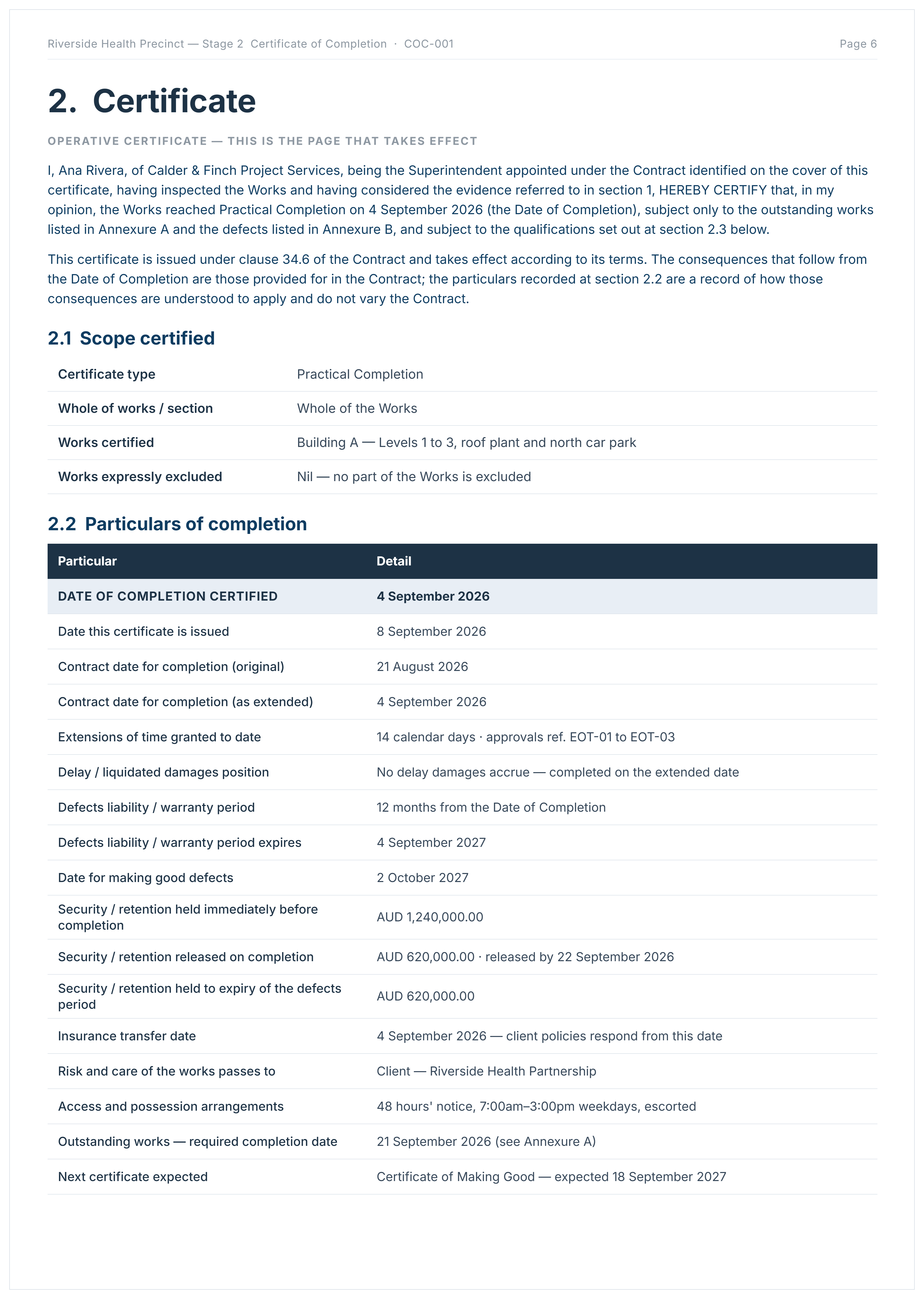
Here is an example of a certificate of completion for a construction project, issued by the superintendent for practical completion of a health precinct stage. It shows section 2, the operative page that actually takes effect.
How to Use This Free Certificate of Completion Template in Word Format
Choose the completion type at section 1 first, since the same event carries a different name in every contract family. Then work forward: section 1 fixes what is certified, section 2 is the page that takes effect.
Replace every bracketed field, delete every EXAMPLE row, and never issue it without Annexures A and B.
- Complete the cover with the project, contract, parties, certifier and distribution list.
- Select one completion type at 1.1, matching your contract family.
- Record the basis at 1.2: the clause relied on, the inspection dates, and exactly what is certified and excluded.
- Work through the fourteen conditions precedent at 1.3, with an evidence reference against each.
- Obtain a written waiver for any condition not satisfied, or do not issue.
- Complete the operative certificate at section 2 and the particulars at 2.2.
- Build Annexure A for outstanding works and Annexure B for defects.
- Complete the handover checklists, then sign and issue.
Classifying items between Annexure A and B decides money. Outstanding works are not yet done and are withheld from payment. Defects are done badly and are secured by retention instead.
Why Issue a Certificate of Completion of Project?
A certificate of completion in construction protects owners and contractors by formally documenting when obligations shift from construction to warranty. Clear certification prevents payment disputes and occupancy delays that damage project closeout and stakeholder relationships.
Formal completion documentation delivers these protections:
- Establishes legal completion dates: Prevents disputes over warranty commencement, liquidated damages termination, and retainage release timing.
- Triggers final payment processing: Authorizes release of withheld funds after contractors demonstrate substantial performance and submit closeout documentation.
- Protects lien rights: Creates documented completion dates contractors need for mechanics lien filings during payment disputes.
- Enables occupancy authorization: Provides owners formal documentation supporting certificate of occupancy applications and insurance policy activation.
- Shifts maintenance responsibility: Transfers facility care from contractor to owner, defining who handles repairs after handover.
- Activates warranty coverage: Starts manufacturer warranty periods and contractor guarantee obligations tied to documented completion milestone.
- Supports insurance claims: Provides insurers verified completion dates needed for builder's risk policy termination and permanent coverage activation.
- Facilitates project closeout: Creates documented milestone required for final accounting, lender draws, and administrative closure.
Teams that document completion formally close projects faster than those relying on informal handovers. The difference lies in clear documentation rather than verbal agreements when final payment timing gets disputed.
💡 Pro Tip: Issue two certificates - one at substantial completion for payment release, another at final completion after punch list. Contractors push for payment before fixing defects. Separate certificates protect owners whilst releasing most funds to maintain contractor relationships.
When Should to Issue a Construction Certificate of Completion?
Certificate of completion for construction projects should be issued when work reaches substantial completion. This means the owner can occupy or use the facility despite minor incomplete items.
Issue completion certificates at these critical project milestones:
- Substantial completion achievement: When construction reaches where buildings can be occupied for intended purpose despite minor punch items.
- Certificate of occupancy receipt: After building officials inspected facility and issued permits authorizing occupancy under applicable building codes.
- Punch list finalization: Once parties documented incomplete work with specific locations, required corrections, and agreed completion deadlines.
- Closeout documentation submission: When contractors provided as-built drawings, O&M manuals, warranties, training, and all required contract deliverables.
- Lien waiver collection: After receiving unconditional waivers from contractors and conditional waivers from subcontractors protecting owners.
- Final payment processing: Before releasing retainage and processing final contractor payments, using certificates documenting substantial performance occurred.
- Warranty period commencement: At specific date when manufacturer warranties and contractor guarantees begin coverage periods per contract terms.
- Insurance policy transitions: When builder's risk coverage terminates and permanent building insurance activates, requiring documented completion dates.
💡 Pro Tip: Issue substantial completion certificates within 48 hours of final walkthrough. Delays give contractors excuses to dispute the date later. Document everything immediately whilst memories are fresh and defect lists are accurate.
Problems with Generic Completion Certificate Templates in Excel and Word
Generic downloadable construction certificate of completion templates create documentation gaps that undermine legal protection during closeout. Generic formats in Excel and Word lack the contract-specific language and verification fields that courts require when payment disputes or warranty claims arise.
Typical problems with manual completion documentation:
⚠️ Missing contract-specific language: Free templates omit precise completion definitions, punch list procedures, and warranty provisions in construction contracts.
⚠️ Vague punch list documentation: Generic formats allow ambiguous descriptions like "minor touchups needed" that contractors dispute during negotiations.
⚠️ Incomplete signature blocks: Templates downloaded online lack spaces for required parties including surety representatives, lenders, or commissioning agents.
⚠️ No lien waiver integration: Word formats don't remind teams to collect unconditional waivers protecting owners from subcontractor disputes.
⚠️ Ambiguous completion dates: Excel templates use imprecise language about completion timing, creating warranty disputes and liquidated damages claims.
⚠️ Version control failures: Multiple people editing Word files creates conflicting certificates showing different completion dates or punch items.
⚠️ Missing occupancy references: Generic templates omit fields confirming certificate of occupancy issuance, creating premature building use liability.
⚠️ Inadequate warranty documentation: Free formats don't require verification that warranty certificates and O&M manuals before certifying substantial completion.
💡 Pro Tip: Never accept contractor-prepared certificates without architect review. Contractors issue their own certificates claiming completion before punch lists are agreed. Always require your design professional's independent verification before signing anything.
Issue Construction Completion Certificates with Mastt AI
Every construction project reaches the critical handover moment when work transitions from contractor responsibility to owner operations. The difference between smooth closeout and extended disputes lies in documentation establishing completion dates, remaining obligations, and warranty commencement.
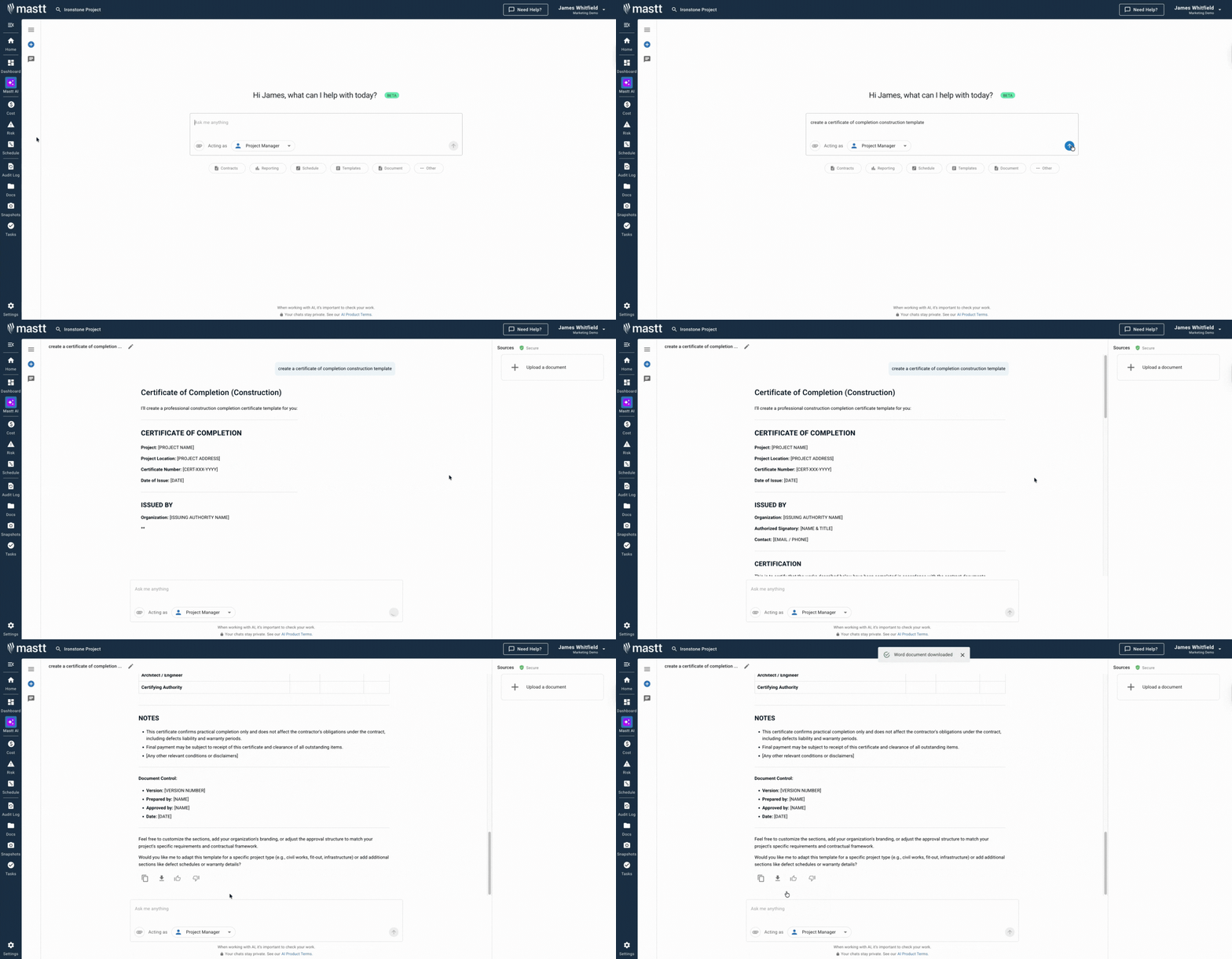
With Mastt AI, you generate professional certificate of completion of construction project tailored to your contract requirements in seconds. No more struggling with generic templates that miss contract-specific language or reformatting old project documentation for new closeouts.
👉 Create your construction completion certificate with Mastt AI and formalize project handover with confidence.
Related Articles and Templates
Explore these resources for construction completion, practical completion, handover, and project closeout:

Written by
Jackson Row
Jackson Row is the Growth & North American Market Lead at Mastt. With a background in risk modeling, cost forecasting, and integrated project delivery, he helps capital project owners work smarter and faster. Jackson’s work supports better tools, better data, and better outcomes across the construction industry.

Free certificate of completion construction template to formalize project handover and trigger warranty periods. Verify work completion, document punch list status, and protect payment rights with proper closeout certification.

Top Performers Don’t Guess. They Deliver.
Cut the stress of showing up unprepared
Start for FreeTrusted by the bold, the brave, and the brilliant to deliver the future