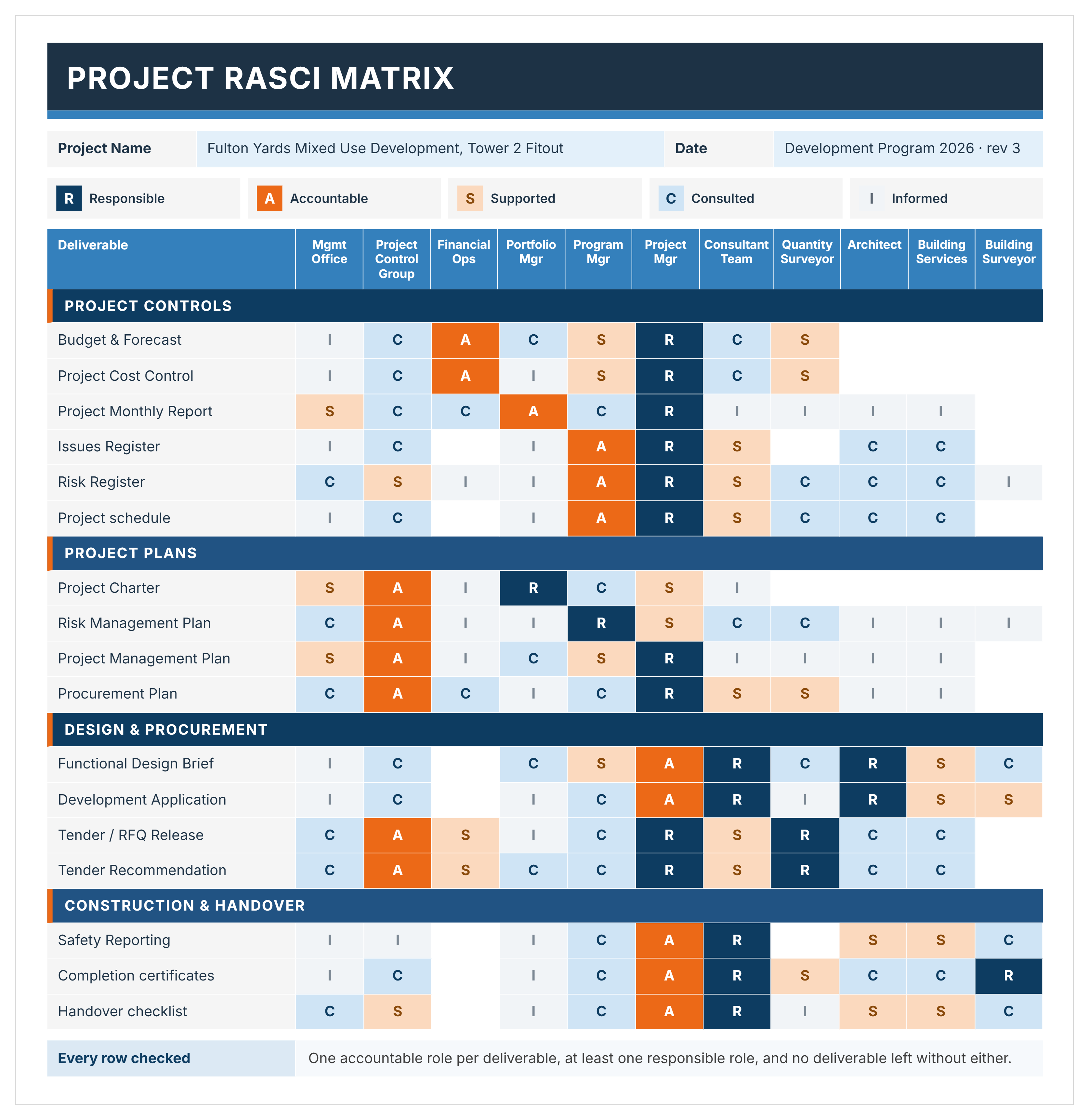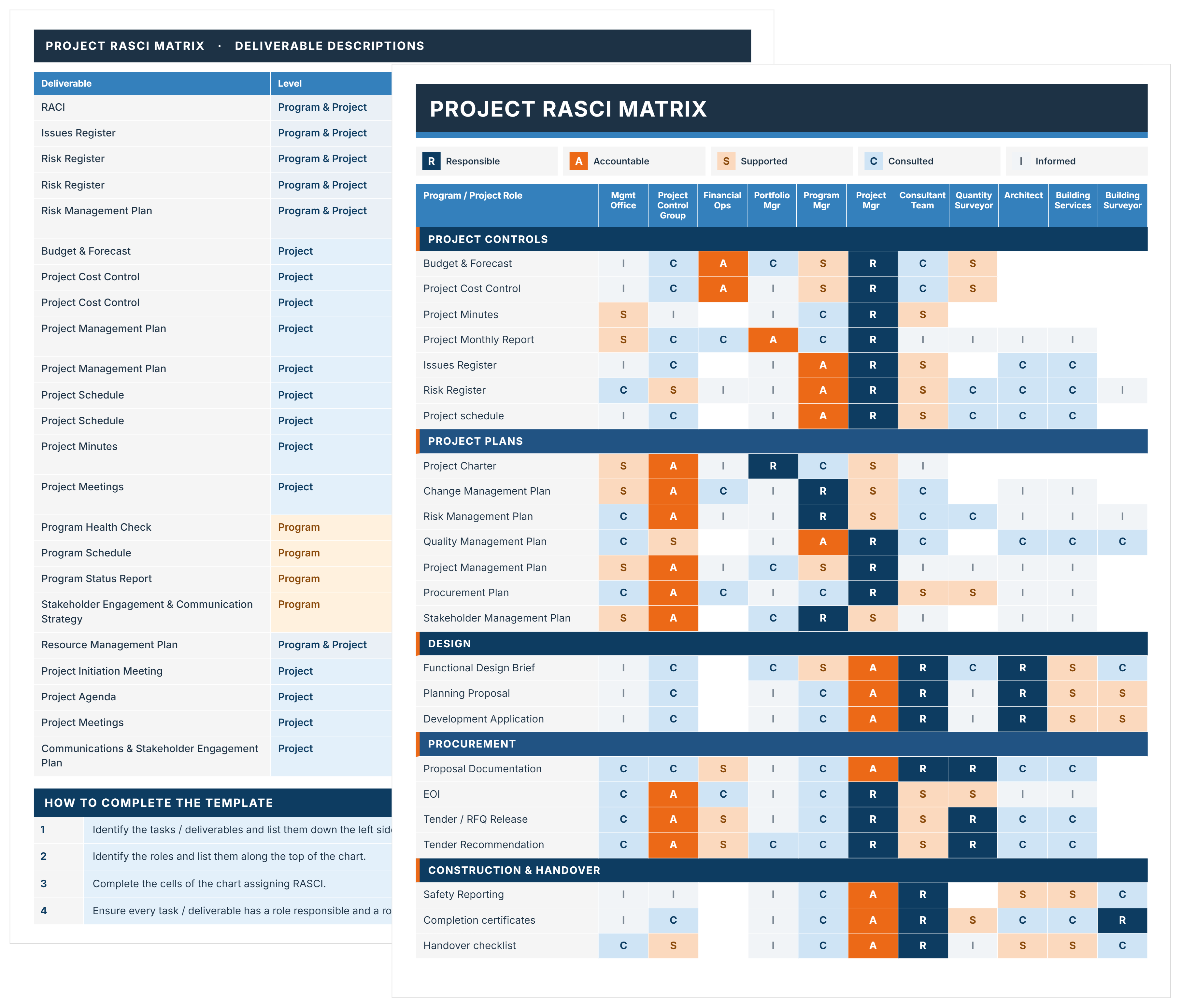
RASCI matrix template example mapping construction project roles and responsibilities across your team
Free Template

RASCI Matrix

Use this free RASCI matrix template to assign Responsible, Accountable, Supportive, Consulted, and Informed roles to every project activity. Eliminate role confusion before work starts.

Templates
Word Template
Excel Template
Powerpoint Template
RASCI Matrix
Template by
Doug Vincent
Published:
Feb 13, 2024

What is a RASCI Matrix?

A RASCI matrix is a responsibility assignment chart widely used in project management. It assigns one of five designations to every person on every activity. Those five designations are: Responsible, Accountable, Supportive, Consulted, and Informed.

RASCI matrices arrange activities in rows and participants in columns. Each cell in the chart holds a single letter. The RASCI model traces back to role-mapping techniques from the United States. Firms like Ernst & Young and DuPont later formalized the approach.

The RASCI definition applies across industries: construction, IT, finance, and operations. Recognized by PMI (Project Management Institute), PRINCE2, and ISO 21500, it works across any project delivery model. What matters most is that every deliverable has a named owner.

What's Included in a RASCI Matrix Template?

A RASCI matrix template contains all five RASCI roles in a ready-to-fill grid for task distribution across every participant. The template lays out a simple structure: activities on one side, people on the other.

Core components of this grid include:

  • Activity list: Every deliverable, work item, or key decision, listed as rows down the left side.
  • Participant headers: Names or designations of every contributor, arranged across the top row.
  • Responsible (R): The person who executes the work. The Responsible (R) designation means they own delivery.
  • Accountable (A): The single owner who approves and signs off. Only one A per activity.
  • Supportive (S): The Supportive role provides active assistance to the R party without full ownership.
  • Consulted (C): Subject matter experts whose input is sought. Two-way communication only.
  • Informed (I): Parties who receive updates. One-way communication on completion.
  • Legend: A key explaining each letter, placed below or beside the grid.
💡 Pro Tip: Keep activities at deliverable or phase level, not micro-tasks. Mapping every sub-activity creates a grid no one maintains past week two.

Why Use a RASCI Framework Instead of RACI?

The RASCI framework solves a gap the RACI model leaves open. It formally recognizes support contributors: people who actively assist without full ownership.

Standard RACI matrices only assign four designations. The RACI roles (Responsible, Accountable, Consulted, Informed) don't formally account for contributors who assist without owning.

A RACI chart example makes this clear: an engineer providing materials support for a design activity has no clean home in RACI. In RASCI, they hold an S. On a complex project with many workstreams, that distinction prevents accountability failures.

The RASCI matrix gives project teams sharper ownership clarity. Here's why they choose it:

  • Prevents R overload: The S designation absorbs active support so the Responsible party isn't buried in work.
  • Reduces ownership disputes: S vs R clarifies who leads and who assists when multiple people share a deliverable.
  • Eliminates consulting confusion: C is for input only. S means active, ongoing participation with real output.
  • Improves project outcomes: Clear designations close accountability gaps on critical deliverables.
  • Formally recognizes support contributors: Informal helpers go unacknowledged in RACI. RASCI gives them an official position.
  • Aligns with governance frameworks: PMI, PRINCE2, and Lean Six Sigma practitioners use RASCI in project governance documentation.
  • Better for cross-functional work: When departments share deliverables, the S assignment prevents duplication and under-delivery.
💡 Pro Tip: Don't apply RASCI to every project. For small teams with simple deliverables, RACI matrix is enough. Reserve RASCI for work where support functions are genuinely separate from doing.

How to Create and Use a RASCI Chart Step by Step

To create a RASCI matrix, list activities as rows, add participants as columns, and assign one letter per cell. Start during project initiation, before any work begins. Assigning designations after activities start creates gaps and disputes fast.

Follow these steps to build and apply it:

  1. Define the scope: List every project task, key decision, and major deliverable. Use a work breakdown structure template as your starting point.
  2. Identify all participants: Name every person, function, or department involved. Include external parties and contractors.
  3. Assign for each specific task: Go row by row. Give R, A, S, C, or I to every participant-activity pair.
  4. Apply the one-A rule: Every activity gets exactly one A. Shared accountability on a task is no accountability at all.
  5. Check for task execution gaps: Every activity needs at least one R. No R means no one is doing the work.
  6. Review team members' columns: Scan vertically per person. Too many R assignments is a resource risk. Redistribute early.
  7. Validate with participants: Share the draft with everyone involved at your project kickoff meeting. Disputes surface here, not during project execution.
  8. Distribute and reference it: Issue the finalized document at kickoff. Revisit at every phase gate review.

In use, the RASCI matrix is the first reference point when ownership is disputed. "Check the RASCI" resolves conflicts faster than any follow-up meeting.

💡 Pro Tip: When assigning R, ask: "Who takes the call at 10pm if this fails?" That person is your R, not whoever simply helps.

Generate and Download Custom RASCI Template with Mastt's AI Assistant

Mastt's AI Assistant eliminates the manual work of building a RASCI document from scratch. Downloading a blank RACI matrix template and reformatting it for your project wastes hours.

Here's what you can do:

🚀 Generate from any project type: Describe your project and team structure. Mastt's AI builds a complete RASCI grid instantly.

📂 Upload an existing scope document: Drop in a PDF scope of work or project brief. AI extracts activities and pre-fills the chart.

Refine through conversation: Adjust designations, add activities, or rename participants by simply typing your changes.

📑 Export in Excel or Word: Download your finished document in Excel or Word, no reformatting needed.

Getting started is easy:

  1. Type a request like "create a RASCI matrix for a commercial construction project" or "build a RASCI chart for a software rollout."
  2. Refine through dialogue, add activities, reassign designations, or upload a supporting document.
  3. Download your finished RASCI file in Microsoft Excel or Word, ready for team distribution.

Every conversation stays private in your secure workspace.

👉 Visit the Mastt Help Center to learn more about Mastt's AI Assistant.

Mastt's AI Assistant interface generating RASCI matrix template to map roles and responsibilities across project team

Who Should Use a RASCI Responsibility Matrix?

Project managers are the primary owners of a RASCI matrix. They build, maintain, and enforce it. Any group with unclear ownership benefits from one.

The project team must understand their designation from day one. Here's who benefits most:

Project Manager: Builds, owns, and maintains the chart. Uses it as the definitive reference when ownership disputes arise.

Project Owner: Holds the A designation on key decisions and strategic deliverables. Defines sign-off authority before work starts.

✅ Business Analyst: Facilitates RASCI workshops. Maps project roles across workstreams and validates designations with contributors before kickoff.

PMO Director: Standardizes RASCI use across the portfolio. Drives consistent project planning and governance documentation.

General Contractor: Clarifies the stakeholder network across owners, trade contractors, and consultants on construction projects.

✅ Operations Manager: Uses RASCI to bring process improvement clarity where cross-functional accountability breaks down.

Construction Project Manager: Assigns designations across design teams, trade contractors, and owner's representatives on capital works.

✅ Change Manager: Tracks a team member's obligations across overlapping organizational programs.

💡 Pro Tip: Assign a single "RASCI owner," one person who keeps the document current. Without one, the chart goes stale after the first scope change.

When Your Project Needs a RASCI Grid

Set up a RASCI matrix at project initiation, before activities begin and assumptions take hold. Starting early is directly tied to project success. A late rollout means inheriting undocumented ownership agreements that are hard to undo.

Use one in these situations:

  • Project kickoff: Before any work begins. Establish designations for every key deliverable and decision point.
  • Multi-team or multi-contractor projects: When more than one department or trade shares accountability for the same deliverable.
  • New team formations: When contributors are unfamiliar with each other's authority or decision limits.
  • Scope changes: When new work is added, assign designations before that work starts.
  • Phase gate transitions: Before moving between project phases, re-validate all designations against updated scope.
  • Compliance or regulated work: When each approval or sign-off step needs a documented A designation for audit purposes.
  • Project recovery: When work is off-track, a RASCI audit quickly surfaces unassigned activities and ownership voids.

Most project teams introduce RASCI too late, after confusion has already set in. Build it before the kickoff meeting, not during it. People align on assignments more honestly when stakes aren't yet personal.

Best Practices for Building Accurate RASCI Charts

Building an accurate RASCI matrix demands discipline beyond basic designation assignment. These practices address real failure points, not textbook advice.

☑️ Run a vertical column audit: Scan each person's column, not just rows. A column dense with R assignments is an overload risk most reviewers miss entirely.

☑️ Version-control every revision: Add a date stamp and a one-line change note to every update. When disputes arise weeks later, the version history shows exactly what was agreed.

☑️ Cap S assignments per activity: Limit Supportive designations to two per activity. More than two signals unclear ownership. Elevate one to R or consolidate the support function.

☑️ Co-create it, don't hand it down: Build the RASCI grid with your team in a workshop. Contributors who co-create it respect it more during execution than those handed a finished document.

☑️ Keep decision grids and deliverable grids separate: On larger projects, maintain two grids, one for who makes decisions and one for who produces work. Combining them creates noise.

☑️ Separate R and A on critical deliverables: When one person both executes and approves, there is no independent check. Build in separation wherever quality sign-off matters.

☑️ Use the grid to catch scope creep early: Any new activity not in the RASCI has no formal owner. That gap is your earliest scope creep warning signal.

Common Problems with Free RASCI Templates and Manual Charts

Free RASCI templates create accountability problems before a project even starts. Static downloads don't hold up under real project conditions.

⚠️ Generic activities don't fit your project: Free downloads use placeholder items that require a full rebuild before they're usable.

⚠️ S and C designations get confused: Most free documents include no guidance on the difference. Teams mis-assign these regularly, leaving support contributors invisible.

⚠️ Version chaos from shared files: Without a central system, teams circulate outdated copies. Different contributors work from different grids, with conflicting owners assigned.

⚠️ No RACI chart layer for decisions: A separate RACI decision tool is often needed for decision ownership alongside a RASCI. Free downloads rarely provide both in one cohesive structure.

⚠️ Reformatting a RACI template into RASCI adds a column but nothing else: Most people add the S column without updating the underlying process. The S designation exists on paper but has no defined meaning in practice.

⚠️ The RACI framework assumption breaks down: RASCI only works if the document stays current. This principle, that the grid is a live source of truth, collapses when updates stop.

⚠️ Column overloading goes unnoticed: Without automation, no one sees that one participant holds R on the majority of activities until burnout hits.

⚠️ Free downloads don't adapt across project types: A grid built for software delivery doesn't translate to construction, finance, or operations without a full rebuild.

The real cost of a bad RASCI isn't rebuilding the document. It's the ownership disputes, missed deliverables, and stalled decisions caused by working from a broken grid.

Fix Role Confusion for Good with Mastt

When a RASCI matrix is built from a generic download and never updated, it stops working fast. Role confusion returns. Ownership voids widen. Decisions stall.

Mastt's AI Assistant generates a customized RASCI document in seconds. Describe your project, and it builds the grid tailored to your team and activities, no blank files, no manual formatting.

👉 Build your first RASCI matrix free in Mastt's AI Assistant today.

FAQs About RASCI Matrices

RASCI is an acronym for Responsible, Accountable, Supportive, Consulted, and Informed. These five designations cover every level of project involvement, from execution to passive awareness.
RASCI adds the Supportive designation to the standard RACI set. The S formally recognizes contributors who assist the Responsible party without full ownership, a gap RACI doesn't address.
Microsoft Excel is the most common choice because it handles large grids and supports color-coding. Word works for smaller projects or narrative-style documentation. Mastt's AI Assistant exports in both.
Update it at every scope change, team change, and phase gate transition. A RASCI grid is a live document, not a one-time setup completed at kickoff.
Yes, but it's not recommended on high-stakes deliverables. When one person both executes and approves, there is no independent check. Separate R and A wherever quality sign-off matters.
Topic: 
RASCI Matrix

Written by

Doug Vincent

Doug Vincent is the co-founder and CEO of Mastt.com, leading the charge to revolutionize the construction industry with cutting-edge project management solutions. With over a decade of experience managing billions in construction projects, Doug has seen the transformative power of the industry in building a better future. A former program manager, he’s passionate about empowering construction professionals by replacing outdated processes with innovative, AI-driven tools. Under his leadership, Mastt serves global clients, including governments, Fortune 500 companies, and consultants, delivering solutions that save time, enhance visibility, and drive efficiency. Doug also mentors entrepreneurs and shares insights on LinkedIn and YouTube.

LinkedIn Icon
Back to top

Frequently Asked Questions

More Templates

Supercharging Construction Project Management with AI Powered Tools