

.avif)

Construction 4.0 uses connected data, automation, and digital technologies to improve project delivery. Some of these tools already improve specific site tasks, though much of their potential remains unrealized. This article explains which technologies are helping, how teams can apply them, and what is holding back wider adoption.
What Is Construction 4.0?
Construction 4.0 is the application of Industry 4.0 principles and technologies to the construction industry. It connects physical work with digital systems, using shared data and automation to support project planning and delivery.
Industry 4.0 refers to the fourth industrial revolution. In manufacturing, it connects machines, sensors, and software so factories can monitor production and respond to conditions in real time. Construction 4.0 applies this approach to the changing conditions and activities of a building project.
For example, Building Information Modeling (BIM) provides structured design information. Cameras and Internet of Things (IoT) sensors capture site conditions and progress. One use of AI in construction is interpreting this data to help teams understand ongoing work. Robots can also automate tasks such as surveying and scanning.
What Are the Core Principles of Construction 4.0?
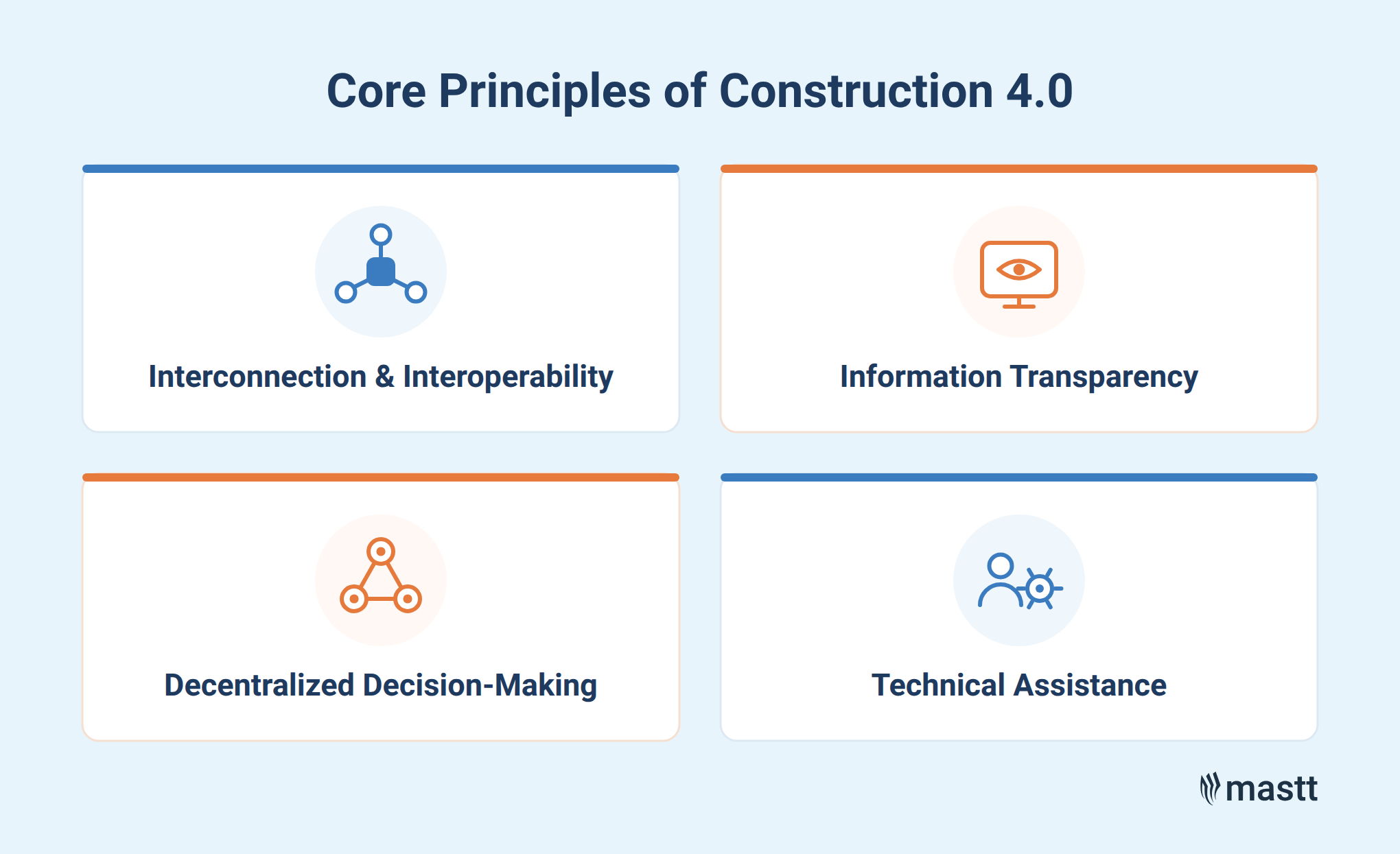
Construction 4.0 centers on connecting systems, making information understandable, enabling decisions where work happens, and supporting people with technology. Hossain and Nadeem’s research explains how these Industry 4.0 principles apply to construction:
- Interconnection and interoperability: People, equipment, and software connect and exchange usable information. Shared data structures help different systems interpret information consistently, reducing repeated data entry.
- Information transparency: Digital models and sensor data provide an understandable view of physical conditions. Teams can use that view to compare site conditions with the design and identify discrepancies.
- Decentralized decision-making: Connected teams and systems use shared information to make decisions where work happens. Suitable systems can respond automatically within defined limits, with people handling exceptions.
- Technical assistance: Digital tools help people interpret information and perform demanding or repetitive tasks. Applications include decision-support tools and robots that assist with surveying, fabrication, or hazardous work.
Applying these principles requires clear responsibilities for information and action. Project teams need to establish who maintains shared data and which decisions people or systems can make using it. Automated tasks also need defined limits and a route for human review when conditions fall outside those limits.
Which Construction 4.0 Technologies Improve Productivity?
BIM, site cameras, and robotic total stations are helping teams coordinate and carry out work. Sensors also support timely decisions about site conditions. Other applications, including autonomous surveying and AI for material tracking, remain areas of research with potential for further improvements.
1. BIM for design coordination and prefabrication
Looking at the past 20 years, I would put BIM among the biggest technological advances in construction. It helps teams coordinate designs and reduce design conflicts. On larger projects, models also support prefabrication, helping improve productivity and shorten construction durations.
BIM supports material logistics as well. In Finland, we are seeing detailed material quantity takeoffs from models used to coordinate deliveries in kits. Each kit brings together what a crew needs at a particular work location. With a one-day takt, those deliveries provide the materials needed for each day’s work.
2. Cameras and drones for site documentation
Helmet-mounted 360-degree cameras are one application where we have seen practical productivity improvements. They allow people to document work areas as they move through the site, creating a visual record of conditions.
Drones support documentation of external works and infrastructure projects. Their imagery can help teams measure material stockpiles and identify visible quality defects. These applications provide useful information about what is happening outdoors.
3. IoT sensors for managing concrete drying
Concrete drying is a practical example of how IoT sensors support site decisions. In Finland, ensuring concrete is sufficiently dry before installing floor coverings is a recurring challenge.
Sensors in the concrete and surrounding air provide information about temperature and humidity. Teams can respond to those readings in real time and adjust environmental conditions to support drying.
We have seen concrete drying improve when people can take action based on these measurements. The value comes from connecting the readings to decisions about the drying environment.
4. Robotics for layout and autonomous surveying
Robotic total stations help crews locate the points specified in the design without relying on tape measurements. This makes it easier to build accurately and reduce problems caused by deviations from the design.
We have also been investigating Boston Dynamics Spot for autonomous data collection inside buildings. The proposed workflow would use other data sources to identify where production has advanced. The robot could then interact with an elevator, reach the relevant floor, and collect laser scans of those areas.
Equipment cost remains a barrier to wider adoption. This autonomous surveying workflow is still being investigated, and its productivity potential has yet to be established.
5. AI for understanding site activity through materials
Our research is exploring how AI can help us understand site activity through material movement, reducing reliance on individual workers’ location data.
The approach uses sensors embedded in concrete to measure changes in weight across the building. AI would help distinguish between weight changes associated with people and those associated with materials.
Images from 360-degree or fixed cameras, along with material QR codes, would help identify the items present. By combining these sources, we aim to build a clearer picture of what is happening on site without tracking individual workers.
How Can Teams Implement Construction 4.0 on a Project?
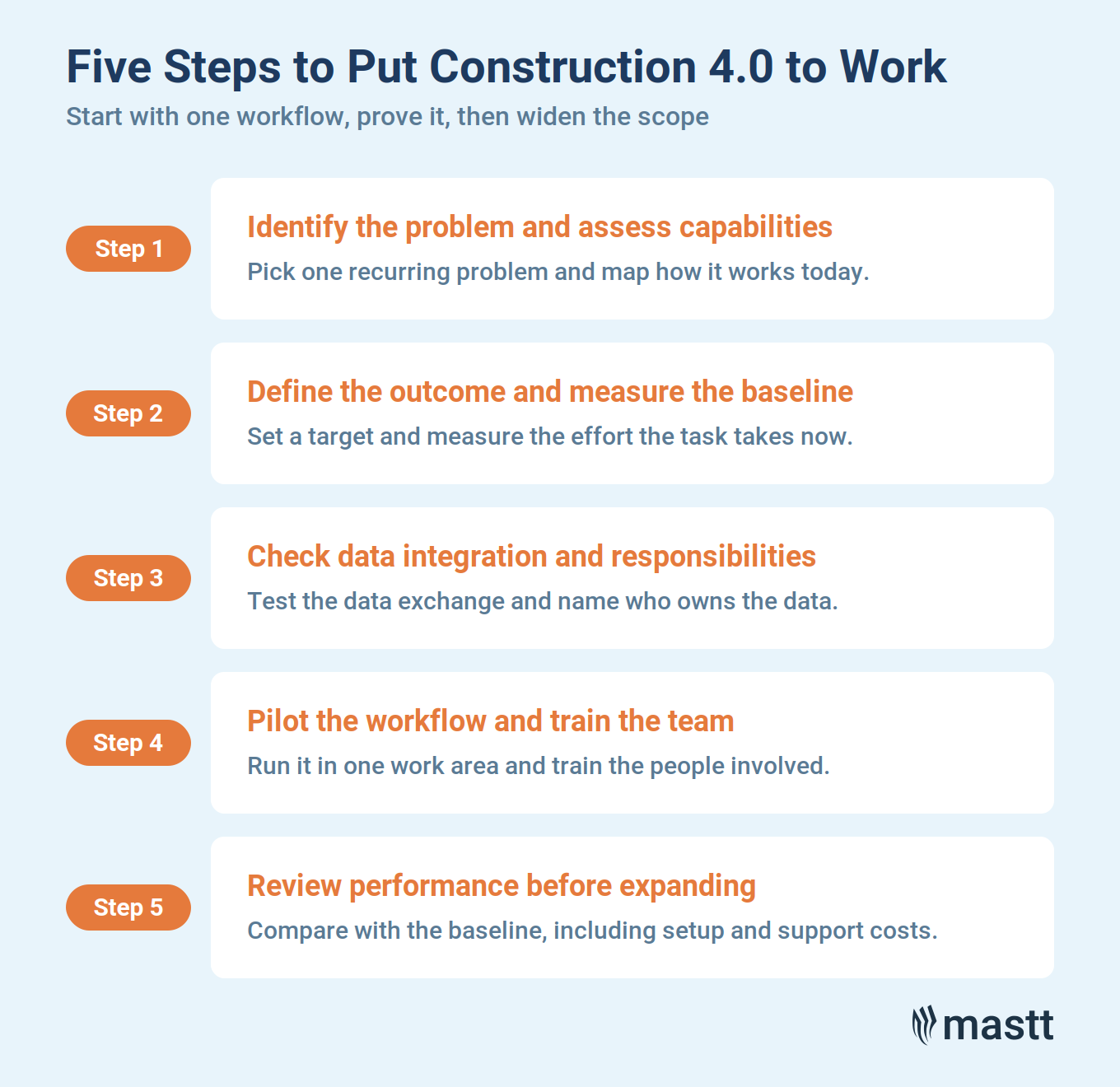
Teams can implement Construction 4.0 by choosing a specific workflow, connecting the information it requires, and testing its performance before wider adoption. The process should account for the people using the technology and the decisions they need to make.
Step 1: Identify the problem and assess current capabilities
Choose a recurring problem that affects production or management workload. Establish how the work happens today, which systems support it, and where information is missing.
For example, crews waiting for materials may face problems with delivery timing or movement within the site. Understanding the cause helps determine whether the project needs better tracking, changes to logistics, or both.
Step 2: Define the outcome and measure the baseline
Decide what improvement the technology should deliver. For a reporting workflow, record the hours spent collecting information and preparing reports. For material handling, measure the effort required to get materials to the work location.
Set a target before introducing the tool. Keep the work scope and quality requirements consistent when comparing performance.
Step 3: Check data integration and responsibilities
Identify which information must move between systems and test that exchange using actual project data. Check whether users need to re-enter information or manually reconcile different records.
Repeated data entry is a practical concern because each additional application can divide management attention. Identify which existing tasks the new workflow will replace, and assign responsibility for maintaining its data.
Step 4: Pilot the workflow and train the team
Test the application within a defined work area or process. Train the people collecting the information and those responsible for responding to it.
A concrete-monitoring pilot, for example, needs someone to review readings and arrange adjustments when drying conditions become unfavorable. The trial should test that response alongside the sensors and software.
Step 5: Review performance before expanding
Compare results with the baseline, including time spent operating the technology and checking its outputs. Include implementation costs, such as setup and training, alongside ongoing support costs when assessing the return.
Use feedback from site teams to identify extra work or unreliable information. Resolve those issues and document the working process before extending it to other areas or projects.
What Are the Barriers to Adopting Construction 4.0 Technologies?
Disconnected software and the additional work required to use it are major barriers to adopting Construction 4.0. Equipment costs, dependence on individual vendors, and concerns about collecting workers’ personal data also affect adoption.
These barriers help explain why useful individual applications have not always improved overall productivity:
One barrier to realizing Construction 4.0’s productivity potential is that individual applications still operate separately. Each requires a user, and the same information often has to be entered repeatedly. We need systems that share common concepts and data models so teams can combine useful applications without adding more manual coordination.
What Will Drive the Next Stage of Construction 4.0?
Further progress in Construction 4.0 depends on connecting useful applications and reducing the effort required to collect and use project information. There is considerable potential, but individual technologies still need to work together more effectively.
The developments I would like to see include:
- Applications that share common concepts: Construction management systems need compatible data models so information can move between them. Teams should be able to combine tools from different vendors without entering the same information repeatedly.
- Better integration of AI into project management: We have been exploring how AI could help project managers handle their workload. The opportunity is to support management tasks where limited staff capacity affects what teams can accomplish.
- Autonomous data collection guided by site activity: Our robot research has investigated using other data sources to identify where production has advanced. That information could direct a robot to the areas requiring updated laser scans.
- Site monitoring with less reliance on personal data: Our material-monitoring research explores combining sensor readings with camera information. The aim is to understand site activity through material movements without relying so heavily on tracking individual workers.
BIM shows that technologies can take time to reach wider use and deliver practical benefits. Design coordination and prefabrication demonstrate what that adoption can achieve. The newer applications still need to fulfill their potential.

Turn Construction 4.0 Into Measurable Improvements
Construction 4.0 delivers value when technology helps people complete work with fewer errors and less effort. Start with a recurring project problem, choose an application that fits the workflow, and measure its effect on both site and management work. Expand its use when the results justify it.

Written by
Olli Seppänen
Olli Seppänen is a tenured Associate Professor of Operations Management in Construction at Aalto University in Finland, and co-author of the foundational text on location-based management for construction. He co-founded the construction software company Vico Software, chairs the board of site-intelligence firm Aiforsite, and initiated the Aalto Building 2030 research consortium. At Mastt, he contributes content on construction productivity, lean, and digital delivery.

.avif)
Contributions by
Doug Vincent
Doug Vincent is the co-founder and CEO of Mastt, the AI capital-project management platform used by governments, Fortune 500 companies, and consultancies across APAC, North America, and MENA. Before founding Mastt in 2019, he spent a decade at RPS delivering more than $2 billion in capital works, including the $2.1B Defence Navy Infrastructure program, and holds a CPSPM certification with the AIPM. He contributes content and speaks on AI in capital project delivery at Mastt.
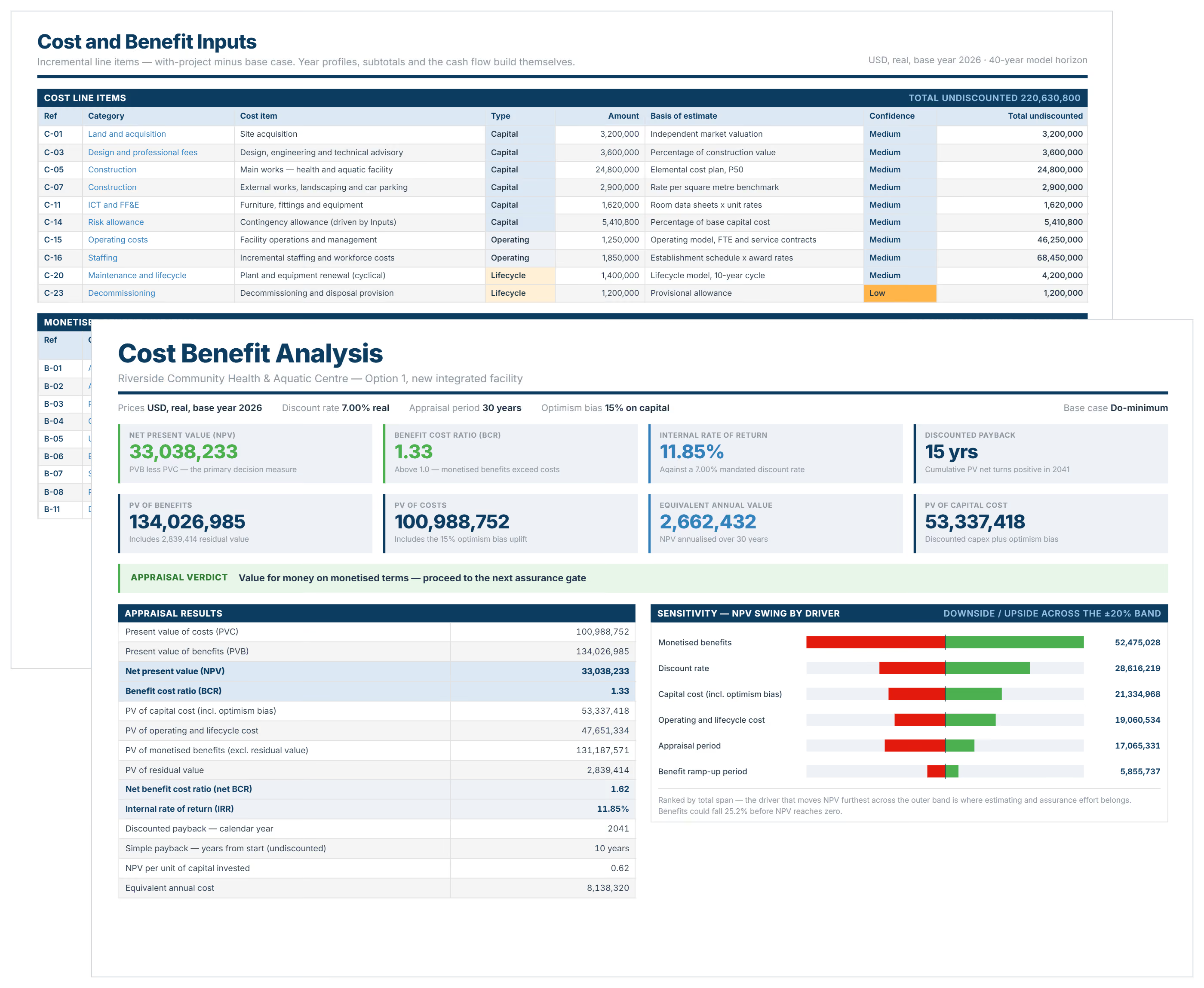
Cost Benefit Analysis Template
Use this cost-benefit analysis template to justify investments and secure funding. Quantify returns, compare options, and demonstrate ROI before committing resources.

Walk Into Every Meeting With Confidence, Clarity, and Control
No one wants to look unprepared, blindsided, or uncertain in front of stakeholders — but that’s exactly what happens without Mastt.
Start for FreeTrusted by the bold, the brave, and the brilliant across governments, Fortune 500s, and the world’s best in delivering the future