

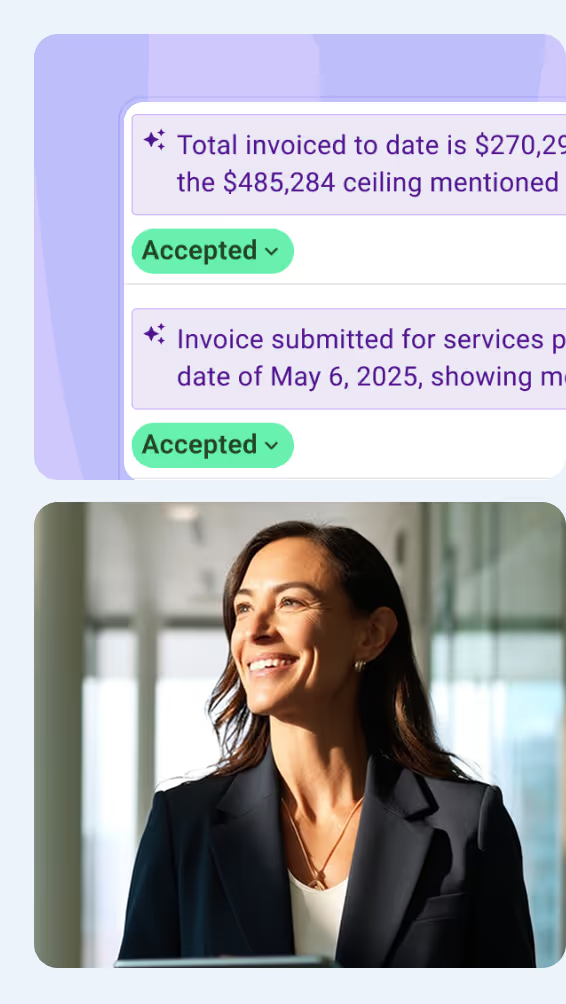



An AI readiness assessment finds the data, access, reviewer, and cost gaps that can stall a construction AI trial before the team commits to one. This guide explains how to assess a construction workflow, interpret the findings, and prioritize preparation. A worked example shows how the assessment informs a decision about testing AI for project cost reporting.
What Is an AI Readiness Assessment?
An AI readiness assessment is an evaluation of whether an organization’s strategy, data, technology, people, and governance can support a specific use of artificial intelligence (AI). It compares current capabilities with the requirements of that use and identifies gaps.
Its main purpose is to help decision-makers choose whether to proceed with a controlled pilot, prepare further, or reconsider the proposed use. This gives the organization a basis for deciding where to commit time, staff, and budget.
In construction, the assessment examines readiness for project tasks, such as cost reporting or document search. It checks the project records, construction systems, client permissions, and staff that each task relies on.
How to Conduct an AI Readiness Assessment in Construction
Assessing readiness to use AI in construction starts with a specific workflow, then examines the data, systems, people, and controls needed to support it. For each step below, the team should record the evidence reviewed, gaps, required actions, and who will address them.
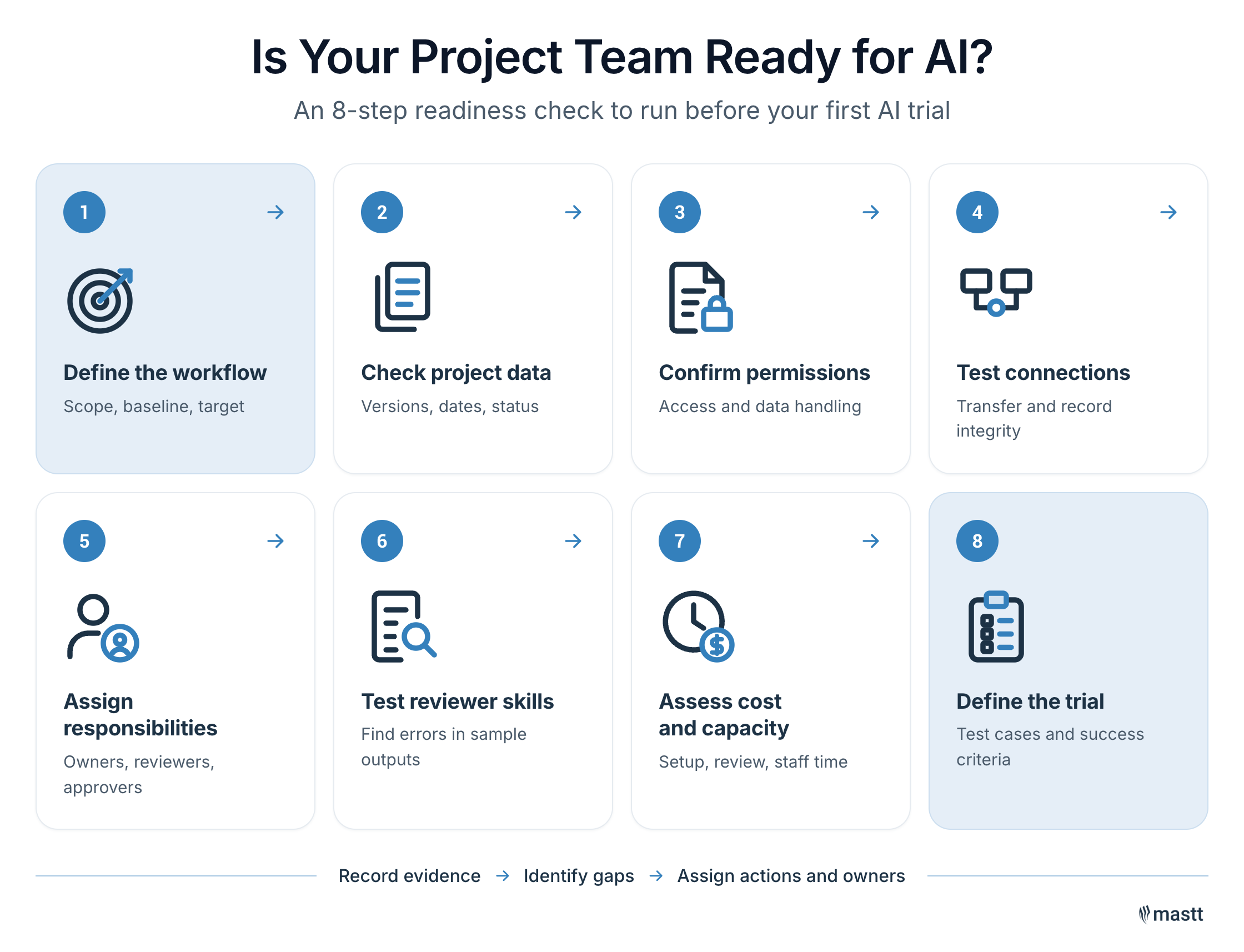
Step 1: Define the workflow and expected improvement
The team should define a specific task and the problem it needs to solve. Examples include drafting cost reports, summarizing site meeting actions, or searching project documents.
When a construction company asks where to start with AI, I ask what problem it wants to solve and why. Teams often arrive with solutions in mind, but the problem needs to be clear before those solutions can be evaluated.
Before choosing a use case, I recommend that leadership sit down with department heads and field users and ask where their pain points are. That listening exercise surfaces what people care about and where AI can add value.
The team should document:
- Scope and users: The project, task, and roles included.
- Current performance: Time spent gathering information, producing the output, reviewing it, and correcting errors.
- Expected improvement: A measurable target against the baseline, with clear quality requirements.
- Operating limits: What AI may read, draft, or change, and which decisions require human approval.
For a cost-reporting pilot, define which tasks a tool such as Mastt AI Agent would handle. The scope could cover preparing a draft, with staff retaining responsibility for figures and approval.
Step 2: Check AI data readiness in project records
The team should inspect the records needed for the selected task and confirm that users can identify the correct versions and interpret them accurately.
I see teams dive into AI adoption and then pause because they do not have the internal data resources to support it. They realize they need to address the data first.
The review should check:
- Document revisions: Current drawings and specifications are distinguishable from superseded versions.
- Cost status: Approved budgets, current forecasts, and pending change orders remain distinguishable.
- Dates: Records show their reporting period and latest update.
- Project context: Project identifiers, units, and other essential details are retained.
Each data gap needs someone responsible for correcting it and maintaining the records during the trial.
💡 Pro tip: Tracing one figure from the latest cost report back to its source and approval record can reveal conflicting versions or missing decisions.

Step 3: Confirm access to client and project information
Relevant project, IT, and legal representatives should review client requirements, provider terms, and access settings to establish:
- Permitted records: Which projects and information the tool may use.
- Access boundaries: Which users and connected tools may retrieve information.
- Provider handling: Where data is processed, who can access it, and whether it may be used for model training.
- Retention and removal: How stored information and access will be managed when the trial ends, or staff leaves.
For a consultancy serving several clients, access testing should confirm that one client’s restricted records cannot appear in another client’s results. Unresolved permissions need a decision before the affected information enters the pilot.
Step 4: Evaluate connections to construction systems
For a shortlisted tool, the team should compare an authorized sample transfer with its source records. Before tool selection, the following checks can serve as requirements for evaluating candidates.
I still see a strong preference for off-the-shelf AI construction tools because many construction organizations do not have an internal team of technical specialists.
The review should check:
- Transfer method: Whether a controlled export is sufficient or a maintained connection is needed.
- Record integrity: Whether project identifiers, cost codes, dates, revisions, and change order status survive the transfer.
- Access controls: Whether restrictions between projects, clients, and users remain effective.
- Tool replacement: Whether project records remain usable if the tool is disconnected or replaced.
Step 5: Map AI responsibilities to project approval roles
The team should assign named people to maintain inputs, review outputs, approve their use, and resolve problems. For a cost-reporting pilot, responsibilities could include:
- Workflow owner: Defines the reporting need and coordinates the trial.
- Data owner: Maintains the source records.
- Output reviewer: Checks figures, status, and explanations.
- Report approver: Authorizes the report for issue.
- Technical contact: Manages connections, access, and technical problems.
One person may hold several roles. The team should also name a backup reviewer and someone authorized to pause the trial.
These responsibilities should fit existing project controls. The National Institute of Standards and Technology (NIST) AI governance guidance recommends documenting AI roles and connecting AI governance to existing risk controls.
Step 6: Assess the project team’s ability to review AI outputs
Intended users should review sample outputs against source records, using examples with known errors or missing information. The exercise should test whether reviewers can:
- Interpret costs: Distinguish an approved budget increase from a forecast overrun.
- Verify sources: Identify superseded drawings or records from another project.
- Recognize uncertainty: Flag missing dates, unclear change order status, or unsupported explanations.
Mastt’s 2026 AI in construction research surveyed 108 construction project management professionals. Among respondents, 29.6% identified accuracy and trust as their biggest barrier to greater AI use.
The team should record missed errors, training needs, and the time available for practice. Early-career staff also need opportunities to learn the underlying work, including estimating and checking calculations. AI adoption in construction explores the wider people issues behind implementation.
Step 7: Assess costs and staff capacity around project deadlines
The team should prepare an estimate covering:
- Setup: Preparing records, configuring exports or connections, and training reviewers.
- Ongoing work: Updating inputs, checking outputs, correcting errors, and maintaining connections.
- Tool charges: Expected costs across users, projects, and reporting cycles.
- Staff availability: Reviewer capacity around reporting deadlines, site commitments, and leave.
The estimate should separate one-time costs from recurring charges and staff hours. Assigned staff should confirm their availability, and the pilot should have a spending limit and usage tracking.
Time-saving estimates should cover the complete task through to an approved output, including review and corrections.
Step 8: Define a trial using representative project conditions
The trial owner should document the project scope, authorized records, reviewers, test cases, and acceptance criteria before testing begins.
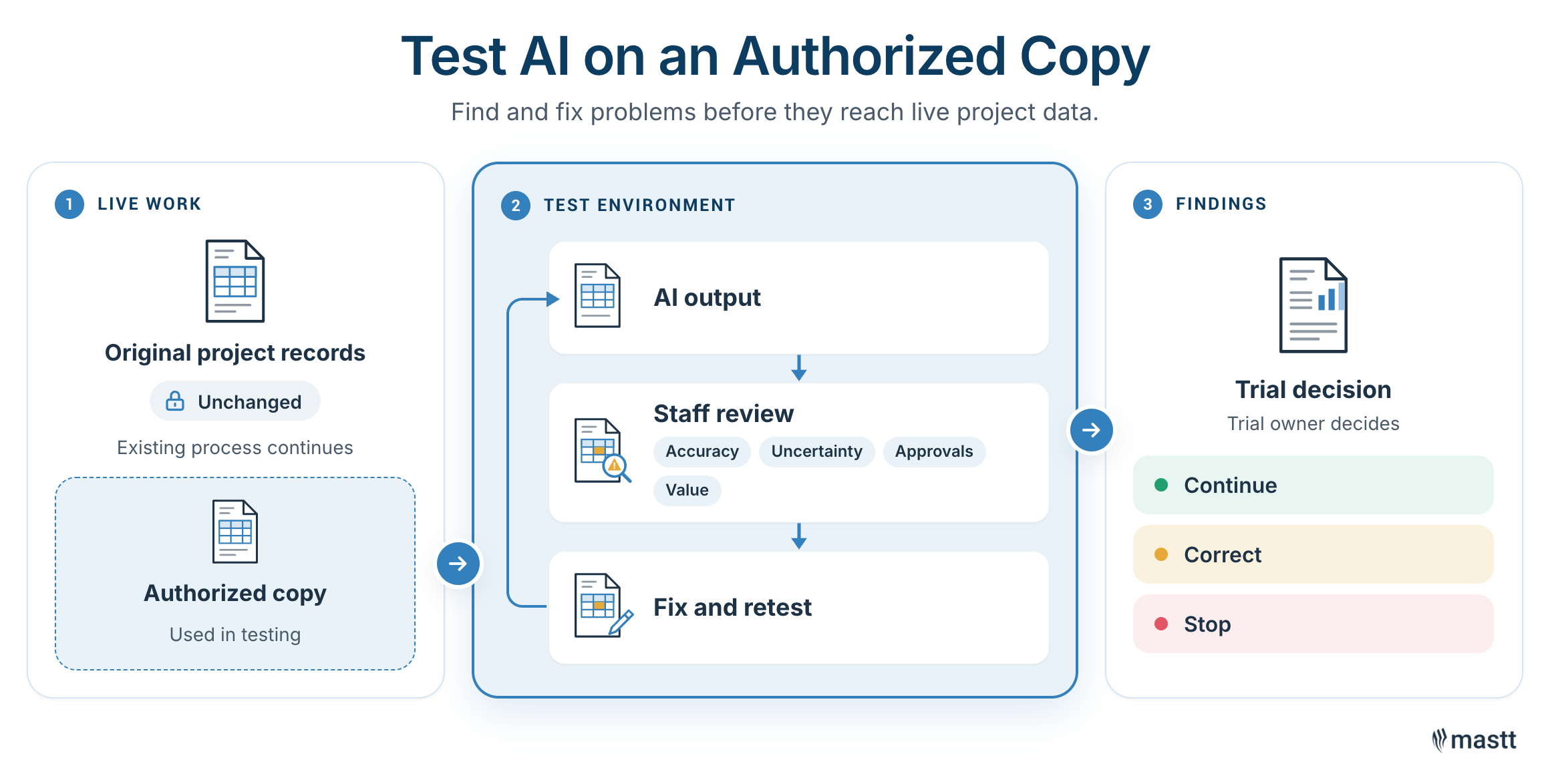
I have seen integration issues during testing and have been glad they occurred in a copy of the production environment. Testing on a copy gives the team a way to investigate and fix problems without changing live financial data. For more on choosing between real and test data based on risk, see lessons on adopting AI in construction.
For cost reporting, an authorized copy of a reporting pack could include pending change orders, outdated forecasts, and missing commentary. The trial owner and reviewers should agree on how to check:
- Accuracy: Figures match source records, and pending changes remain distinguishable from approved amounts.
- Uncertainty: Missing information and unsupported explanations are flagged.
- Approvals: Draft outputs receive the required review before issue.
- Value: Total preparation, review, and correction effort is measured against the baseline.
NIST’s AI Risk Management Framework measurement guidance recommends testing performance in conditions similar to where the system will be deployed.
The plan should define what results justify continuing, correcting, or stopping the trial, and who makes that decision. It should also explain how the team will complete the task through its existing process if testing is paused.
Common AI Readiness Gaps in Construction Teams
In my experience, AI pilots in construction run into trouble when costs, user interest, success measures, or data handling haven’t been checked first. Each of these gaps maps to a step in the assessment above:
- Costs outrun the pilot budget: Early pilots can go over budget quickly, including token consumption charges. Projecting costs before the pilot starts, and using a sandbox where the use case allows it, keeps spending in check.
- End users don't want the tool: A pilot needs innovation champions who are open to trying new tools and will share what works. Keeping sign-up open to any volunteer widens the group.
- Success measures are never agreed: Set the metrics, and the person who judges success, from the start. Otherwise, the team can spin its wheels.
- Data goes into tools unchecked: Before sharing, staff should confirm the information belongs in an AI tool and check the tool's data and training settings.
Most of these gaps come down to people and planning more than technology. Teams tend to focus on the technical side of a pilot, while culture and change management take longer to build. When a gap appears, I go back to the first question: what problem are we trying to solve, and why?
How to Interpret AI Readiness Assessment Results
The results should show whether the selected workflow can proceed to a controlled pilot and which gaps prevent it. The team should judge each gap against the pilot’s requirements and the consequences of an incorrect or unauthorized output.
The findings can support three practical outcomes:
Strengths in one area do not resolve weaknesses elsewhere. Reliable project data, for example, still needs permission for use and a qualified reviewer.
The third outcome can be hard to accept. I encourage teams to say no early when a use case isn't viable, rather than push it through.
AI Readiness Assessment Example: Project Cost Reporting
A project management consultancy is preparing to test AI-drafted commentary for its monthly cost reporting. In this hypothetical example, the tool would use a checked reporting pack to draft explanations for project manager review. Staff would retain responsibility for approving figures and issuing the report.
Assume the current process takes five staff-hours per report, including preparation, drafting, review, and corrections. The assessment identifies the following:
The assessment outcome is preparation required. Data corrections, access controls, and reviewer coverage need to be resolved before the pilot proceeds. The potential time savings remain a question for testing.
During the pilot, figures must match the checked pack, change order status must remain clear, and unsupported explanations or missing information must be flagged. Total time to produce an approved report would then be compared with the five-hour baseline and the agreed improvement target.

Keep the Assessment Current as Your AI Use Grows
A documented assessment gives a construction business a basis for deciding where to invest its effort. A clear explanation of what is ready, what needs attention, and why helps leaders and project teams agree on an achievable next step.
Keeping that assessment current makes progress visible. As the team builds skills, improves its data, and tests its systems, it gains evidence to support the next decision. Each review can show how its capacity to use AI is developing.

Written by
Erin Khan
Erin Khan is a construction technology expert, speaker, and guest lecturer at USC and UCLA Extension, and the founder of Erin Khan Consulting in Los Angeles. A civil engineer, she spent a decade delivering projects at Morley Builders and leading construction innovation at Suffolk Construction, and was named to BuiltWorlds' Adoption Leaders 50. She contributes content on AI and technology adoption in construction at Mastt.


Contributions by
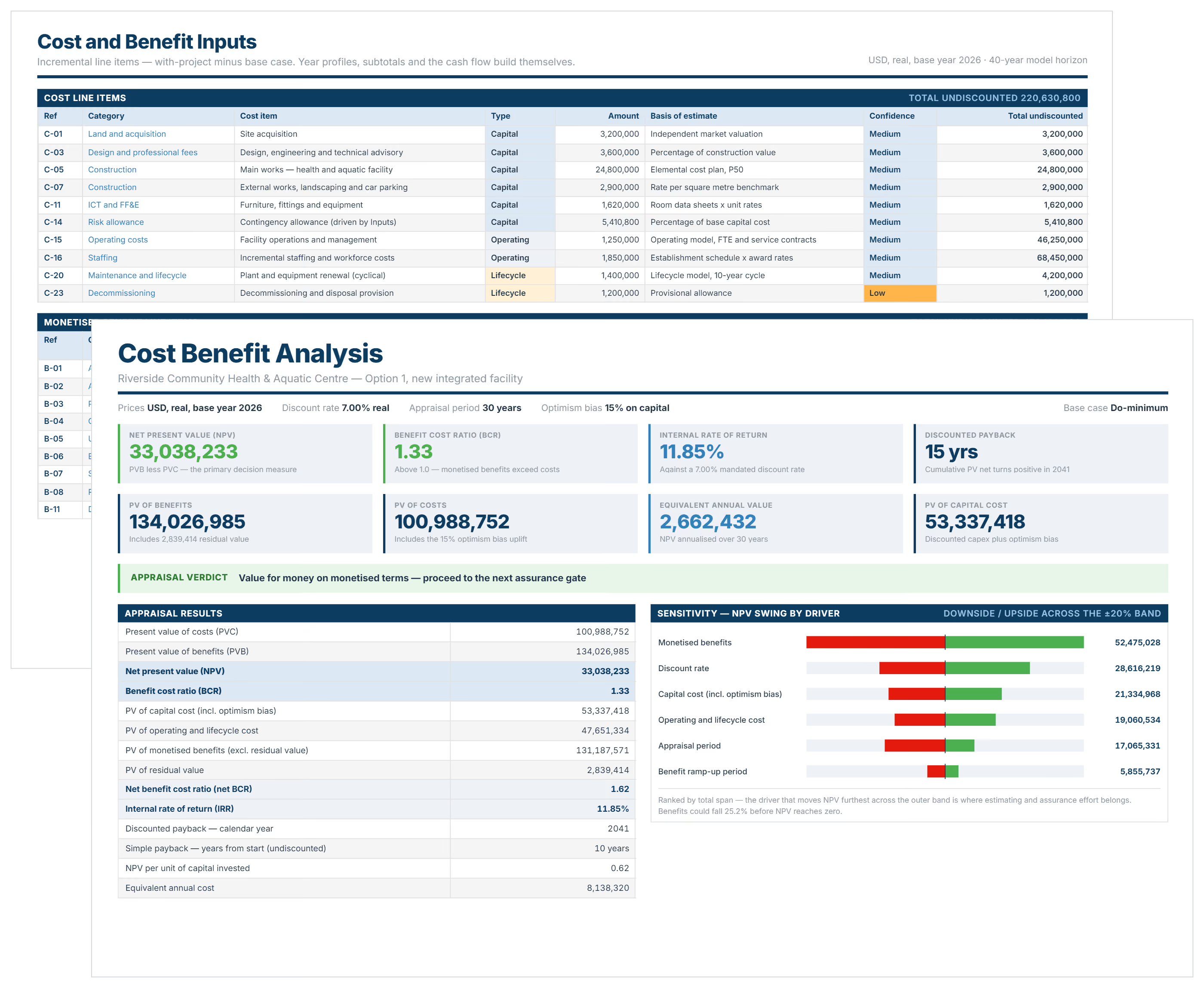
Cost Benefit Analysis Template
Use this cost-benefit analysis template to justify investments and secure funding. Quantify returns, compare options, and demonstrate ROI before committing resources.

Walk Into Every Meeting With Confidence, Clarity, and Control
No one wants to look unprepared, blindsided, or uncertain in front of stakeholders — but that’s exactly what happens without Mastt.
Start for FreeTrusted by the bold, the brave, and the brilliant across governments, Fortune 500s, and the world’s best in delivering the future




.avif)