




Construction defect claims can cost more than the original project's profit margin. When water intrusion or foundation cracks surface months or years after completion, the financial and legal consequences ripple across every party involved.
This guide breaks down the four main defect types, explains how the claim process works, and covers the timelines that determine if you can pursue or defend against a claim.
What are Construction Defect Claims?
Construction defect claims are legal actions that arise when a deficiency in a building's design, materials, or workmanship causes physical damage or loss of value. These construction claims are rooted in a failure to meet accepted trade standards, design specifications, or contractual requirements.
Defects are generally categorized as either patent (obvious upon inspection) or latent (hidden until damage manifests). Valid claims must prove a breach of contract or a failure to meet the professional standard of care.
Standard defect claims do not qualify if the issues result from normal wear and tear, owner negligence, or a lack of routine maintenance.

4 Common Types of Construction Defects that Lead to Claims
Claimed defects are categorized into four primary types: design, material, workmanship, and subsurface deficiencies. These classifications identify the root cause of the failure and determine which party is legally and financially responsible:
1. Design defects
Design defects occur when architectural or engineering plans contain errors that make a structure unsafe or non-functional. Since these flaws originate in the planning phase, the design professional often bears liability for the resulting claim under professional negligence.
⚠️ Example Scenario: An architect specifies a high-performance curtain wall system but fails to account for wind-load pressures at higher elevations. Under extreme weather, glass panels deflect beyond structural tolerance, causing total seal failure and widespread air infiltration.
2. Material defects
Defective materials involve components that are manufactured incorrectly, damaged during transit, or fundamentally unsuitable for the environment. Liability usually sits with the manufacturer, though contractors may share responsibility if they knowingly installed inferior substitutes.
⚠️ Example Scenario: A developer installs composite decking with an improper resin-to-fiber ratio. Despite correct installation, the material suffers from internal fungal decay and crumbles within three years, leading to a total replacement of all decks.
3. Workmanship defects
Workmanship defects result from a failure to execute construction according to design documents or building codes. These are the most common sources of claims and are generally the responsibility of the general contractor and their specific trade partners.
⚠️ Example Scenario: A roofing subcontractor fails to install kick-out flashing where a roof eave meets a vertical sidewall. Water is diverted behind the exterior cladding rather than into the gutter, causing hidden rot in the structural wall sheathing.
4. Subsurface and geotechnical defects
Subsurface defects stem from inadequate site preparation or failure to properly interpret geotechnical reports. Because the ground supports the building's foundation, these issues often give rise to the most expensive and complex latent-defect claims.
⚠️ Example Scenario: A site contractor fails to achieve the specified 95% Proctor density on expansive clay. As soil moisture fluctuates, the slab-on-grade heaves and cracks, compromising the structural integrity of load-bearing masonry walls.
💡 Pro Tip: To quickly distinguish between design and workmanship defects, check the spec type. If the spec is prescriptive, and it fails, it's likely a design defect. If the spec is performance-based, and it fails, the burden of proof shifts to the installer or manufacturer.

Patent vs. Latent Construction Defects
Construction defects are classified as either patent or latent based on their visibility at the time of project completion. While patent defects are identified through standard walkthroughs, latent defects often remain hidden until physical damage manifests years later.
For patent defects, the law presumes the project owner accepted the condition if they failed to list it on a punch list or in a notice of completion. For latent defects, experts often rely on forensic modeling to demonstrate that the deficiency existed at the time of construction.
How Does the Construction Defect Claim Process Work?
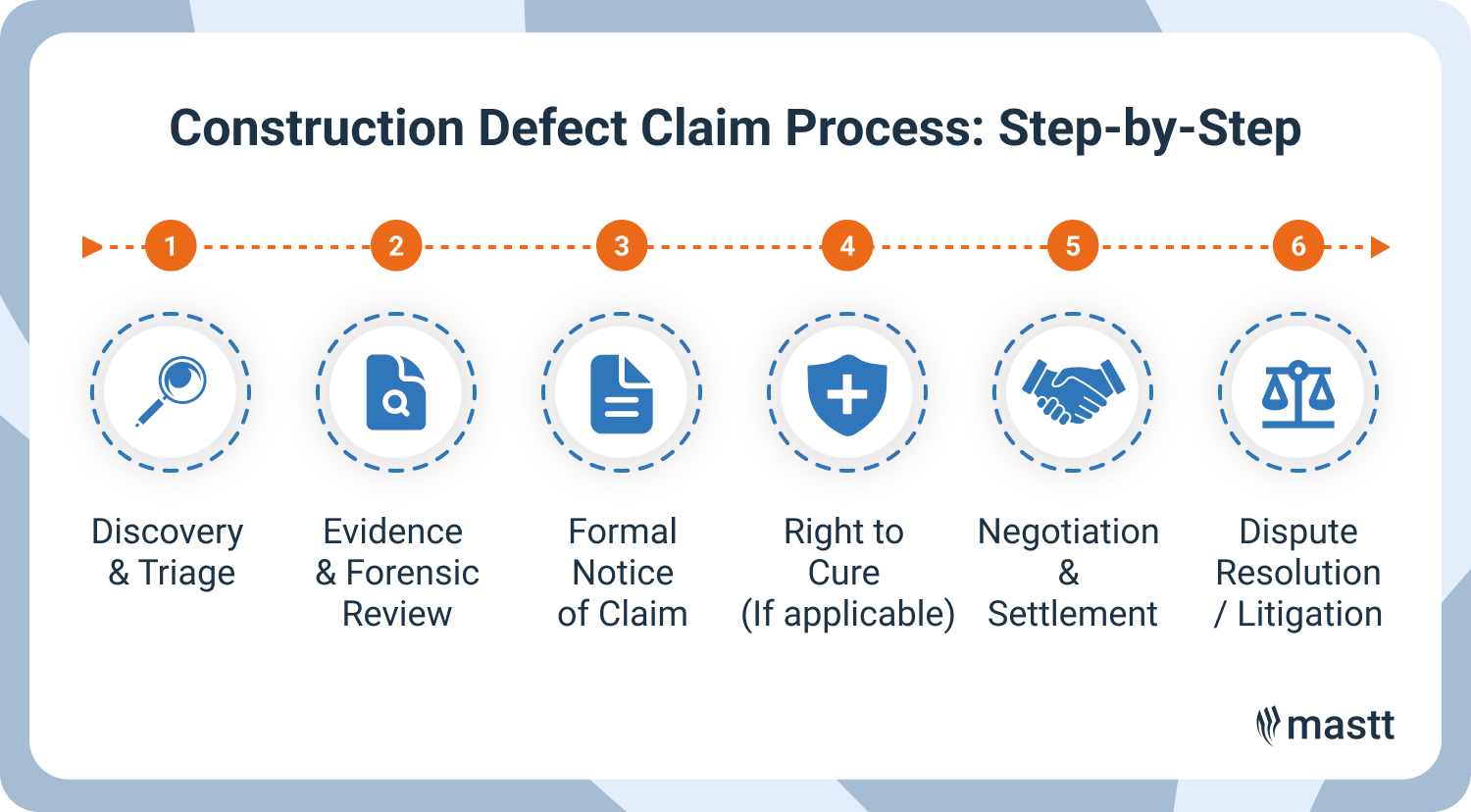
Construction defect claims follow a specific legal sequence that begins with discovery and ends in either a negotiated settlement or formal litigation. This structured timeline ensures that all parties have the opportunity to assess the damage and pursue a resolution without immediate legal intervention.
1. Evidence gathering and forensic discovery
The process begins by identifying the issue and creating a detailed evidence trail using photos and construction daily logs. Forensic engineers then provide technical reports to prove the defect resulted from construction errors. Storing these records in a centralized platform ensures a timestamped audit trail that is difficult to dispute.
2. Formal notice of claim
A formal written notice must be sent to the contractor, developer, or designer believed to be responsible. This document specifies the defect, the resulting damage, and the relevant code violations. Strict statutory deadlines apply, and missing these windows can permanently bar the right to recover damages.
3. Statutory right to cure
Many jurisdictions grant contractors a right to cure, providing a mandatory window to inspect the defect and offer a remedy. The builder must be allowed reasonable site access to conduct their investigation. Following the inspection, the contractor provides a written response offering repairs, a settlement, or a denial of the claim.
4. Remedial negotiation and settlement
Parties then review the contractor’s response to negotiate a repair scope or a financial payout. This phase is usually the most efficient way to resolve the issue while avoiding the high costs of litigation. Any agreed-upon repairs must be documented with a new contract and fresh warranties for the remedial work.
5. Formal dispute resolution or litigation
If negotiations fail, the claim moves to formal dispute resolution like mediation, arbitration, or a lawsuit. This stage involves an extensive discovery phase where legal teams exchange documents and take sworn testimonies. While most cases settle before a verdict, the process can take years and require significant spending on legal and expert fees.
💡 Pro Tip: Consult a construction attorney immediately upon discovering a defect. Laws vary drastically by state, and a legal professional can identify which specific deadlines apply to your project before you inadvertently waive your rights.

Key Timelines for Construction Defect Claim
The statute of limitations for a defect claim begins when a defect is discovered, while the statute of repose acts as an absolute cutoff based on the project's completion date. Missing either window permanently bars the right to recover damages, regardless of the defect's severity.
💡 Pro Tip: Check the dispute resolution clause in your contract immediately. Standard forms (like AIA A201) often enforce a strict 21-day notice deadline from the moment a defect is discovered. If you miss this contractual window, your claim can be dismissed on a technicality, even if you are still within the legal statutory period.
Who is Liable for Claimed Defects in Construction?
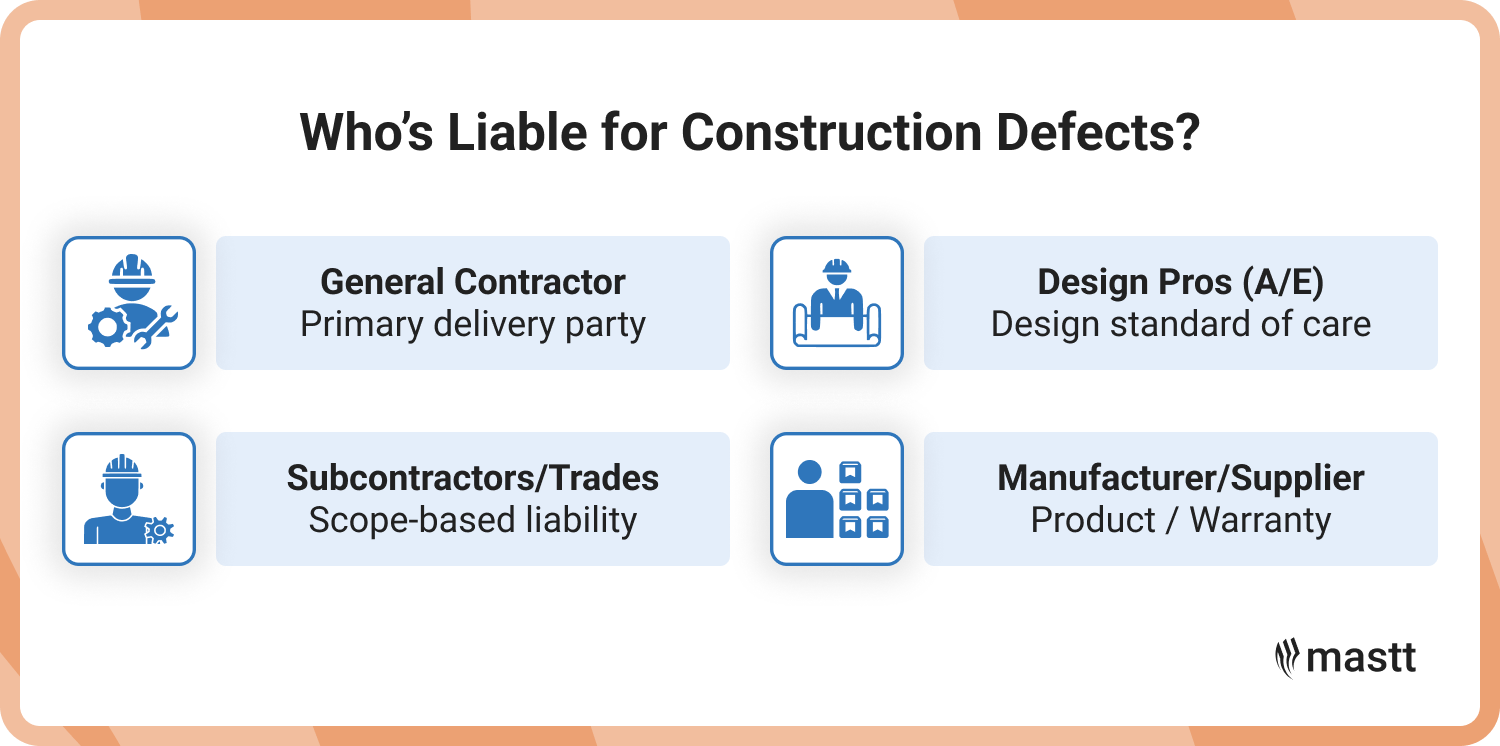
Liability for construction defects falls on the party whose negligence or breach of contract caused the failure. In many cases, responsibility is shared among multiple parties, including general contractors, subcontractors, design professionals, and manufacturers.
- General contractors: Typically bear primary responsibility for overall project delivery. They can be held liable for their own work as well as defective work performed by their subcontractors. Contractual indemnification clauses often allow GCs to shift risk back to the responsible subcontractor.
- Subcontractors and trade partners: Liable for defective work within their specific scope, whether plumbing, electrical, roofing, or another trade. General contractors often pursue subcontractors through contractual indemnity agreements to cover repair costs.
- Design professionals: Liability for design deficiencies falls on the architect, engineer, or other design professional who created the faulty plans. Their work is judged against the professional standard of care. Claims against them are typically covered by professional liability insurance.
- Material suppliers and manufacturers: Manufacturers can be held liable for defective products under product liability laws or breach of warranty claims. Material suppliers may also be liable if they provided the wrong materials or recommended an inappropriate product.
Joint and several liability lets project owners collect full repair costs from any at-fault party. Usually, the general contractor pays the entire bill and then recovers money from subcontractors. This ensures the building gets fixed even if some parties cannot pay.
What Types of Insurance Cover Claims on Construction Defects?
Commercial general liability and professional liability are the primary policies for construction defect claims. These policies provide the financial backing needed to handle repair costs and legal defense when a project fails:
- Commercial General Liability (CGL): This policy covers property damage or injuries caused by an accident. It typically covers resulting damage, such as a ruined floor from a leak, rather than the cost to repair the faulty pipe itself.
- Products-Completed Operations: This covers claims that arise after the project is finished and handed over. It is vital because most construction defects remain hidden until years after the crew has left the site.
- Professional Liability: Also known as Errors & Omissions (E&O) insurance, this policy covers design professionals for claims related to professional negligence.
- Builder’s Risk: This covers damage from fire, theft, or weather during the actual construction phase. The policy ends at project completion and rarely covers defects found once the owner moves in.
Many policies include a work exclusion that prevents contractors from using insurance to cover their own faulty workmanship. However, if a subcontractor’s mistake causes the damage, this exclusion may not apply. This nuance makes the relationship between the main contractor and their trades a central factor in insurance payouts.
Best Practices for Preventing Construction Defect Claims
Preventing claims requires rigorous field verification and centralized digital documentation. These steps create a clear record that protects you from future legal issues:
☑️ Standardize digital field forms: Use mobile checklists that require photos of critical work before the next trade starts.
☑️ Implement automated workflow gates: Block tasks from being marked "complete" until the required quality documents are uploaded.
☑️ Centralize digital traceability: Keep all site photos and change orders in one timestamped system to create a single source of truth.
☑️ Monitor real-time risk flags: Use dashboards to spot small, repeating mistakes across different trades before they become major failures.
☑️ Synchronize design-to-field updates: Use automated systems to ensure project teams always build from the most recent plans.
☑️ Conduct BIM coordination reviews: Fix design clashes on a computer screen before any actual construction begins.
☑️ Engage third-party forensic inspectors: Hire independent experts to check high-risk areas like waterproofing for a second opinion.
💡 Pro Tip: Tie your progress payments directly to your digital quality control logs. When subcontractors know their payment depends on a verified audit trail, the accuracy of your documentation and the quality of the workmanship improve significantly.

Reduce Construction Defect Risk with Proactive Project Controls
Construction defect claims are usually decided by the quality of your records. Centralized project controls turns scattered data into a history of accountability that defends your reputation. Focusing on this level of data integrity serves as a reliable defense for years to come.

Written by
Kristel Sapungan
Kristel Sapungan is a licensed architect and Content Writer at Mastt, combining her technical background with expertise in SEO and digital strategy. With experience in architectural design, construction documentation, and on-site coordination, she delivers precise, high-quality content for the construction and capital works sector. Her work enhances industry communication by translating complex concepts into clear, professional narratives.


Contributions by
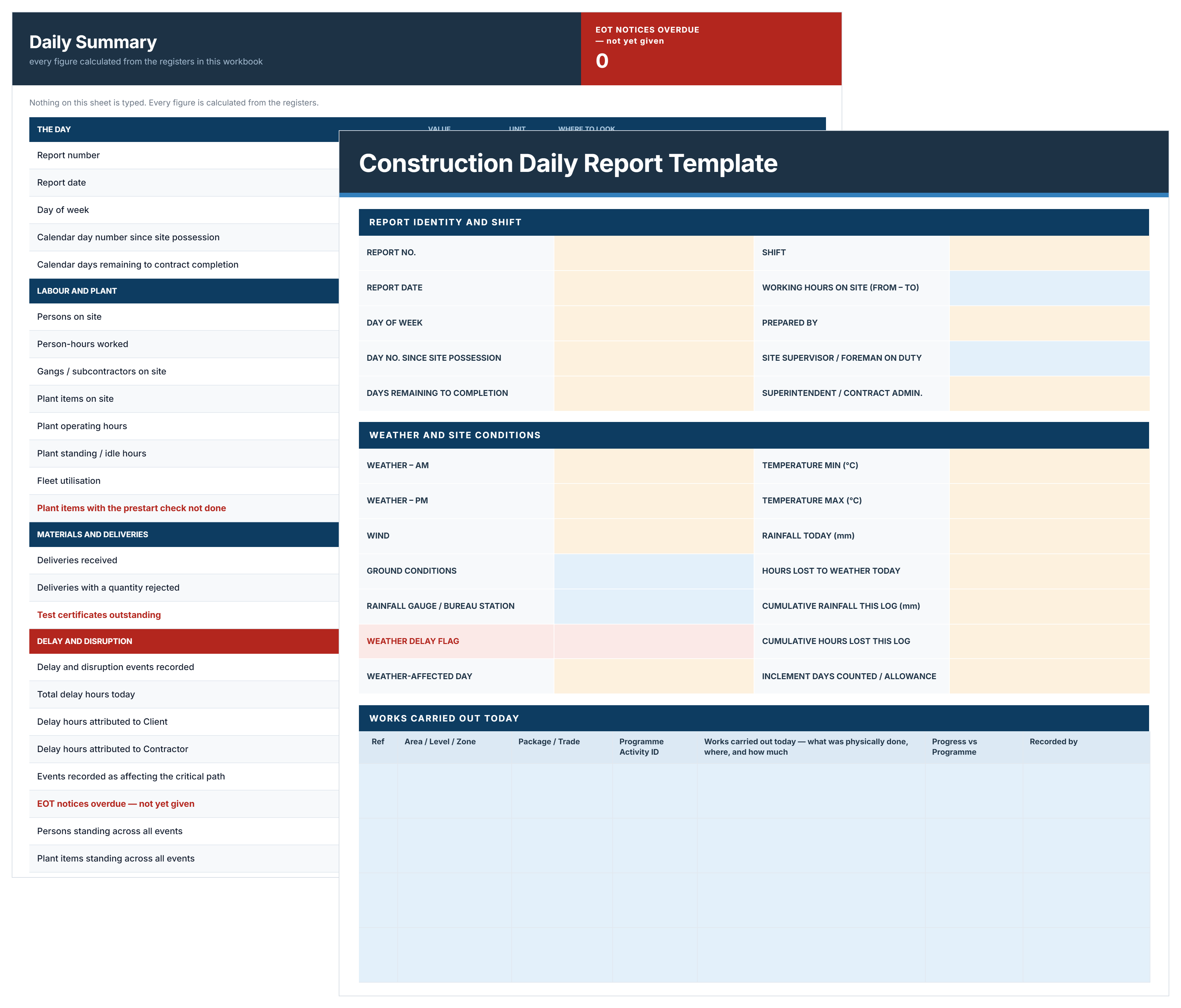
Construction Daily Report Template
FREE construction daily report template in Excel format. Capture what was built, who was on site, what stopped work, and the evidence behind every hour lost.

Walk Into Every Meeting With Confidence, Clarity, and Control
No one wants to look unprepared, blindsided, or uncertain in front of stakeholders — but that’s exactly what happens without Mastt.
Start for FreeTrusted by the bold, the brave, and the brilliant across governments, Fortune 500s, and the world’s best in delivering the future