Post author:
Kristel Sapungan

Construction claims are formal contract requests for extra time or payment. Learn claim types, the claims process, and practical ways to prevent disputes.
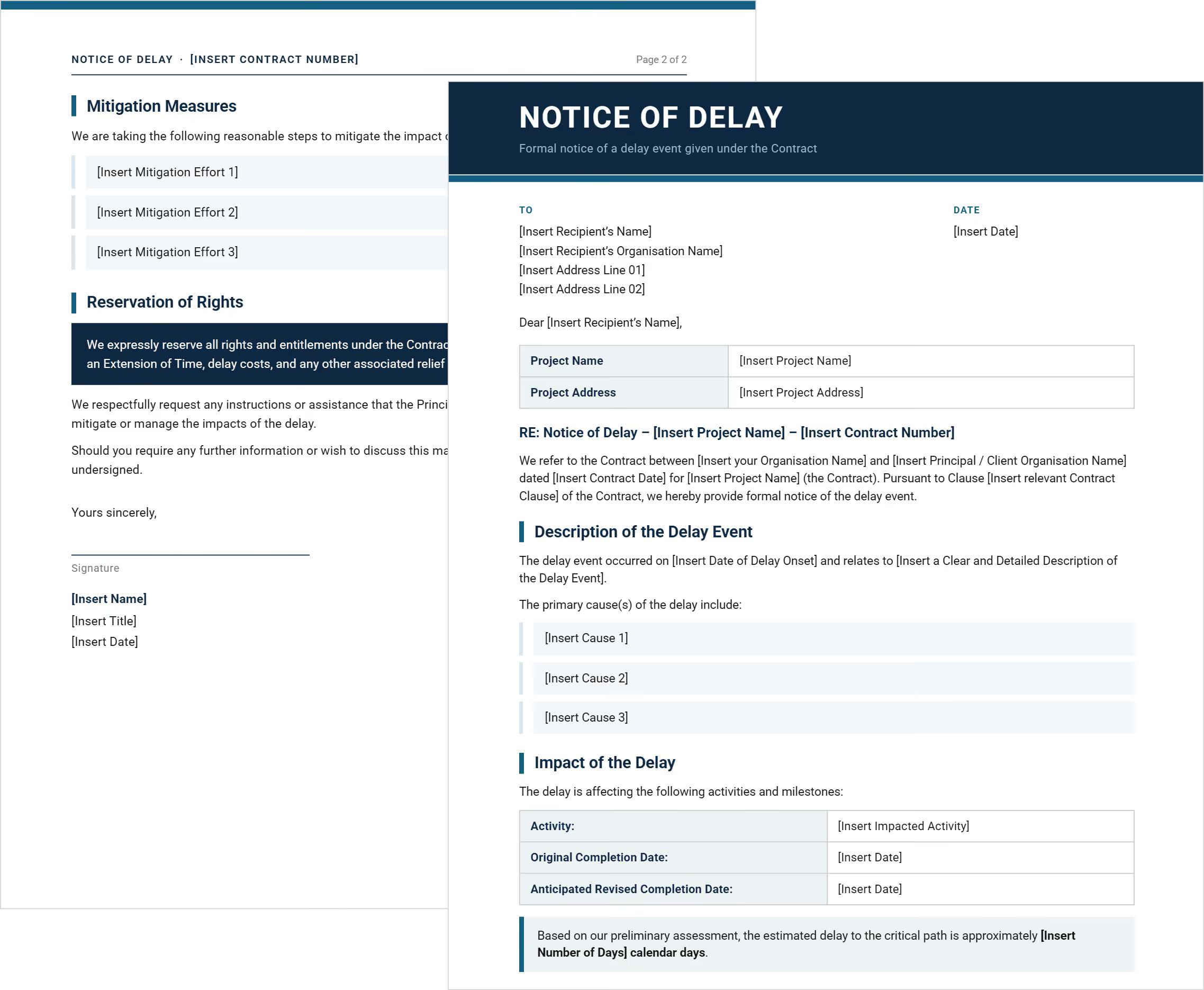
Use this notice of delay template to protect extension of time rights, avoid contractual time bars, and document critical path delays with proper notice compliance.

Construction claims are official demands for extra time or payment. They occur when project events change from the original contract terms. Claims can add cost, extend time, and trigger disputes if they are handled late or without evidence.
This guide covers the most common claim types, how the process works from notice to resolution, and practical strategies for managing claims across your projects.
Construction claims are formal contractual requests for additional compensation, time, or other relief. A claim is made when one party believes the construction contract entitles them to more than what is currently being provided.
Contract claims often come from changes, delays, unforeseen site conditions, payment issues, or alleged breaches. If the parties cannot resolve the issue, it can escalate into a formal dispute such as mediation, arbitration, or litigation.
Industry standards like the AIA A201 General Conditions define a claim as a demand for money, time, or relief asserted as a matter of right. This clause clarifies that the burden of proof rests entirely on the party filing the request.
📝 Note: In the US, a claim usually means a disputed request for time or money under the contract. In Australia, the term is commonly used to mean a progress payment request.

A change order is a mutual agreement to modify scope, cost, or time. A construction claim, on the other hand, is a disputed request when parties cannot agree. The distinction matters because claims require more documentation, take longer to resolve, and can damage project relationships.
For example, when the owner agrees to a contractor’s request, it becomes a change order. When the owner disagrees, and the contractor pursues the request, it becomes a claim.
Most construction claims fall into eight categories, ranging from schedule delays to work defects. Identifying the correct type helps you immediately identify the relevant contract provisions. This precision helps project teams respond faster and more accurately.
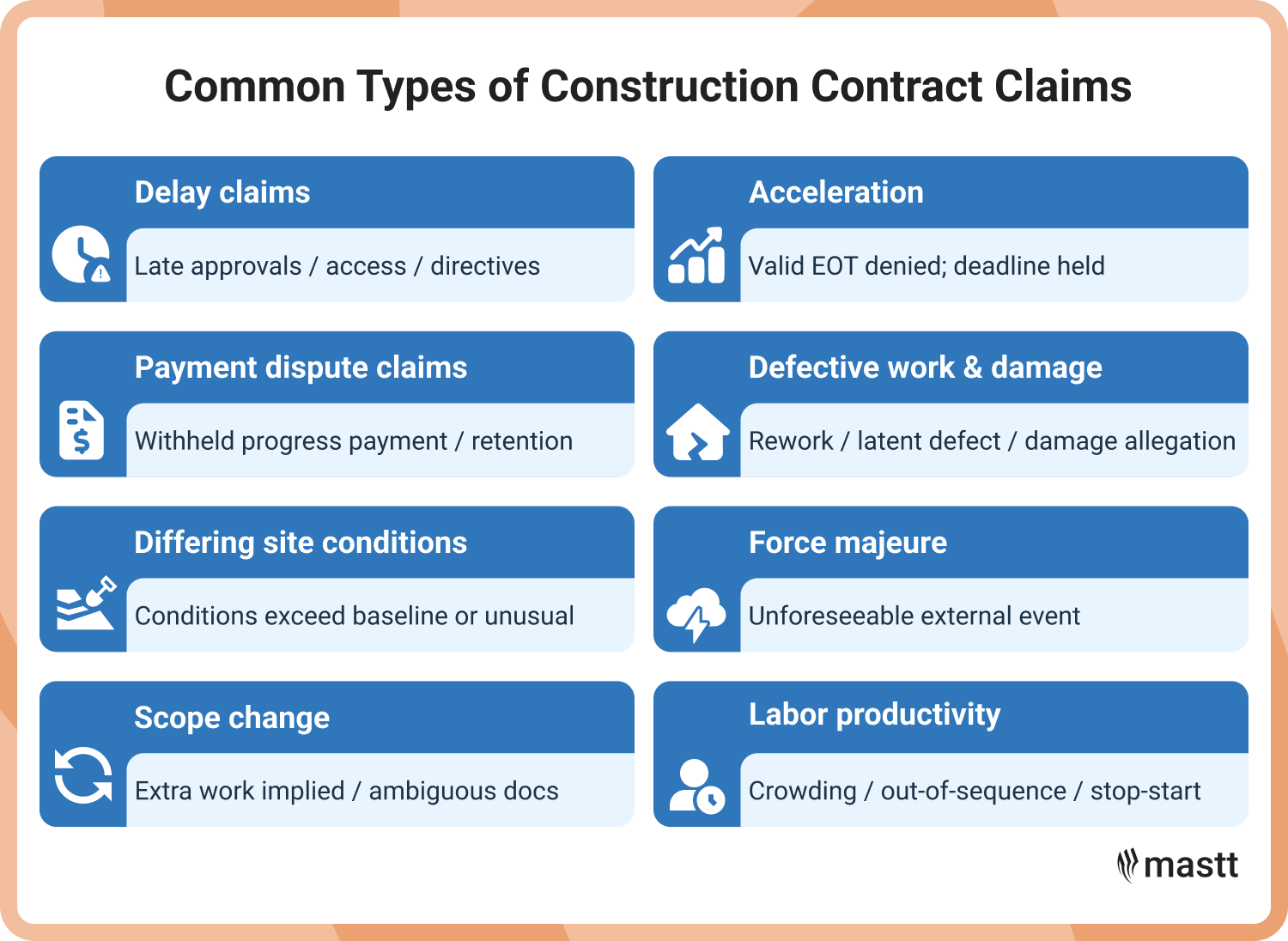
A delay claim requests time or money when the project completion slips due to external events. Establishing entitlement requires proving the delay impacted the critical path. Non-critical delays generally do not warrant a contract extension, even if they were caused by the owner.
Example: An owner delays shop drawing approvals by four weeks. The claim hinges on a Time Impact Analysis (TIA) proving zero float remained. If the contractor had their own concurrent delays, the owner might grant time but refuse to pay the extended general conditions costs.
Payment disputes arise when a party withholds funds based on contract interpretations or quality issues. These often involve Schedule of Values disagreements or retention. They escalate quickly because they restrict cash flow, often forcing subcontractors to suspend performance.
Example: A general contractor uses a "pay-if-paid" clause to withhold funds because the owner hasn't paid. The subcontractor argues the clause is unenforceable or that the GC failed a condition precedent, like submitting lien waivers. The dispute turns on complex risk transfer laws.
These occur when actual conditions differ materially from the contract (Type I) or are unusual (Type II). Entitlement usually depends on the Geotechnical Baseline Report (GBR). If conditions exceed the GBR baseline, the contractor is typically entitled to relief.
Example: A contractor hits 15,000 psi rock where the GBR indicated a maximum of 5,000 psi. This forces a switch from standard ripping to blasting. The claim covers the new equipment costs and the productivity loss during the method change.
Constructive changes happen when a contractor performs extra work they believe is implied, but the owner refuses to pay. These usually stem from ambiguous design or RFI responses. The contractor relies on the implied warranty of plans to recover costs.
Example: An architect notes "add secondary drain pans per code" on a submittal, though drawings only showed primary pans. The contractor files a claim under the Spearin Doctrine. They argue the cost belongs to the owner because the original bid documents were incomplete.
Constructive acceleration occurs when an owner denies a valid time extension but insists on the original deadline. The contractor must spend extra money to recover the time that should have been granted. This is often the most contentious claim type.
Example: An owner denies a time request for a hurricane. Fearing liquidated damages, the contractor adds shifts to recover the lost time. The claim seeks reimbursement for premium labor and "trade stacking" inefficiencies caused by the implied order to accelerate.
These disputes involve quality issues or "latent defects" that appear years later. Liability shifts based on whether the root cause is poor workmanship or a specification error. Proving the cause often requires forensic analysis.
Example: A cladding system leaks three years post-completion. The owner blames workmanship, but forensic analysis proves the specified sealant was chemically incompatible with the substrate. The contractor shifts liability to the design team's professional indemnity insurance.
Force majeure claims involve unforeseeable events beyond human control, like natural disasters or pandemics. Contracts usually treat these as "excusable, non-compensable" delays. The contractor gets more time to avoid penalties but must absorb the costs of the extended duration.
Example: A geopolitical conflict halts the supply of steel for eight weeks. The contractor submits a claim for a time extension to avoid liquidated damages. Since the owner isn't at fault, the contractor bears the overhead costs and idle equipment expenses during the wait.
These assert that external disruptions reduced workforce efficiency, even if work never stopped. This "loss of efficiency" often stems from overcrowding or out-of-sequence work. Success requires proving the disruption was not caused by the contractor's own mismanagement.
Example: Late framing forces a piping contractor into a "stop-start" workflow. They use a "Measured Mile" analysis, comparing production in a clear area (10 units/hour) against the disrupted zone (6 units/hour). This difference quantifies the financial value of the lost efficiency.
In practice, these construction claims rarely happen in isolation. A single problem often triggers a chain reaction, where a site condition creates a delay that eventually forces acceleration. If you treat each issue separately, you risk missing the full financial impact of the event.

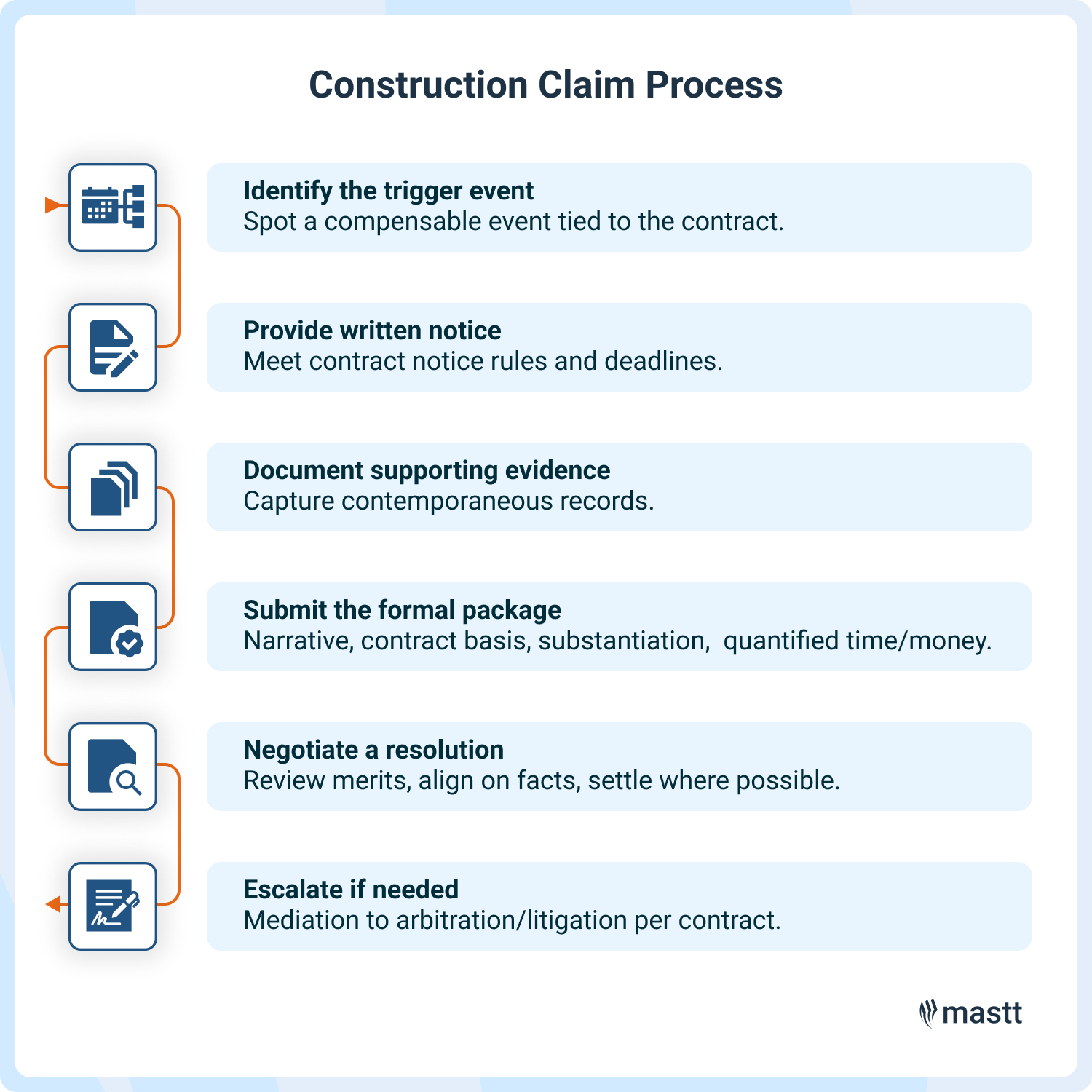
The claim process begins when a compensable event, like a delay or a scope change, occurs on the project. This triggers a predictable sequence of steps designed to resolve the issue. Understanding each step helps project teams protect their rights and build a stronger position.
The first step is recognizing when a compensable event occurs, which entitles a party to relief under the contract terms. This might be a delay caused by the owner, changed site conditions, or additional work directed without a change order. Early identification matters because most contracts require notice within a specific timeframe.
Timely written notice is critical. Most construction contracts specify exactly how and when notice is given, often within 7 to 21 days of the triggering event. Missing notice deadlines can forfeit rights entirely, even if the underlying claim is valid.
Construction claims are built on contemporaneous records, documents created at the time events occurred, not reconstructed later. Gather daily reports, correspondence, meeting minutes, photos, cost records, and schedule analyses.
A well-organized submission signals that the project team has performed the necessary due diligence. The formal claim package typically includes a narrative explaining the facts and the legal basis for relief. It also contains supporting documentation and a precise quantification of the time and money sought.
Most entitlement requests are resolved through negotiation rather than formal dispute resolution. Both parties review the documentation, discuss the merits, and attempt to reach a settlement. Approach negotiations with a willingness to understand the other party's perspective.
Unresolved claims move into the contract dispute resolution process once negotiations break down, often starting with mediation before escalating to litigation.
Arcadis data shows that this route takes an average of 12.5 months in North America, resulting in significant time and financial costs. To prevent these delays, experienced teams strive to settle disputes before formal proceedings become necessary.

Construction contract claims are typically managed by the project manager or contact administrator, depending on the project's setup. However, effective claim outcomes rely on input from several other roles. The roles below are commonly involved in the construction contract claim process:
Clear roles and handoffs reduce claim risk. When each party understands who issues notices, who owns the records, and who can approve decisions, teams respond faster and avoid missed timeframes.
Prevention is far more cost-effective than retroactive claim management. While you cannot eliminate every dispute, you can significantly reduce its frequency and severity. To minimize exposure, implement these five strategies:
💡 Pro Tip: Run a weekly issue-to-activity link. Tie each emerging issue to the exact program activity it impacts, then attach the record set. It turns arguments into traceable cause-and-effect.

Once a potential claim arises, your reaction speed and strategy determine whether it becomes a minor hiccup or a costly litigation battle. To resolve issues efficiently and protect your project's interests, take these five immediate actions:
💡 Pro Tip: Upon receiving a formal notice, send a formal letter stating you are reviewing the matter while "Reserving All Rights" under the contract. This prevents silence from being seen as an admission of fault. It gives the team time to investigate facts without accidentally accepting liability.
A good approach to claim management starts with consistency across projects, such as using a standard process for identification, review, and resolution. Beyond that foundation, the practices below help project teams respond faster and document better:
☑️ Establish a claim handling process: Standardize how claims are identified, logged, substantiated, reviewed, and resolved. Define escalation paths, response timeframes, and decision authority.
☑️ Train project teams on procedures: Equip site and project teams to spot claim triggers early, meet notice requirements, and maintain the right records from day one.
☑️ Use centralized documentation systems: Keep contracts, communications, and evidence in one searchable system with a clear audit trail, so your position is easy to prove and quick to review.
☑️ Monitor trends across your portfolio: Track claim types, causes, trades, forms, and project stages to identify repeat patterns, then adjust templates, controls, and governance accordingly.
☑️ Set minimum record standards for claim events: Define the “must-capture” evidence for delays, instructions, and changed conditions, so every project builds defensible files in the same way.
These practices work best when they are treated as project controls. Put them into your standard delivery rhythm, assign owners, and make them easy to follow, so the right actions happen before issues turn into formal claims.
Claims are easier to manage when your construction project cost management software and scheduling platform stay aligned, with other tools strengthening the process. Here are the core tool categories project teams rely on most often:
If you want to reduce tool switching, construction project management software like Mastt combines cost, schedule, risk, and document management in one platform, with AI-powered features that automate manual tasks. This helps teams reduce manual reconciliation, maintain a cleaner audit trail, and respond faster when claim risks emerge.

Proactive project controls reduce construction claims by keeping scope, cost, schedule, and decisions visible as work progresses. When teams capture directions in real time, manage change orders consistently, and keep records aligned to budget and program, issues are easier to resolve early and less likely to escalate into formal disputes.
Written by
Kristel Sapungan is a licensed architect and Content Writer at Mastt, combining her technical background with expertise in SEO and digital strategy. With experience in architectural design, construction documentation, and on-site coordination, she delivers precise, high-quality content for the construction and capital works sector. Her work enhances industry communication by translating complex concepts into clear, professional narratives.


Contributions from

Cut the stress of showing up unprepared
Start for FreeTrusted by the bold, the brave, and the brilliant to deliver the future