
.avif)
Olli Seppänen is Associate Professor of Practice at Aalto University in Finland and a leading global authority on location-based management systems (LBMS). He leads Finland's Building 2030 consortium, which aims to halve project duration through industrialized construction.
We asked Olli what location-based management systems are, why construction projects run long, and how takt production cuts duration in half. He also shares results from Building 2030 and his view of Construction 4.0 technology on live sites.
From Construction Laborer to Global Authority on LBMS
Olli's path into location-based management started with a summer job hauling materials during a recession. The experience of being, in his words, basically the waste, set the direction for everything since.
Q: How did your career take you from construction laborer to Aalto University?
A: I came to construction by accident. I was graduating from business school when there was a recession in Finland, and the only work available during the summers was construction labor.
I started as a construction laborer and noticed that this was horribly inefficient. I was basically the waste. All my work was a waste. I was taking apart and demolishing structures that had already been built, hauling materials for people, and trying to figure out where everyone was.
I thought this was the perfect place where productivity improvement was required, so I started a startup company focusing on construction scheduling and planning. We started working on location-based management systems back in 2001 when we started the company.
There was a professor at the University of Technology who was really interested. I actually didn't know much about construction, so he privately taught me in the evenings to learn the basics.
We sold the software to the four biggest construction companies in Finland. It started to grow quite rapidly and gained interest in the United States and Australia. Professor Russell Kenley was our reseller in Australia at the time, and the company was acquired by Graphisoft in 2005.
I worked for Graphisoft for a couple of years, and then we did a management buyout and formed Vico Software in the United States. I moved there and lived there for eight years, helping with large hospital projects, especially to implement building information modeling and location-based management.
I'd been working on my doctoral thesis in the evenings and finished it in 2009 on location-based management. That's how I got the opportunity to come to Aalto University in 2015.
Now I've been continuing to work on location-based management, adding AI, IoT, and other things to the mix. I formed the Building 2030 consortium, which was quite easy for me because everybody was my client from my business times. It was easy to get connections, build a consortium of 16 companies, and have them set aggressive goals for themselves.
Q: What are you working on right now?
A: We just got a funding decision on furthering digital situation awareness. We have been doing digital situation awareness based on cameras and IoT sensors for some time.
The problem with those approaches is that they rely heavily on personal data. In Europe, there's quite a bit of personal data legislation, and the trade unions may not appreciate that we are collecting location information of workers.
So we are now trying a different way by focusing on material deliveries and turning the building into a massive scale. By putting sensors in the concrete, we are able to measure the weight of every square meter in the building. Can we achieve digital situation awareness by looking at how the weights are moving?
We can identify easily with AI, which weights are people and which are materials. Then we can use 360 cameras or fixed cameras to detect materials and their QR codes. Based on those, we hope to get a pretty good picture of what's going on without actually tracking people.
What Is a Location-Based Management System in Construction?
A location-based management system plans and controls work by physical location rather than by activity. Olli explains the concept with an example that any project team can picture.
Q: What are location-based management systems, and why do they matter for project delivery?
A: They are actually quite simple in concept. Construction products are physical products, and it's all about dividing them into smaller pieces.
Let's take an apartment building as a simple example that everybody can understand. Every apartment could be a location. Or every room of an apartment could be a location. The smaller you make the locations, the faster you can do your project, but it is a little more painful to manage them if you go too small.
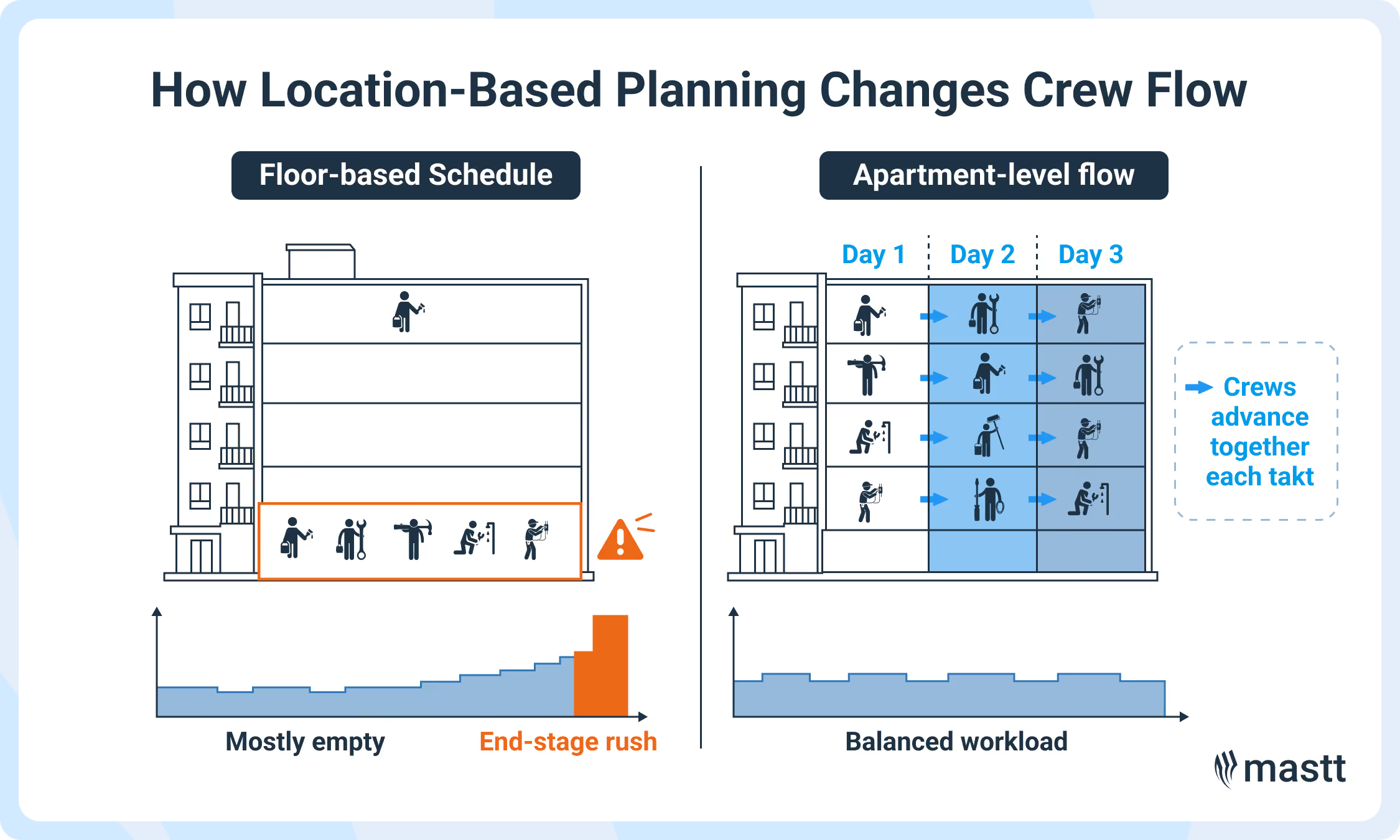
The idea is to get work flowing in parallel. In a traditional construction project, you would manage an apartment building, maybe by floor. When you go down to the apartment level, every single apartment has a crew working productively in it, and they all move to the next apartment at the same time.
That rhythm is called the takt time. If the takt time is one day, every day, everybody moves to the next apartment.
In a traditional project, you would have almost empty floors because everybody is given a full floor. You don't see anybody there, but in the last two months before commissioning, there's a huge number of people everywhere, fixing mistakes and catching up on delays.
A location-based project would be balanced. Every apartment has one crew at all times, moving at the same rhythm through the building.
“There's no end-of-project hurry, because you divide that end-of-project rush evenly over the whole duration. That's how you can get half the duration and increased quality.”
- Olli Seppänen
Q: What gap was your 2010 textbook with Russell Kenley trying to fill?
A: At that time, everybody was using activity-based systems, and many still are. Software like Primavera, for example, and the critical path method, which are often required by contracts. Those are not very good for the productive implementation of the work.
We separate the project management purposes of scheduling, which is about delays and figuring out who is liable for a delay, from productivity-related systems, which are about making work flow and getting the most out of your resources.
There was a gap. Everybody was focusing on project management, but the site managers who are actually running the project cannot really use those schedules. They are very good for negotiating with clients about time-extension claims, but not very good at directing the crews.
That was the main gap we were trying to solve. How to bring a practical tool to site managers so they can talk about resources and how many crews are needed, and improve productivity on construction sites.
Why Construction Projects Take Longer Than They Should
Ask Olli what slows projects down, and he doesn't start with technology or contracts. He starts with the plan itself.
Q: What patterns really slow down construction projects?
A: One is the planning itself. There are so many unneeded buffers. Everybody is adding contingencies to all the durations.
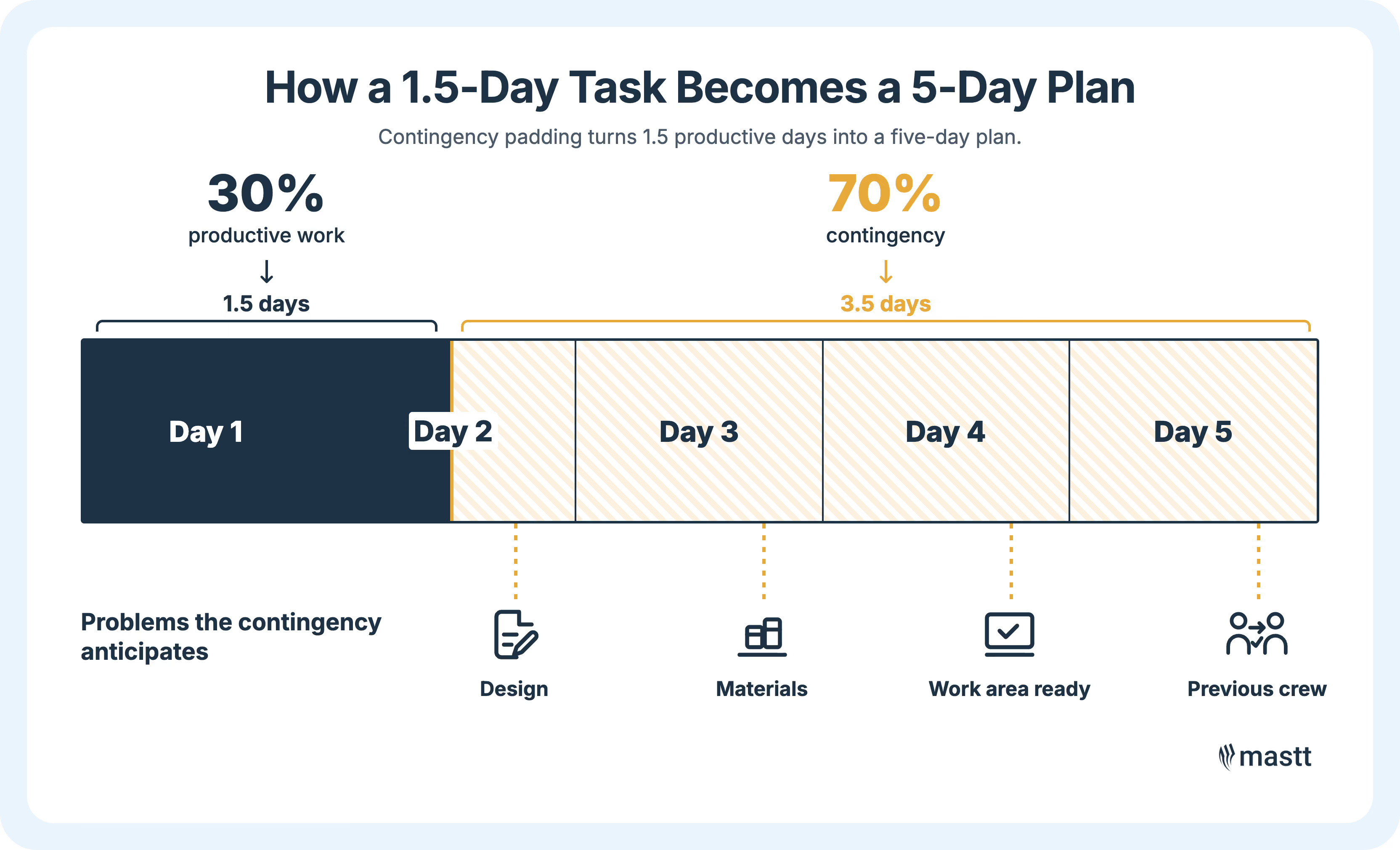
Actual work might take one day, but the contractor says five days because they are anticipating that somebody else will cause them a problem. Everyone is baking a lot of contingency into their durations.
We have been doing indoor positioning studies, for example, and a five-day task can require just 30% of that time. It really could take one and a half days if you were doing things productively.
It's so difficult to get all the materials, all the designs, and all the conditions in order before you start work. Based on their early experience, everybody factors in all these problems, and that contingency-adding behavior increases durations.
Then, of course, there are the root causes. Why don't we have the design ready on time? Why don't we have all the materials on time? Why are there so many extra materials on the work site, interfering with the work?
Why is the preceding crew not ready when the next crew starts? And why are they not providing quality work so the next crew has the best productive circumstances to do their work?
None of these things is very complex. The problem is that there are so many of them at the same time. It's very difficult for site management to keep a list of everything that needs to be done for production to proceed productively.

How to Start With Takt Production
Olli’s research on location-based management, takt production, and construction production control has received more than 4,900 citations on Google Scholar. Most of it focuses on what happens after the plan meets the site.
Q: How has your research on takt production and the last planner system supported the sector?
A: There are a lot of things that we don't know. When the industry sees something that works, they jump on it. They typically read a little bit and then go do it.
Our work as academics is to anticipate the problems they are facing and try to bring more knowledge, so people do not stop when they hit the first problem on site.
My research is mostly focused on production control. What actually happens when you implement location-based management on site, and how do you control it when there are deviations?
One of the problems we noticed early on is that people give up if they cannot follow the original plan. A typical location-based project doesn't go according to the original plan.
There's too much variability in the process and too many random things. But the best projects, which achieve good results, are able to steer the project and control it to still get most of the benefits, even though the final process is not at all like they originally planned.
This kind of knowledge we need to bring so people don't lose faith when the first problem happens on site. It's very easy to plan a location-based schedule; it's much more complicated to actually make it happen.
That's where most of my research work has gone. Other researchers are maybe more in that theoretical planning area. I'm more in the practical, dirty business of actually making it work.
Q: Where should teams start with takt production, and what are the common mistakes?
A: There are a lot of textbooks and written materials, and also consultants who can help people begin. I can give recommendations if somebody wants to start and doesn't know where. Just contact me, and I will help you get started.
The most common mistake is to be too idealistic about it and choose too aggressive goals for the first project. I would advise that you don't go for the smallest location size in your first project.
Many companies are starting with a one-week takt time and floors. Let's try it on floor level, with one week per floor.
When that works out, and you have some experience with the system, then you can start to tighten the screw. Go to smaller locations and smaller takt times and start to get bigger benefits.
Typically, there are so many problems with material delivery and other things that if you go to too small takt times too early, you will just end up in chaos. It makes sense to start easy and go harder in the second or third project when the team has some experience.
The most difficult thing is to start too aggressively too early, and then say this doesn't work because there were so many uncertainties in the process.
Inside Building 2030, Finland's Push to Halve Project Duration
The Building 2030 consortium set what was seen as a very aggressive goal. Last year, individual projects started hitting it.
Q: What progress has Building 2030 made toward halving project durations?
A: We started the consortium 10 years ago, so this is the 10th anniversary. We initially had 11 companies and all the universities.
We do contract research with the consortium based on the topics they choose. They pay an annual fee that funds our research, and our doctoral students work on those projects. Takt production has been a continuous theme, and every year, there is at least one topic related to it.
Halving construction durations was seen as a very aggressive goal, but last year, there were already projects that achieved it. Individual projects, not yet at scale.
One of the contractors finished a residential construction project in six months. It also exceeded all quality expectations, so it was of better quality than any of the normal 12-month or 14-month projects. It included a lot of prefabrication, of course, and the takt production principles. A lot of time went into preparing it.
Even more, we have been focusing on reliability so that no project gets delayed. I'm happy to report that last year, the consortium members didn't have any delayed projects. The Finnish companies were quite reliable in the schedule already, I think 85% when we started.
“But now we have the first year with no delayed projects. 100% on-time performance.”
- Olli Seppänen
Q: What is driving Finland to find these efficiencies?
A: Labor shortage is the key. We have an aging workforce and a lot of imported workers from other countries. On our biggest construction sites, we can have 18 languages on one project.
Almost nobody speaks Finnish, and many of the workers don't speak English either. Visual management and working through translators has become the norm, and it's only going to get worse.
We also have urbanization still going on. People are moving from the countryside to cities, especially to the Helsinki area, so that's the same housing problem. And of course, the construction industry is a big part of carbon emissions in Finland. It's a very important industry, and we need to improve it.
I think the companies wanted to come because they have R&D (research and development) departments, of course, but those look at immediate needs, maybe two or three years down the line. They wanted something where we can think longer about big shifts. Those shifts cannot be implemented by one company alone but need a critical mass of companies driving in the same direction.
That was the starting point for the consortium. We would bring international benchmarking and ideas to change the whole industry, not just individual companies.
Q: Where are you hoping the consortium will go next?
A: The most impactful things have been process-related and management-related. But I really hope that we also get somewhere with technology implementation. Now that AI tools are becoming more widely applicable, we really can transform some things, especially on the project management side, where there's an even bigger amount of labor.
We are figuring out how to get more out of our project managers, because there are not enough of them.
So, integrating AI better into the mix, integrating digital situation awareness and IoT sensors where we need them, respecting personal data, of course, and then also looking into robotics and how they could fit into our goals.
Construction 4.0: Promise vs. Proof on Site
Olli works at the sharp end of Construction 4.0, putting the Internet of Things, AI, and robotics onto live construction sites. His verdict on where the technology stands today is blunt.
Q: Where are IoT, AI, and robotics making a genuine difference in construction today?
A: I think most of it is currently promise, and not proof. The biggest impact we have received is with the management-related things like takt production.
Everywhere else, the main problem has been that all the new technologies and apps typically require a user. Our consortium companies have said that the productivity of their management staff has not increased. They cannot provide any more revenue per person in managerial roles than before the technology.
Every time you get a new app, it dilutes the management's attention. Earlier, when they were doing checklists and papers, there was a rule that every time you brought in a new checklist, you had to take one out. Otherwise, people are just doing checklists.
Every time you get a new app, it just increases the number of apps you need to use, and they don't talk to each other.
All the software providers are focusing on their app and not on interoperability. It makes it very difficult for site people to increase productivity, because the same information has to be entered over and over again. That's the number one thing to solve.
Every construction management software should speak the same language and have similar data models. Some kind of standardization is required. We have been working on ontologies and semantic interoperability, but software companies have not yet implemented these ideas into their systems.
Many companies are also hesitant to lock into one vendor's big suite of software. It would benefit the whole technology sector if the systems were more interoperable and plug-and-play. Then you can take one piece from one vendor and another from other vendors, and they would work together.
But we have seen some very good examples. The 360 cameras that people are wearing on their helmets to document the site are increasing productivity and working at the moment.
Drones are very good for external infrastructure and situational awareness. You can measure material piles, document everything outside, and figure out quality defects.
Then there are the Boston Dynamics Spot robots and similar robots, which can do survey tasks inside. They are not yet very popular because they are too expensive at the moment, but I think they have a lot of promise.
We have been investigating the Boston Dynamics Spot for autonomous data collection, so the robot can interact with the elevator, know where things are happening based on other data sources, and do laser scans of the areas where production has advanced.
In Finland, there's also a big problem that concrete doesn't dry, and it's not safe to put floor coverings down before the concrete dries. Sensors in the concrete and sensors in the air measuring temperature and humidity are commonplace now. The concrete is drying better because people are able to take action in real time.
So there are many good point solutions. What I'm hoping is that they will somehow get integrated into a system, and I think there's a lot of work to do on that front.
Q: What has technology really changed in construction over the last 20 years?
A: I would say building information models is probably the biggest. In 20 years, we have achieved scale. Most projects, maybe not the simplest ones, have building information, and designs are getting coordinated, which is eliminating a lot of problems.
If we look at the biggest projects and the best projects, they are using building information models for prefabrication purposes, which is, of course, increasing productivity and shortening durations.
Many are also using robotic total stations for layout, which makes it easy to build and design without using tape measures like in traditional construction. You can have a robot point out the actual points and get very close to the actual design, which eliminates problems.
The new tools that are now emerging have not yet had big productivity impacts. But based on the experience with BIM, I assume that in 20 years we will see a completely transformed construction. The technologies that are now coming into the market have a lot of potential. They just have not reached that potential yet.
The Biggest Shift Coming in the Next Five Years
For the biggest shift of the next five years, Olli points to logistics and methods rather than any single technology.
Q: What one shift will have the biggest impact on construction delivery in the next five years?
A: Globally, when we look, we see strong areas in different aspects. If we took all the best practices globally, we would already now achieve very good performance in construction projects.
In Finland, I would say industrial logistics and implementing takt production at scale are still the keys in the next five years, not some technology.
Industrial logistics has not typically been done on construction sites. But now, because of takt production, everybody understands that material management is a very critical part, and the general contractor and the owner need to be on top of it. You cannot leave it to subcontractors to deliver their materials.
So we are starting to see consolidation centers and very detailed quantity take-offs at the material level, based on BIM models. Then coordinated deliveries come in kits. Bring everything a crew needs to a location, just in time, every day if you have a takt time of a day.
And of course, prefabrication, increasing prefabrication everywhere we can. The construction industry is quite slow to change, so we need to leverage those ideas that are already ongoing. Those are the three.
Other countries should also start looking more at takt production. There are good initiatives in the United States, in California, Germany, Norway, and probably many other places I don't know about. It's a good place to start the transformation.
“When you see that you can do things 20-30% faster in your first project without any new technology, then there will be an appetite for more. It's a driver for development.”
- Olli Seppänen
Halving Project Duration Doesn't Wait on New Technology
Nothing Olli describes waits for a breakthrough. The scheduling methods exist, the textbook has been in print since 2010, and Finnish sites are proving the results project by project.
What separates a six-month build from a fourteen-month one is preparation, material logistics, and the discipline to keep steering when the plan wobbles. That's a management problem, and management problems can be fixed on the very next project.
The harder shift is cultural. Contractors pad durations because experience has taught them to expect problems, and the padding then guarantees the slow project they planned for. Breaking that cycle is where the halved durations come from.
Note: This Q&A article is part of Mastt's interview series featuring construction industry experts. Olli Seppänen's responses have been lightly edited for readability.

Written by
Jackson Row
Jackson Row joined Mastt's founding North American team in 2023, implementing the platform for US government agencies and Fortune 500 organizations. He holds a Bachelor of Engineering in civil and mining engineering from UNSW and began his career as a construction cadet on civil projects in Sydney. At Mastt, he contributes articles on payment and client-side project management.

Contributions by
Olli Seppänen
Olli Seppänen is a tenured Associate Professor of Operations Management in Construction at Aalto University in Finland, and co-author of the foundational text on location-based management for construction. He co-founded the construction software company Vico Software, chairs the board of site-intelligence firm Aiforsite, and initiated the Aalto Building 2030 research consortium. At Mastt, he contributes content on construction productivity, lean, and digital delivery.
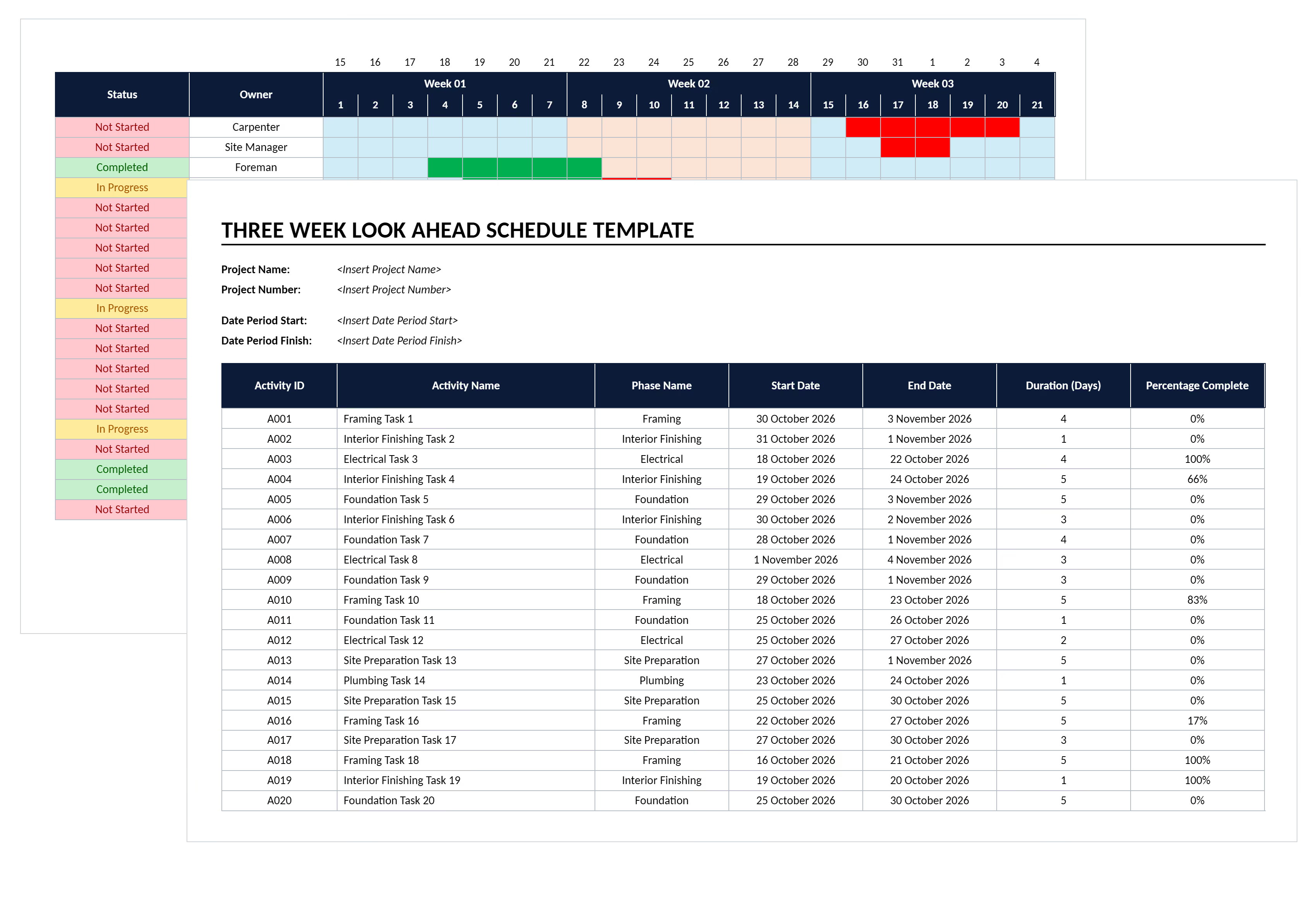
3 Week Look Ahead Template
Use this FREE 3-week look-ahead template to bridge master schedules and daily work. Coordinate trades, sequence subcontractors, and identify constraints three weeks ahead.

Walk Into Every Meeting With Confidence, Clarity, and Control
No one wants to look unprepared, blindsided, or uncertain in front of stakeholders — but that’s exactly what happens without Mastt.
Start for FreeTrusted by the bold, the brave, and the brilliant across governments, Fortune 500s, and the world’s best in delivering the future