


Improving construction productivity means completing more planned work to the required quality with the same labor, time, and resources. During our interview, location-based planning expert Olli Seppänen explained how project teams can shorten schedules while improving quality and reliability. Here are eight practical steps drawn from his insights.
1. Check Work Readiness Before Releasing a Task
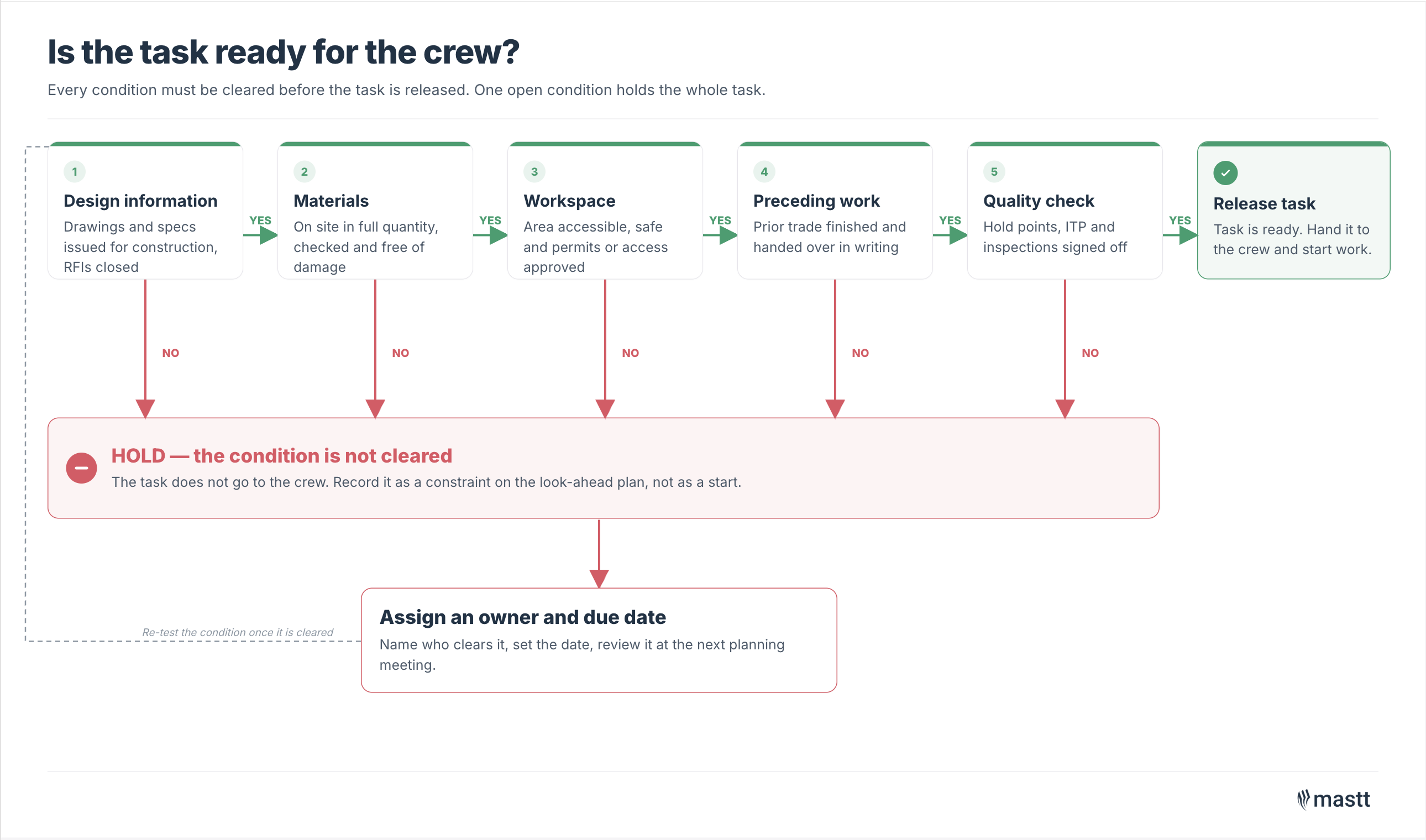
Check every task for readiness before assigning it to a crew. Confirm that the design, materials, workspace, preceding work, and required quality will be ready at the planned start.
None of these things are very complex. But the problem is that there are so many of these things at the same time that it’s very difficult for site management to keep a list of everything that needs to be done in order for production to proceed productively.
- Olli Seppänen
Contractors often extend task durations because earlier experience tells them to expect disruption. A one-day activity may become a five-day allowance when the surrounding conditions are unreliable. That added contingency protects the contractor and lengthens the project.
Create one readiness check for every task in the short-term production plan:
- Confirm that the latest design information is available.
- Check that the correct materials will arrive before the crew.
- Remove stored materials that block access or reduce workspace.
- Verify that the preceding crew has finished its work.
- Check that the completed work gives the next crew suitable conditions.
- Assign every unresolved item to an owner and due date.
Indoor-positioning research shows how much unused time can sit inside a planned duration. In one five-day task, workers were present in the location for only 30% of the scheduled period. Under productive conditions, the work could have taken about one and a half days.
2. Build a Production Schedule for Site Control
Use a production schedule to turn project dates into clear decisions about crews, locations, resources, and handoffs. Keep it connected to the master schedule so daily control remains aligned with contractual milestones.
Activity-based scheduling systems] are very good for negotiating with the clients about time-extension claims, but not very good at actually directing the crews. That was the main gap we were trying to solve: how to bring a practical tool to site managers so that they can talk about resources and how many crews are needed.
- Olli Seppänen
Traditional project scheduling tools such as Primavera remain useful for critical path planning and delay analysis. Site managers need another view that shows how work will move through the building.
The two schedule views should serve different decisions while using the same project dates:
For each active trade, record the planned crew size and the resources needed for the work ahead. Check whether those assumptions provide enough capacity to maintain the intended flow. This gives project managers enough detail to spot a crew or resource problem before it affects a milestone.
3. Divide the Project Into Repeatable Work Locations
Divide the building into locations so different crews can work at the same time. Each location should contain a defined work package that one trade can complete before moving forward. A location could be a floor, apartment, room, or another physical area.
Every apartment could be a location. Or every room of an apartment could be a location. The smaller you make the locations, the faster you can do your project. But it is a little bit more painful to manage them if you go too small.
- Olli Seppänen
Floor-level planning can leave large areas lightly occupied until work accumulates near completion. A location-based management system divides those floors into smaller production zones. For instance, in an apartment building, crews can work in separate apartments and move forward together.
Smaller locations allow the following work to begin sooner and create more parallel flow. They also give the site team more areas to coordinate. Choose the smallest location the team can control without losing the planned rhythm.
4. Start the First Takt Project at Floor Level
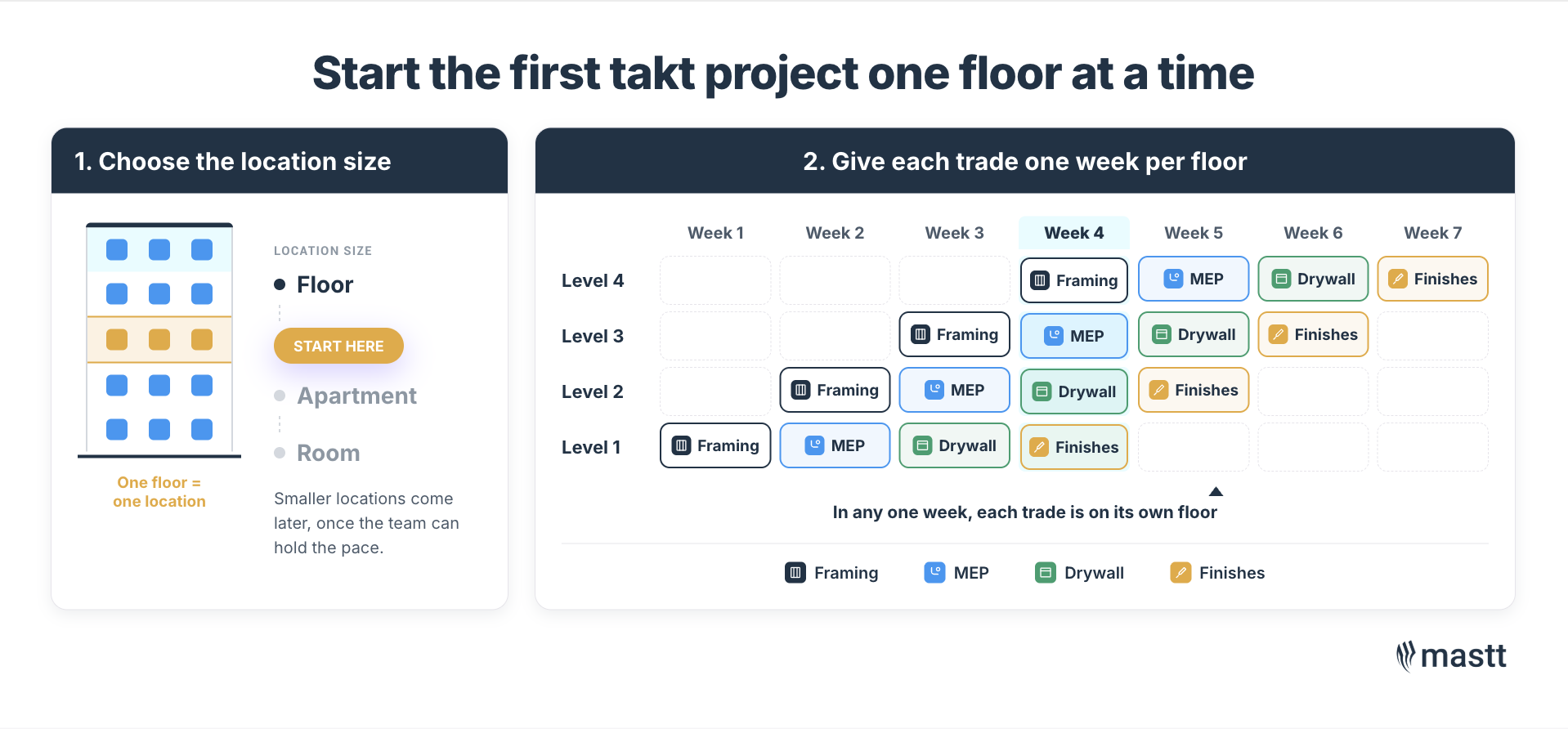
Begin the first takt project with floor-level locations and a one-week takt time. Under this arrangement, each trade has one week to complete its package before moving floors. The pace gives the team time to learn the production system.
The most common mistake is to be too idealistic and choose too aggressive goals for the first project. I would advise that you don’t go for the smallest location size in your first project. Let’s try it on floor level. Let’s have one week per floor.
- Olli Seppänen
An aggressive first plan gives the team little room to learn how to control the sequence. Starting at floor level allows trades to coordinate labor, materials, access, and quality checks before each handoff.
Choose a repetitive area for the pilot, then agree on the trade sequence and completion requirements for each handoff. From that sequence, set the crew sizes and material release dates needed for the one-week cycle.
5. Keep Steering Production When the Plan Changes
Expect the location-based plan to change once work begins. The schedule still gives the team direction, while production control adapts the sequence as conditions change.
A typical location-based project doesn’t go according to the original plan. There’s too much variability in the process and too many random things. But the best projects which achieve good results are able to steer the project and control it to still get most of the benefits, even though the final process is not at all like they originally planned.
- Olli Seppänen
The first deviation does not mean the method has failed. Construction contains too much variability for every crew movement to follow the baseline exactly. The team must keep the production plan current as actual work changes.
When the sequence changes, find the first location and trade that moved away from the planned rhythm. Check the effect on the following crews, adjust the remaining work, and update the production view.
Preserve as much crew continuity as possible while changing the sequence. The final path may differ from the baseline and still retain the main production benefits.
6. Control Material Logistics at Project Level
Match each material delivery to the crew, location, and date shown in the production schedule. The general contractor and owner should coordinate that flow across all trades. Project-level control prevents separate delivery plans from competing for the same space and access.
Material management is a very critical part, and the general contractor and the owner need to be on top of it. You cannot give it to subcontractors to deliver their materials. So we are starting to see consolidation centers, very detailed quantity takeoffs based on BIM models, and coordinated deliveries in kits.
- Olli Seppänen
When subcontractors arrange deliveries separately, one location may receive too much material while another receives too little. A shared logistics plan connects ordered quantities and delivery times with the production sequence.
Build the material flow around four controls:
On large projects, a consolidation center can receive, check, and sequence materials before site delivery. To support that process, owners can require a logistics plan and clear reporting for long-lead items.
7. Prepare Prefabrication Before Site Installation
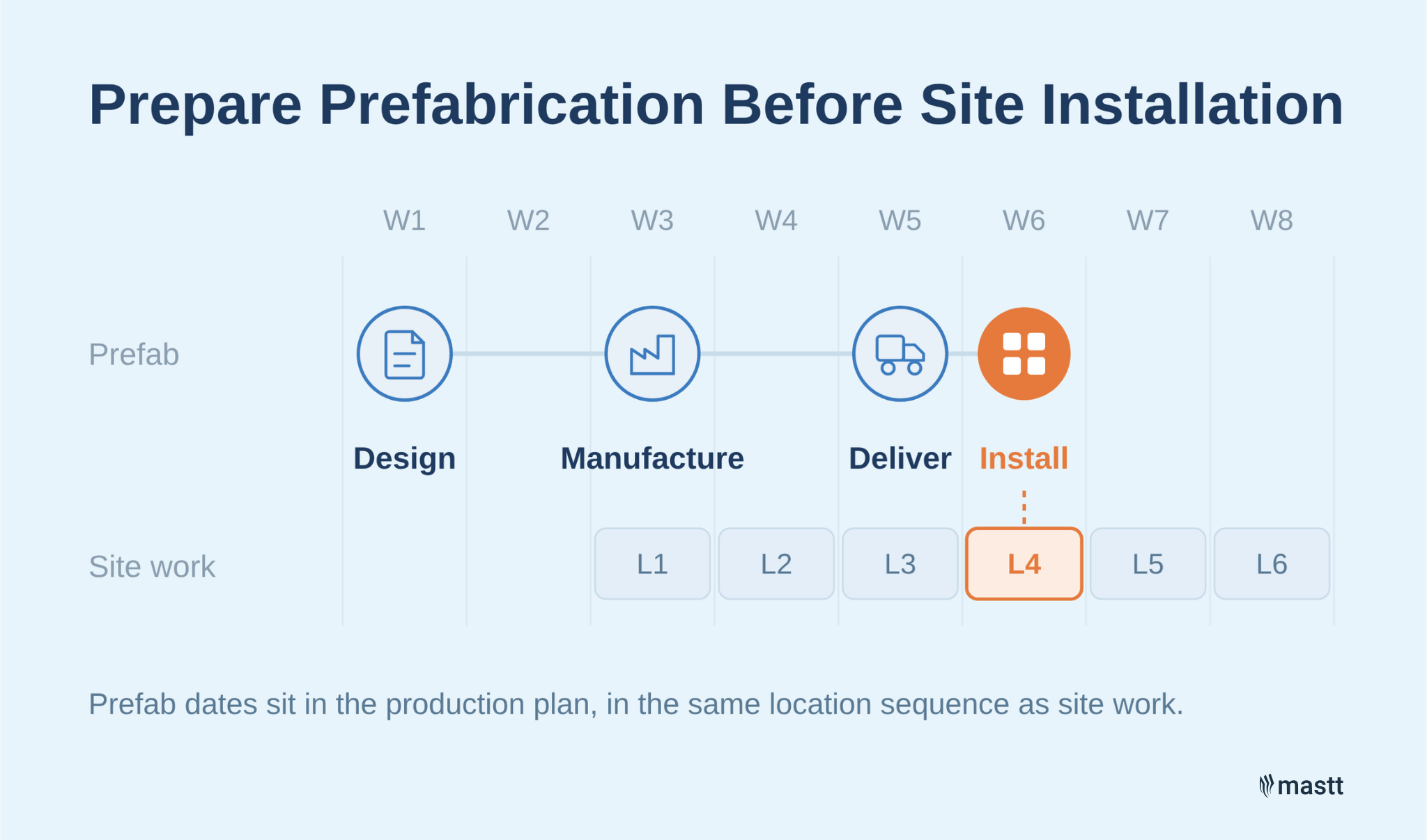
Use the takt plan to set the design, manufacturing, delivery, and installation dates for prefabricated work. This preparation places each assembly in the site sequence before production begins. Crews can then install it during the planned location cycle.
There was a residential construction project that was finished in six months by one of the contractors and also exceeded all quality expectations. It was better quality than any of the normal 12-month or 14-month projects. It included a lot of prefabrication, of course, and the takt production principles. A lot of time went into preparing it.
- Olli Seppänen
The six-month outcome depended on the preparation behind the takt. Prefabrication supports flow when design approval, manufacturing, and delivery follow the installation sequence. The same project also exceeded the contractor’s usual quality results.
Start with repeatable assemblies that the project team can coordinate through BIM. For each assembly, confirm the design approval, manufacturing cut-off, delivery location, and installation slot. Place those dates in the production plan so procurement follows the same location sequence as site work.
8. Connect Project Systems Before Adding New Apps
Before adding another application or software, map how project information moves between the existing systems. As part of the map, note where teams enter the same data more than once.
Every time you get a new app, it just increases the number of apps you need to use, and they don’t talk to each other. All the software providers are focusing on their app and not on interoperability. It makes it very difficult for site people to increase productivity. The same information has to be entered over and over again.
- Olli Seppänen
Repeated entry takes time and creates conflicting records. Use the workflow map to confirm that a new tool can connect to source data or replace a manual process.
Answer four questions before deployment:
- Which system holds the source record for each data type?
- How will the new application receive and return that information?
- Who will correct failed transfers or conflicting records?
- Which manual entry or report will the project stop using?
Run one real progress update through the proposed workflow and record every manual entry. Compare the time with the current process. Approve the application when the test shows a clear reduction in repeated work.
How to Measure Construction Productivity Improvements
Record a baseline before introducing the new production method, then compare results by trade and location. The measures below track work readiness, crew flow, material delivery, quality, and time lost to repeated data entry.
Review the results during the weekly production meeting and investigate the largest gaps by trade and location. Project-wide averages can hide a recurring constraint in one work area. Assign each corrective action to an owner, then check the same measure during the next reporting cycle.
Start With a Manageable Takt Plan
Improving construction productivity starts by removing the uncertainty built into task durations and giving site teams a production plan they can control. Olli recommends beginning with a one-week takt per floor, then refining the approach as the team gains experience. This gives teams a practical way to shorten schedules and sustain the gains from one project to the next.
Note: The insights and quotations in this article come from Mastt’s interview with Professor Olli Seppänen.
.avif)
Written by
Doug Vincent
Doug Vincent is the co-founder and CEO of Mastt, the AI capital-project management platform used by governments, Fortune 500 companies, and consultancies across APAC, North America, and MENA. Before founding Mastt in 2019, he spent a decade at RPS delivering more than $2 billion in capital works, including the $2.1B Defence Navy Infrastructure program, and holds a CPSPM certification with the AIPM. He contributes content and speaks on AI in capital project delivery at Mastt.


Contributions by
Olli Seppänen
Olli Seppänen is a tenured Associate Professor of Operations Management in Construction at Aalto University in Finland, and co-author of the foundational text on location-based management for construction. He co-founded the construction software company Vico Software, chairs the board of site-intelligence firm Aiforsite, and initiated the Aalto Building 2030 research consortium. At Mastt, he contributes content on construction productivity, lean, and digital delivery.
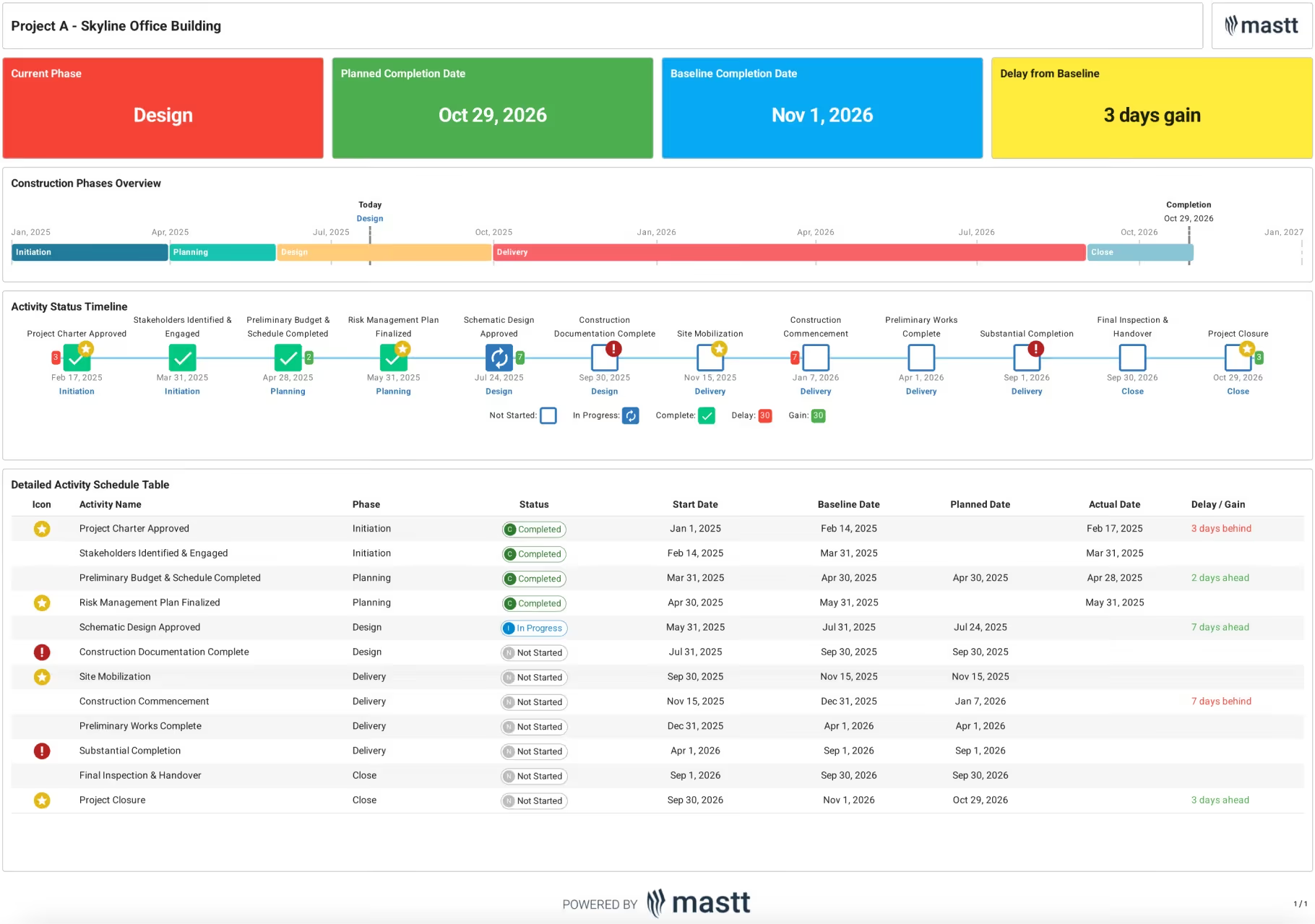
Construction Schedule Template
Use this FREE Construction Schedule Template to plan and outline all phases, milestones, and tasks. Keep your construction project organized and on track from start to finish.

Walk Into Every Meeting With Confidence, Clarity, and Control
No one wants to look unprepared, blindsided, or uncertain in front of stakeholders — but that’s exactly what happens without Mastt.
Start for FreeTrusted by the bold, the brave, and the brilliant across governments, Fortune 500s, and the world’s best in delivering the future