


Most construction projects run two schedules. The contractual one, tied to milestones and updated monthly, and the one the crews work to, which lives on a whiteboard in the site trailer and gets rubbed out every Friday. The Last Planner System closes that gap by making the field the source of the plan. It sits underneath construction project scheduling without replacing it, and it changes what the whole project team owes each other.
What Is the Last Planner System?
The Last Planner® System (LPS) plans construction week to week through commitments made by the people who will do the work. Foremen, trade supervisors and superintendents, the "last planners," decide what gets done instead of receiving a schedule from the office. Reliability is measured every week, and the reasons work does not happen get recorded and fixed.
Its full name is the Last Planner® System of Production Control. Production control means steering work toward the planned outcome and finding another path when the planned one closes. The name is a registered trademark of the Lean Construction Institute, which stewards the method and publishes its standard work.
A master schedule says what should happen. It cannot say whether a crew has the drawings, the materials, the access, and the preceding work finished to a standard they can build on. Only the people doing the work know that, so you ask them weekly and keep score.

Who developed the Last Planner System?
Glenn Ballard and Greg Howell developed it through research in the 1990s, and Ballard formalized it in his 2000 doctoral thesis at the University of Birmingham. The two had founded the Lean Construction Institute three years earlier.
How does it relate to lean construction?
Lean construction applies manufacturing ideas about flow and waste to building work, and LPS is its production planning engine. Most teams meet lean construction scheduling through LPS before anything else in lean project delivery, and it is the one component that works on its own.
Who is a "last planner"?
The system takes its name from the last person to plan the work before it gets built. Every level above adds detail to what should happen; the last planner is the one who converts that into an assignment for a specific crew, with the authority to promise it will happen.
In construction the 'last planner 'is usually the trade foreman or superintendent, and in design the architectural and engineering project managers. Against them sit the first planners, the project managers and schedulers who set the milestones at the start.
First planners decide what should happen; last planners decide what will. Each week a last planner names the work their crew will do, anything blocking it, and the reason if it does not happen.
Why Only Half the Weekly Work Plan Gets Done
On the Lean Construction Institute's numbers, only 54% of work planned for a given week gets completed in the time allowed. LCI stewards the method and has an interest in that figure, but roughly one task in two slipping is the problem the whole system was built to attack, and two things cause it.
The first is that the schedule everyone reports against was never built to direct crews. A detailed critical path method (CPM) schedule models the network and carries the contractual dates, which makes it the evidentiary basis for a delay claim rather than a set of instructions. Timothy Mather spent 23 years building CPM scheduling software at PMA Technologies, so his view of its limits carries weight.
"I see the field work and the schedule as running on two separate parallel paths. Even if you were to do an update bi-weekly, that 30,000 activity schedule is not actually driving work on the site."
- Timothy Mather, COO at Strategic Business Solutions and former CTO of PMA Technologies
What fills the vacuum is a parallel planning system nobody contracted for. The trades, as Mather describes it, "have their own little two week look ahead schedule," and that informal plan gets reconciled backwards into the construction master schedule every few weeks, producing a list of activities out of sequence, started early, or never started at all. He has a name for the reconciliation. "It just seems like Kabuki theater to me."
The second cause is what unreliability does to the durations themselves. When a crew cannot trust that the work in front of them will be ready, they price that risk into their own numbers. Olli Seppänen is Associate Professor at Aalto University and co-author of the standard textbook on location-based management, and his research uses indoor positioning to measure what crews actually do on site.
"Actual work might take one day, but the contractor is saying five days, because they are anticipating somebody else will cause them a problem. So everyone is baking in a lot of contingency in their durations."
- Olli Seppänen, Associate Professor, Aalto University
His positioning studies put a number on it. A five-day task, measured, "requires just 30% time present." That measures presence on the work face rather than productive effort, so it is no claim the task could be done in a day and a half. It does show how much of a booked duration is protection against other people's unreliability.
So the two problems feed each other. Unreliable handoffs make trades pad, padding makes the schedule fiction, and a fictional schedule cannot be used to make anyone reliable.
What Are the 5 Levels of the Last Planner System?
The five levels of LPS are master scheduling, phase scheduling, lookahead planning, weekly work planning, and learning. Each runs on a different horizon with a different set of people in the room, and each hands its output down to the next. The Lean Construction Institute frames the underlying logic as five conversations:
- Should. Pull planning establishes what the project needs to happen.
- Can. Make-ready planning gets upcoming work into a state where it is possible.
- Will. Weekly work planning turns that into promises from named people.
- Did. Daily commitment management confirms the work happened.
- Learn. The team reviews its own reliability and changes something.
LCI splits the mechanics into eight key elements: milestone planning, pull planning, make-ready planning, weekly work planning, constraint management, daily huddles, Percent Plan Complete, and reasons for variance. The five levels below group those eight.
Vocabulary varies between publishers, who variously call these components, elements or parts, level three make-ready rather than lookahead, and level four commitment planning.
One warning from the practitioner literature is worth carrying through all of it. The system was designed as a whole, and treating it as a menu you order from is the most reliable way to get nothing out of it.
Level 1: Master scheduling
Master scheduling sets the milestones and the overall sequence. This level is deliberately coarse, carrying milestones and phase durations instead of thousands of activities, and it is normally extracted from or reconciled to the contract schedule. It is also the only level of the five where the client is in the room by default.
Level 2: Phase scheduling and pull planning
Phase scheduling works backwards from one milestone with the trades who will deliver it, hence pull planning, and it happens two to three months before the phase starts. Each trade posts what it needs from the trade before it, and the sequence gets argued out over half a day or a day. The argument is the deliverable. A pull plan everyone agreed to in twenty minutes was not a pull plan.
What the trades negotiate is handoffs, and the useful ones carry conditions of satisfaction. Not "slab complete" but what state the slab is in, cleaned to what standard, with what tolerances and which penetrations set. That level of detail is where a missed dependency surfaces, months before it would have stopped a crew.
One further step is the one most often skipped. Once the plan is built, the team compares its total duration against the time available, and any slack is held as a single buffer at the end of the phase instead of handed back into individual durations.
That distinction separates two things people lump together. Seppänen objects to contingency hidden inside individual task durations, where nobody can see it and everybody adds their own.
Lorne McClurg, Director of Moto Projects and a client-side project manager in Adelaide for over twenty years, is talking about program contingency rather than task durations, and defends the other kind.
"Too many times these days people strip out contingency and program. It's get it done faster, get it done tomorrow. It's like yeah, but it's raining today. I can't do it tomorrow. I have to draw down on some contingency."
- Lorne McClurg, Director at Moto Projects
They are describing the same principle from opposite ends. Buffer held visibly, where the team can see it and decide together when to spend it, is contingency doing its job. Buffer hidden inside forty separate task durations is the same time, spent worse.
Level 3: Lookahead planning and make-ready
The lookahead is the window, usually about six weeks. Make-ready is the work inside it: breaking phase activities down to crew-level assignments, finding constraints, removing them before they bite. Six weeks comes from the paperwork. Submittal review runs four weeks or more and RFI turnaround two to three, so a shorter window cannot make most work ready in time.
A constraint is anything that would stop a crew starting. The standard categories are predecessor work, design and information, materials, labor, equipment, space and access, and external approvals or permits. Seppänen's list of what actually stops crews, drawn from location-based projects, is the same list a make-ready process hunts for.
"Why don't we have the design feasible on time? Why don't we have all the materials on time? Why there are so many extra materials on the work site that is interfering with the work? Why is the preceding crew not ready when the next crew starts?"
- Olli Seppänen
None of those are complicated on their own. There are simply a great many at once, and as Seppänen puts it, "it's very difficult for site management to keep a list of everything that needs to be done in order for production to proceed productively." That is the argument for a formal log instead of a superintendent's memory.
A constraint log is that list. Each row names one constraint, the person who owns clearing it, and the date it is needed by. Add the CPM activity ID it blocks and you can also see which constraints sit near the critical path, which takes about a minute per row and which most logs skip. A look-ahead schedule with no constraint log attached is just a shorter Gantt chart.
Work that clears its constraints early goes into the workable backlog, a reserve of jobs ready to start. When a planned task dies on Tuesday morning, the backlog stops the crew wandering off to begin something unready. A team without one improvises, and improvised work is where next week's constraints come from.
Notice how much of that category list sits outside the contractor's control. Design not feasible on time, materials on a long lead, approvals outstanding. On most jobs, a meaningful share of the log ends up with the client's name on it, which is dealt with further down.
Level 4: Weekly work planning
Only work that has been made ready gets into the weekly work plan. One rule, and the one most often broken, because a task with an open constraint still looks perfectly schedulable on a Monday morning. Committing to it anyway teaches the crew that commitments are decorative.
The meeting is a cycle of requests and promises. One trade asks another for a specific piece of work by a specific date, and the second either promises or declines. A decline is useful, because it surfaces the problem while there is time to fix it. This is what the literature calls reliable promising, and it only works if declining is allowed.
McClurg never uses the term, but he describes the mechanism as well as anyone. Asked what a client-side project manager does, his answer skips contract administration entirely.
"Our role is to help people solve problems. Help people remain on track to deliver the promises they made to other people... it's making sure that people honor their promises, and giving them tools to help them do that."
- Lorne McClurg
Weekly work planning is one of those tools, in that it makes the promise explicit, public and dated, and then counts whether it held.
Good assignments meet five tests. They are clearly defined, sound, in the right sequence, sized to the crew's real capacity that week, and used for learning afterwards. Sizing is the one to watch, because an oversized plan produces exactly the same missed commitments as an unready one and is much harder to spot.
Level 5: Daily huddles and learning
The daily huddle is a ten to fifteen minute stand-up at the board where each crew leader confirms whether yesterday's commitment landed and flags anything that will stop today's. It catches problems while they are cheap, because daily adjustments are easier than weekly ones and weekly ones far easier than monthly.
At the end of each week the team scores what was completed against what was promised, then asks why the misses happened. Collecting reasons on its own is record-keeping. Recurring reasons have to go through a root cause method, usually the 5 Whys, and each should produce a named counter-measure with an owner and a due date that somebody checks the following month.

Last Planner System Example: One Milestone, Start to Finish
None of the five levels makes much sense in isolation, so here is one thread running through all of them. It is a constructed Last Planner System example rather than a real project, but the mechanism is the one teams actually experience.
Two things in that sequence are worth noticing. The painter declining to commit to the signed-off areas is the system working, not a gap in it. And the counter-measure on Friday points at the client rather than the trade, which is where the reasons actually led.
What Does the Evidence Say About the Benefits?
The evidence is narrower than the marketing. Improved plan reliability is well supported, and almost everything stacked on top of it gets asserted without a citation, so the two are worth separating.
What is reasonably evidenced:
- Plan reliability improves, and productivity follows. Ballard's thesis treats 70% Percent Plan Complete as the level where productivity gains start appearing, against the 54% baseline. It is the method's core claim, and it comes from its originator's own doctoral research.
- The waste it targets is real. PlanGrid and FMI's 2018 Construction Disconnected report, a survey of nearly 600 construction leaders, put United States rework caused by poor communication and bad project data at $31.3 billion a year, with 22% traced to poor project information alone. Missing information is a constraint, and constraints are what make-ready removes.
- Design rework may be the bigger prize. Ballard's informal studies suggest teams spend around half of design time on unnecessary rework. He co-authored the method, so treat it as an interested figure.
What is claimed but not evidenced:
Three benefits appear on nearly every page written about this method, including the Lean Construction Institute's, with no study attached.
- Improved safety. Fewer unplanned tasks should mean fewer improvised methods, and improvised methods are how people get hurt. Plausible, unmeasured.
- Better collaboration. Universally asserted, never defined in a way anyone could test.
- Shorter project duration. The hardest of the three to isolate, because teams that adopt this rarely change only this.
One study gets read two ways. A 2022 paper in Advances in Civil Engineering on road projects for the Addis Ababa City Road Authority is widely cited as proof the system works.
Read the method section and all three sites used the critical path method against a master schedule with no weekly work plan or lookahead in place. It documents a top-heavy implementation more clearly than an outcome, and it is the only sizeable study from infrastructure rather than building work, so anyone asking about roads and civil specifically is working from very little.
A proven reliability mechanism and a well-quantified waste problem still beats the evidence base behind most delivery interventions anyone will try to sell you.
How Percent Plan Complete and the Other Reliability Metrics Work
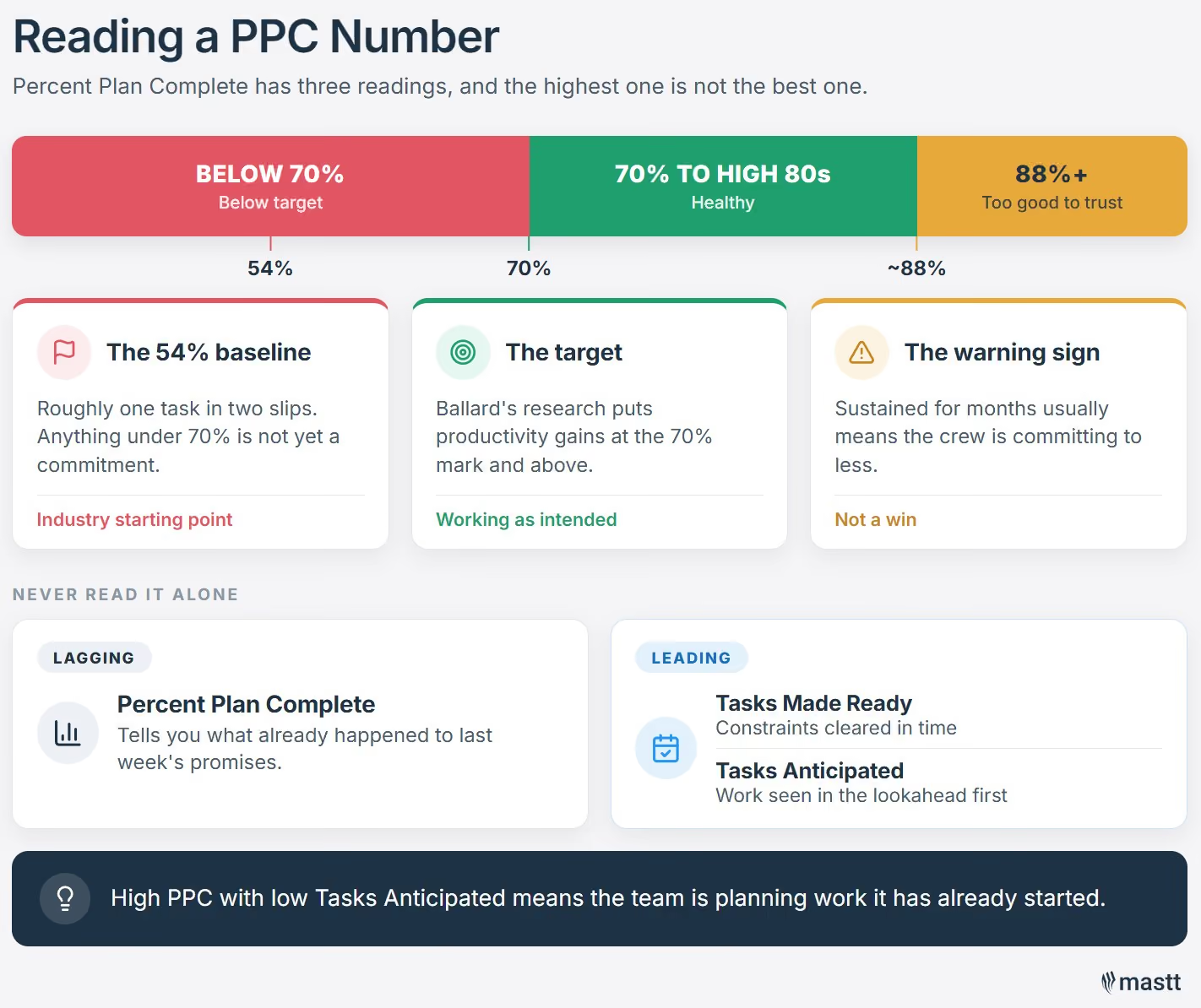
Percent Plan Complete (PPC) is the number of commitments completed divided by the number made. Twenty tasks promised and fifteen delivered is a PPC of 75%. No partial credit, because a task that is 90% done does not release the following trade.
Against the 54% baseline, a team running the system properly should reach the 70s. Two caveats matter more than the number itself. PPC counts tasks without weighting them, so nine trivial tasks done and one critical task missed still scores 90%. And a PPC that sits above the high 80s for months usually means the team is under-committing.
PPC is also a lagging measure, and that is the argument for having two others alongside it.
Tasks Made Ready is the share of lookahead tasks whose constraints were cleared in time. It measures whether make-ready is working, and make-ready is the level that fails first.
Tasks Anticipated is the share of this week's work that was visible in the lookahead a few weeks ago. Low Tasks Anticipated with a high PPC means the team is planning work it has already started. Read those three together with the constraint closure rate and you can tell whether the reliability is real or manufactured.
Anyone can game the metric, and you should assume someone will try, so here is what catches it:
- Compare Monday's committed plan against Friday's scored sheet. If tasks were added mid-week and then scored complete, the scoring is measuring something other than commitment.
- Read PPC against milestone movement. A PPC in the high 80s on a job that just lost a week means the plan is covering everything except the work that matters.
- Watch who scores it. Scored in the room in front of the people who promised is real. Scored afterwards by an engineer who missed the meeting counts for nothing.
- Look at the shape of the reasons for variance. Everything in one bucket, or everything in "other" and "weather", means nobody is doing root cause.
One thing you should not do is make PPC a contractual key performance indicator or attach money to it. The moment it carries a penalty, crews commit to less and the reasons stop naming anyone who might object, and you have lost the only diagnostic the system produces. The metric's own originators warn against exactly this.
What LPS Requires From the Client Side
A constraint log turns the client into a participant instead of an observer. Within about three weeks of it going live, the owner and the design team appear on it by name, with dates against them, and that is the single biggest difference between this method and a contractor's internal planning routine.
Client-side items are among the most common entries in any make-ready process. RFI responses, submittal reviews, decisions, site access, permits, third-party approvals, owner-supplied equipment, stakeholder sign-offs. For a contractor, converting diffuse client-side slowness into a dated named list is the point. For a client, it is worth understanding before asking for the system.
The log is also a contemporaneous record. A constraint reading "awaiting RFI 214 response," open for six weeks with a name against it, is dated evidence of causation and discoverable in a dispute. It cuts both ways, which is arguably the point, though it is not the way most clients first imagine the system working for them.
An obligation with no reciprocal commitment gets treated as a stick with no handle. A constraint log without matching client undertakings on RFI turnaround, submittal review periods, decision dates and access dates will not survive month three.
Contractors should ask for those undertakings when the system is proposed, and clients are better off offering them unprompted. Reciprocity is why the method sits naturally on integrated project delivery, alliance and early contractor involvement contracts, where everyone is already in the room. On hard-money lump sum with an adversarial relationship, mandating it produces a performance instead of a system.
How Pull Planning Reconciles With Your CPM Baseline
The two run at different altitudes and both stay. The critical path method schedule, whether it lives in Primavera P6 or Microsoft Project, remains the contractual model of record and the basis for entitlement, extensions of time and float, meaning the slack an activity can absorb before it delays a milestone.
The Last Planner System governs what actually gets built in the next six weeks. What CPM cannot do is tell a crew what to start on Monday, and when trades re-sequence a phase in the room they have written new logic the model has to catch up with.
Four things need defining explicitly before the two drift apart:
- Decide what a pull plan is, contractually. Is its output an informal production plan that must conform to the accepted schedule, or a legitimate source of schedule revision requiring formal submission? Almost no specification says, and your scheduler will ask first.
- Make the monthly narrative do the work. Require it to list logic changes, duration changes and added or deleted activities, naming the session that generated each. Ask for "evidence the pull plan fed the update" and you will get a sentence.
- Route constraints correctly. A constraint that might affect a milestone belongs in the risk register. One that will is a live delay event with a notice obligation, and filing it as a risk is how parties lose entitlement.
- Align the data dates. A monthly update dated the 25th and weekly plans ending Friday will never tie.
Getting this wrong carries a cost that rarely appears in anyone's budget. Mather has watched clients answer an untrustworthy contractor schedule by quietly building a second one.
"If you have an owner's rep, they may maintain their own critical path schedule almost as a defensive move... that's an out of pocket cost. The contractor is going to build that cost into their price and the owner's rep or the internal organization is going to have to pay to have their own schedule maintained."
- Timothy Mather
A production layer both sides trust is the cheaper answer to that.
Row for row the two will never match, since CPM activities run five to twenty days against weekly assignments of one to five. Reconciliation means weekly completions rolling up into CPM percent complete and remaining duration, with the documents staying separate.
Build a CPM at assignment level and you just recreate the 30,000-activity problem Mather describes in why construction schedules don't match what's happening on site.

Why LPS Rollouts Fail on Real Projects
Rollouts fail at the bottom of the system, almost never at the top. Master scheduling and phase pull planning are the visible, enjoyable parts and they usually happen.
Make-ready, weekly commitment and learning take discipline every week, and those are the ones that quietly stop. The literature is overwhelmingly positive, which should make you suspicious, so here is what shows up in the monthly report.
- Make-ready never really happens. The lookahead is a filtered Gantt chart, or the constraint log exists with no names, no dates, and nothing ever closing. This is the most common failure and everything downstream fails with it.
- Unready work gets committed anyway, because the weekly plan has to look full for the client. Clients often cause this by reacting badly to a short plan.
- The room is run as command and control. The superintendent tells each trade where to put its sticky note, and the plan becomes the same top-down schedule with more furniture. Commitment cannot be extracted, only offered.
- Reasons for variance are collected, charted, and never actioned. The same reason appears three months running with no counter-measure recorded.
- People in the room cannot commit. The foreman is present but his labor is allocated by a regional resource manager, or his own subcontractors are not there.
- The meeting stack duplicates. The system gets bolted on top of the existing owner-architect-contractor meeting, the coordination meeting and the foremen's meeting, so the same ground gets covered four times and attendance decays.
- Everything runs well on a baseline that was never achievable. PPC in the 80s and the job is still late, because the schedule was fantasy at award. This will not recover a job that was lost at tender.
The fifth one looks like an attendance problem and is really an authority problem. McClurg's test for whether the right people are in any problem-solving room is short.
"Have they got the responsibility, authority and accountability to be able to make decisions and provide direction?"
- Lorne McClurg
Where the answer is no, that person can attend every session for a year without making a commitment worth counting.
Seppänen has watched the same collapse in location-based implementations and traces it to a single moment. "One of the problems we noticed early on is that people give up if they cannot follow the original plan," he says, and the projects that come out well do the opposite.
"The best projects which achieve good results, are able to steer the project and kind of control it to get still most of the benefits even though the final process is not at all like they originally planned."
- Olli Seppänen
How to Tell Whether LPS Is Really Running
A project running the system produces six artifacts as by-products. A project performing it cannot produce them at all, and that difference is the whole test, whether you are a client checking a contractor or a project team checking itself.
- The six-week lookahead, which shows whether make-ready happens at all.
- The current weekly work plan, with named crews and specific tasks.
- The constraint log, each row carrying an owner and a required-by date.
- Constraint closure rate, opened against closed, plus the average age of open items.
- PPC over eight weeks or more, never a single figure, with Tasks Made Ready beside it.
- Reasons for variance by category, with the counter-measures taken.
A team genuinely running LPS can send all six the same day, because they already exist. Anyone who needs a week to assemble them is assembling them.
On site, a few things reveal more than the reporting will. Check whether the plan on the wall is current or three weeks stale, and whether the board is anywhere the crews can see it.
Sit in a weekly work planning meeting and watch who speaks, because if the trades are silent the commitments belong to somebody else. Ask a foreman, without the superintendent standing there, to show you his crew's tasks for the week. Then read the closed items in the constraint log rather than the open ones, because sixty open and four closed in three months is a graveyard.
The most useful question takes ten seconds. Ask what a crew does when it gets blocked. "They find something to do" means there is no workable backlog, and a workable backlog is the entire point of the lookahead.
Putting it in a contract, or introducing it mid-job
Specifying the method carries a risk clients rarely price. Production planning and the management of the contractor's own labor are means and methods, and prescribing them hands the contractor an argument that the client directed how the work was to be planned. That is manageable, and the way around it sits in the wording:
- Specify outputs, not the method. Require a rolling six-week made-ready lookahead, a constraint log with named owners and dates, weekly commitment plans, and weekly reliability measurement with root cause analysis. Any contractor already running LPS will propose it by name.
- If you name it, carve out means and methods. State that the contractor remains solely responsible for sequencing and for achieving the schedule, and that client attendance at pull planning is neither direction nor acceptance of any date shown.
- Flow it down, do not reach past the contract. A client has no contract with the subcontractors. The obligation sits with the contractor to procure their attendance and to include the requirement in its subcontracts.
Price it honestly. Facilitation, foremen out of the field, a large room and often an external coach for the first few months are real preliminaries cost, and introduced after award the whole thing is a variation.
Most projects meet this method mid-job, usually because a contractor raised it, and quite a lot is available without a variation (change order). The six artifacts can be asked for as reporting, since a contractor already running the system produces them anyway.
Interface-milestone sessions can be attended. The client can commit to its own turnaround times, which costs nothing. What cannot happen without a variation is mandating the full cadence on a contractor who does not run it, so test what exists first. A 3-week look-ahead template is a reasonable interim reporting format if nothing is in place today.
Is LPS Worth the Time?
The return shows up six weeks before a problem lands, in a sentence from the foreman who will be blocked by it. A monthly report carries the same information after the fact, when the only remaining question is who pays for it.
Everything depends on the bottom two levels holding, and they are unglamorous. Make-ready and weekly commitment take an hour a week from people who are busy, they produce no artifact anyone enjoys reading, and they are the first things dropped when a job gets hard. They are also the only part of the system that touches what gets built tomorrow.
Where the data exists but reconciling it to the baseline takes a week of retyping, that is a tooling problem more than a planning one. Construction project scheduling software that holds the baseline and the field data in one place is where to look next.
Quotes come from Mastt's video interviews with Timothy Mather, Olli Seppänen and Lorne McClurg, each available in full.
.avif)
Written by
Doug Vincent
Doug Vincent is the co-founder and CEO of Mastt, the AI capital-project management platform used by governments, Fortune 500 companies, and consultancies across APAC, North America, and MENA. Before founding Mastt in 2019, he spent a decade at RPS delivering more than $2 billion in capital works, including the $2.1B Defence Navy Infrastructure program, and holds a CPSPM certification with the AIPM. He contributes content and speaks on AI in capital project delivery at Mastt.


Contributions by
Timothy Mather
Tim Mather is a former CTO and COO of PMA Technologies, where he spent 23 years developing construction scheduling and risk analysis software. He co-developed NetPoint® and NetRisk™ and co-authored "Core Traits of a Reliable Schedule." At Mastt, he writes on construction scheduling, project controls, and AI in construction.
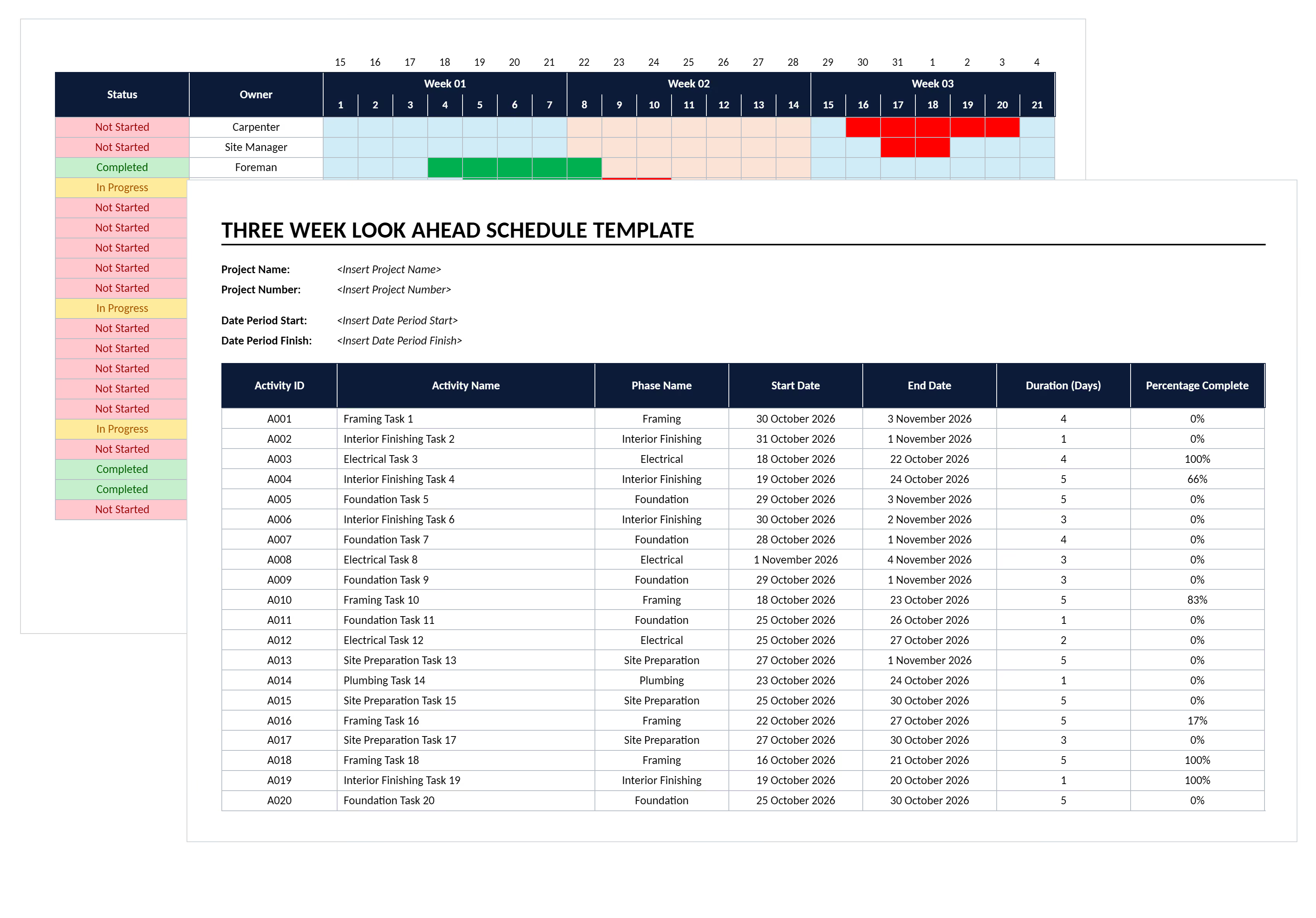
3 Week Look Ahead Template
Use this FREE 3-week look-ahead template to bridge master schedules and daily work. Coordinate trades, sequence subcontractors, and identify constraints three weeks ahead.

Walk Into Every Meeting With Confidence, Clarity, and Control
No one wants to look unprepared, blindsided, or uncertain in front of stakeholders — but that’s exactly what happens without Mastt.
Start for FreeTrusted by the bold, the brave, and the brilliant across governments, Fortune 500s, and the world’s best in delivering the future