




Adaptive project management uses regular feedback to adjust project decisions as requirements and conditions change. In construction, that means giving teams a structured way to respond when design development, site discoveries, or delivery constraints affect planned work.
This guide explains the approach, compares it with the predictive method, and sets out how to apply it on capital projects.
What Is Adaptive Project Management?
Adaptive project management is an approach that develops and adjusts project plans through ongoing learning, stakeholder feedback, and review. It suits projects where requirements or solutions are uncertain and likely to evolve, consistent with PMI’s definition of adaptive planning.
An adaptive project management approach starts with an agreed goal, while project planning becomes more detailed as knowledge improves. In construction, teams can apply it to evolving design requirements and use adaptive planning practices to manage uncertain delivery conditions within an approved scope.
Predictive vs. Adaptive Project Management
Predictive project management emphasizes delivering an established plan, while adaptive project management builds in opportunities to reassess it. Here’s how the two approaches compare:
Characteristics of an Adaptive Approach in Project Management
An adaptive project management approach combines flexible planning with disciplined review of decisions and assumptions. Its defining characteristics show up in the following team practices:
- Iterative planning: Teams revisit plans after a defined period of work or review, using what they learned to decide the next activities.
- Continuous feedback: Designers, trades, suppliers, and users contribute information while the team can still influence the outcome.
- Responsiveness to change: A material finding triggers evaluation and an agreed response before dependent work proceeds.
- Outcome-based priorities: Teams assess decisions against the required facility performance and delivery milestones.
- Visible assumptions: Unconfirmed conditions, selections, and lead times remain visible until evidence supports a decision.
- Learning during delivery: Teams investigate missed commitments and adjust the process before repeating the same work.
When unexpected information arrives, I also look for the opportunity it might create. I ask what I could do if I were starting today with that knowledge. A changed condition can reveal an option that was not available when we made the original plan.
Benefits of Adaptive Project Management in Construction
Adaptive project management helps construction teams spot problems while they still have time to influence the outcome. Acting earlier can improve delivery in the following ways:
- Reduced rework exposure: Reviewing a mockup or coordinated design can reveal an issue before the team repeats it across multiple rooms or floors.
- More reliable workflow: Confirming that information, materials, and access are ready helps crews make achievable commitments.
- Earlier cost visibility: Emerging changes can enter the forecast while the owner still has options to evaluate.
- Better stakeholder alignment: Regular decisions with users help the design reflect how the completed facility must operate.
- Focused management effort: Recurring blockers show where a decision or additional coordination could release dependent work.
The Last Planner System supports these benefits through collaborative planning and early constraint removal, giving construction teams a structured way to act on feedback during delivery.
The Five Phases of the Adaptive Project Framework
The five phases of Robert K. Wysocki’s Adaptive Project Framework (APF) are version scope, cycle plan, cycle build, client checkpoint, and post-version review. Cycle planning, execution, and client review repeat as the solution develops, with each phase serving the following purpose:
These construction applications are illustrative. Set design release gates around procurement and installation commitments so unresolved choices receive the necessary review before production begins.
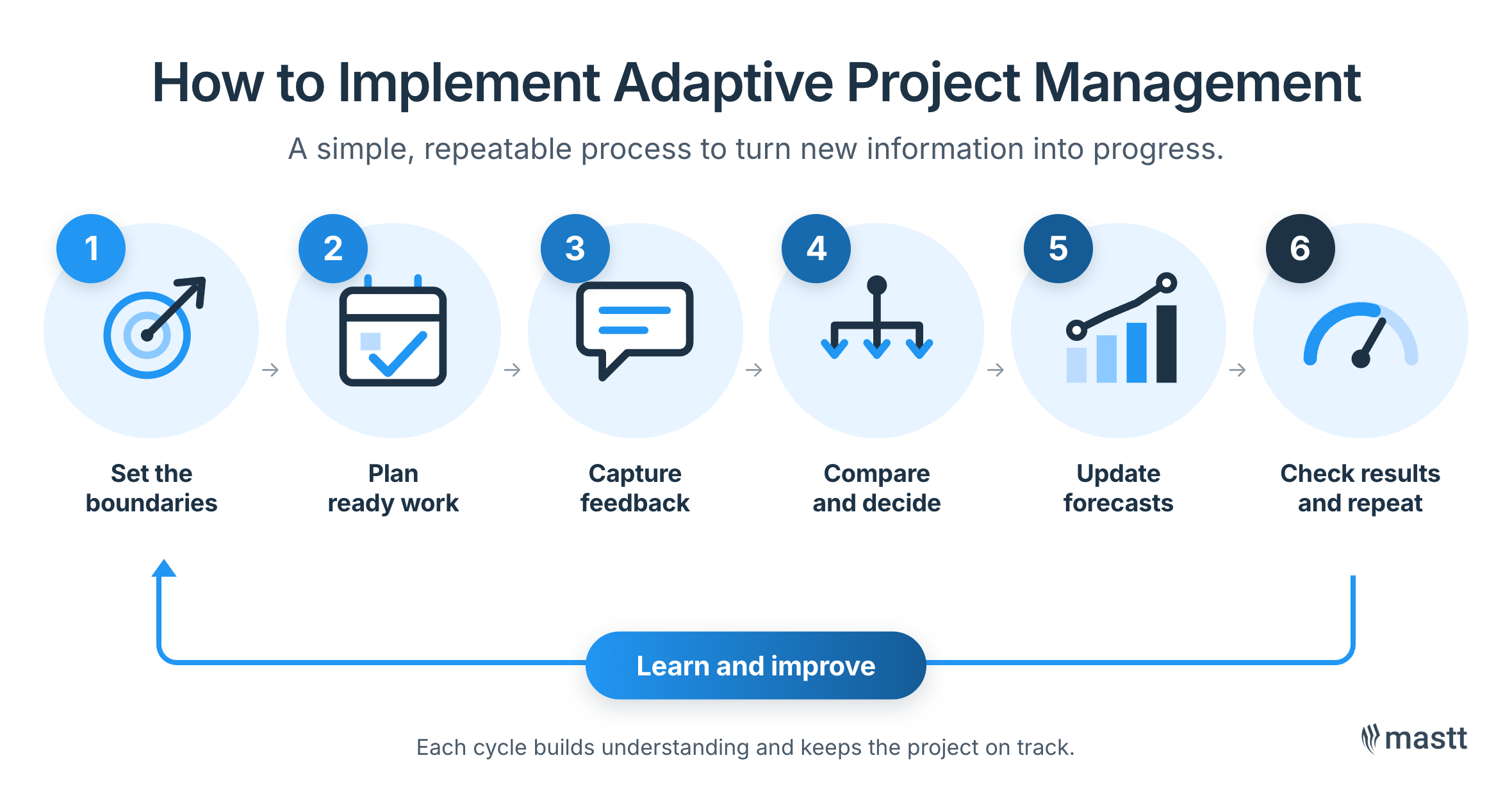
How to Implement Adaptive Project Management
Implement adaptive project management by making feedback part of how you plan, authorize, and review upcoming work. Start with one package where uncertainty is holding up decisions, and give the team a clear process for resolving it.
These steps connect that process to the project’s schedule, budget, and required outcome:
Step 1: Set the outcome and decision boundaries
Define the package’s acceptance criteria, budget allowance, required completion date, and interfaces. Record what is fixed and which details remain open for development.
Assign decision responsibilities across the owner, designers, and contractor. Agree who can adjust activities within an approved package and who authorizes changes affecting scope, cost, or milestones. Make approval lead times part of the plan.
Step 2: Build a short-term plan around work readiness
Translate the project schedule into upcoming work that the team can prepare and commit to. Check drawings, materials, access, predecessor activities, and inspection requirements before agreeing start dates.
Where details remain uncertain, rolling wave planning develops them as the work approaches while retaining the overall project structure. The technique supports adaptive working and can also be used within predictive projects.
Keep long-lead procurement and approval deadlines visible beyond the immediate planning horizon.
Step 3: Capture feedback and identify the limiting constraint
Use site coordination and design meetings to ask what changed, what prevented planned work, and what needs a decision next. Support concerns with locations, affected activities, and evidence.
Look for related problems across packages. Several trades waiting on the same coordinated drawing may point to an information constraint affecting the next handoff. Assign responsibility for resolving that constraint and confirm what will demonstrate closure.
Step 4: Compare responses and authorize the adjustment
I call this optioneering, developing options in a disciplined way and explaining what each means for the client. I bring the client into the decision with the time, cost, and outcome implications of each option. Their involvement helps them understand why the eventual outcome may differ from the original proposal.
Check the options with the people responsible for design and delivery, including their effects on access, testing, and other trades’ sequences.
Record why the option was selected, who approved it, and which documents must change. Communicate the decision before teams rely on the revised information. Keep unresolved commercial matters clearly identified through the project’s agreed change process.
Step 5: Update forecasts and contingency exposure
Update expected cost and completion outcomes when credible new information emerges. Keep the approved budget distinct from the latest forecast, and identify pending changes so the owner can see their potential effect.
I need a clear picture of current costs and schedule performance before I can assess alternatives. Reliable budgeting and forecasting let me compare what an option costs with the time it might save and the outcome it delivers. We have been entrusted with the client’s money and time, and we need to account for both clearly.
Track approved contingency drawdown alongside remaining risks. Reconcile allowances when a risk becomes a priced change so the same exposure is not counted twice.
💡 Pro Tip: Before accepting a resequencing proposal, price the return visit. Include remobilization, protection of completed finishes, renewed access, and inspection requirements in the review.
Step 6: Check results and plan the next cycle
Compare completed work with commitments and investigate the reasons for misses. Confirm whether the action removed the original constraint, then reassess what now limits progress.
Teams using the Last Planner System can track Percent Plan Complete, which measures weekly commitments completed as promised, and investigate the reasons for missed commitments.
Review decision turnaround, overdue blockers, and milestone forecasts alongside task completion. A high completion rate on minor activities can coexist with a blocked critical handoff.
Where Does Adaptive Planning Work Best in Construction?
Adaptive planning suits construction work where new information can materially change the next decision. Predictive planning remains useful where requirements, methods, and dependencies are sufficiently established.
- Design development: Use repeated reviews where user needs or technical solutions require refinement before release.
- Refurbishment: Revisit affected packages as investigations reveal existing conditions.
- Occupied facilities: Confirm work arrangements as operational needs change available access or shutdown windows.
- Uncertain procurement: Reassess alternatives and dependent activities when suppliers provide new delivery information.
For a fully coordinated fabrication package, protect agreed release dates and production sequences. Additional iteration can create disruption once materials have been ordered or manufacturing has started.
Adaptation also needs available decision-makers and enough time to act. If owner reviews repeatedly miss their required dates, shorten the decision path or adjust the plan to reflect the actual approval time.
Examples of Adaptive Project Management in Construction
Construction projects test adaptive thinking when new information changes the available options or the outcome a client can achieve. Two experiences from my work show why the response needs to consider the client’s purpose alongside delivery targets.
A budget cut that changed the outcome
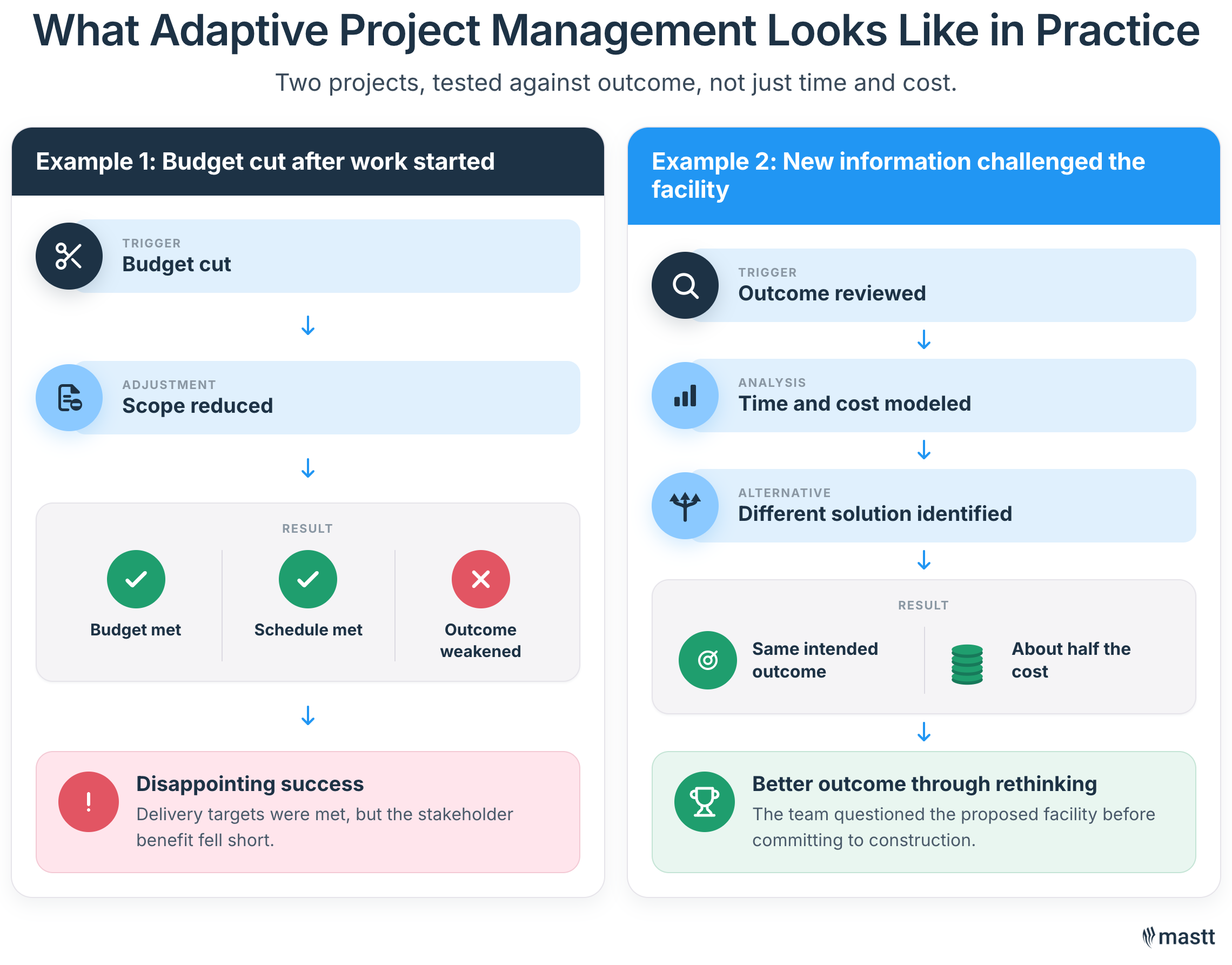
On a defense construction project, our budget was substantially reduced after the contractor had started on site. We worked hard to deliver the revised scope and finished under the revised budget and ahead of the revised schedule.
The stakeholders were disappointed because the result no longer gave them the benefits they had expected. I describe that as a disappointing success. We had met the revised delivery targets, yet the outcome fell short of what mattered to them.
That experience reinforced for me how important it is to bring clients into decisions as circumstances change. They need to understand what an adjustment means for the outcome they will receive.
New information that challenged the proposed facility
On a transport project, a client came to us with a proposed facility and a specific outcome they wanted to achieve. We modeled the time and cost implications and examined what they actually needed.
Our assessment identified a combination of actions that could achieve the intended outcome without building the facility, at about half the cost. That was the option we put to the client.
For me, the client-side role includes questioning whether the proposed project is the best way to deliver the benefit. In this case, the modeling gave us a basis for reconsidering the original solution before committing to construction.
Put Adaptive Planning Into Practice
Adaptive project management makes feedback part of deciding how work proceeds. The practical starting point is a package with unresolved decisions and a team able to act on new information.
At the next planning review, select that package, identify its main constraint, and assign the decision required before work proceeds. Use the risk register to record related uncertainties and responses, then check those responses at the following review.

Written by
Dr. Greg Usher
Dr. Greg Usher is a company manager at Beca and an Adjunct Research Fellow at the University of Southern Queensland, holding a PhD in project management and a Fellowship of the Australian Institute of Project Management. Over a 20-year executive career, he has led major construction and defense programs, including a $1.96 billion naval capability infrastructure sub-program, and has authored a book and peer-reviewed research on project complexity and resilience. At Mastt, he contributes content on project management and client-side project delivery.


Contributions by
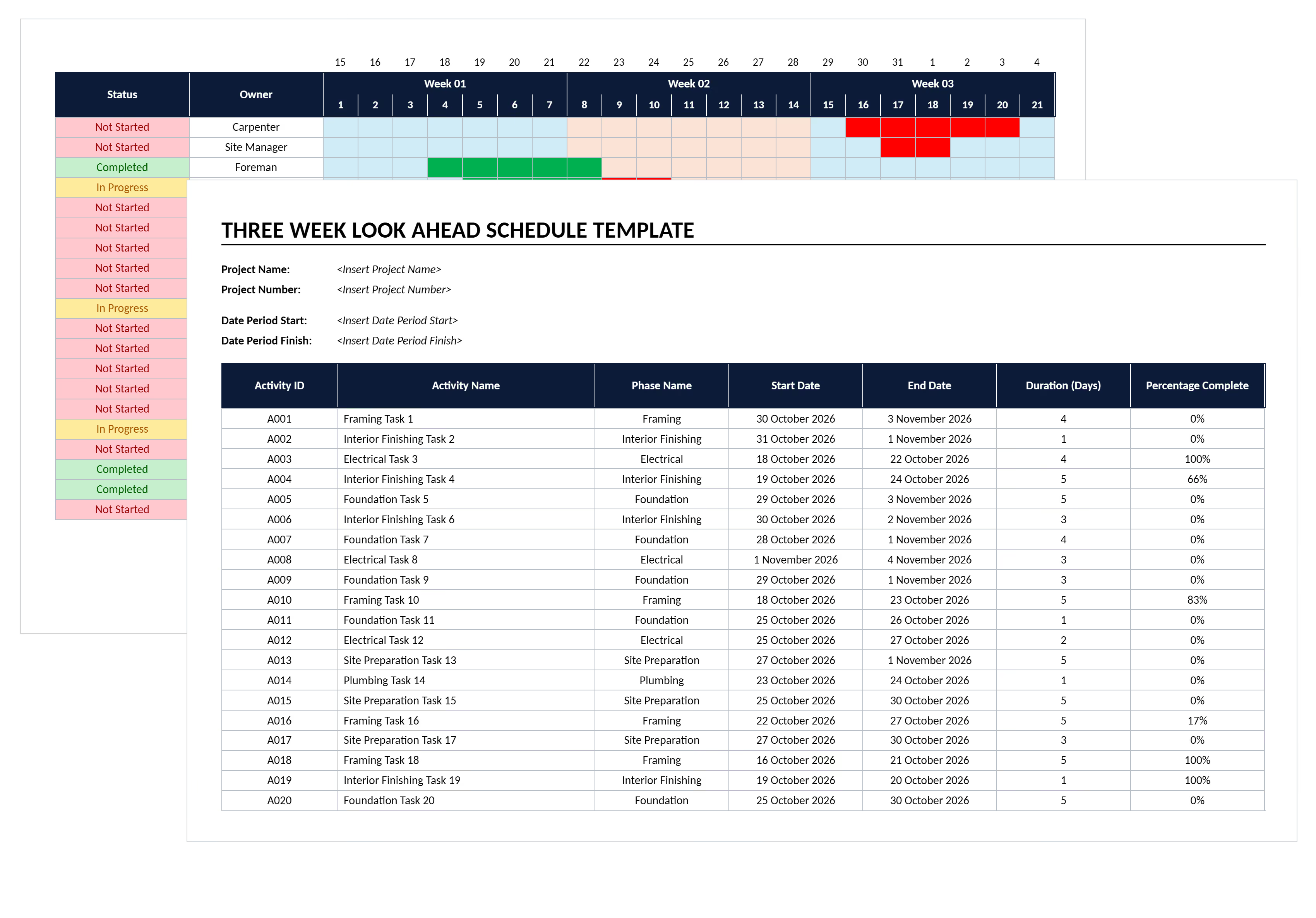
3 Week Look Ahead Template
Use this FREE 3-week look-ahead template to bridge master schedules and daily work. Coordinate trades, sequence subcontractors, and identify constraints three weeks ahead.

Walk Into Every Meeting With Confidence, Clarity, and Control
No one wants to look unprepared, blindsided, or uncertain in front of stakeholders — but that’s exactly what happens without Mastt.
Start for FreeTrusted by the bold, the brave, and the brilliant across governments, Fortune 500s, and the world’s best in delivering the future

.avif)
![Guide to Construction Planning for Project Managers [Free Construction Plan]](https://cdn.prod.website-files.com/607f739c92f9cf647516b37b/673325d1cb6e80e8d540967f_6715a990204d69d4923da363_Guide%2520to%2520Construction%2520Planning%2520for%2520Project%2520Managers%2520%255BFree%2520Construction%2520Plan%255D.avif)