




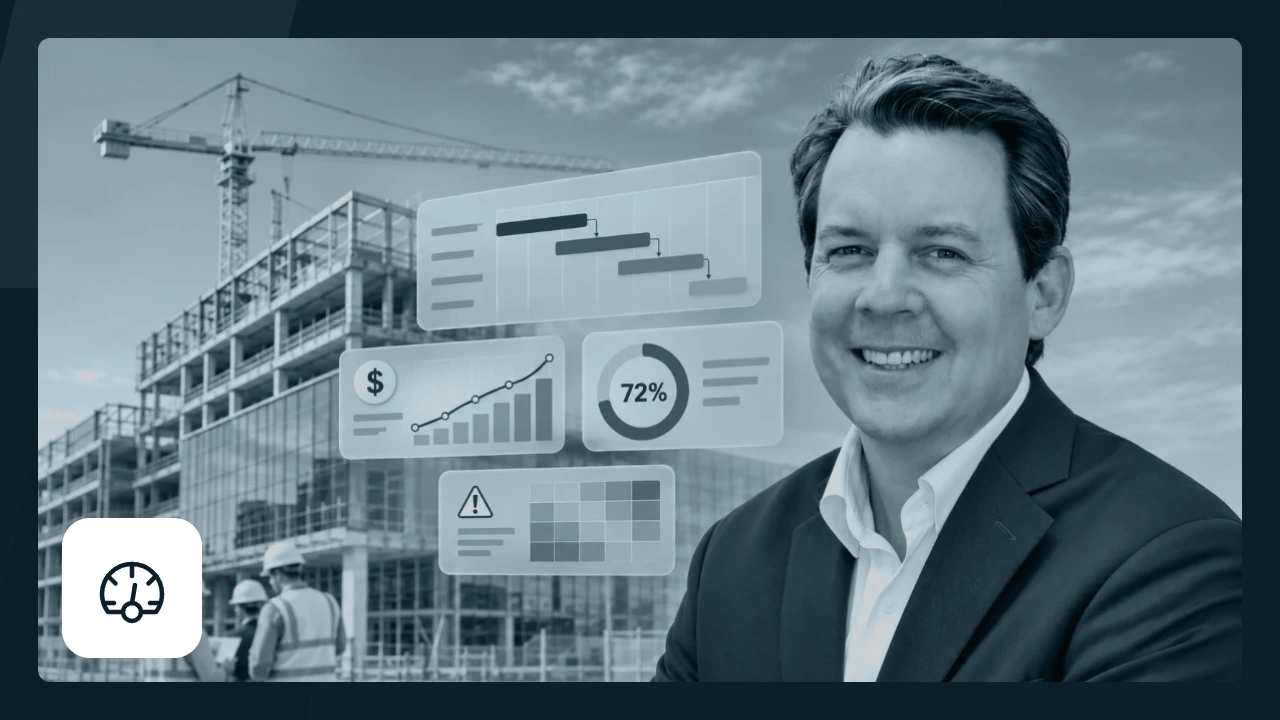
Dathan Beasley is Project Controls Director at Turner & Townsend and a Region 5 Director at AACE International. Three decades on megaprojects have left him blunt about contingency, risk registers, habit, and what AI is actually good for.
How Do People End Up Working in Project Controls?
Dathan grew up in the Whitsunday Islands in Queensland and started his career at Bechtel. Mining, metals, infrastructure, oil and gas, aluminum smelters, paper mills, mineral sands, copper, uranium. He was in Iraq during the second war, working with USAID (the US Agency for International Development) and the US Department of Defense on power reconstruction and distribution.
Q. Project controls is not a degree subject. How did you end up in it?
A. Project controls is something none of us studied for. If you talk to any project controls professional who has been around a little while, we all fell into this gig. We all fell in love with it, and we may be sadistic in our minds, but we fell in love with it. It is not something you go and study for, and that goes for people all around the world.
Q. You came through Bechtel and then Emirates Global Aluminium. What drew you to the big ones?
A. I am just a megaprojects guy. Anything with a B behind it is generally where I fall, and I go where I need to go.
Before I came to the States, I worked for Dubal, which is now EGA, Emirates Global Aluminium, and we were doing a lot of their megaprojects. I grew up on the contractor side and the delivery and owners' side, so I have seen it from both.
Q. What does your work at Turner & Townsend look like now?
A. I joined in 2018. They dragged me from the Middle East to San Francisco, working with one of the high-tech manufacturers, doing a lot of estimating on their data centers. Back then we were being asked to find experienced data center people for an industry that was relatively new at that scale.
About two years in, the Houston team found out about me and said, what are you doing in San Francisco with your background? Oil and gas, megaprojects, get down here. So I went to Houston and set about expanding our project controls capability in the real estate space.
What I found was that the real estate world here in the US did not really think it needed project controls, which was disappointing given the amount of money they are now spending. That is changing. Oil and gas companies already knew it, because they had done it before.
I then got tapped on the shoulder by our Boston team to join the life sciences group. I live in Texas, work out of the Boston cost center, and I am currently with a major life science company in Indianapolis. I travel a bit.
Q. You run an AACE region on top of the day job. Why put the time in?
A. I have been a big believer and supporter of AACE International (the Association for the Advancement of Cost Engineering) since I was a graduate. Every country I have been to, I have been involved in some capacity. When I moved to Houston I ran the AACE chapter there for a couple of years, and I got T&T team members more involved. Now I am a Region 5 Director.
I did not want to stop there, either. I was in DC recently for the Project Controls Expo, which is another industry player trying to build project controls up. I do not care who you work for. Let's just do it right, let's do it properly, and we can all learn from one another. That is where my passion lies.
What Is Project Controls, and How Does It Differ From Accounting?
Ask most people in the US what project controls means and they will say scheduling. Dathan's definition is wider than the mechanics of how to implement project controls, and closer to what a project controls dashboard actually shows you.
Q. In the US, project controls usually gets heard as scheduling. How do you define it?
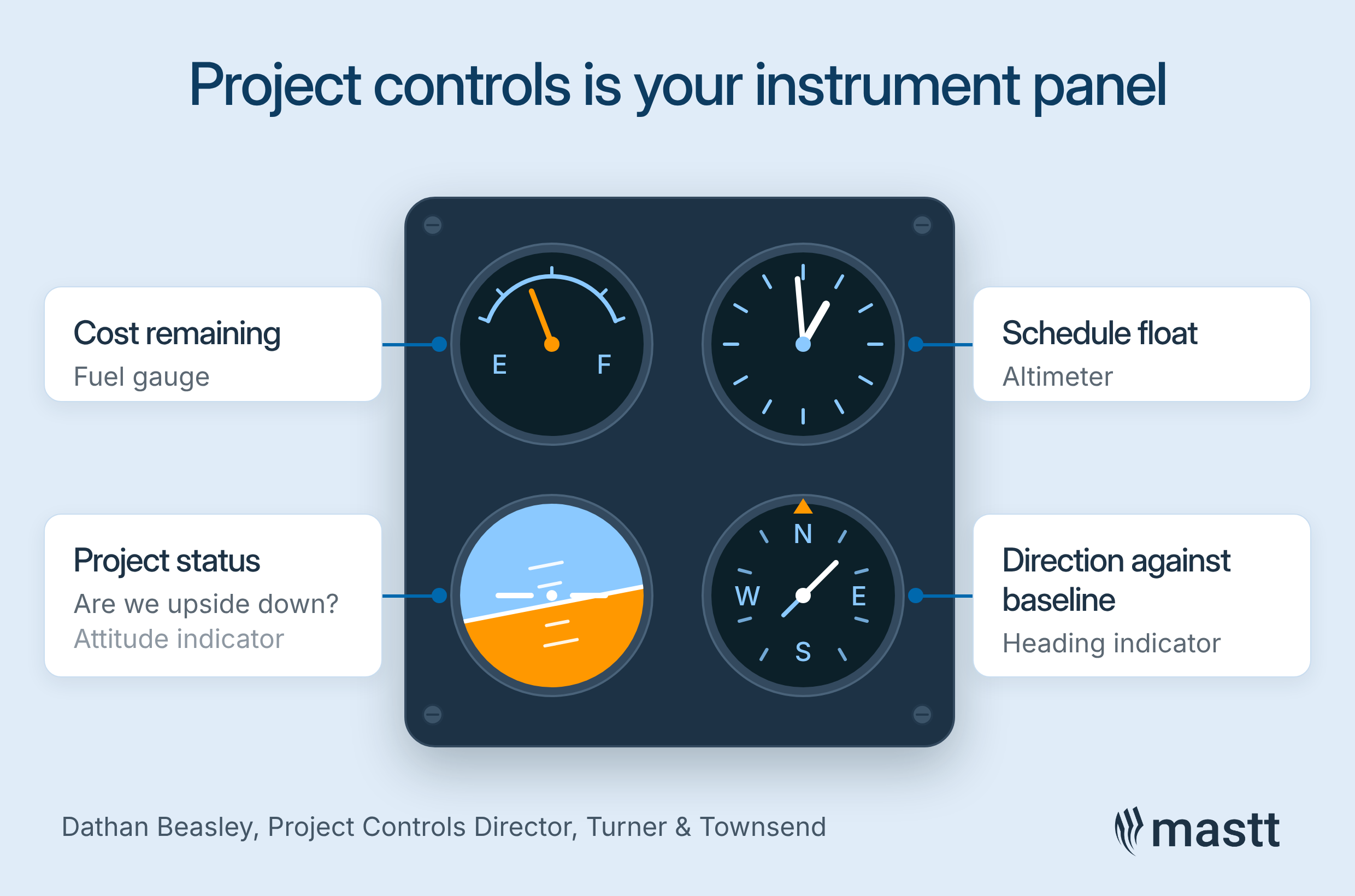
A. I put project controls down like flying a plane. Anyone can fly a plane. We can all grab hold of the yoke, move it around, go up. That is great.
Project controls in that plane is the instrument panel. It tells me how much fuel I have left, what direction I am going, how much altitude I have, whether I am flying upside down. You can fly a plane upside down and not even realize it.
We are there to help you see the future. We are there to guide you in a direction. If you want to go down a path, fine, but here is what the data tells us. It does not mean that is always going to happen. What it does is give people information they can act on.
Q. Where does project controls end and project accounting begin on a capital project?
A. We are not accountants. If you pick a date and time, accountants are very, very good down to the cent on what you have spent. Great, awesome, you need them.
Project controls is what are you going to spend in the future, and what is it going to be. It is a range. I am not going to know exactly what it is, but I am going to come close, and we work in ranges.
Project controls is what are you going to spend in the future. I am not going to know exactly what it is, but I am going to come close.
- Dathan Beasley
So if an issue is coming, we can tell the owners, we can tell the banks, we can tell whoever it is. It is easier to fix an issue now that we can see it than to wait until it has happened and then fix a problem.
Q. Does project controls travel between sectors, or do you need industry experience?
A. Everyone sits there and says you need data center experience. Hang on a minute. Cable's cable, steel's steel, concrete's concrete. Contracts are contracts. It does not change when you go down to basics.
Earned value is still measured the same way. As long as you identify how you are going to measure it and what your common factor is, it is the same. When you change it halfway through, that is where you get into trouble.
There are a couple of quirks in every industry, and the question is what am I missing and what do I need to change. But the fundamentals move with you.
Why a Flat 10% Construction Contingency Does Not Work
This is where Dathan gets most animated. Most teams set a construction contingency, or size a contingency budget, by picking a percentage and working backwards. He thinks that is a habit nobody has examined.
Q. Most capital projects carry a flat contingency percentage. What goes wrong with that?
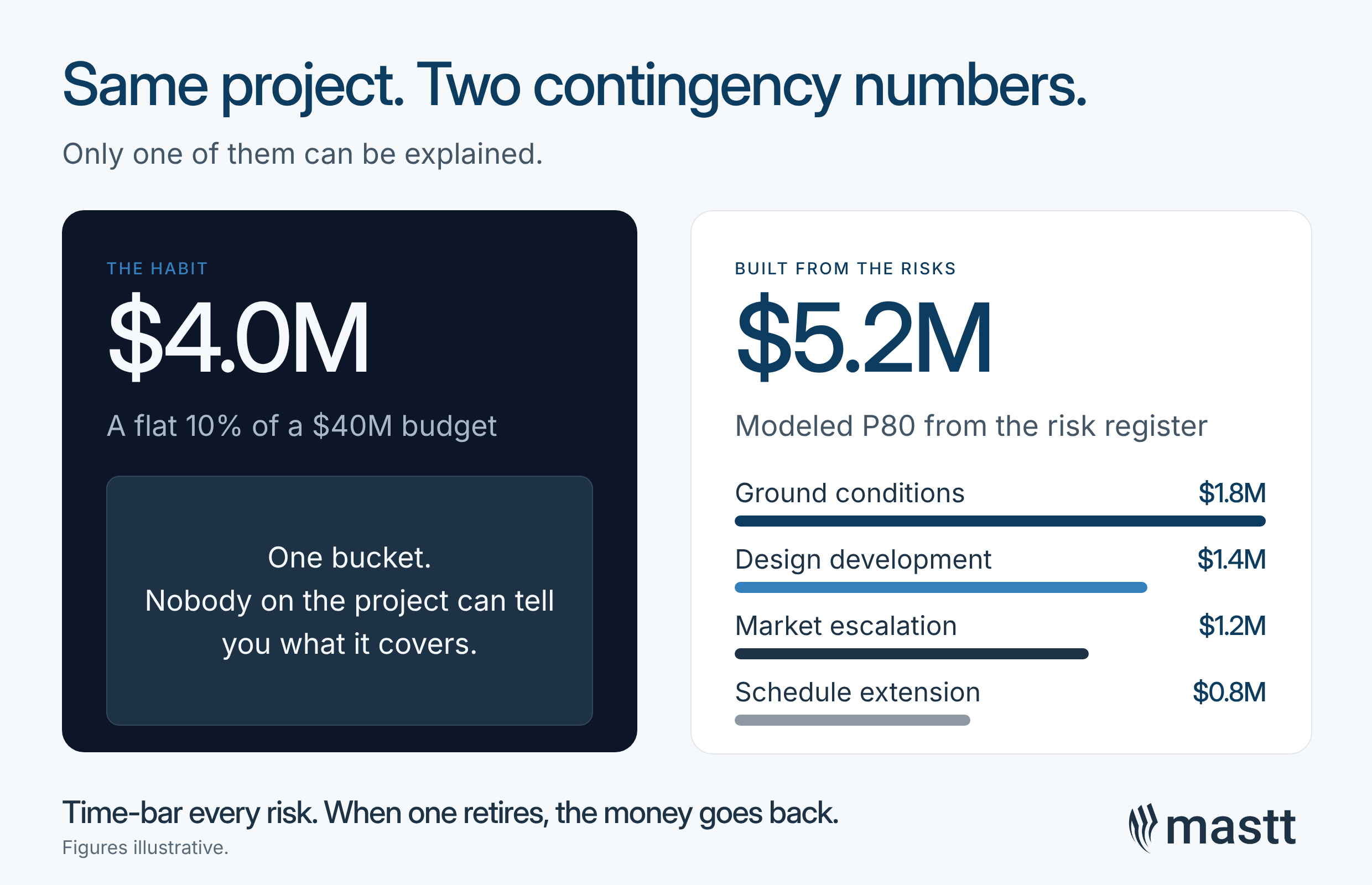
A. On every project we have a 10% contingency. Great. Why? What is the 10% for?
When I started digging into it, the answer was: we just have a bucket of money to save us if something goes wrong. That is not what it should be. You should be building up your contingency to allocate to certain activities or events that could happen and that you need money for.
Q. If not a flat percentage, where should the contingency number actually come from?
A. Obviously you are going to have known unknowns and unknown unknowns, and that is always the hard one to calculate. That is where identifying risk, doing the right ranging and, most importantly, time-barring risks comes in.
If you do not time-bar them, they just sit there forever and you never get rid of them. We have an engineering risk. Well, we are deep into construction. Engineering is done. Why is that still a risk?
Rather than going towards a contingency of 10% or 5% or 7%, whatever you have done in the past, say: I need this level of contingency, and it is made up of these risks. We have done the modeling. We have linked the schedule with the model. We have linked our cost with the model. We have done Monte Carlo simulations of these risks. Here are the top ones. Here is the probability, the consequence and the impact. Here is how much money you should have.
I need this level of contingency. It is made up of these risks.
- Dathan Beasley
That part they get. They do not do it, but they get it.
Q. What should happen to the money when a risk is retired?
A. Here is the part I notice on a lot of projects. Okay, well, that risk is now gone. Give the money back. No, no, no, we do not want to do that. We want to have it.
So hang on. You are going back to the mentality of needing a chunk of change sitting there just in case something happens, or in case I made a mistake somewhere. That is okay, but identifying what the risks are would identify what your contingency should be.
Q. Some organizations genuinely want more than one bucket. Does that work?
A. If you need buckets of money, let's break it up. Let's have an owner's contingency. Let's have the project contingency. Let's have a management reserve where, to make a company comfortable, we give it to them. Here is your management reserve. It is there for you, you can do what you want with it.
Those are the sorts of things I really want people to engage with, because that is going to give you a true representation of the cost of the project.
Q. Why does getting contingency right matter more than most teams assume?
A. What do they say? I want things fast, I want them cheap, and I want good quality. I keep saying, of those three, I will give you two. Which one do you want to get rid of? You can have a balance of all three, but you cannot have all three perfectly at the top of their line.
No matter how well you design a project, no matter how well engineered it is, if you kill someone that is a bad thing. That is always top of the list. But if it is over budget and you miss your date, you fail. Engineers do not like hearing that.
How to Make a Risk Register Drive the Cost Forecast
Dathan presented at the Project Controls Expo in Washington DC with Asma, a Turner & Townsend risk lead. Their session asked why a risk register so often sits on a shelf, filled in once from a template and never revisited, instead of driving the forecast. It is the gap between having a construction risk management process and actually using one, which is what risk management software exists to close.
Q. Your Expo session argued that risk registers should not sit on a shelf. What was the case?
A. It is something I took for granted. I would just think, well, okay, if I have cost and schedule, those two are married at the hip. And risk, if you are not talking to these guys, and the risks you are identifying are not impacting my forecast, then why are you here? We might as well ignore it. Why are we wasting money?
If the risks you are identifying are not impacting my forecast, then why are you here?
- Dathan Beasley
It is more important that those risks are driving our forecasts.
Q. What was the response from the room at the Expo?
A. We had a room of about 60 seats. They filled up, and there were people lined down the sides of the room. I am sitting there thinking, they are here for you, young lady. Not for me. For my risk manager, Asma. When it comes to risk, I have never come across someone with more passion for it.
The questions we got asked were, hey, we want to do that, it never happens. Okay, why? We ended up moving away from the presentation and it became a healthy mentoring session, which was really cool. Then we had to leave the room because someone else was coming in, so we moved out into the hallway and kept going.
Q. If teams want risk-driven forecasting, why does it so rarely happen?
A. It is not that people do not want it. It is that people do not know how to implement it, or they do not know, or they have been pushed back.
And let's face it, when you run out of money, who do you get rid of first? Usually your environmental person goes first, and then your risk person. Which is sad. It is really sad.
Q. What did the size of that turnout tell you about the profession?
A. A lot of people have reached out afterwards saying they would love to continue the discussion. Let's jump on a call, or hey, when you are in Boston or Indy or DC or Texas again. It is surprising how many have come out saying they want to keep going.
This is music to my ears, because now project controls is no longer a magic box. It is something that is structured, something that is there, something we can all do and be better at. It comes down to education. You do not have to be an expert at it, but at least if you are aware of it, you know it is an important part of a project.
How Project Controls Caught a Contractor's Cash Flow Problem
Dathan's example goes back to a megaproject in Dubai and a team member who found invoicing boring. It is a case for treating invoice validation as analysis, not administration, and for running every claim past an invoice verification checklist.
Q. Can you give an example of project controls catching a problem before it landed?
A. We had a lady doing invoices in the Middle East. We were in Dubai on a megaproject. She said, look, I am done. This is boring. This means nothing. I have mastered it, I have been doing it for six months, I am excellent.
I said okay, what do you mean? Let's have a look at it. So we picked up an invoice, the first one off the top.
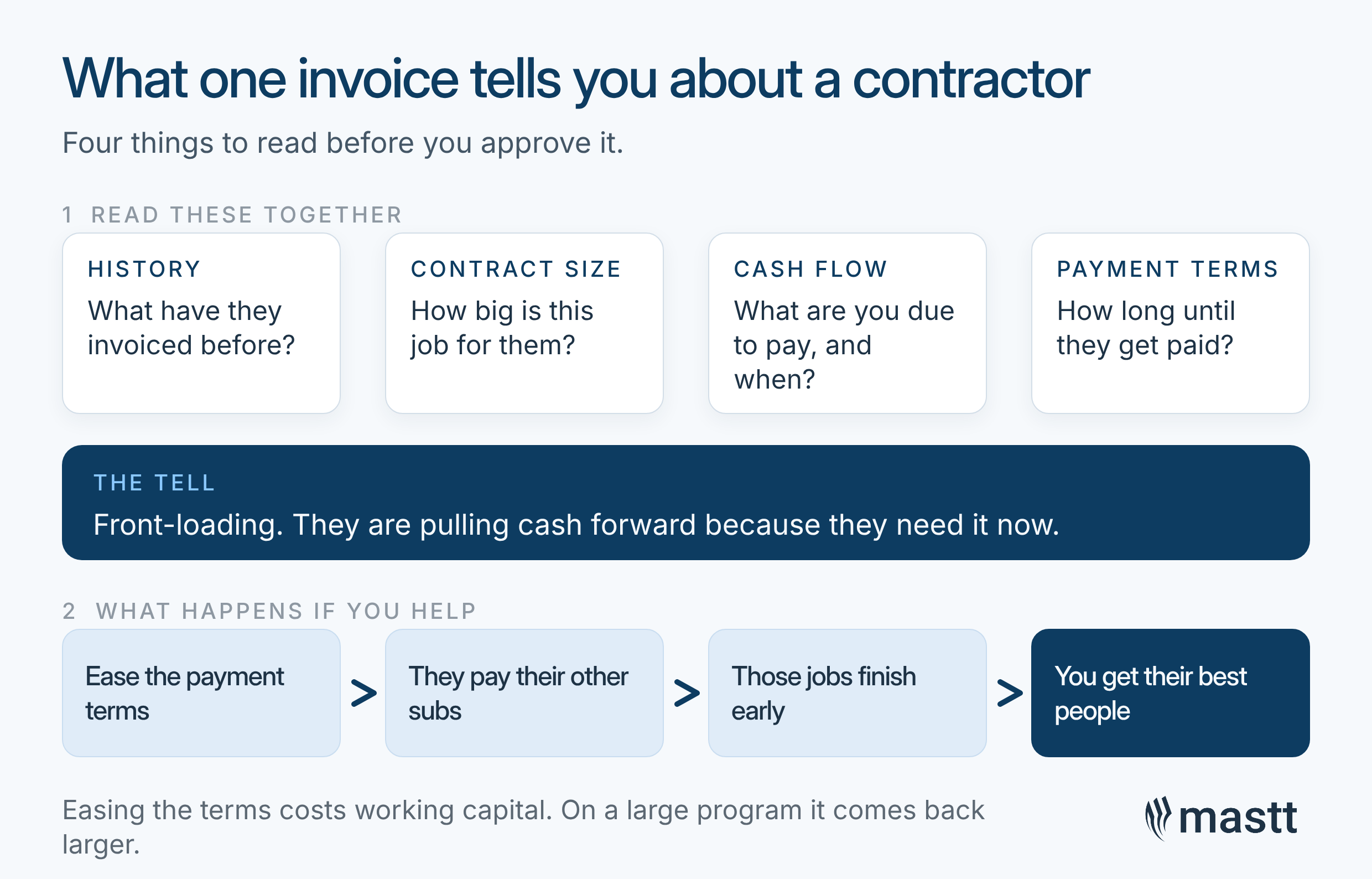
I am looking at it and I say, show me the history. Have a look at the size of the contract, what the cash flow was, what we committed, what your payment terms are, and what has happened. And I am looking at it going, I think this company is in trouble.
Q. What in that invoice told you the contractor was in trouble?
A. Look at the way they have structured it. They are front-loading a lot of things. They are really trying to get a lot more cash in their pocket. And there had been a couple of issues, not big ones, but a couple.
So we got the contractor in and I said, no, no, hey, is everything okay? I am just looking at the way you are invoicing. Is there a problem from a cash flow perspective? No, no, no, we are fine, this is good, we have done this all the time.
I said, no, look, I want to help you. Would it help if we gave you more cash up front? Can we change the payment terms? And he turned around and said, are you serious? I said yes. Something tells me something is wrong, I do not know what it is.
Q. Was something actually wrong when you dug into it?
A. We dug a little deeper and found he had six or seven projects going. He had so much cash flow at the tilt with all the others that he was robbing Peter to pay Paul.
We had a rather large program and a lot of flexibility, and we really liked the services he provided. He said, if you could change our payment terms to this. To us it was a drop in the bucket. It meant nothing in the grand scheme of things.
For him, he was able to pay the other subs on his other projects. They then finished earlier. He came back and gave us the better team members. Then he said, I can give you more people, but I am going to give you a discounted rate. The money it cost in working capital to front the guy, we actually saved more than what it cost us in the first place.
We went on to do phase two of the project and he came back and said, I want to work with you again.
Q. What did that teach the person who thought invoicing was boring?
A. She was with me the whole time. Every time we came across something, and this happened over a couple of years, at each step she is going, you picked up one invoice.
It is those little things that help. That is what I try to encourage people with. It does not matter what you are doing, there is meaning for it, there is a reason for it. Let's get into it.
Why "We've Always Done It That Way" Breaks Capital Projects
Thirty years in, the phrase Dathan hears most often is also the one he trusts least.
Q. How much of project delivery is still habit?
A. One of the things I have found in the last 30 years is that I always run up against the philosophy of, well, we have always done it that way.
I remember being in the Middle East with a very experienced project manager running a half a billion dollar capital program. He said, I need this. I said, okay, great, but why? Well, this is the way we have always done it. I have done it this way for 35 years.
Give me a chance and I'll show you you've been doing it wrong for 35 years and got lucky.
- Dathan Beasley
You read all the stories. There are some great books on megaproject failures and some great case studies. A lot of the projects that are done extremely well, it is luck. They do not have structured progress in place, they do not have the right terminology or the right execution strategies. It is pure luck.
Q. You mentioned an engineer who refused to give you a forecast. What happened?
A. I was doing an underground mine at Ridgeway Deeps in Orange, New South Wales, with Newcrest Gold. Fantastic job. You go two miles underground and when the lights go out, you have never experienced dark until you see that.
We were looking at engineering deliverables, putting hours to a forecast. I needed the chief engineer to give me an update. He said, I am not telling you that. I said, what do you mean? He said, I can tell you what I have done, but I am not going to tell you how long it is going to take.
I said, why? He said, well, I will put a date down, or I will put man-hours down, I will blow that, and you will come back and belt me over the head with it.
Q. How did you get the chief engineer to start giving you a forecast?
A. I went, okay, there is a fundamental flaw here. I am not here to police you. We in project controls are not accountants.
It took me a little while to convince him. Then all of a sudden he started giving me the numbers, I did not belt him, and he came back and said, Dathan, this is brilliant.
He knew what his manpower requirements were. He knew who and what discipline he could get. When someone from another project said they needed an electrical person, he knew he could spare them, because he could see what was left over and rearrange it. He said, I am now the greatest engineering manager here in this company.
Q. Is poor project controls mostly a people problem rather than a process one?
A. It is. Project controls is the same. And what I love about these industry events is you have got a room with thousands of years of engineering, construction and project controls experience in it. Listen to their stories. You would be amazed what you could learn, and go, hang on a minute, if I put that in place I can avoid that happening.
The other thing I say to every boss and every leader I have worked for is, make a decision. I can fix a wrong decision. There is no problem. With the best information you have, make a decision.
I can fix a wrong decision. I can't fix a no decision.
- Dathan Beasley
If you do not make a decision, I cannot fix a no decision. It is too late, we have wasted it, and there is nothing I can do or change.
How AI Is Changing Project Controls Work
Dathan sits on Turner & Townsend's AI committee and has built his own AI agent that reviews his day. His framing is less about what AI replaces than what it hands back, which is the same case we make for the Mastt AI Agent.
Q. What does AI actually change for a project controls team?
A. I love it. It takes a lot of that desktop review, a lot of that number crunching. What it does is give me more time to analyze and review the data rather than crunch the numbers.
Before all that came on board, we used to sketch things out on a board. We would use set squares and do our drawings, and we would do our schedules that way, or have schedules on the wall with rope. Then that turned into computers and we could crunch it a lot better. Every new thing that came along gave us more time to analyze.
It gives me more time to analyze. The art of analysis was lost.
There was a time where everything just pumped through with so much noise. We could get cost reports, we could produce schedules. But was anyone reading them? No. The computer said yes, so okay.
Q. How do you use AI on your own project controls work?
A. I am a big believer in AI as a thought partner. There is a guy down in Austin, Geoff Woods, who wrote The AI-Driven Leader, and he has this concept where AI is his thought partner. The podcast is well worth listening to.
So I could put a project controls plan together. Great. Challenge me. What have I missed? I am taking this controls plan and this is my strategy going into life sciences. Then I go to data centers and ask what the quirks are and what I need to change.
Could I have done that without it? Absolutely. It might have taken me a couple of days, or a week, or two weeks of finding information. Whereas now you have terabytes of data out there helping you analyze and get to what you need.
Q. Where does AI produce the work rather than just check it?
A. If I get an invoice in, I can give it to AI with the contract and say, get rid of the dumb stuff. Do they have the right rates? Do they have the right people? Are they billing correctly? Then I can go and look at progress, spend time on site, and physically see what they are actually billing for.
We have drones now that will grab a BIM (Building Information Modeling) model, do a video of the site, upload it, and color in what is done through visual recognition. From that I can pull the data, set up progress measures, set up progress reports, and analyze trends and installation rates. We could not have done that before.
When I need to produce something, AI gets 60% of it right. That puts me on a basis, and now I am correcting rather than starting from scratch. What is really interesting is it picks up things I would have thought of eventually, or have in the past, but that took me a couple of weeks, or that I may have missed.
Q. You have built a personal agent. What does it do?
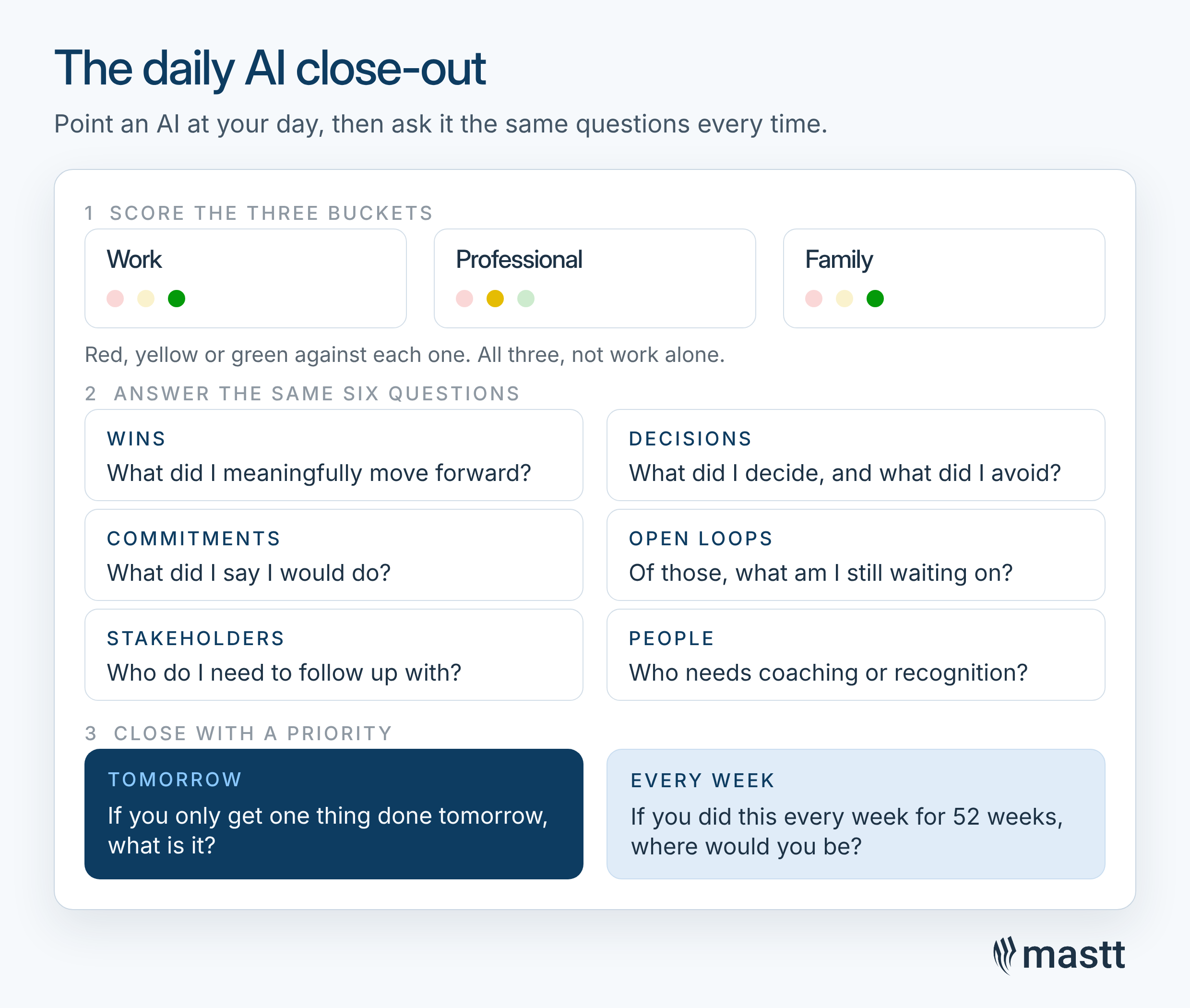
A. I put my world into three buckets. My work, which is Turner & Townsend and what I get paid for. My professional life, where I want to improve myself and improve others by raising awareness. And thirdly family, because if it was not for them I could not do what I have done.
As I have gone higher in leadership, reflection has become one of the biggest things. I never did it. I never looked at what I was doing or how I was doing it. It was always bang, bang.
So I built a bot. At the end of every day it looks at my personal emails, my professional life, what I have asked it to develop in the AI space, and my work life, and it scores those three fields red, yellow or green.
Q. What does that agent actually report back to you each day?
A. It does a snapshot. Here are your wins and your progress. What did I do meaningfully, what did I move forward today, what am I satisfied with. Then it looks at my directions and decisions. You made this decision, why?
It covers the commitments I have made, what is on my radar, emerging risks or issues, stakeholders I need to follow up with, and decisions I have avoided or delayed. It flags things that did not seem right and things it would keep an eye on.
Then it goes to people and leadership. What did I notice about the people around me, who impressed me, who needs coaching, who should I give recognition to. Then it loops back to the open commitments, what we are waiting on, and what I need to capture in my action list.
At the end it says, here is the number one thing. If you only get one thing done tomorrow, do this. At the end of the week it does a wrap-up and asks a simple question. If you did this every week for the next 52 weeks, this is where you would be.
Q. Did the agent tell you anything you did not expect to hear?
A. It looks at all my meetings and said, here are several meetings you turned up to that you did not need to be at. I said, no, no, I am the lead, I am the project controls director, I have to be there.
It said, no. If you were not there, that still would have happened. That information still would have gone out. There were no decisions made that needed you.
That opened my mind, and I cut down my meetings. Then they added another couple of projects on to me, which maybe made it worse.
Q. Where should a project controls team start with AI?
A. Start small. If I can save one of my staff members five hours a week, what is that going to do? Five hours a week at their rate over a year. That is money I can save a client. That individual can now work on the business rather than just working on a project.
An easy one would be invoice reviews. Low-hanging fruit, and the kind of desktop check automated AI invoice scanning now does in seconds. Grab the PO (purchase order), grab the invoice, put it into an AI engine, get rid of the dumb mistakes. A desktop review goes from several hours to seconds. We just rolled something like that out.
I just completed a cost and schedule risk analysis three weeks ago to go to our board for funding. I compared it against the one I did back in February. Grab the two documents, do a comparison, give me analysis on the changes. It did that in three minutes. Then I read it, go, yeah, that makes sense, hang on, is that right, and go back and validate.
Q. What is the AI committee at Turner & Townsend working on?
A. We are starting out small. I do not want to do something just for the sake of it. I want to do it so it helps.
We have an IT department that will not let you do anything outside their boundaries, and at our size, of course they have to do that. If it was a mum and pop shop, I would pay $200 a month for a tool and it would be amazing what I could do. But my data set is a lot smaller there. It is all relative.
The other thing is you are not only saving the hours. You are also finding issues, and you are making it a consistent approach to doing something.
What Good Project Controls Looks Like in Practice
There is a line Turner & Townsend uses internally that Dathan keeps coming back to: be brilliant at the basics. His own version of it is blunter. Do the dumb stuff right, and the rest is easy.
It runs through everything he described. A contingency number nobody can explain is not a basic done right. A risk register that never touches the forecast is not a basic done right. An engineer who will not give you a number because he expects to be punished for it is not a basic done right.
None of that is a tooling problem, and he is clear that AI does not fix it either. What AI does is clear the noise so there is time to look at the things that matter. The judgment still has to come from somewhere.
What strikes us most about Dathan's view is how much of it comes back to people. The contractor in Dubai did not need a better system, he needed someone to ask whether he was okay. The chief engineer in Orange did not need a better forecasting method, he needed to know he would not get hit with it. The room in Washington DC was full because people wanted permission to do the thing they already knew was right.
Project controls, done properly, is the instrument panel. But somebody still has to look at it.
Note: This Q&A is part of Mastt's interview series with practitioners delivering capital projects. Dathan's responses have been lightly edited for grammar, clarity and readability.

Written by
Jackson Row
Jackson Row joined Mastt's founding North American team in 2023, implementing the platform for US government agencies and Fortune 500 organizations. He holds a Bachelor of Engineering in civil and mining engineering from UNSW and began his career as a construction cadet on civil projects in Sydney. At Mastt, he contributes articles on payment and client-side project management.

Contributions by
Dathan Beasley
Dathan Beasley is a Director at Turner & Townsend in Houston, with more than 25 years of experience on complex capital projects. His work includes billion-dollar programs for Fortune 500 companies. He also serves as AACE International’s Region 5 Director and on the Project Controls Expo USA Board of Advisors.
Project Controls Dashboard
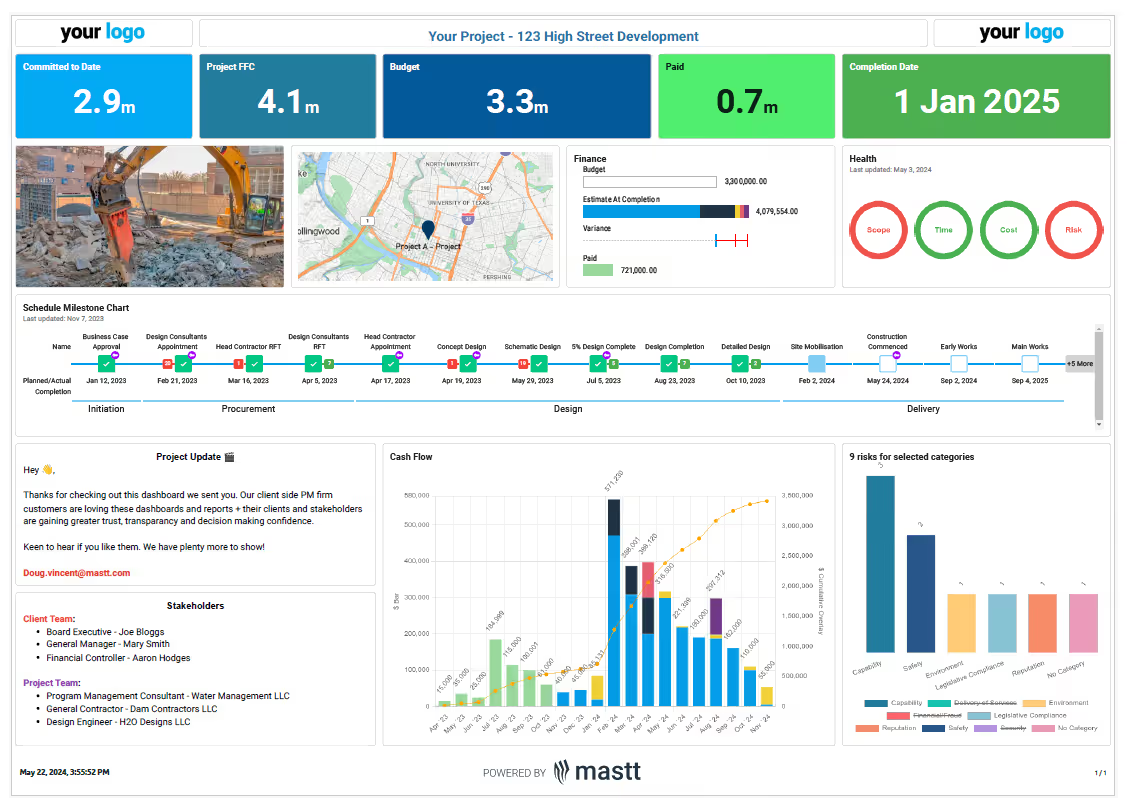
Use this FREE Project Controls Dashboard to oversee cost, schedule, risks, and performance with precision. Track key metrics in one connected view, supported by live project control charts and real-time reporting.

Walk Into Every Meeting With Confidence, Clarity, and Control
No one wants to look unprepared, blindsided, or uncertain in front of stakeholders — but that’s exactly what happens without Mastt.
Start for FreeTrusted by the bold, the brave, and the brilliant across governments, Fortune 500s, and the world’s best in delivering the future


