
.avif)
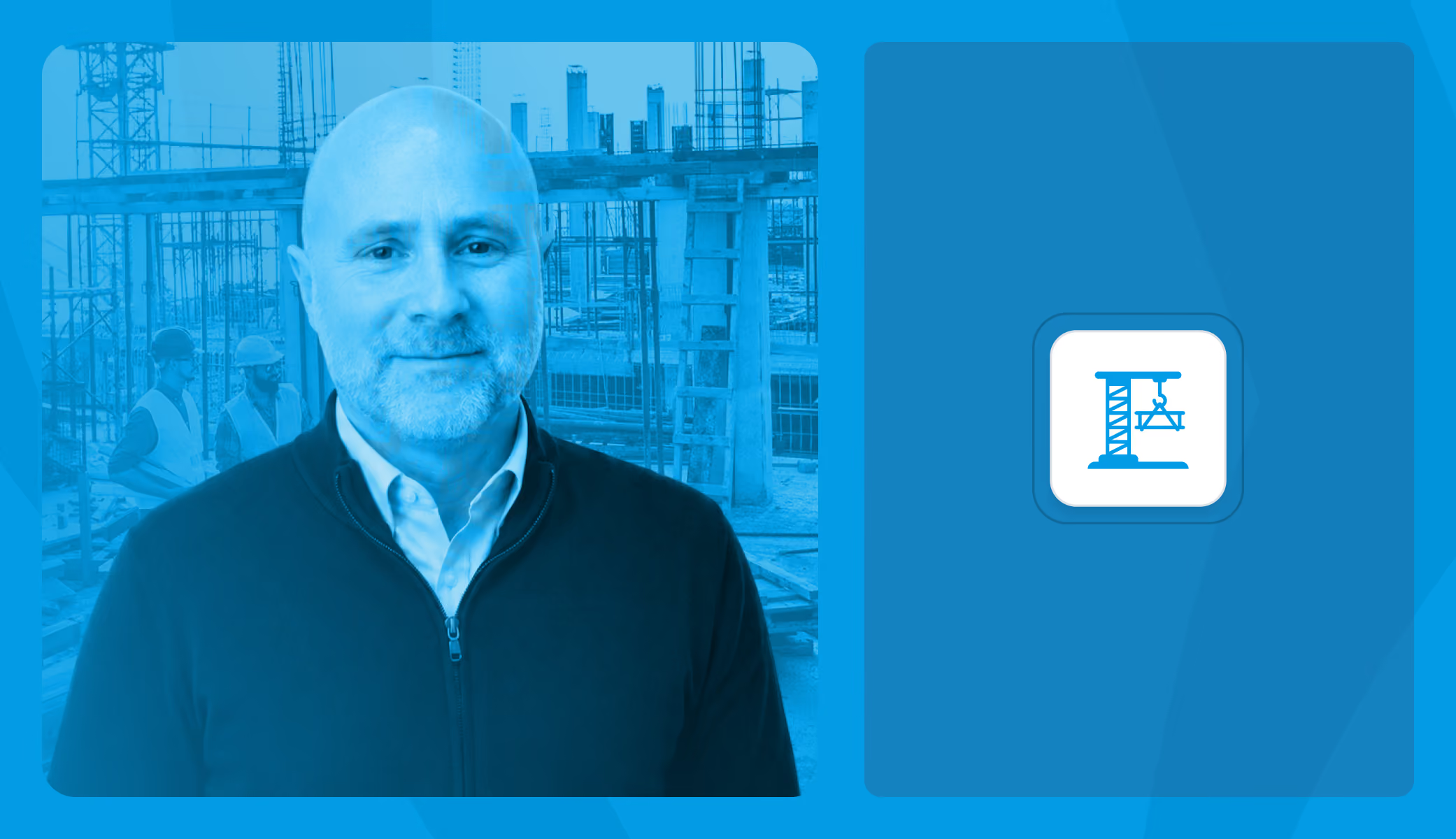
Lorne McClurg has more than 20 years of project management experience and has held executive positions in the independent project management sector. For the last fifteen years, he has run Moto Projects, the South Australian consultancy he co-founded.
In this Q&A, Lorne covers his path into the field, the skills disappearing from construction sites, what good governance looks like, and more.
Lorne McClurg's Career: From Big Firms to Moto Projects
Lorne McClurg did not set out to run his own firm. A career that began in education and corporate projects pulled him into construction, then into client-side project management roles that left him doing less of the work he actually enjoyed. He explains what changed.
Q: You have worked at large firms through to founding your own practice. What led you to start Moto Projects?
A: I was born and raised in a property industry family, so I have been around the sector for most of my life. I spent a bit of time fighting the familial pull, but eventually ended up in a career in project management.
It did not start in construction. It was education and training projects, corporate development projects, and that evolved into construction over time.
I worked my way through various private organizations delivering capital projects and found myself as a regional manager for a large multi-listed entity. At which point I realized I was not delivering projects anymore. I was delivering HR solutions more often than not.
That was not much fun. I like being outside, kicking dirt, talking to consultants, and problem-solving. That is the job. So I left the big multinational and started out on my own.
Fairly quickly, I joined forces with my now business partner, because one plus one can equal three rather than one equalling one. We formed Moto Projects, and we have been together nearly fifteen years.
We have ten people now, working predominantly in South Australia, venturing further afield at the request of key clients. I often ask my staff why we do what we do. We do it because we enjoy working with people in the industry. They are my kind of vibe.
What Does a Client-Side Project Manager Do?
A client-side project manager represents the owner, not the builder. The work is less about technical delivery and more about keeping people aligned and accountable to what they promised. Lorne puts it more bluntly.
Q: How do you describe the client-side PM role to someone who has never worked with one?
A: Usually in a somewhat derogatory way. We herd cats.
Our role is to help people solve problems and stay on track to deliver the promises they made to other people. We do not have a technical role as such. We have a contractual role in many cases, so we need a good understanding of contracts and the English language.
But by and large, it is a people-focused role. It is about helping people get what they need done when they need it, and supporting them over the hurdles they will encounter along the way.
It comes down to making sure people honor their promises and giving them the tools to do that.
How to Tell If a Construction Design Is Complete
Judging whether a design is complete is hard when the people signing off on it do not build for a living. Lorne's test is simple: can the experts explain their documents in plain English? His answer also exposes a deeper skills problem running through the industry.
Q: How do you know when designs are fit for purpose or incomplete, when end users are busy in their day-to-day?
A: It is complex, and I do not think there is a one-stop answer. The client-side PM should not be a technician by default. Our job is not to get down into the weeds, because bogging ourselves down there costs us perspective and objectivity.
Our job is to help the experts get their work done correctly. The best test for whether they are doing that is getting them to explain their documents in plain English.
The world has become too full of jargon, and construction and design are no different. Our clients do not come from those sectors. They will stare blankly and not understand. Our job is to translate, and also to help the design teams explain things plainly.
If they can explain it clearly in plain English, we are more likely to be on track to deliver what the client wants. The client can say, "I understand that, but no, that is not what I mean. This is what I mean." We test it up front. It is the old measure twice, cut once. Work at the front end makes the back end easier.
There is a deeper problem underneath this. The reality is that head contractors do not really know how to build anymore. They know how to administer trade contracts and manage a program to get trades on site. The qualified tradesperson who worked their way up to site manager is disappearing fast.
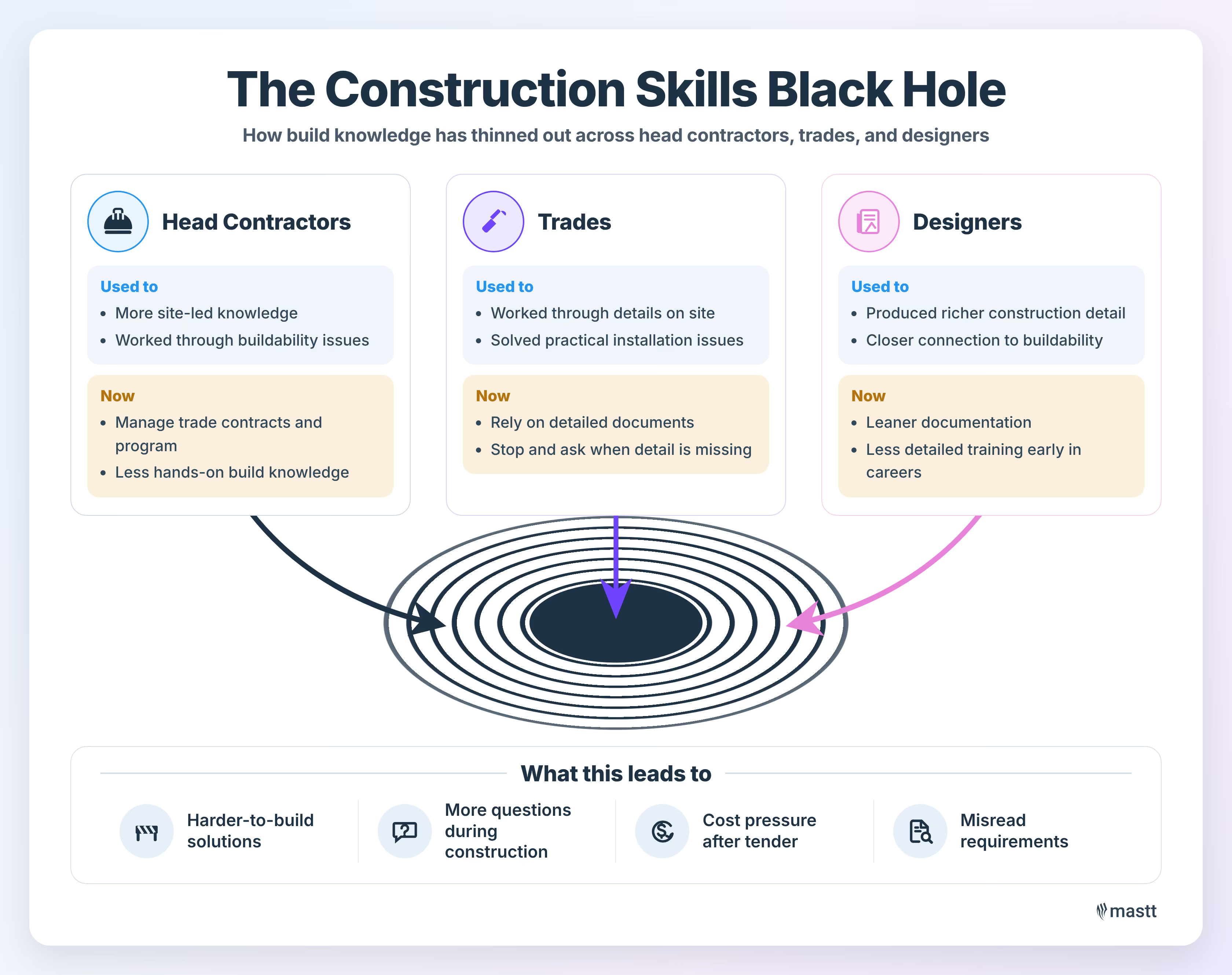
Trades do not know how to build either. They know how to assemble. They rely on really good documents to know how to put something together. If the detail is lacking, they stop and ask for it.
And designers do not know how to document the way they used to. I am very much a Gen X / product of the boomer era, and the detail that used to exist in design has thinned out. The education at the front end of people's careers does not teach detailing the way it once did.
We have a black hole in the industry. The old crusty guys on site who could work things out with the trades and banter with the architect to solve a problem have retired or died. There is no mechanism bringing that skill set back.
So we are always going to carry the risk of things being hard to build, of solving problems mid-construction, and of cost pressure after tender because people did not interpret the requirements properly. I do not have a solution for changing that. Our job is to help people get through that space.
The real test is whether the participants can clearly and unambiguously explain to a client how their needs will be met. If everyone in the room can say, "I understand exactly that, and that is what I need," most problems become easier to solve.
If I describe a project to a group of people, everyone will have a different picture in their head of what it looks like at the end. Our job is to make those pictures the same picture, and to keep adapting it as we hit changes and road bumps.
At the end of the job, everyone should stand back and say, "That is exactly what I thought I was getting." It might look completely different from the image they started with, but they got what they expected. That is a successful job. We do not create the picture. We manage everyone's view of it so it stays the same.
The Construction Skills Gap on Site
The on-site conversations that once solved problems are fading as a generation retires and remote work takes hold. Lorne has responded by pushing his team back toward face-to-face contact. Here is how the role has shifted over two decades.
Q: With emerging professionals not having the same relationships and conversations on site, how has your role had to change compared to 10 or 20 years ago?
A: I get grumpier. That goes with losing my hair.
It is about encouraging people to actually have a conversation. Rock up on site and look at the thing. There are a lot of factors that affect their ability to do that. Have they got the fee? Are they located in the right spot? Have they got the technical expertise to engage in the conversation and solve problems? Do they have the responsibility, authority, and accountability to make decisions?
I get a bit old school and tell my guys to get people around the table in front of the problem. COVID accelerated the push to online, and that is fine, but no one is looking, pointing, and touching the same thing at the same time.
Some of the preferred ways of communicating today do not give a full picture, and they do not let people collaborate the way they used to.
I sound like a dinosaur, but construction has not changed in thousands of years. Some of the products have changed. The actual process has not. We start with the ground, and we work our way up. That is universally how it has been done.
So go back to fundamentals. What worked for thousands of years has only changed in the last ten to twenty years, and that change introduced a fresh set of problems. Getting people back to one-on-one communication around a table, solving it together, is how we work through it.
Early Warning Signs of Poor Project Governance
Good project governance comes down to clear communication and a clear line on who decides what. When that breaks, projects stall, and trust erodes. Lorne describes the warning signs he watches for.
Q: What does good project governance look like, and what are the early warning signs that it is breaking down?
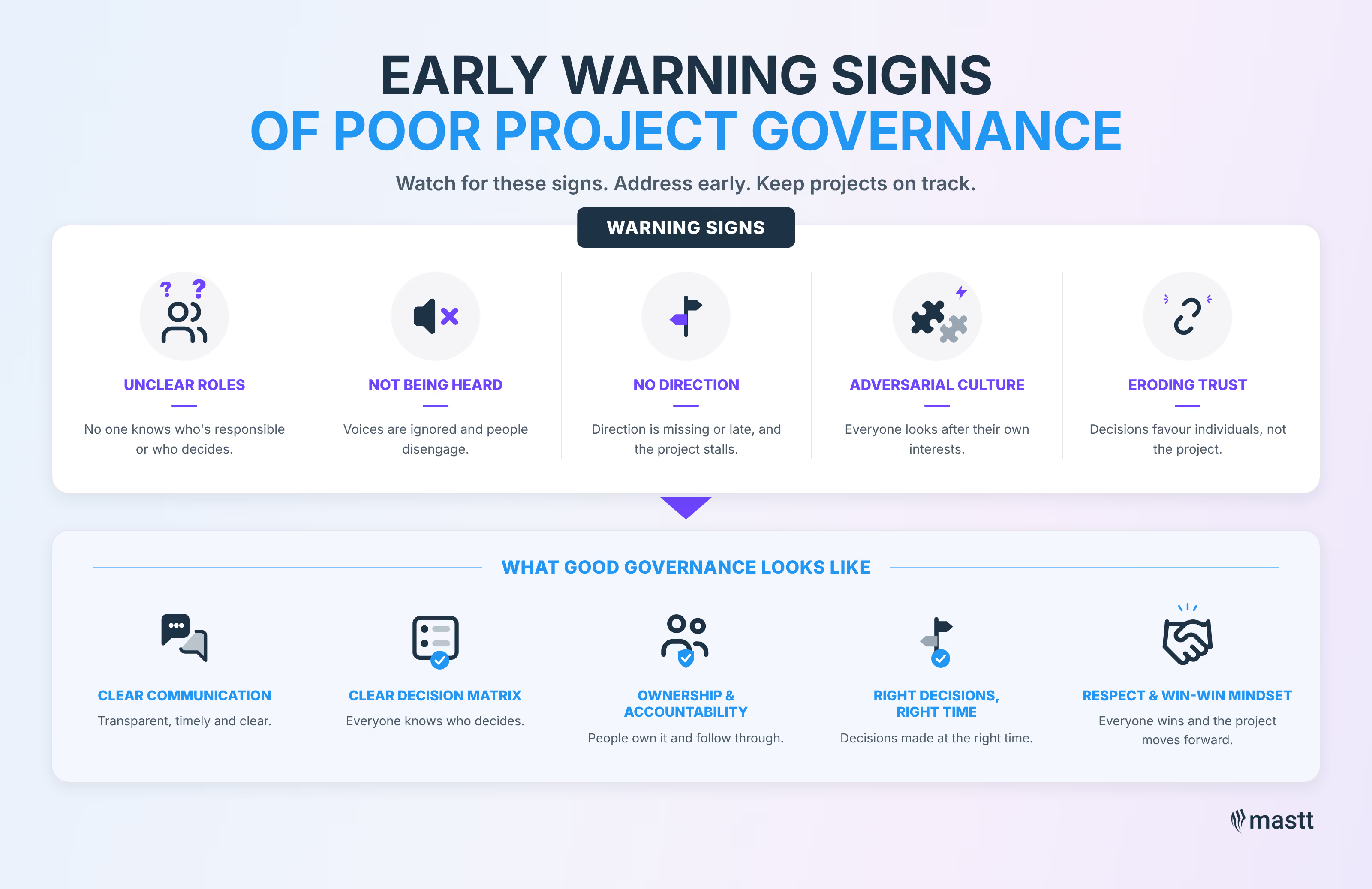
A: Good governance is all about communication. It needs to be transparent, timely, and easily understood, backed by people who can take responsibility, hold accountability, and provide direction and decisions.
Good communication plus a good decision-making matrix leads to good governance. A project progresses well when people make good decisions at the right time to get through the hurdles. Projects run smoothly when there is no problem, but that is not the real world. There are always problems.
A lot of governance trouble happens when it is not clear who is responsible and who is accountable for a decision. Public sector projects are notorious for it. Too many cooks, too many fingers in the pie. You need a clear matrix of who is responsible, who decides, and who carries accountability for getting through the problem.
Governance breaks down when people are not being listened to, are not given decisions and direction, and retreat into their corners. The construction industry is notoriously adversarial, usually around money. Most of our issues come back to money. If people are not making a buck, it gets hard.
A good governance framework, with a team where everyone is making a quid, and everyone respects that everyone needs to make a quid, tends to go pretty well.
It falls apart when trust erodes, when decisions are made in the interest of a participant rather than the project. Broken trust leads to broken communication, which leads to poor or untimely decision-making.
Why Time Is Money in Construction Projects
On a construction project, time and cost are the same problem seen from different angles. Every delayed decision burns a fee somewhere. Lorne explains why he treats the two as one.
Q: Is it always about cost, or sometimes about time?
A: They are one and the same. In construction, time is money.
If a client is slow to select tiles and the architect keeps running back and forth to chase them, the architect is burning fee. Architects, engineers, and project managers sell time.
If things are not moving, we are losing money, or we put our hand out to the client who asks why we are charging them. Because you are taking too long to decide.
If money were no object, time could do whatever it liked. But money is always an object. So time becomes an object too.
How Schools and Non-Profits Deliver Capital Projects
Schools and similar organizations run major capital projects without doing it every day. Lorne spent six years on the board of Pulteney Grammar School, chairing its Strategic Capital Works Committee. The experience reinforced what he sees daily in his own practice.
Q: You spent six years on the board of Pulteney Grammar School. What did that teach you about delivering capital projects inside an organization that does not do it every day?
A: It fed straight into my day job, because our clients are organizations whose day job is not construction. Schools are the same. They are educational facilities, but an independent school is a business, like most of our clients. Their business is educating kids.
They put business managers and directors of capital projects in place to deliver that. Fortunately, most independent schools, Pulteney included, have good business managers who understand the process and usually have the authority to move projects forward. That happens under the direction of a committee like the one I chaired, which reports to the board.
Good business managers know they are not project managers. They engage independent PMs for anything significant, so they can get on with running the business while someone more experienced manages the delivery risk.
I was lucky. We had good business managers who got the right technical and expert support during capital projects. People like me on the committees could ask questions of the business managers, who could ask their experts, so everyone had a clear understanding of who was doing what, when, and how to keep decisions moving.
Why Owners Need an External Project Management Advisor
Organizations that build occasionally rarely hold the construction expertise to manage the risk in-house. Lorne argues that the capable ones recognize the gap and bring in outside help. The reasoning comes back to focus.
Q: Schools, not-for-profits, and government agencies run significant capital programs without construction expertise in-house. Why is external advisory so critical?
A: So they can get on with their day job. The school executive's primary focus is running a school, much as a banker's focus is running a bank. It is not putting up a building.
Good leaders know what they do not know as well as what they do. They outsource what they do not know to people who do. My experience across multiple independent schools, and my time at Pulteney, was working with people who knew when they needed expert external help.
That freed them up to do their day job, and the day job is what pays for the capital projects. Try to blend the two roles into one, and something has to give. Something will not be done well when you are doing two things at once.
Good organizations, including local government, know when their skill sets are not enough to tackle the hurdles their projects will face. They get experts. It is why I do not play AFL footy. I know I cannot. Leave it to the experts.
What to Look for in Construction PM Software
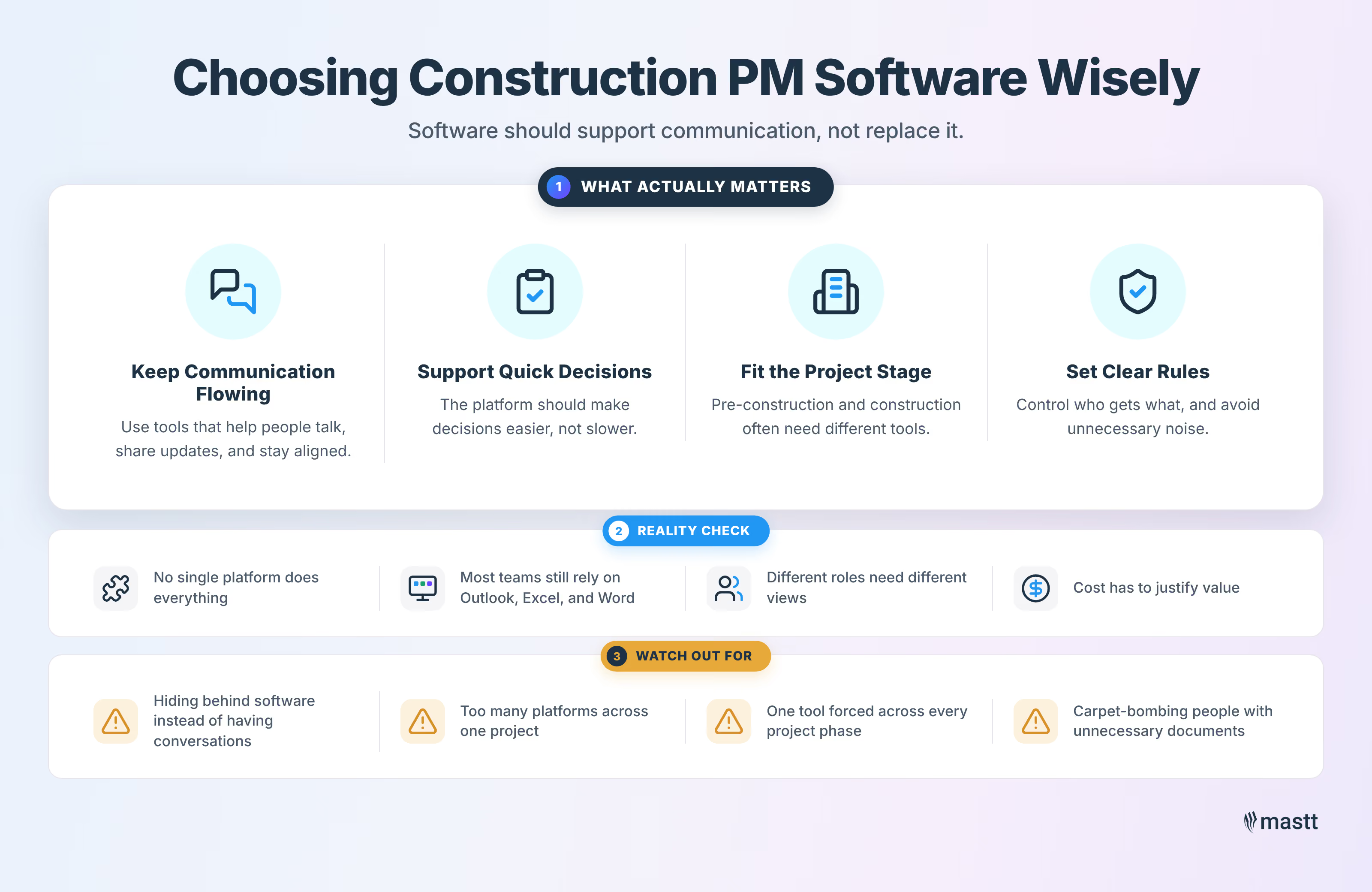
The market is crowded with project management platforms, and Lorne is openly skeptical of most of them. His view is that software should serve communication, not stand in for it. Here is what he tells owners and PMs to look for.
Q: There is no shortage of construction software. What should a project owner or client-side PM actually look for, and what works in practice?
A: I am a cynic who has been forced to use project management software. Harking back to old-school ways, I think a lot of people hide behind software, and behind what it supposedly does or does not do, to avoid having conversations.
There is no end to software. Vendors have come at us left, right, and center over the years. I am currently registered on at least four different platforms for different projects, and they are all a nightmare, to be honest. They all do some things really well and other things really badly.
Do they add value to my life and my role? Probably not. We pretty much all have to use the Microsoft suite anyway, Outlook, Excel, and Word.
Microsoft does not do project management software. They do MS Project, which is a Gantt-charting fluff tool. So other platforms have sprung up, but you still come back to Microsoft to feed inputs into them, which is another bugbear of mine.
The software all comes at the project from different viewpoints depending on your role. Some projects suit certain platforms because they are very builder-focused, and a builder's focus differs from a design team's, which differs from a project manager's. I have not found one platform that does everything.
A project runs through a lifecycle. Concept, design, documentation, approvals, tendering, then a contractor comes on, and it moves into subcontracting and construction. Those are two quite different worlds needing different tools. I have not found a package that does both pre-construction and construction equally well.
They are also expensive. The vast majority of projects in Australia are delivered to feasibility, which relies on minimizing cost and maximizing return. If you are adding tens of thousands of dollars of software, and it is debatable whether it gives you tens of thousands of dollars of efficiency, you have to ask why you are doing it.
Builders do it really well and use it almost universally because it is a good risk management and document management software for all the subcontractors they deal with. Whether a design team gets huge value from it, I am not sure. On really big, complex programs, maybe. On individual standalone projects, I am not so sure the value is there. And it comes with hooks I do not like.
So what should PMs look for? Whatever the client and the builder need to use to keep communication flowing and the decision-making efficient. That is all we need.
Then be really firm on the rules for using it. On most platforms, people carpet-bomb correspondence and documents to anyone and everyone. They become a great tool for filling inboxes with stuff most people do not need to read. It is just people covering themselves.

Can You Manage Projects Without Software?
Strip the platforms away, and Lorne says the job barely changes. Most of project management, in his telling, happens out loud rather than on a keyboard. He breaks down the split.
Q: If there were no project management software, how would you do your job?
A: Pick up the phone, type some emails.
I often say to my crew that 80% of what we do as project managers should come out of our mouths. 20% comes out of our fingertips, and that is mostly documenting, so we have a contractual paper trail. The rest should come out of your mouth.
So pick up the phone. Arrange face-to-face meetings. If you have to, use something like Teams to have a somewhat face-to-face conversation. That is how people solve problems.
The software does not solve the problem. It captures the solution everyone agreed to. It is a tracking and document management tool.
We would work the way we did in the 80s, 90s, and 2000s. Picking up the phone, sending letters, and the old-school ways we had used for a long time before software was invented. And we managed to build buildings just as well back then as we do now.
Modular Construction and AI: Hype vs Reality
Lorne sees real promise in modular construction and real risk in the rush toward AI. The fundamentals of building, he notes, have not moved in thousands of years. He sorts the genuine opportunity from the noise.
Q: Technology is moving fast. What excites you, and what is more hype than reality?
A: I am excited about what modular construction can do. The process of building is much the same, but it is done in a factory and assembled on site. In theory, you use less-skilled labor, supervised by skilled labor, to turn things out faster. You are not subject to the rain we have got out the window here, and you get reasonably high quality and consistency, then plonk it on site and move forward.
To date, I do not think we have found anywhere modular is cheaper, or that much quicker, than traditional construction. You get more control over the quality of the assembly and maybe a little cost efficiency, but it is marginal.
The exciting part is the rise of the Chinese manufacturing base, the quality of the product, and the technology being used. They are moving ahead in leaps and bounds, and that makes the speed of construction worth a real conversation.
As we get better modular outcomes and better supply chains into Australia, that is an exciting opportunity, particularly for the housing shortage. It will need a shift in appetite and a change in what we call home, but we will adapt. That is human nature.
Beyond that, not much in construction gets me excited, because construction is universally the same. A brick goes on top of a brick. A pipe goes in. We see things like 3D-printed buildings, but they are too slow, not efficient, and it is early days.
AI is the buzz. Everyone is pushing it. I think AI is a road to ruin, because people will use it as a way of not thinking for themselves.
AI does not communicate at a human level, and it is not designed to as it currently stands. So much of what we do in construction and development relies on human communication and interpersonal relationships. If we become too dependent on AI, we are going to have some big fallouts.
It will also cost a shipload of money and tie us up, capture us, the way Microsoft has. That is not of great benefit to anyone, being locked into doing things one way.
What Skills Do Construction PM Graduates Need?
As AI absorbs more administrative work, Lorne believes the skill that will set graduates apart is the oldest one: talking to people. He sees that ability fading among younger entrants. His advice is direct.
Q: What skills should a graduate focus on to build a career like yours, as AI keeps progressing?
A: Less scrolling, more talking.
I have got teenage boys. The other day I asked one to call his brother and tell him to come home for dinner. He picked up his phone and started texting. I said, "What are you doing? Call him. Speak to him." We are losing the ability to communicate with language and emotion, to read the cues that are not written down.
There is a massive avoidance of face-to-face verbal communication among graduates and younger generations. I sound like an old boomer, not quite, but close. We are losing that interpersonal skill, and it is going to cause a heap of problems, because it is a human connection that resolves a really bad problem.
A big problem on a construction site is not solved by technology. It is solved by a bunch of people getting together, having a conversation, and mutually agreeing on the outcome.
Everyone knows they will not get everything they want. Each person gets some of what they want, and it solves the problem. That only happens through an interpersonal relationship. It is not coming out of your fingertips on a keyboard, and AI will not deliver it for you.
So young people need to understand they have to talk to people. They need to listen, understand other viewpoints, assimilate them, and collectively find a way to bargain for an outcome and resolve conflict.
Those skill sets are getting harder to teach because the teaching platforms keep pointing students at an AI model or an online lecture. We have to get back to how we solve big problems. We solve them by working together, not by letting machines do it.
How to Turn Around a Struggling Construction Project
When a program is in trouble, Lorne's first piece of advice is to stop worrying about time and start checking whether you are the bottleneck. The fix is usually communication, not control. Here is what he tells owners to do.
Q: If a project owner is in the middle of a struggling program, what is the one thing they should do differently this week?
A: Do not worry about it. It will all work out in the end.
We spend a lot of emotional energy worrying about problems related to time. Time is the one thing we have an abundance of. Every day is more time. We do not have an abundance of money or resources. By worrying too much, we lose our objectivity.
What you should think about is whether you have everything in place to make decisions. Do I have the information I need? Start asking the questions. Am I a roadblock? Am I asking for things I did not flag earlier? If so, get on and answer the questions being thrown at me.
Have other people got problems I am not aware of that are slowing them down? Go and ask. "Hey, how are you doing? Have you got a problem I can help you fix?" It is a simple interpersonal thing. Get back to communication, to what is your issue, and how do we solve it.
Sometimes there will be problems that cannot be solved, and it just takes time to get through them. A major weather event puts my program under pressure. I cannot do anything about that.
But what can we do to plan ahead and fix the outcome at the other end of the event? How do I make sure everyone has the tools to solve the problems that flow from the problems we cannot influence?
So take a chill pill. Very few projects sit idle forever. They get through it, but they get through it by humans working together to move it forward.
As the project owner, make sure you are not the problem. Have a really good look in the mirror, which people struggle to do. Is there anything I am doing that is causing problems for other people? If not, what problems are other people facing that I might help solve?
That is how you get through program constraints. Sometimes you just reset your expectations, because the problem is not anyone's particular doing. It is just a problem. That is why we build programs with contingency.
Too many times these days, people strip the contingency out. Get it done faster, get it done tomorrow. Yes, but it is raining today, so I cannot do it tomorrow, and I have to draw down on some contingency.
Note: This Q&A article is part of Mastt's interview series featuring construction industry experts. Lorne McClurg's responses have been lightly edited for readability.

Written by
Jackson Row
Jackson Row is the Growth & North American Market Lead at Mastt. With a background in risk modeling, cost forecasting, and integrated project delivery, he helps capital project owners work smarter and faster. Jackson’s work supports better tools, better data, and better outcomes across the construction industry.

Contributions by
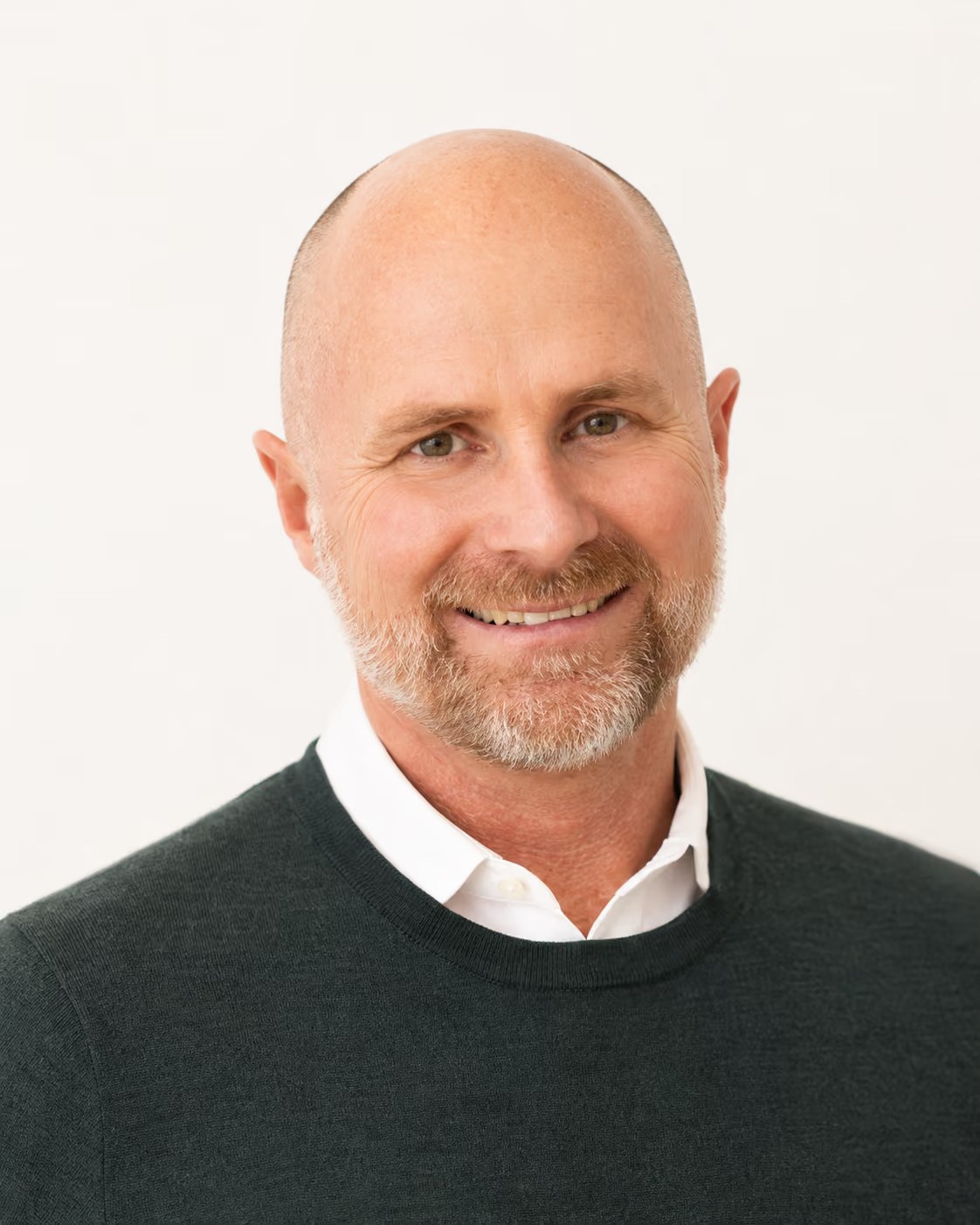
Lorne McClurg
Lorne McClurg is the Director and co-founder of Moto Projects, an Adelaide-based independent project management consultancy with 25 years in client-side delivery. He specializes in contract superintendence, procurement strategy, and risk management, delivering projects across commercial, education, health, and public infrastructure in South Australia. Lorne contributes content on construction project delivery and risk management at Mastt.
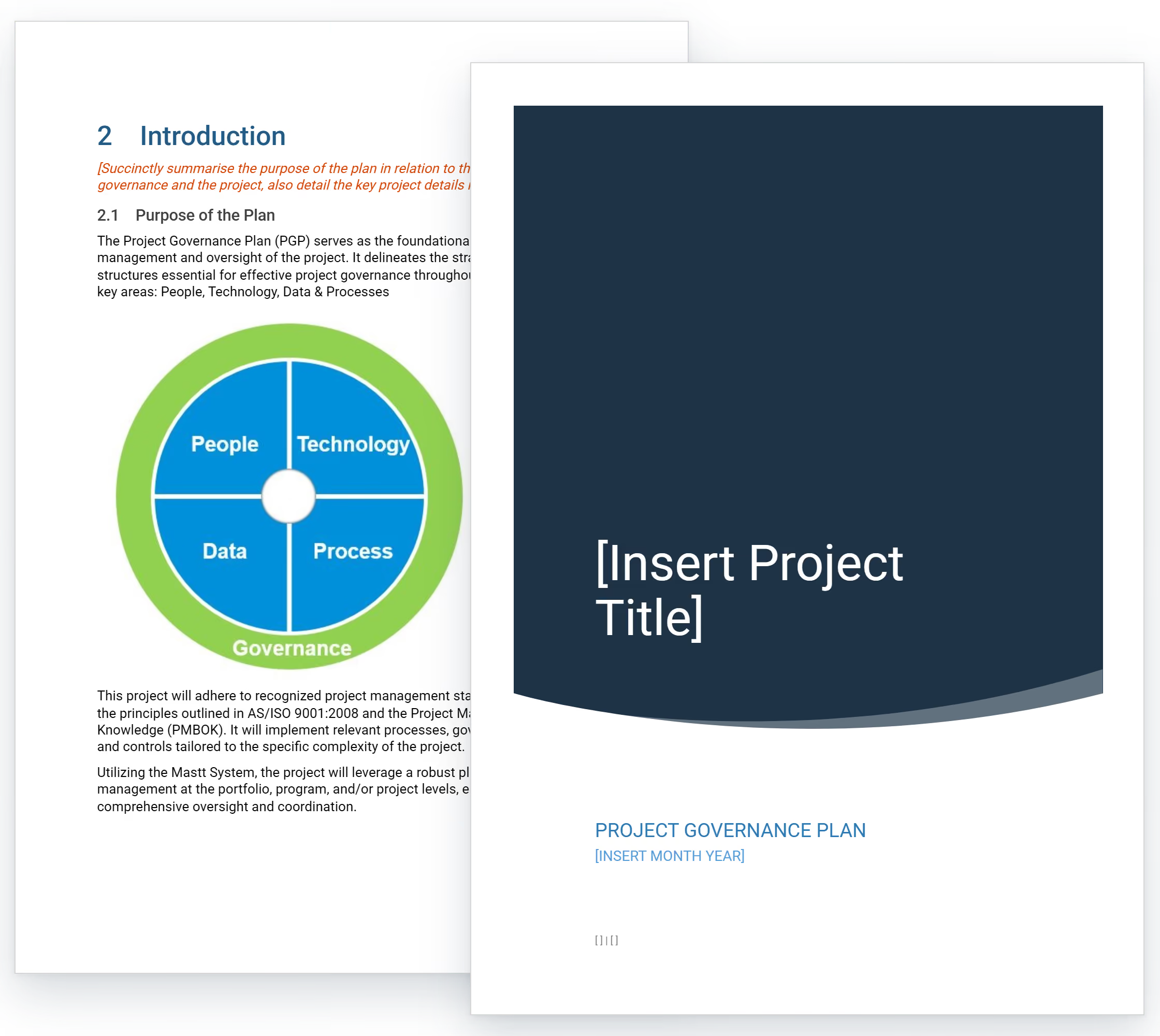
Project Governance Template
Use this FREE project governance template to establish decision authority and prevent scope disputes. Define approval hierarchies, escalation paths, and stakeholder roles before execution begins.

Walk Into Every Meeting With Confidence, Clarity, and Control
No one wants to look unprepared, blindsided, or uncertain in front of stakeholders — but that’s exactly what happens without Mastt.
Start for FreeTrusted by the bold, the brave, and the brilliant across governments, Fortune 500s, and the world’s best in delivering the future