

A contract management specialist oversees every stage of a contract's lifecycle. This includes drafting, negotiating, monitoring compliance, and managing closeout. In construction, they protect owners by ensuring agreements with contractors and subcontractors stay on track.
This guide explains the role, core responsibilities, key skills, and salary expectations for contract management specialists. It also looks at how the role supports construction project delivery.
What is a Contract Management Specialist?
A specialist for managing contracts controls how an agreement is administered after award and before closeout on behalf of an organization. The work protects commercial position and helps keep project requirements enforceable in practice.
The role matters in contract management because contract issues can grow quickly when they are not picked up early. A specialist helps prevent delay, cost exposure, and avoidable disputes by keeping obligations visible and enforceable.
Contract Management Specialist vs Contract Manager vs Contract Administrator
A contract management specialist sits between administration and management. The role has more ownership than a contract administrator. It has less strategic authority than a contract manager.
For example, when a contractor submits a change order, the contract management specialist checks the relevant clause and prepares the position. The contract manager decides the commercial response. The contract administrator records the change and updates the file.

Core Responsibilities of a Contract Management Specialist
A contract management specialist helps keep the agreement workable after award and before final closeout. Early work often starts with clause review and drafting support, because weak wording and missed requirements tend to create avoidable problems later.
The core responsibilities usually include the following:
- Reviewing key terms: Check clauses early so the team understands approval limits, pricing mechanics, and notice exposure before an issue hardens.
- Supporting drafting and redlines: Tighten wording during procurement or negotiation so the final agreement can be administered without avoidable ambiguity.
- Managing change order administration: Test whether a proposed change is contractually valid, properly instructed, and supported by the right record.
- Monitoring compliance requirements: Track insurance, warranties, and other live commitments that can affect payment, approval, or downstream risk.
- Maintaining project records: Keep contract registers and supporting files in a condition that can support a payment position, delay response, or formal dispute.
- Reviewing correspondence: Read project communications for anything that may trigger notice obligations, alter entitlement, or shift legal position.
- Supporting payment and entitlement reviews: Check whether payments, supporting records, and contract conditions align before the team accepts or rejects a request.
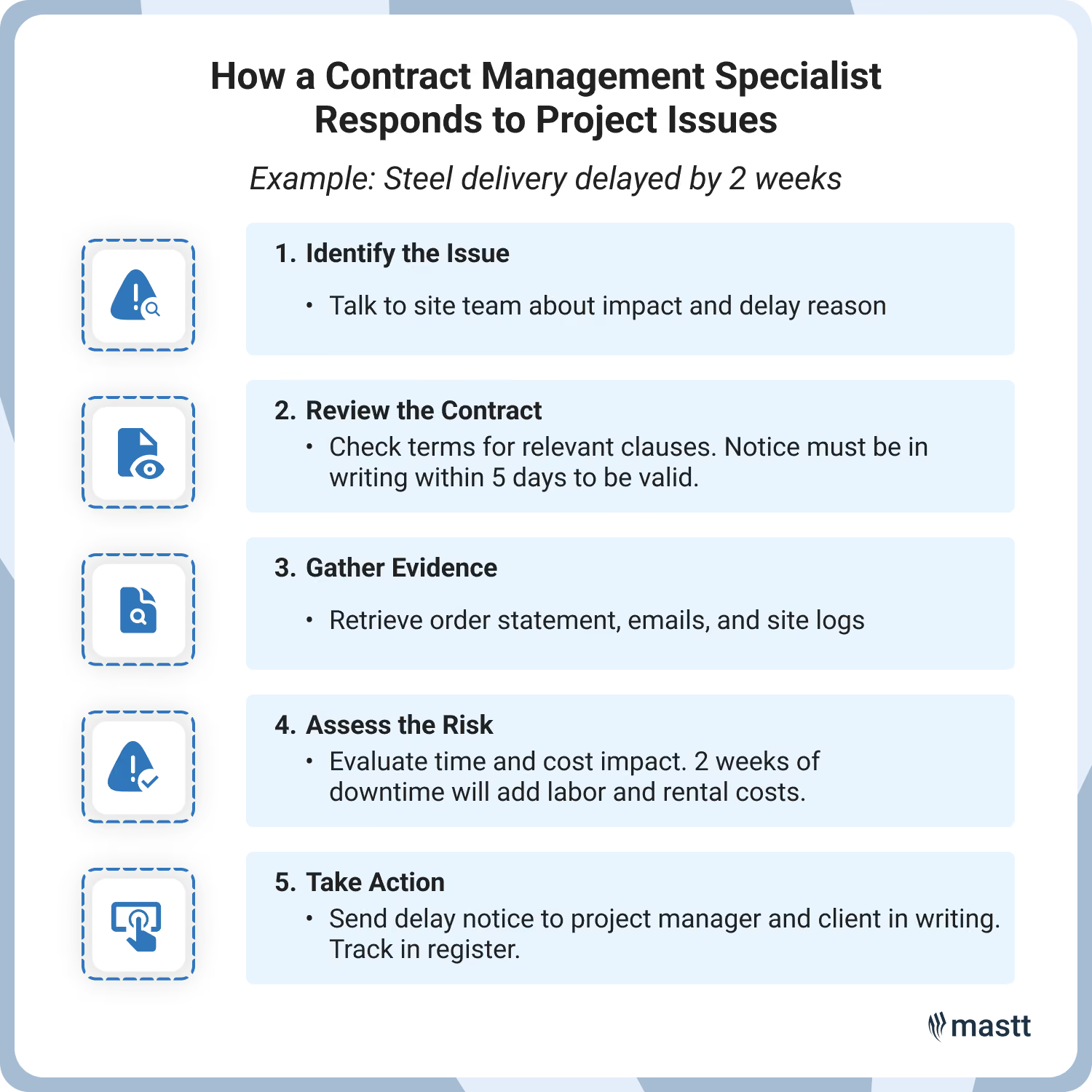
For example, a change order may seem straightforward when it first arrives. A specialist will check the instruction, the notice timing, and the supporting records before the team responds. That early review can prevent avoidable cost exposure later.
What Does a Contract Management Specialist Do Each Day?
A contract management specialist spends the day moving between live issues, internal follow-up, and record control. The work shifts with project stage. It also shifts when a payment issue, delay event, or change order starts to affect position.
Morning: Review live issues and urgent actions
The day often starts with the items that can weaken rights if they sit too long. Early review is less about clearing emails and more about spotting what now needs action and what may later affect position.
- Checking priority actions: This includes notices, response deadlines, payment items, and other matters that need immediate attention.
- Reviewing new correspondence: This helps identify whether an email or submission changes the project’s position under the agreement.
- Following current change orders: This confirms whether each item has the right support and the next step before it moves further.
💡 Pro Tip: If an instruction changes scope but approval is still unclear, treat it as live risk straight away. Risk register software helps teams track ownership, monitor cost exposure, and keep follow-up visible before the paperwork catches up.
Midday: Coordinate reviews and support decisions
As the day moves on, the focus usually shifts from identification to position-building. This is where stronger specialists separate a recordable issue from a defensible one by testing the clause, the facts, and the support behind both.
- Reviewing the relevant clause: This helps confirm whether the issue is supported by the agreement and whether further action is required.
- Preparing issue summaries: This gives the project or commercial team a clear view of the facts, the wording, and the current record trail.
- Coordinating internal input: This brings in legal, procurement, or delivery leads when a response needs broader review.
Afternoon: Update records and close out open items
Later in the day, attention often turns to the controls that keep a weak issue from becoming a bigger one. Good follow-up at this stage protects the file before memory fades or positions start to drift.
- Updating registers and trackers: This keeps key dates, notices, submissions, and live issues current.
- Recording status changes: This makes sure open matters are properly documented.
- Closing out follow-up items: This helps the team end the day with a clear record of what has been resolved and what still needs action.
The daily pattern is not fixed. On one project, most of the day may go to payment review and notice timing. On another, it may turn on delay records or a disputed instruction. What stays consistent is the need to test the issue early, before the file starts telling a different story from the project team.
💡 Pro Tip: Skilled specialists do not wait for a formal dispute before tightening the record. When a change order, delay event, or payment issue starts to form, they make sure the notice trail, supporting documents, and response dates are already in order.

Skills That Make a Successful Contract Management Specialist
The role requires someone who can spot commercial pressure early and test whether the file supports the position being taken. Technical knowledge matters, but it only becomes useful when the specialist can apply it to live issues with sound judgment.
The strongest skills usually include the following:
On a live project, these skills rarely appear in isolation. For example, a change order review may not turn on legal wording alone. It often depends on whether the specialist can read the clause, test the records, and explain the exposure clearly to the team.
How to Become a Specialist in Contract Management
Specializing in managing contracts means moving from support work into decision support, issue ownership, and team guidance. To get there, you need stronger judgment and proof that you can handle pressure without losing control of the details.
Step 1: Master the core work before chasing the title
Start by becoming dependable in the fundamentals. You need to read clauses accurately, protect notice timing, and keep records in a condition that can support a position later.
Then go one step further. Do not just complete the task. Understand which clause controls the issue, what right may be lost if action is late, and where the exposure really sits.
Step 2: Take ownership of small issues first
The move into a lead role usually starts when you stop acting only as a coordinator. Instead of passing items along, take ownership of smaller issues from start to finish and show that you can manage them properly.
For example, if a change order comes in, check the clause, confirm the notice position, test the supporting record, and prepare a short recommendation. That shows you can do more than move information between teams.
Step 3: Learn how experienced leaders make decisions
Next, pay close attention to how senior staff assess exposure and choose a response. Watch how they deal with incomplete records, disputed instructions, weak support, or a position that is legally arguable but commercially weak.
After each review, ask what drove the decision. That habit sharpens judgment because you start to see when a team is protecting entitlement or holding back from a weak escalation.
Step 4: Strengthen your written advice
Once your issue handling improves, focus on how you present it. Lead roles depend on clear written advice because decision-makers need concise notes they can act on quickly.
A good issue note should explain the event, the relevant wording, the record position, and the recommended next step. Clear writing builds trust because it shows you can think through the issue before passing it on.
Step 5: Build credibility across teams
At this stage, technical skill alone is not enough. A lead needs cooperation from legal, procurement, finance, and delivery teams, so your follow-up style matters.
That trust grows when your summaries are accurate, your deadlines are reliable, and your escalations are proportionate. Senior leaders notice who raises the right issue at the right time.
Step 6: Show that you can improve the process, not just follow it
To move into a lead position, show that you can make the function stronger. That may mean tightening a register, improving a notice tracker, refining a template, or fixing a weak handoff point between teams.
This is where many people stand out. Employers notice when someone removes repeat failure points instead of only managing the same issue better each time it returns.
Step 7: Build a promotion case with evidence
Finally, make your progression visible. Keep a record of the matters you handled, the actions you led, and the improvements you introduced so your experience is easy to demonstrate.
Do not wait until an interview to gather proof. A strong promotion case shows that you have already been operating close to lead level, even before the title changes.
💡 Pro Tip: Professionals who know how to use AI for contract review often move faster into lead-level work. Faster clause review creates more time for issue assessment, risk judgment, and better recommendations.
Certifications for a Contract Management Specialist
The best certifications for a contract management specialist are the ones that strengthen practical contract knowledge and support career growth. They are not always required, but they can help the specialist build credibility and move into broader roles.
The most relevant options include the following:
- CPCM (Certified Professional Contract Manager): Builds deeper knowledge of contract formation, administration, and governance.
- CCCM (Certified Commercial Contract Manager): Suits professionals working in commercial contract environments.
- CFCM (Certified Federal Contracts Manager): Best for those working with government agreements or public procurement.
- NCMA certifications: Useful for building structured knowledge and recognized credentials.
- Procurement and supply certifications: Help when the position overlaps with sourcing or supplier management.
- Legal and business qualifications: Strengthen commercial understanding without requiring a full certification.
The right option depends on where the position is heading. A specialist moving toward public-sector work will need different credentials from someone aiming for commercial leadership. In most cases, certification adds the most value when it supports hands-on experience.
Career Path for a Specialist in Contract Management
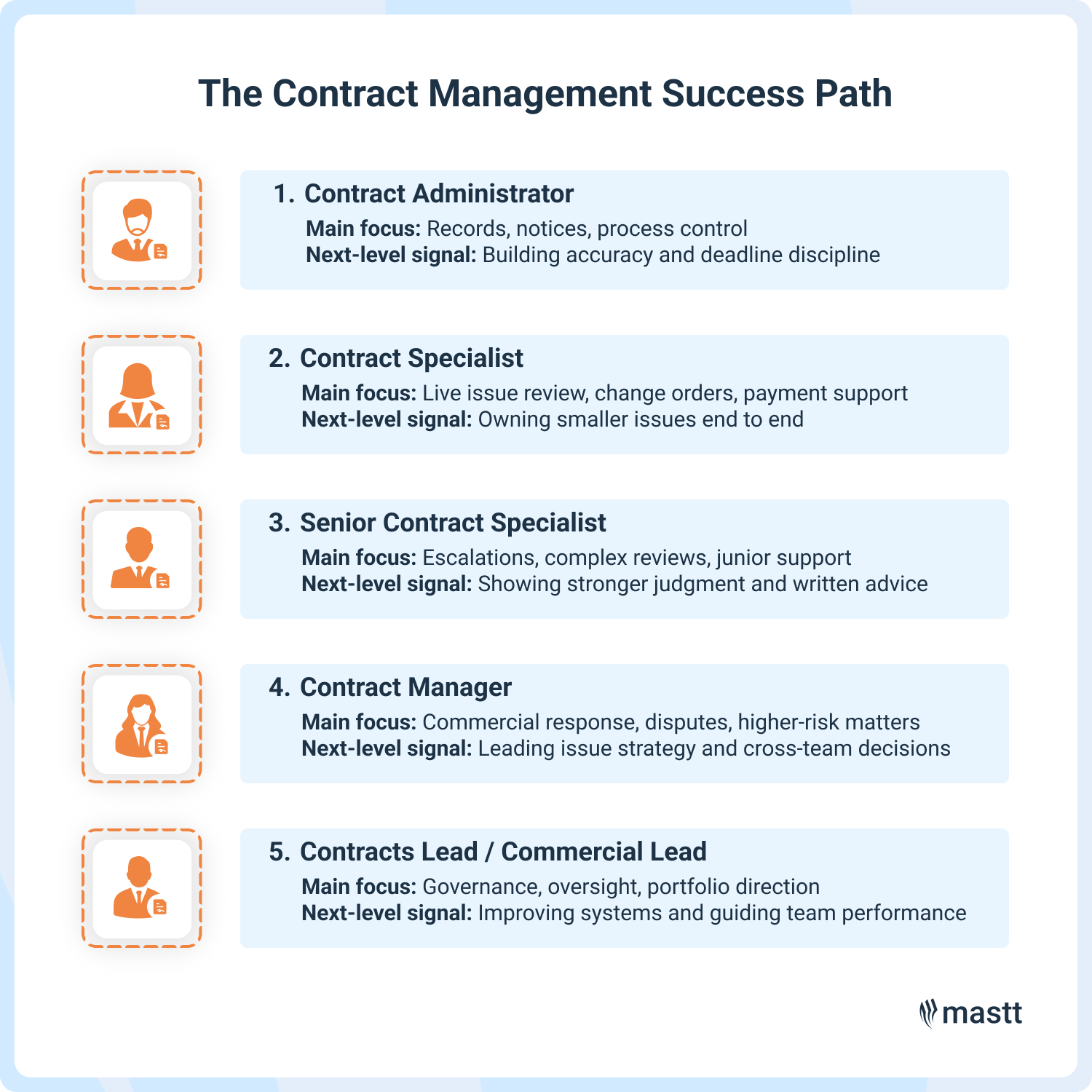
The career path usually starts in support roles and moves toward broader ownership of commercial issues. As the position becomes more senior, the work shifts from coordination into decision support, issue leadership, and team oversight.
Early career roles: Entry-level support and process control
These roles build the habits that later support sound judgment under pressure. This is where people learn that accurate records and timely follow-up are not admin tasks alone. They are what protect position when an issue turns formal.
- Contract administrator: Assists with document control, register updates, and day-to-day administration.
- Junior contract specialist: Helps with correspondence checks and issue tracking under supervision.
- Procurement or commercial coordinator: Supports supplier terms and record management in organizations with shared functions.
Mid-level roles: Active issue handling and day-to-day control
At this stage, the specialist begins handling live matters with less supervision. The work becomes less about tracking activity and more about understanding which issue needs action now and which one can wait.
- Contract specialist: Reviews clauses, supports change orders, checks payments, and follows live issues across active agreements.
- Contract management specialist: Controls day-to-day review, coordination, and commercial follow-up during delivery.
- Commercial specialist: Helps assess entitlement position and project support issues in some businesses.
💡 Pro Tip: Progress speeds up when you stop passing on updates and start testing the strength of the position yourself. A short note that identifies the controlling clause and the real weakness in the file will carry more weight than a longer status report.
Senior roles: Greater ownership and stronger judgment
The work stays close to the detail, but the level of judgment becomes much higher. Senior roles are often defined by how well someone can frame a defensible position and guide others without over-escalating too early.
- Senior contract specialist: Handles more complex matters, supports escalations, and guides junior team members.
- Senior commercial specialist: Helps manage cost-related issues and entitlement reviews in more commercially focused teams.
- Lead contract specialist: Oversees issue review and supports wider team coordination across active work.
Management and leadership roles: Broader authority and commercial direction
At this level, the focus moves beyond issue handling and into direction. The work is no longer just about reading the file correctly. It is also about deciding when to escalate, where to hold position, and how to manage exposure across a wider scope.
- Contract manager: Leads responses on high-risk matters, disputes, and major changes.
- Contracts lead: Controls a wider package of work, program, or portfolio with broader authority.
- Commercial project manager: Directs commercial strategy and supports higher-level decisions beyond administration.
A useful way to read this path is by looking at how ownership changes over time. The real shift in progression usually happens when others start relying on your judgment, not just your follow-up. That is often the point where the role begins to move from support into leadership.
💡 Pro Tip: Pay attention to the first role where you are trusted to frame the issue, not just track it. That is usually the real turning point in progression, because future promotions often follow judgment already shown in practice.
Contract Management Specialist Salary by Region
Reported pay for this role ranges from $89,508 to $116,362 per year in the United States, although local averages vary by region, employer, experience, and job scope. Some figures are listed as a single average, while others are shown as a salary range.
Titles are not always used consistently across regions. In some markets, the position sits closer to commercial management, while in others it is closer to contract administration or project delivery. Compare pay against the actual responsibilities of the role rather than the title alone.
How Specialists for Contract Management Support Construction Projects
In construction, these specialists support projects by applying the agreement to live issues before they turn into larger commercial problems. This helps teams respond earlier on notice timing, payment review, delay exposure, and closeout risk.
This support often includes the following:
- Protecting notice rights: Helps keep notice timing intact so valid positions are not weakened before the issue is fully assessed.
- Checking change orders: Tests whether the instruction, pricing basis, and approval path support the position being advanced.
- Supporting payment review: Checks payments and supporting records before a recommendation is made.
- Strengthening delay response: Connects program events to clause requirements before time-related exposure starts to widen.
- Reducing dispute exposure: Keeps correspondence and issue history in a condition that can support the owner’s position later.
- Improving accountability: Makes it easier to trace who needed to act, what was required, and where follow-up has stalled.
- Supporting closeout: Helps confirm that final submissions and unresolved items do not carry into handover unnoticed.
For example, a delayed instruction may first look like a site issue. Early review can show whether it affects notice timing or later entitlement. That gives the team a chance to protect position before the issue hardens into a dispute.
💡 Pro Tip: On live projects, notice failure often causes more damage than a weak argument on the merits. Check the timing first. If the right was not preserved, the rest of the position may never fully recover.
Tools and Software Contract Management Specialists Use
Contract lifecycle management (CLM) platforms, document systems, and project registers help keep records and actions under control. The best setup gives teams clear visibility over approvals, due dates, change activity, and compliance requirements.
💡 Pro Tip: Use a construction contract management software workflow that links notices, change orders, correspondence, and key dates in one place. This helps teams spot gaps early and defend the project record later.

Advance Your Career in Contract Management
Contract management is a strong path for professionals who want greater commercial responsibility over time. Keep obligations visible, respond before deadlines slip, and make the record easy to defend. More ownership usually follows when others can rely on your judgment under pressure.
.avif)
Written by
Doug Vincent
Doug Vincent is the co-founder and CEO of Mastt, the AI capital-project management platform used by governments, Fortune 500 companies, and consultancies across APAC, North America, and MENA. Before founding Mastt in 2019, he spent a decade at RPS delivering more than $2 billion in capital works, including the $2.1B Defence Navy Infrastructure program, and holds a CPSPM certification with the AIPM. He contributes content and speaks on AI in capital project delivery at Mastt.


Contributions by
Contract Management Dashboard
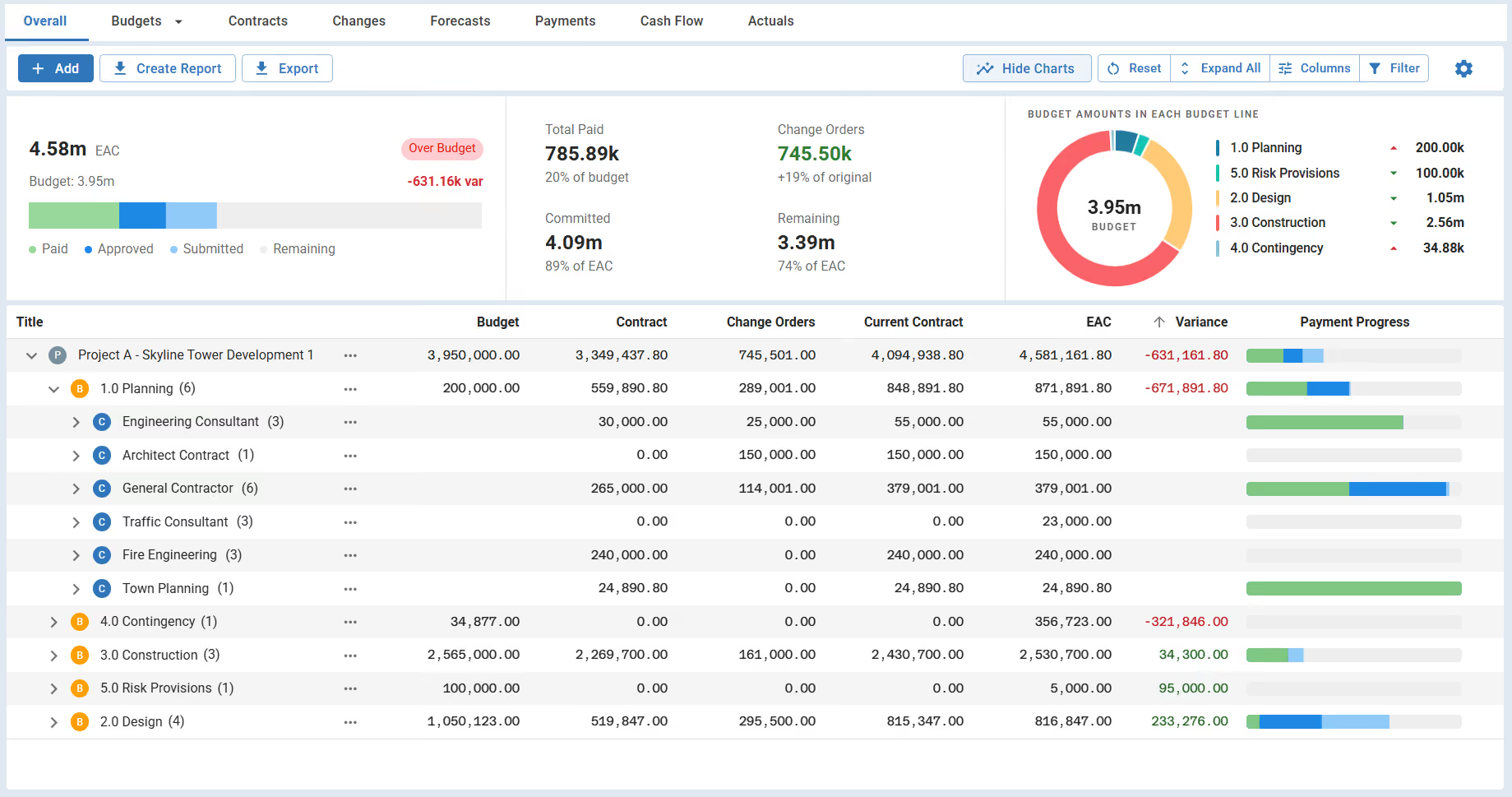
A free contract management dashboard for owners and client-side teams. Track contract values, change orders, payments, and compliance in one live view.

Walk Into Every Meeting With Confidence, Clarity, and Control
No one wants to look unprepared, blindsided, or uncertain in front of stakeholders — but that’s exactly what happens without Mastt.
Start for FreeTrusted by the bold, the brave, and the brilliant across governments, Fortune 500s, and the world’s best in delivering the future


.avif)