
.avif)
Timothy “Tim” Mather spent more than two decades building the scheduling software that major capital programs run on. At PMA Technologies, he co-developed NetPoint® and NetRisk™ and co-authored ‘Core Traits of a Reliable Schedule Protocol,’ an industry paper arguing that schedules exist to drive execution, not to document complexity. He is now COO at Strategic Business Solutions.
We asked Tim questions about why the master schedule doesn't drive the work, what AI will actually change in project scheduling, and what it will take for the industry to move. He makes a precise case for where AI will break that inertia, and why construction's deep conservatism means adoption will be slower than technologists expect.
CPM Scheduling Today: What’s Improved and What Hasn’t
Most practitioners know the master schedule and the field work don't line up. What's less understood is where things have genuinely improved over the past decade and where the same problems persist despite better tools.
Q: You’ve been building scheduling software for decades. What’s actually changed on a typical major project, and what hasn’t?
A: Sadly, it’s a pretty short list of what’s better. The integration of web-based tools has been helpful. Ten years ago, large projects were almost all Oracle P6, and the majority of that was desktop-based. Even if it was multiple desktops into a single unified platform, it wasn’t web-based, so the ability to integrate other tools and data sources just wasn’t there.
Web platforms changed that. Real-time updates, IoT-style triggers, data sharing across apps: that’s the biggest improvement I’ve seen in the last decade.
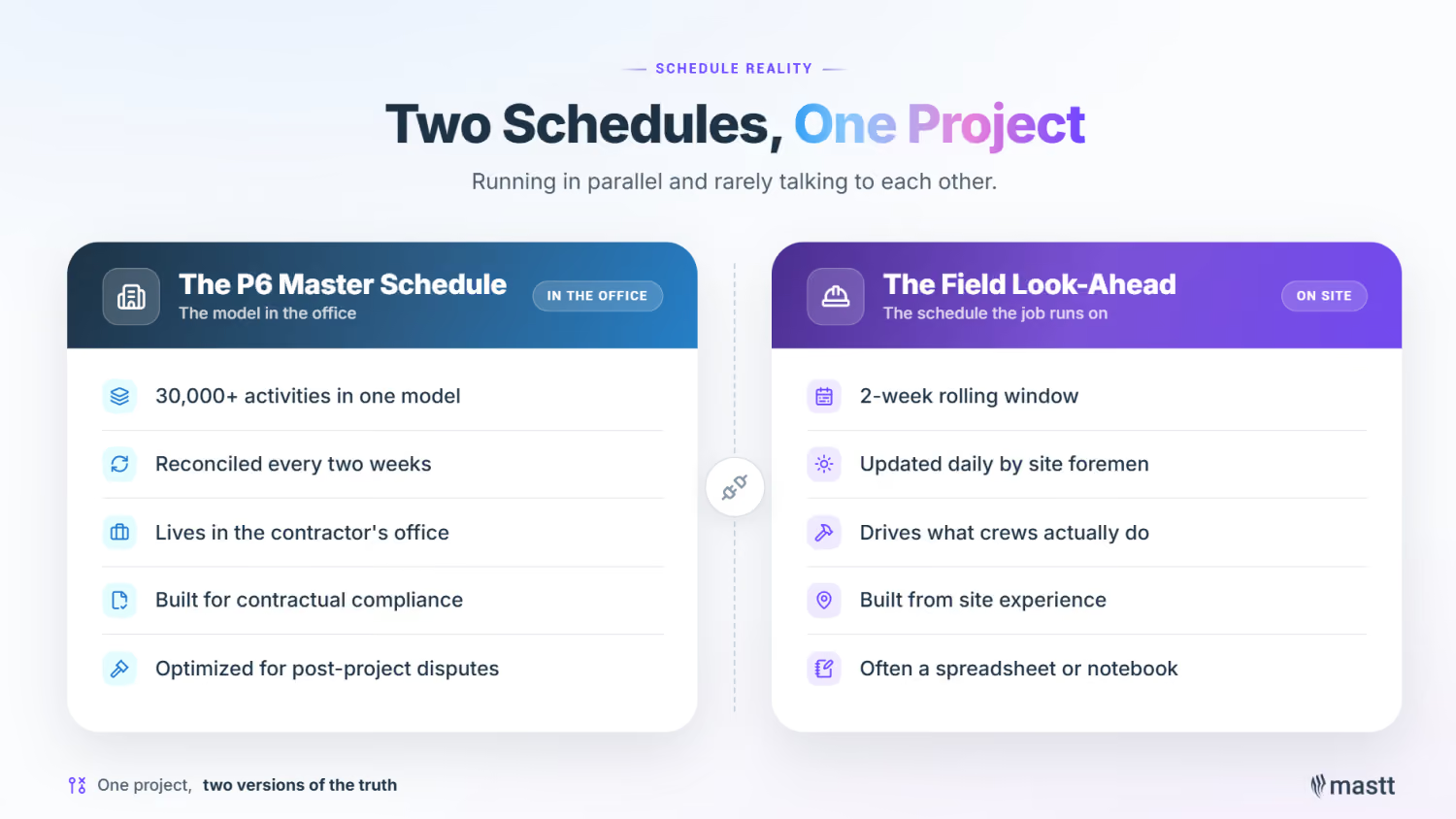
What’s the same? The disconnect between the field and the made-up model that is the critical path schedule in P6. If you have a five-year program with 30,000 activities in it, you’re making it up. You don’t know that three years from now, this I-beam is going to get bolted to that piece of concrete. That’s just not true.
And the other thing that hasn’t changed is the bent of most CPM programs toward litigation and claims, specifically the ability to defend your position on a critical path network after the project ends. That seems like a pretty negative way to spend your energy.
Q: You describe the master schedule and field work as running on “two separate parallel paths.” What does that disconnect actually cost an owner?
A: There’s the out-of-pocket cost first: maintaining two extensive, logically-tied schedules over the life of a project is expensive. The contractor builds that cost into their price. The owner’s rep or internal organization has to fund their own schedule. That’s real money.
But the bigger cost is in execution.
Field crews run on their own two-week look-ahead schedules. Every two weeks or so, someone reconciles that look-ahead against the 30,000-activity master schedule. Things are out of sequence. Things started that shouldn’t have. Things weren’t started that were supposed to be.
Adjustments happen and it just seems like Kabuki theater: you’re trying to align reality when really you should have one consistent platform that is thought out and is accessible to everyone and actually drives the work.
The real cost is delay. If you’re building a pharmaceutical plant, a semiconductor fab, or a casino, you’re losing money every single day it’s not operating. General conditions add up. Liquidated damages kick in depending on the contract. Delay through lack of execution is the single biggest reason to do forward planning well and translate it into a schedule that actually drives the work.
"The goal isn’t more detail, the goal is better execution."
- Tim Mather
Q: Risk analysis tends to happen once at the front end and then not again. Why doesn’t continuous risk analysis happen in practice, and what does AI change about that?
A: A fully updated risk analysis is a time-consuming, expensive manual process. So it tends not to happen.
One of the core arguments in the scheduling protocol we co-authored is that risk should actually be a part of how you run a project throughout execution, not just something you do to pass a stage gate at the beginning. That means having the right durations given the length of the project, not too much float and not too little, and treating Monte Carlo simulation as a living process rather than a one-time exercise.
AI changes the economics of that significantly. The idea of having AI query your risk register to see if any of those risks are emerging, then automatically updating and re-running the Monte Carlo, makes perfect sense. You get continuous risk intelligence without the manual labor cost that currently makes it impractical. That’s a meaningful shift.
Why P6 Scheduling Still Dominates Despite Its Flaws
If CPM scheduling has such a significant disconnect from how work actually gets done on site, why hasn't the industry moved on? That question turns out to have less to do with technology than with the economic and professional structures built around the current system.
Q: CPM/P6 is still the default on virtually every major project. You’ve argued it doesn’t drive execution. So why hasn’t something better displaced it?
A: Inertia: contractual inertia and professional inertia. Contractually, many contracts require a P6 schedule. You can’t just decide to use something else.
From a professional standpoint, P6 scheduling has been made so complicated that you need to be an expert in both the methodology and the software just to navigate it. That makes the scheduler a specialist, which makes them valuable. There’s a whole class of professionals with a career interest in that complexity staying complex.
And then there’s the forensic scheduling expert witness industry, which is a multi-billion-dollar sector. They are invested in knowing how to fight over a P6 schedule after a project ends. They have no financial incentive to see the paradigm change.
Q: You built scheduling software around GPM as an alternative approach. Did that work? What are its limits?
A: GPM (graphical path method) had real applicability in front-end planning. For interactive sessions at the start of a project, building level-zero and level-one schedules, and getting alignment among stakeholders, the graphical nature was genuinely useful. But it didn’t scale.
For something like a turnaround on a chemical plant, there are just too many things happening simultaneously to capture graphically. It wasn’t the answer for large, complex projects.
"The advent of AI within the world of scheduling is probably where the biggest opportunity now lies. "
- Tim Mather
The ability to build a data lake off a whole project and then natural language query that project for answers is going to level the playing field in a way GPM never could. You don’t need to replace P6 if you can make P6 data accessible to everyone who needs it.
How AI is Changing Construction Scheduling
AI is widely framed as the solution to the scheduling problems described above. What that looks like on an actual project, and where the value is concentrated, is what this section covers.
Q: Walk through what natural language querying of a schedule data lake actually looks like for a project team.
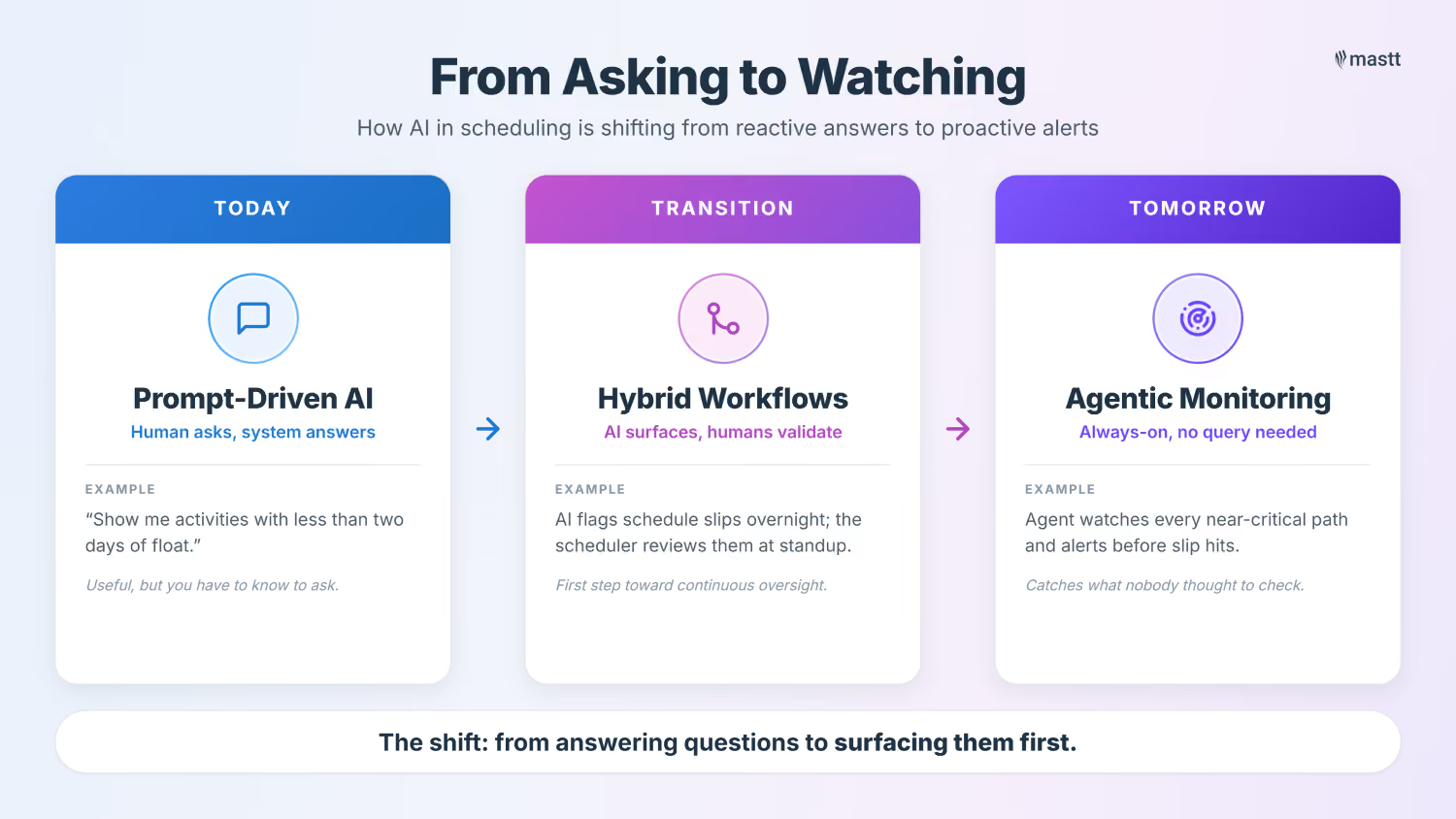
A: Right now, if a CFO or project sponsor wants to know “how many activities have less than two days of float?” they need either a P6 expert or the patience to wait for someone to run the query and format a report. Most of the time, they just don’t get the answer.
Natural language querying against a schedule data lake changes that. You ask the question in plain English and get an answer, without needing to know P6, without needing a specialist to mediate. That levels the playing field for the CFO, the project sponsor, the contractor, and the owner’s rep.
And at the portfolio level, it becomes even more powerful: a project controls leader running 30 or 40 projects worldwide could have one unified view covering finance, schedule, safety, and updates, and query across all of it.

Q: What does agentic AI actually look like applied to scheduling?
A: Prompt-driven is the mode most people are in right now: a human asks a question, the system answers. That has a lot of room to run, and it’s genuinely useful. But the more interesting application is agentic, meaning always-on systems that don’t wait to be asked.
The specific case I’d build first is an agent that watches for near-critical paths trending toward critical. In a 30,000-activity schedule, nobody is monitoring every path continuously; you wait until something turns bright red and then react. But an agent could watch those trends in real time and surface an alert before the path goes critical. That’s getting ahead of the problem instead of reacting to it.
Q: You mentioned “death by a thousand cuts” in the context of risk. What did you mean by that?
A: If a project has a thousand change orders, even if none of them individually affect the critical path, you’ve increased the risk of that project finishing late. You can’t have that much change and not impact something along the way.
AI does a good job of scheming out those scenarios: what if this currently non-critical path becomes critical if these risks emerge? That kind of analysis is tedious to run manually and basically never gets done.
This is also where continuous Monte Carlo simulation becomes valuable.
If you can have AI automatically query the risk register, check which of those thousand change orders is nudging a non-critical path toward critical, and re-run the simulation without scheduling a formal risk review, you get the intelligence you actually need to act on. Without that, you’re driving blind until something turns red.
AI Adoption in Construction: Why the Industry Moves Slowly
Construction has absorbed waves of new technology without fundamentally changing how projects get built. The question with AI isn't whether it can do more. It's whether the industry will actually adopt it, and what will force that to happen.
Q: You’ve seen construction resist new technology before. What does history tell us about how AI adoption will actually play out?
A: About 22 years ago, we built a daily reporting app for Palm devices and assigned it to a field crew. They wouldn’t use it. It fell under the truck wheels or whatever; they wanted their handwritten book. That instinct toward the familiar is not irrational in engineering. You don’t want the bridge to be under-engineered because someone was experimenting. But it does mean new ideas face a very high bar.
What makes AI different this time is the investment behind it.
In my lifetime, there has not been this big an investment this quickly in any given technology. And the use case is genuinely clear. But you have to be honest that the models are still improving non-linearly: something that fails today might work well in three months.
I tried integrating Cursor with Claude Code on my machine about a year ago, and it was like having a really bad intern. I re-tested it a month ago, and it was so much better. It was remarkable. That rate of change is hard to reason about.
Q: You applied the ADKAR change management framework to AI adoption in construction. Where does the industry sit on that curve?
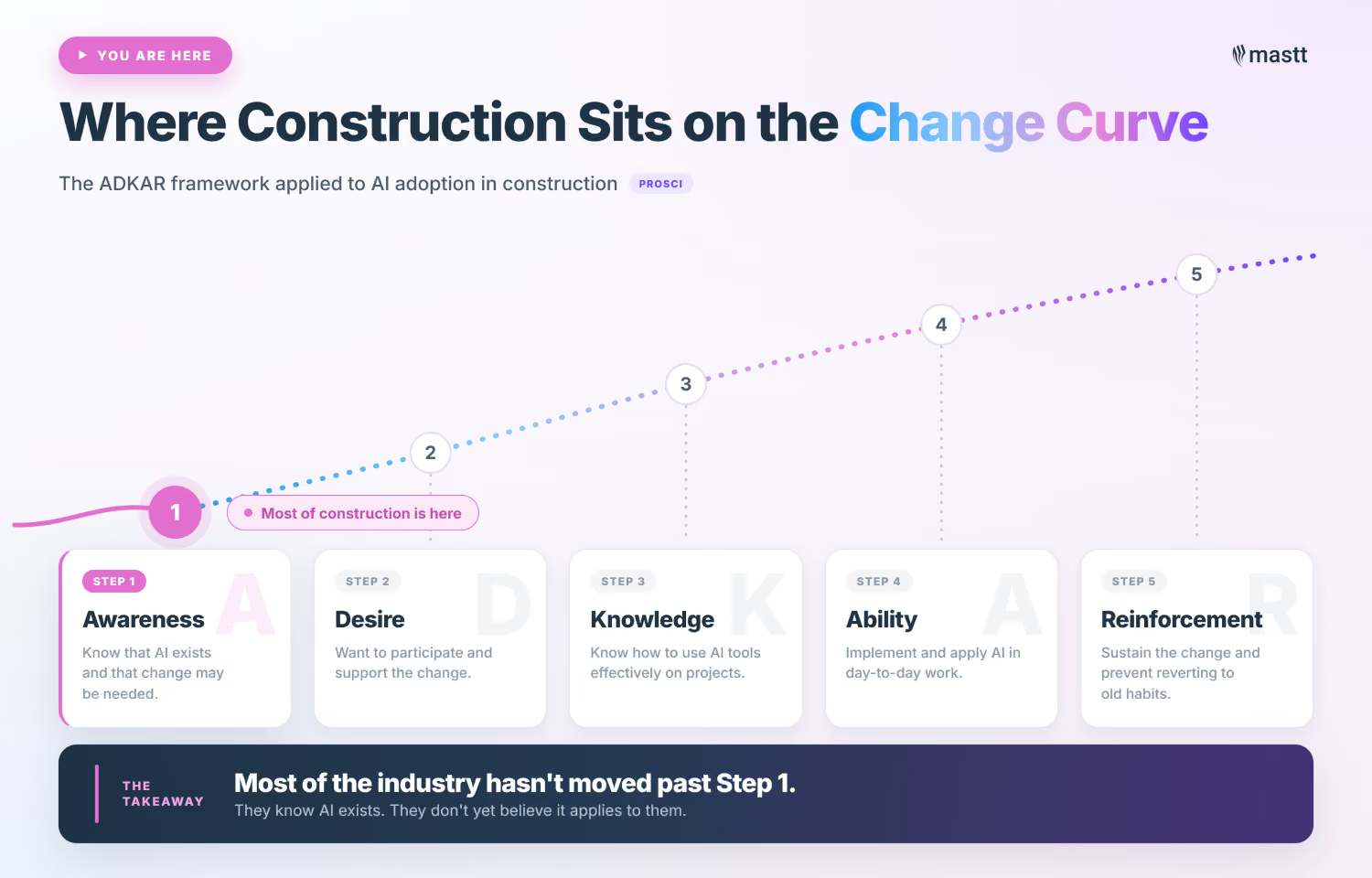
A: ADKAR stands for Awareness, Desire, Knowledge, Ability, Reinforcement; it’s a ProSci framework for organizational change. You have to get through each stage for change to actually happen. You can’t skip awareness and jump to knowledge.
My read is that a lot of the construction industry is not even past awareness yet. They know AI exists. They don’t yet believe it applies to them in a meaningful way, or that they need to change because of it. Until that awareness clicks, it doesn’t matter what training or tools you offer.
What will move them is economic pressure. Somebody is going to figure out how to use AI to deliver projects more efficiently and start undercutting competitors. Once that happens, the rest of the market gets forced into awareness very quickly.
And if an organization like the Construction Users Roundtable or one of the big contracting bodies were to adopt a platform and set a standard, you’d see it accelerate even faster. The question is whether they’ll see the value in moving before the economic pressure forces their hand.
Q: Organizations are starting to create internal AI champion roles. But finding the non-obvious use cases is genuinely hard. How would you approach that?
A: The thing that doesn’t get talked about enough is that people are afraid AI will take their job. In change management terms, that’s resistance, and it will quietly kill adoption even when the official story is that everyone is on board.
The way around it is WIIFM, which stands for “what’s in it for me.” If a project manager’s personal nightmare is updating spreadsheets every week, start there. Show them AI eliminates that specific pain. They’ll adopt it because it did something for them, not because it serves some company-wide strategic initiative.
You also need champions at multiple levels of the organization, not just a single designated AI person, but people in each functional area who can see where the friction is and have the credibility to get their colleagues to try something new.
The Future of the Scheduler’s Role by 2035
As AI takes on status updates, data entry, and progress reporting, the question becomes what the human scheduler's job actually looks like on the other side. That depends on which parts of the role turn out to be genuinely irreplaceable.
Q: If AI handles the data entry, the status updates, and the form-filling, what does a scheduler’s job actually look like in 2035?
A: The real schedulers I’ve met over the years are craftsmen. They don’t just click keys. They understand what they’re trying to accomplish. They understand how to read the model, how to tie logic, how to see the interactions between work streams that don’t obviously connect. That experience and intuition are where the value is.
"If AI handles the data work, those people (schedulers) can spend their time applying what they actually know."
- Tim Mather
On the broader project management side, the PMBOK says 90% of a project manager’s job is communication and coordination. I agree with that. A PM is the only person with a full view across all stakeholder interests. If AI gives them better, faster, more accurate data to communicate from, they can do that core job better.
By 2035, I don’t think progress reporting needs to be a human activity at all; sensors and possibly robots on site will report data in real time. At that point, the scheduler’s value is entirely in their judgment, not their data-entry speed.
In my lifetime there has not been this big an investment this quickly in any given technology. I think AI holds the potential to be more transformational than the internet, and it’s better funded.
- Tim Mather
Note: This Q&A article is part of Mastt’s interview series featuring construction industry experts. Tim Mather’s responses have been lightly edited for readability.
.avif)
Written by
Jamie Cerexhe
A Forbes 30 Under 30 and PMI Future 50 honoree, Jamie Cerexhe is Mastt's co-founder and Chief Technology Officer. He leads the company's AI engineering, agentic pipelines, and security work, and earlier taught software development and contributed to the UNESCO Digital Skills Toolkit. At Mastt, Jamie contributes articles on AI, agentic workflows, and technology adoption in construction.

Contributions by
Timothy Mather
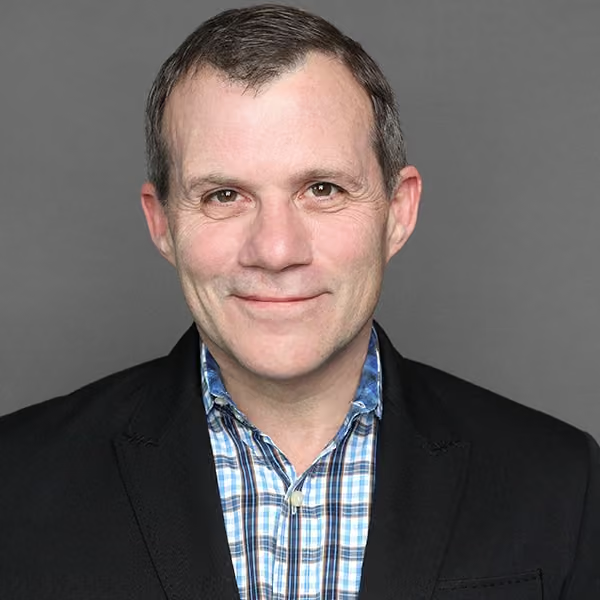
Tim Mather is a former CTO and COO of PMA Technologies, where he spent 23 years developing construction scheduling and risk analysis software. He co-developed NetPoint® and NetRisk™ and co-authored "Core Traits of a Reliable Schedule." At Mastt, he writes on construction scheduling, project controls, and AI in construction.
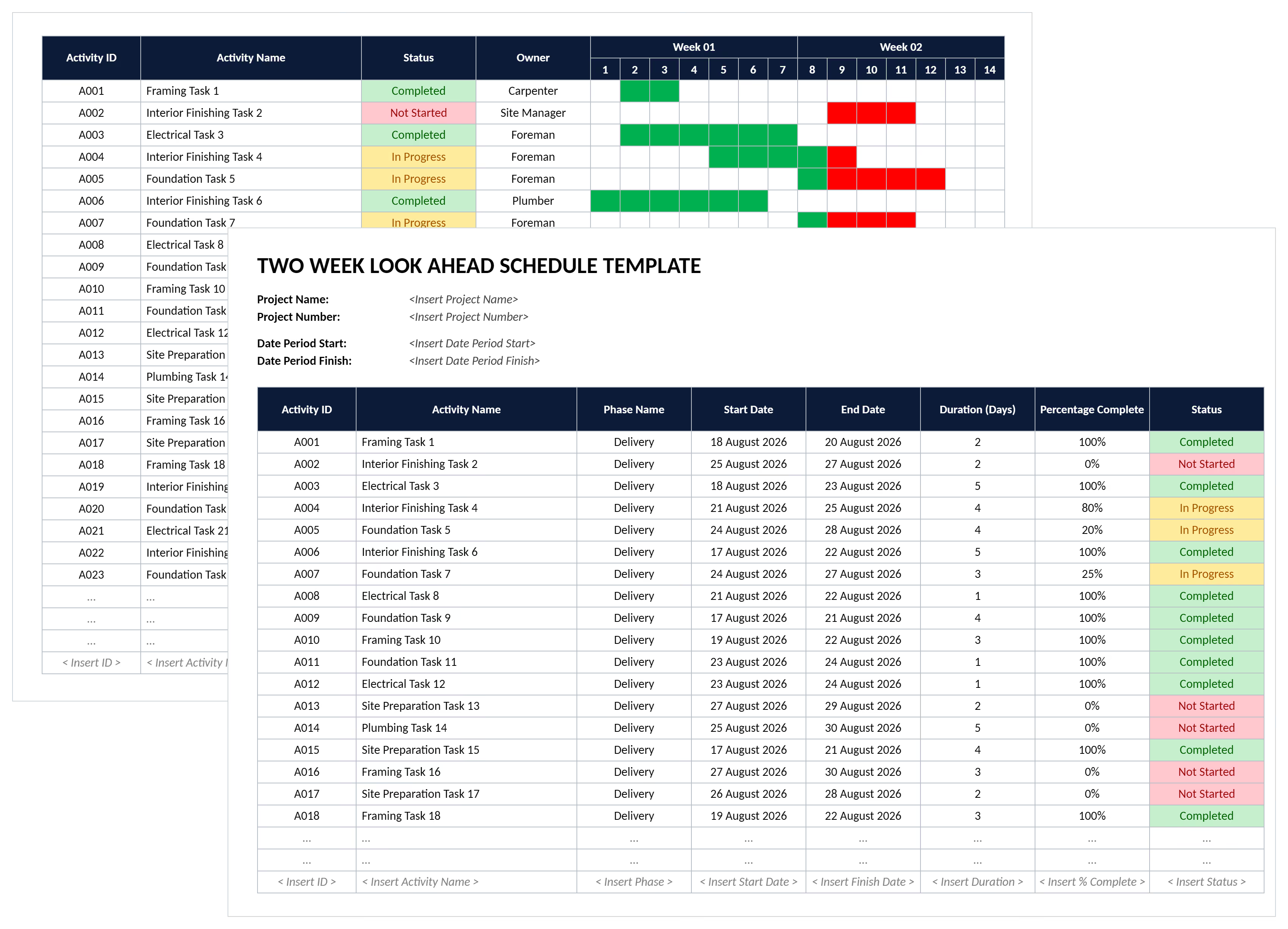
2 Week Look Ahead Schedule Template
Use this FREE 2 week look ahead template to coordinate trades, remove constraints, and prevent delays. Download Excel formats that keep crews productive and plans reliable.

Walk Into Every Meeting With Confidence, Clarity, and Control
No one wants to look unprepared, blindsided, or uncertain in front of stakeholders — but that’s exactly what happens without Mastt.
Start for FreeTrusted by the bold, the brave, and the brilliant across governments, Fortune 500s, and the world’s best in delivering the future