
.avif)
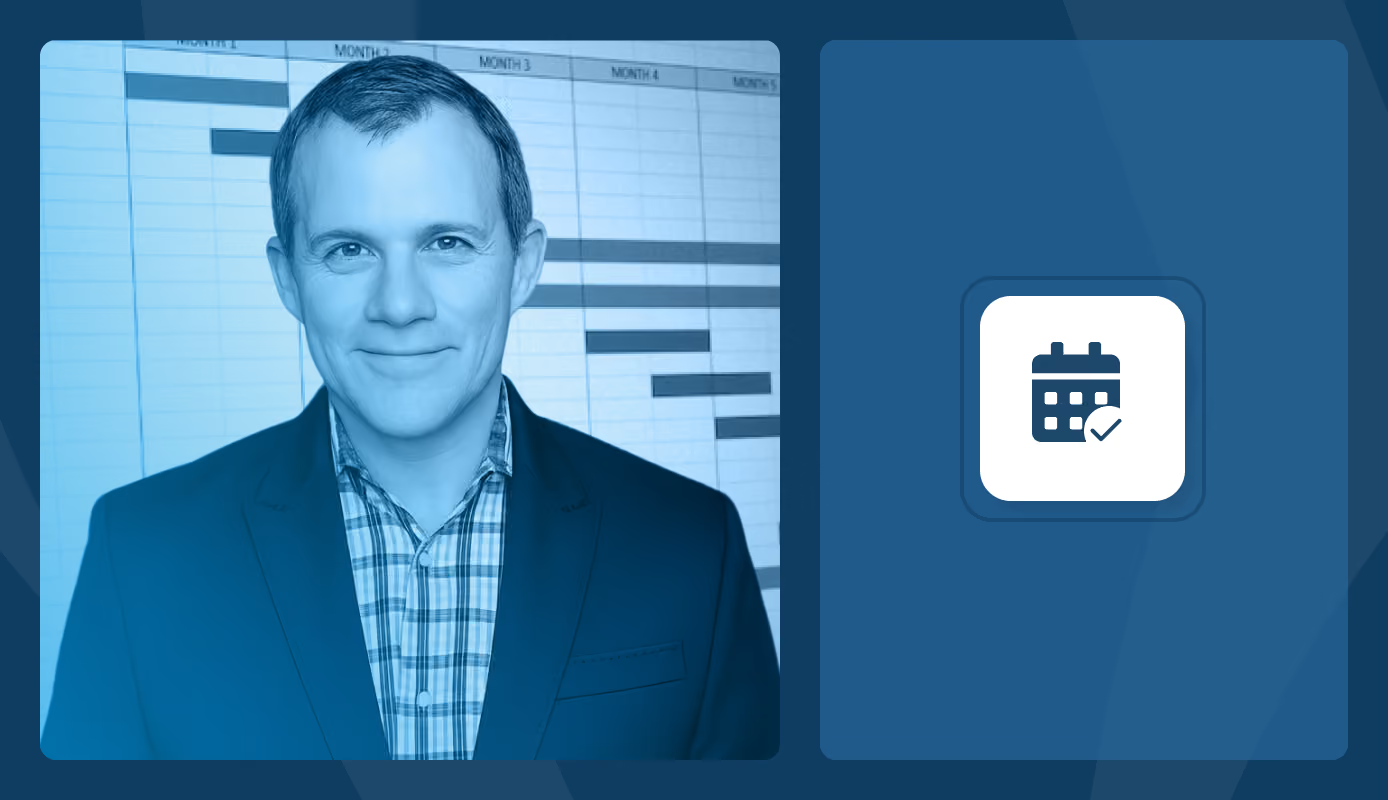
Tim Mather spent most of his career building scheduling software for construction. He started his own company, then merged it into PMA, where he worked on project scheduling and risk management tools for years before leaving last year. In a recent conversation, he shared where he thinks construction project scheduling stands today and what AI might actually change about it.
1. The Schedule and the Fieldwork Are Running on Two Separate Paths
On most major construction projects, the master schedule and the actual fieldwork run as parallel systems. The contractor has a detailed critical path schedule in P6, while the site crew works from a two-week look-ahead that lives separately.
Every few weeks, someone tries to reconcile them. Activities are out of sequence. Work started that should not have started, while other tasks stalled that were supposed to be underway. Tim called this reconciliation cycle "Kabuki theater," where the team is trying to align reality after the fact rather than using one consistent platform that actually drives the work.
I see the field work and the schedule as running on two separate parallel paths. That 30,000 activity schedule is not actually driving work on the site.
-Tim Mather
This gap has been around for at least a decade, and Tim considers it the single biggest unresolved problem in project controls. Web-based tools have made data integration easier, but the schedule is still a reporting tool rather than a management tool on most projects.
💡 Pro Tip: If your schedule update cycle is monthly or bi-weekly but your field teams are making daily decisions from a separate look-ahead, your master schedule is a reporting tool, not a management tool. Closing that gap starts with a platform that connects planning and execution in one place.
.avif)
2. A 30,000-Activity Schedule on a Five-Year Program Is Guesswork
Nobody can predict which steel beam will be bolted to which piece of concrete three years from now. Tim's point is that the level of detail in a long-duration schedule creates a false sense of precision. The activities look specific, but they cannot actually be validated that far out.
If you have a five-year program with 30,000 activities in it, you're making it up. You don't know that three years from now this I-beam is gonna get bolted to that piece of concrete. It's just not true.
-Tim Mather
The cost shows up in execution. When a schedule is too detailed to be practically maintained, updates lag behind reality, logic breaks, and the project drifts. Tim pointed to the general conditions costs accruing every day a project runs late. On top of that, there are liquidated damages and lost operating revenue for facilities that should already be generating income.
As Tim put it, the goal was never more detail, it’s better execution. Adding more activities does not help if nobody can keep the model current.
3. P6 Dominates Because of Contractual and Professional Inertia
Tim gave two reasons why CPM scheduling still dominates virtually every major capital project. The first is that many contracts explicitly require a P6 schedule. That locks in the method before anyone asks whether it is the right approach.
The second is that CPM's complexity has created a class of specialists who depend on it. The more arcane the tool, the harder it is to replace the person who knows it.
Tim also pointed to the forensic scheduling and expert witness industry, which he described as a multi-billion-dollar business built entirely around fighting over P6 schedules after projects go wrong.
Contractually, many of the contracts require a P6 schedule. And from a professional standpoint, you make a P6 schedule so complicated that you have to be an expert scheduler and an expert at P6 to actually navigate it, which then makes that person special.
-Tim Mather
To be clear, Tim was not saying P6 is a bad tool. It works for what it was designed to do. But any new method has to compete against contracts that already name the tool, professionals whose careers are built on it, and a dispute resolution industry that profits from the status quo. That is a lot of gravity to overcome.
4. AI's Biggest Opportunity is Querying an Entire Portfolio
Most conversations about AI in construction zoom in on a single project, but Tim went straight to the portfolio level. For instance, a project controls leader at a pharmaceutical company might have 30 or 40 projects going on around the world. Right now, pulling together a unified picture across all of them is a manual process.
Wouldn't it be wonderful to be able to just have the whole vision available to you to query against from finance, through scheduling, through updates, through safety, everything available in one easy-to-query database?
-Tim Mather
Tim described this as a queryable data lake. Leadership could ask plain-language questions across the whole portfolio, things like total float exposure in a region or which projects are losing ground on structural steel. He also noted that AI could level the playing field so that a CFO, a project sponsor, or an owner's rep could get answers without needing to know P6.
5. Nobody Notices a Critical Path Problem Until It Turns Bright Red
In a 30,000-activity schedule, no human is going to spot a near-critical path quietly losing float over several updates. It only gets attention when it hits zero float and turns red on the dashboard. Tim thinks this is where agentic AI running in the background, could make the biggest difference. An agent monitoring float trends across every path could flag that weeks earlier.
Can we maybe get ahead of the curve a little bit and have agents that watch for trend analysis? Near critical but trending towards critical. You capture it ahead of time in a 30,000 activity schedule. Nobody's going to notice it until it turns bright red.
-Tim Mather
Tim also talked about what he called "death by a thousand cuts" in construction project scheduling. A project might have a thousand change orders, and even if none of them individually affect the critical path, the cumulative effect increases the probability of delay in ways that are hard to see without modeling. AI could run those compound scenarios continuously instead of waiting for a quarterly risk review.
💡 Pro Tip: If you are running Monte Carlo simulations only at stage gates, you are getting a snapshot of risk at a single moment. Continuous, AI-driven risk monitoring turns that snapshot into a live feed.
6. Most of the Construction Industry is Not Even Aware It Needs to Change
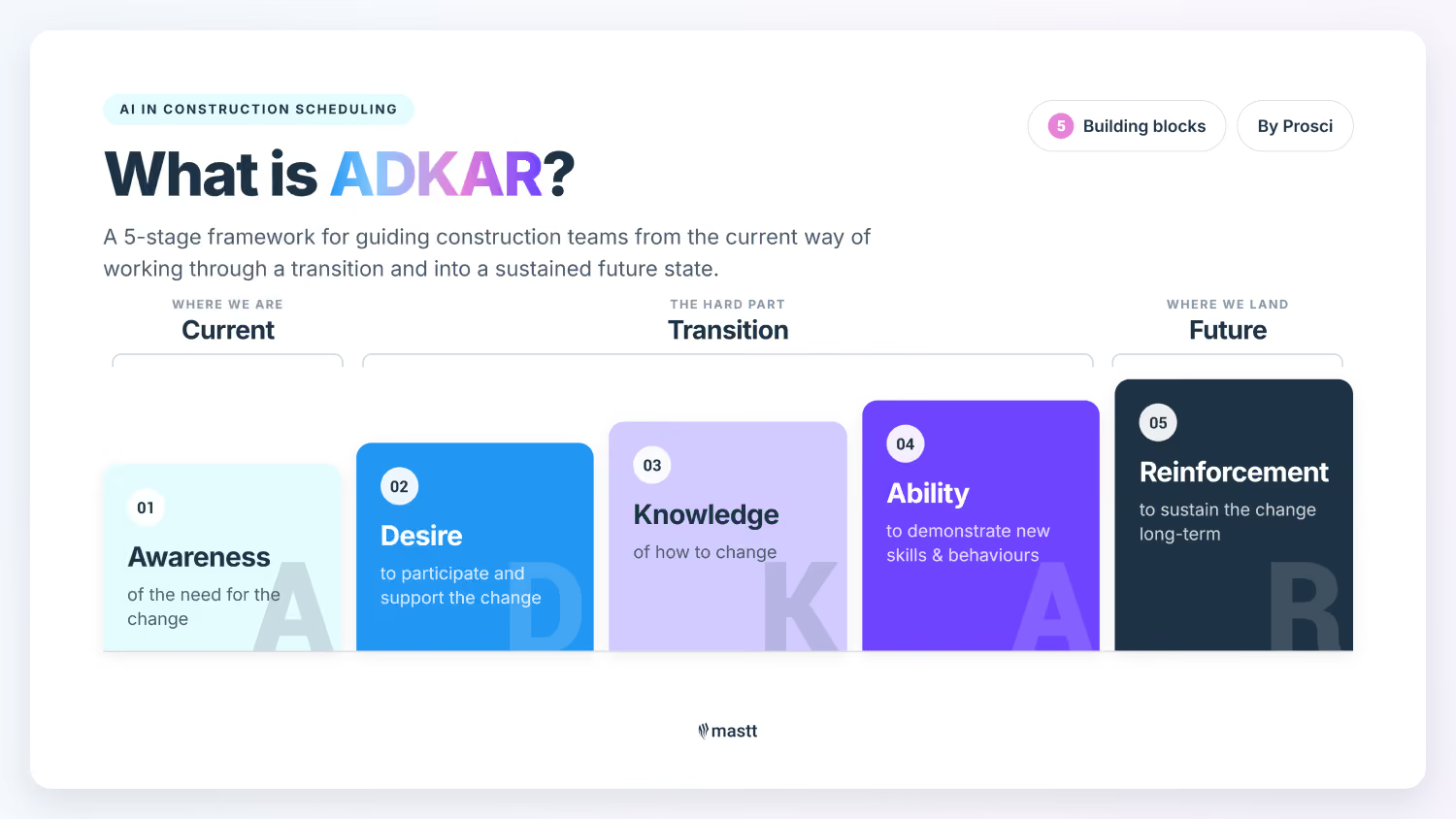
Tim brought up ProSci's ADKAR framework for change management. ADKAR breaks change into five stages (Awareness, Desire, Knowledge, Ability, Reinforcement), and you have to clear each one before the next one matters.
His read is that most of the construction industry has not even cleared the first one. Organizations are delivering projects and generating revenue, and the current process works well enough that nobody is asking whether it should be different. Without that awareness, it does not matter how good the tools are or how much knowledge exists in the market.
I think much of the industry isn't even aware it needs to change at this point. You have to get through each stage gate to actually have a successful change. Until they're aware, it doesn't matter if they have the knowledge or not.
-Tim Mather
Tim expects economics to eventually force the issue. Somebody will figure out how to use AI well enough to start undercutting competitors, and then the rest of the industry will be forced to follow. That is how he sees awareness spreading, through economic pressure rather than persuasion.
7. Start AI Adoption by Fixing the Work People Hate Doing
Tim's approach to AI adoption is to start with the task people hate most. If a project manager's worst task is updating spreadsheets every week, that is where you start. Show them AI can handle that specific pain, and win them over with something that improves their day before asking them to trust the technology with anything bigger.
If a PM's worst nightmare is updating all these spreadsheets, say, you know what, we're going to help you update all these spreadsheets using AI. And then they'll like AI because we've done something for them versus training AI to take their job from them.
-Tim Mather
The reason this matters is that underneath the resistance to AI, there is real fear. Schedulers who spent years mastering P6 and forensic analysis see AI as a direct threat to their livelihood. Tim called this out as a change management problem. In his words, you have to find the WIIFM, or "what's in it for me," before people will engage with the technology at all.
A common approach in organizations is to appoint an "AI champion" and task them with finding AI use cases. But people tend to fall back on the same two or three obvious applications.
Tim's response to this was to think about it as a change management challenge. How do you give an organization psychological safety in the process of adopting AI? And how do you recruit people who will be champions for it at different levels?
The Bottom Line on AI Construction Scheduling
Tim has been building tools for this industry for a long time, and watching them get adopted or ignored. As he put it, there has not been this big an investment this quickly in any technology in his lifetime. But the industry is conservative, and adoption will depend on whether organizations can get past that first ADKAR stage of awareness.
For owners and program managers, it is worth thinking about where your own organization sits on that framework. If the people doing the work are not even aware that things could be different, that is the place to start.
.avif)
Written by
Jamie Cerexhe
A Forbes 30 Under 30 and PMI Future 50 honoree, Jamie Cerexhe is Mastt's co-founder and Chief Technology Officer. He leads the company's AI engineering, agentic pipelines, and security work, and earlier taught software development and contributed to the UNESCO Digital Skills Toolkit. At Mastt, Jamie contributes articles on AI, agentic workflows, and technology adoption in construction.

Contributions by
Timothy Mather
Tim Mather is a former CTO and COO of PMA Technologies, where he spent 23 years developing construction scheduling and risk analysis software. He co-developed NetPoint® and NetRisk™ and co-authored "Core Traits of a Reliable Schedule." At Mastt, he writes on construction scheduling, project controls, and AI in construction.
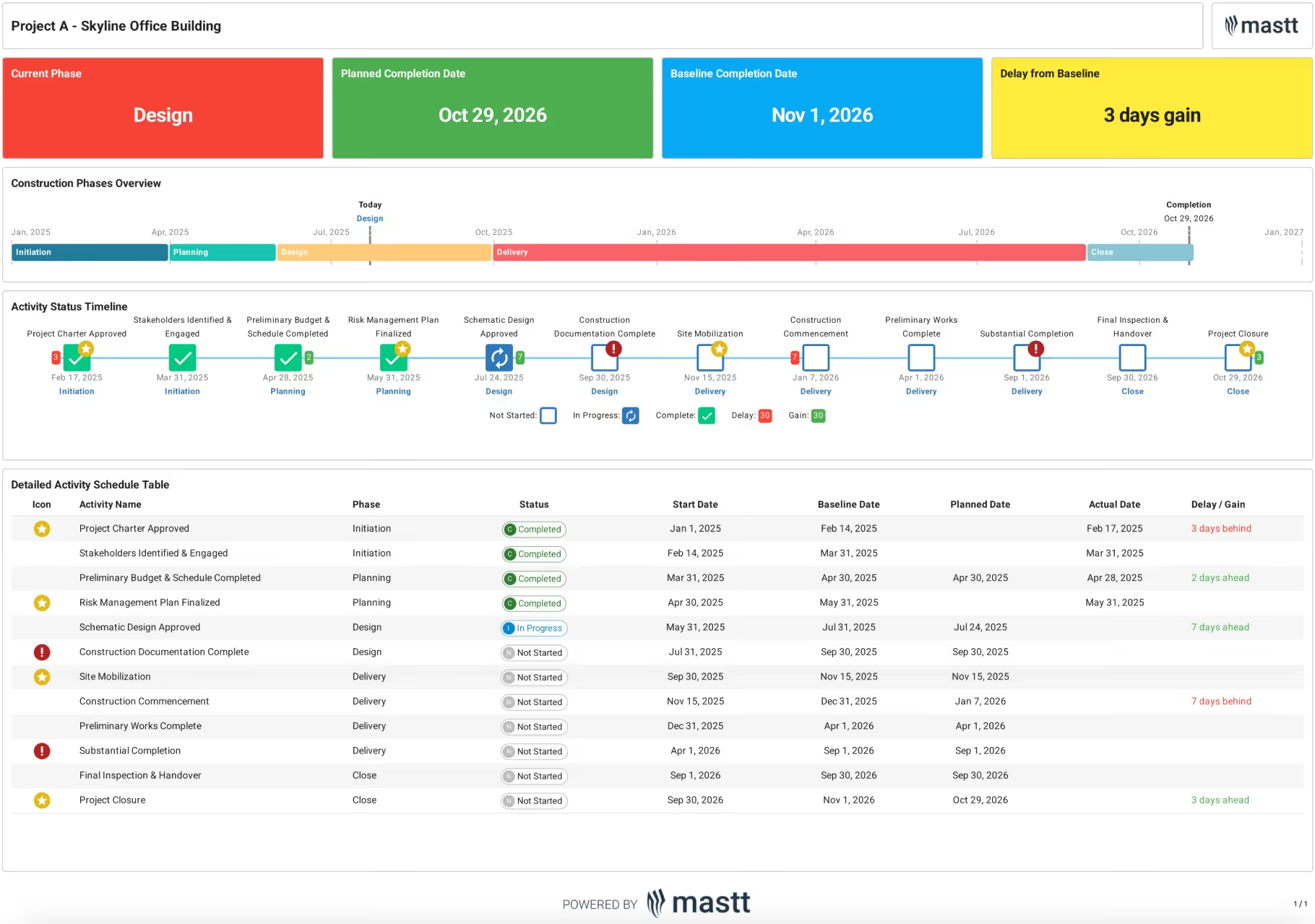
Construction Schedule Template
Use this FREE Construction Schedule Template to plan and outline all phases, milestones, and tasks. Keep your construction project organized and on track from start to finish.

Walk Into Every Meeting With Confidence, Clarity, and Control
No one wants to look unprepared, blindsided, or uncertain in front of stakeholders — but that’s exactly what happens without Mastt.
Start for FreeTrusted by the bold, the brave, and the brilliant across governments, Fortune 500s, and the world’s best in delivering the future