


Managing a construction project means keeping work on track while responding to changes in cost, timing, and client needs. These construction project management tips offer practical ways for managers to improve how they plan work, respond to problems, and guide client decisions.
1. Define What the Client Needs the Project to Achieve
Agree on what the completed project must achieve before the team commits to a design. Understanding the client’s underlying need gives the project manager a basis for assessing the proposed solution.
In Mastt's interview with Greg Usher, he described a transport project where the client wanted to build a new facility. His team examined the intended outcome alongside costs and timeframes. They identified an alternative that could meet the client’s needs without new construction.
To establish whether a proposal meets the client’s needs, work through these questions:
- What problem must the project solve?
- What must the completed asset allow people to do?
- Which requirements are essential, and where is there flexibility?
- How will the client check that those requirements have been met?
Use the answers to document clear performance requirements in the project brief, including how each will be checked. Refer to those requirements during design reviews and ask which ones each major proposal serves. If a proposed saving reduces performance, explain what the client would be giving up before seeking approval.
2. Agree on Scope and Decision-Making Authority Early
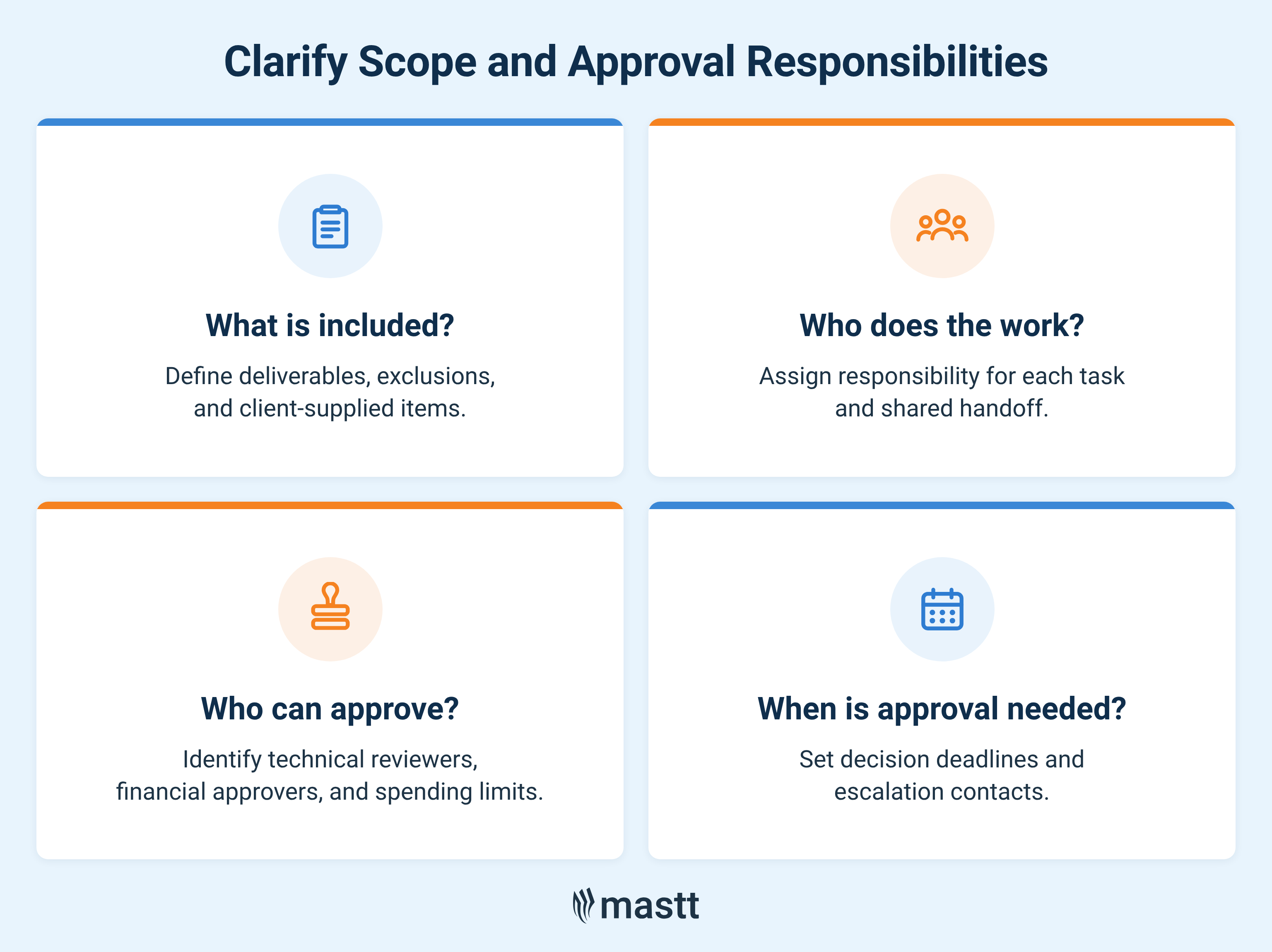
Define what each party will deliver and who can approve changes. Include exclusions and client-supplied items so gaps are visible before procurement or construction begins.
Check responsibilities where one party’s work depends on another. For example, the client may buy equipment that the contractor will install. Agree on who handles delivery and storage, and who prepares the required connections. Record these tasks in a responsibility matrix and review it with the parties involved.
Agree on the approval process with the client. Specify spending limits and decisions that require approval from someone with greater authority. Keep technical review and financial approval separate. A designer may confirm that a substitute product is suitable, while the client must approve its additional cost.
For each upcoming decision, record:
- Who has authority to approve it.
- What information they need.
- When the decision is required to support the planned work.
- Who to contact if approval is delayed.
Allow time for questions and revisions before the deadline. If a decision remains outstanding, explain which activity it could delay and raise it with the agreed decision-maker.
3. Track Forecast Final Cost Against the Approved Budget
Include the expected cost of unresolved changes in the forecast while their prices are being assessed. Otherwise, the client may commit to further spending without seeing how much of the budget is already likely to be needed.
For example, a design revision may require electrical work that has not yet been priced. Ask the cost consultant for an estimate, then check whether the cost plan already includes an allowance for that work. Replacing a $40,000 allowance with a $55,000 estimate increases the forecast by $15,000. Retaining both amounts would count part of the cost twice.
Keep the estimate’s approval status and assumptions visible until the price is agreed. As it becomes a quotation and then an approved commitment, replace the previous amount under the same change reference.
At each cost review, assess how the updated forecast affects the remaining contingency. If a pending change would use most of that allowance, explain the exposure before recommending another discretionary commitment.

4. Build a Realistic Schedule and Update It With Progress
Review the construction sequence with the contractor before agreeing on the baseline schedule. The dates should reflect the dependencies and resources needed to complete the work, giving the team assumptions it can test as construction progresses.
Use the schedule review to establish:
- Which incomplete activity is holding up following work.
- Whether that activity affects the critical path and forecast completion date.
- What resources, information, or access the proposed recovery requires.
- What evidence supports the revised duration.
If the proposal recovers only part of the delay, reflect the remaining effect in the completion forecast. Retain the approved baseline so the client can see how the current plan differs from the original commitment.
5. Review Risks and Upcoming Procurement Decisions
Use look-ahead reviews to identify commitments that need attention before the team loses time or options. This includes decisions due soon that affect work much later in the schedule.
For example, equipment needed several months from now may require design approval this week. Working backward from installation, using the supplier’s confirmed lead time and allowing for delivery checks, establishes when the order must be placed. The design team can then plan its review around that deadline.
If approval begins to slip, check whether the supplier can still hold the delivery date and arrange an assessment of alternatives. Record the fallback alongside the risk owner and the conditions that would trigger its use, so the next review can establish whether action is needed.
6. Give Clients Clear Options When Changes Affect Delivery
When a change affects the intended outcome, explain the feasible responses and what each would mean for the client. Compare cost and timing alongside the functions the completed facility would provide.
Usher recalls a defense project whose funding was cut after construction had started. His team finished within the revised budget and ahead of the revised schedule, yet stakeholders were disappointed because the reduced project lacked functions they had expected.
He calls this a “disappointing success.” His advice is to involve clients in choosing the response while they can still influence the result:
“They are making a decision at that point in time to change an outcome rather than having it thrust on them.”
- Greg Usher
For a funding shortfall, the following comparison illustrates what the client needs to understand:
Include costs such as redesign or temporary operating arrangements so the client can compare the options on the same basis. Review the operational effects with the people who will use the facility, then record the requirements that change when the client makes a decision.
7. Report What Changed and What Needs a Decision
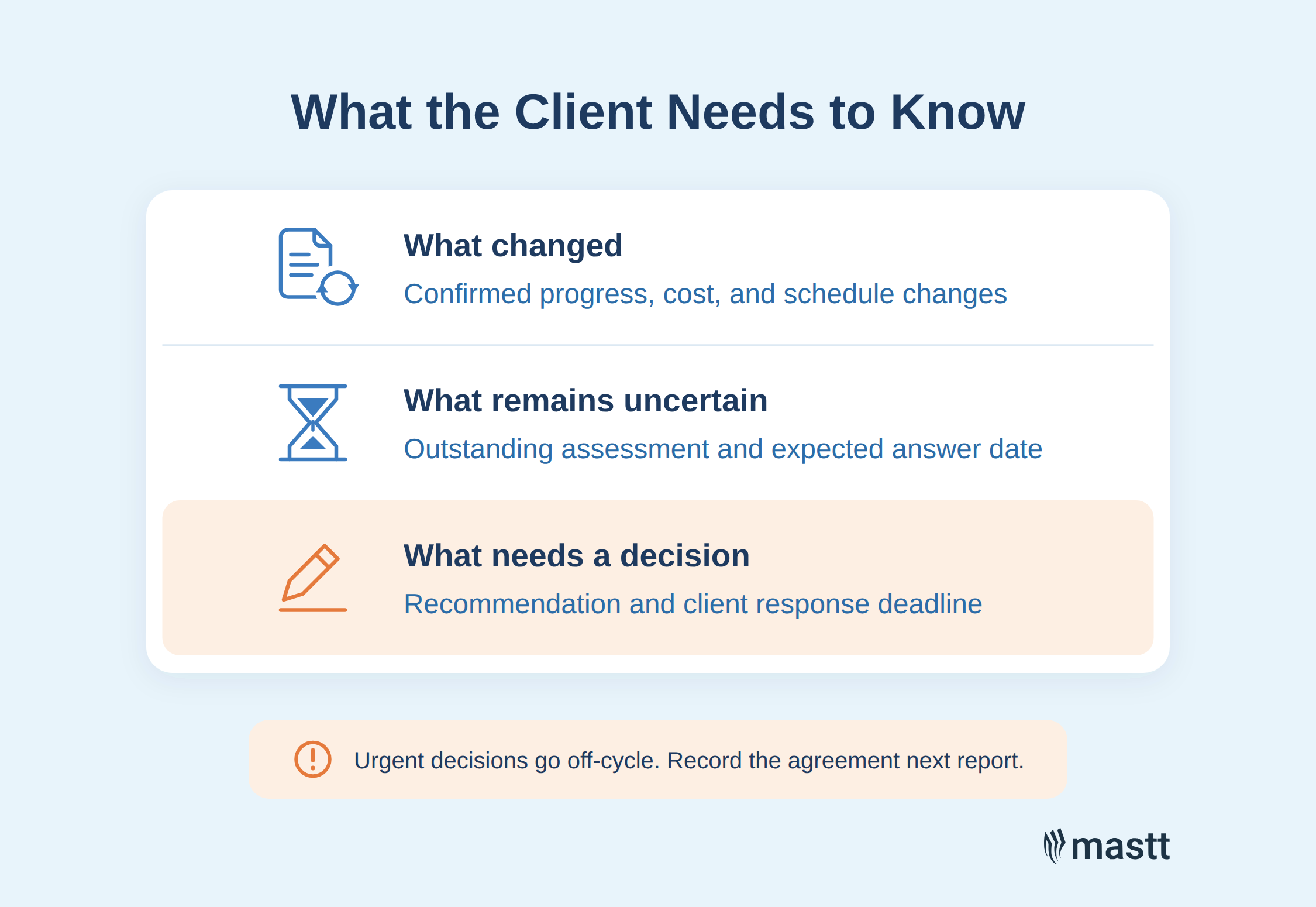
Give the client a consistent account of progress and explain what has changed since the previous report. Distinguish confirmed changes from proposals whose effects are still being assessed.
Before issuing a report, reconcile the cost and schedule information so both reflect the same project position. Where an assessment remains incomplete, explain what is still unknown and when the team expects an answer. Place any decision required from the client beside that explanation, with the recommendation and response date.
Decisions that cannot wait for the reporting cycle need direct follow-up. Include the resulting agreement in the next report so readers can understand how it affected the project’s direction.
8. Keep Instructions, Approvals, and Drawings Traceable
Keep the records supporting a change connected so the team can establish which instruction and drawing apply. Follow the decision through to distribution, because approval alone does not confirm that the site team has received the revised information.
For example, a request for information, or RFI, may lead to a revised construction detail. Link the response to the new drawing and any required change approval, then identify which earlier revision it replaces when issuing it for use.
Check that the process works by selecting a recent change at a coordination meeting. Ask the team to retrieve the supporting instruction and confirm the drawing revision being used on site. Any mismatch gives the document controller a specific distribution or record problem to resolve.
Apply the same principle to shop drawings and product submissions by keeping review comments with the relevant revision. Outstanding comments should remain visible to anyone relying on that submission.
9. Follow Up on Quality and Safety Issues Throughout Delivery
Plan required inspections around the work sequence so the team can check quality while the area remains accessible. Any defect found needs time for correction and verification before dependent work proceeds.
For example, work inside a wall may need inspection before lining begins. Agree on who will inspect and how much notice they need, then allow for reinspection if corrective work is required.
Keep each finding open until the responsible reviewer accepts the correction. The defect record should identify:
- The location and requirement that has not been met.
- The person responsible for corrective work.
- The evidence needed for acceptance.
- The activity that depends on that acceptance.
Changes to the work sequence also require attention to site safety. Ask the responsible site team to assess the revised working arrangements before relying on a recovery plan. Keep this follow-up within the project’s agreed responsibilities, including the applicable inspection and safety coordination roles.
10. Plan Handover Around the Client’s Operational Needs
Bring the operations team into handover planning early enough to arrange the testing and training needed before opening. Their first-day tasks should inform what contractors demonstrate and which operating information they supply. Check that the manuals reflect what was installed, including substitutions made during construction.
Work backward from the intended opening date to schedule those activities while the relevant contractors are still available. If testing or corrective work will remain outstanding, explain any restrictions on operation and agree who manages the follow-up after the main project team leaves.
Which Tools Help Teams Manage Project Delivery?
Choose tools that let the team maintain project information without repeatedly entering the same update. Establish which record supplies each figure or status used in client reporting.
Before adopting capital project management software, ask the people maintaining these records to test a typical update. For example, enter an approved cost change and check how it appears in the forecast and project report. Identify any manual transfers and agree who will handle them.

Put the Tips Into Practice
Use the next project review to identify which management gap is affecting an upcoming commitment. Assign a specific correction and check its completion at the following review. Start with the gap that leaves the least time to act.
Watch Mastt’s full interview with Greg Usher for more on client-side project management and handling changes during delivery.
.avif)
Written by
Doug Vincent
Doug Vincent is the co-founder and CEO of Mastt, the AI capital-project management platform used by governments, Fortune 500 companies, and consultancies across APAC, North America, and MENA. Before founding Mastt in 2019, he spent a decade at RPS delivering more than $2 billion in capital works, including the $2.1B Defence Navy Infrastructure program, and holds a CPSPM certification with the AIPM. He contributes content and speaks on AI in capital project delivery at Mastt.


Contributions by
Dr. Greg Usher
Dr. Greg Usher is a company manager at Beca and an Adjunct Research Fellow at the University of Southern Queensland, holding a PhD in project management and a Fellowship of the Australian Institute of Project Management. Over a 20-year executive career, he has led major construction and defense programs, including a $1.96 billion naval capability infrastructure sub-program, and has authored a book and peer-reviewed research on project complexity and resilience. At Mastt, he contributes content on project management and client-side project delivery.
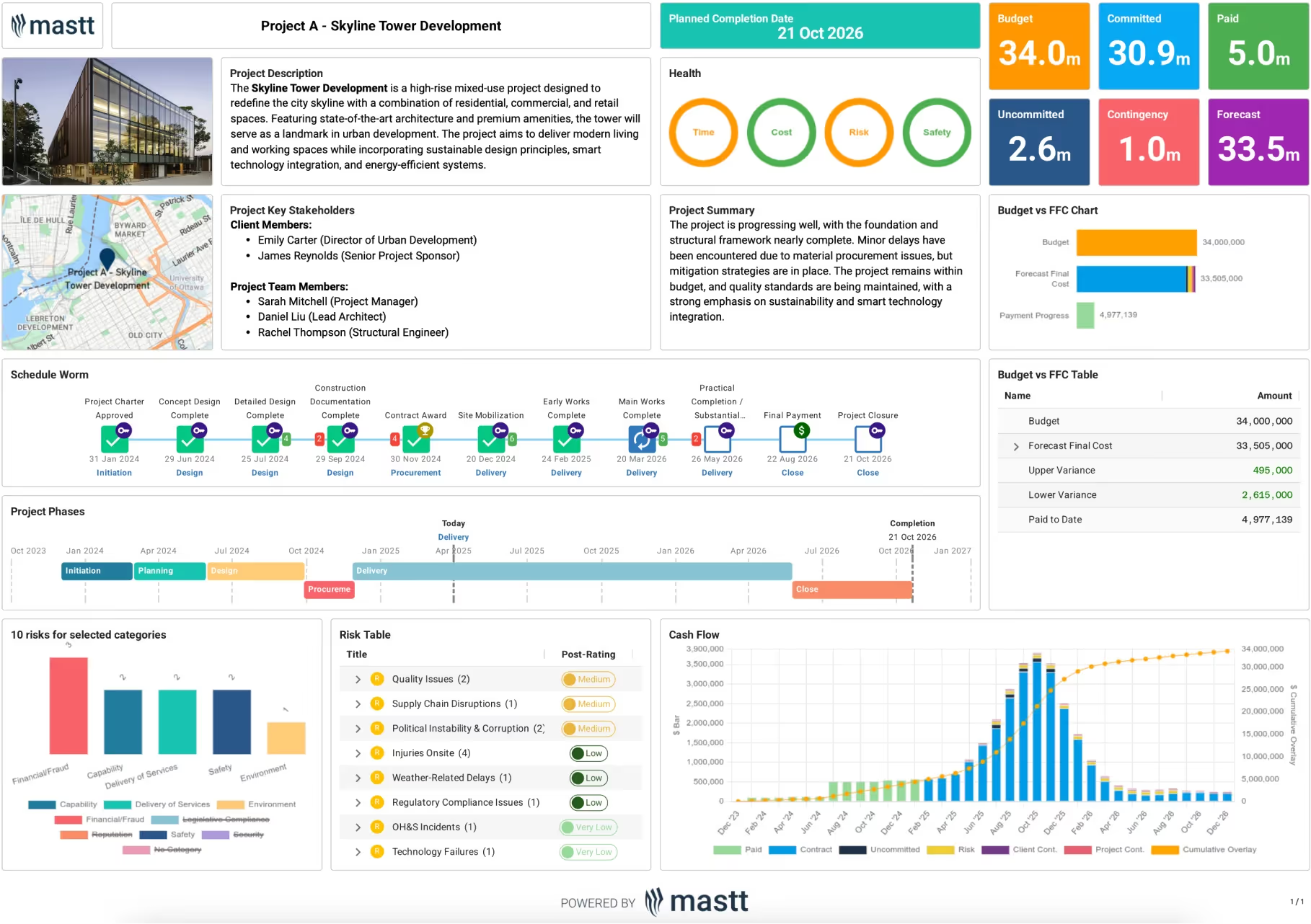
Project Management Dashboard Template
Use this Project Management Dashboard Template to manage your projects in one connected view. Track budgets, schedules, KPIs, and risks with real-time clarity.

Walk Into Every Meeting With Confidence, Clarity, and Control
No one wants to look unprepared, blindsided, or uncertain in front of stakeholders — but that’s exactly what happens without Mastt.
Start for FreeTrusted by the bold, the brave, and the brilliant across governments, Fortune 500s, and the world’s best in delivering the future