


Hospital projects don't behave like other commercial builds. The risks come from places commercial work never has to think about, and most of the decisions that shape the outcome happen long before a contractor is on site.
We sat down recently with Gordon Grover, who founded Specialised Project Consulting (SPC) and has spent 20 years running hospital projects across Queensland. Below are 8 lessons from that conversation about delivering complex healthcare projects.
1. Hospital Project Delivery Is Built Around Clinical Risk Management
The first thing Gordon laid out is that hospital project management is, fundamentally, risk management. Every call a project manager makes on a hospital job is a risk decision in disguise. Whether it's about program, budget, design quality, or build quality, the underlying question is always which risks to accept, which to transfer, and which to mitigate.
The catch is you can't manage risks you've never seen. Hospital exposures like infection control on a live ward, or keeping medical gases flowing during construction, don't show up on commercial fit-outs. Without prior healthcare experience, a PM starts from zero on the parts of the work that matter most.
Client-side project management is all about risk management, whether that's risk to your program, risk to your budget, risk to the quality of the build, or quality of the design. You can't really manage those risks if you don't know what they are.
- Gordon Grover, Founder of SPC
That's why specialist healthcare PMs exist. Pattern recognition on hospital risk only builds through direct hospital work, project by project.

2. CSSD Refurbishments Are the Most Complex Hospital Projects to Deliver
When Gordon talks about complexity in hospital or healthcare construction, he keeps coming back to the Central Sterile Services Department, or CSSD. It's where every surgical instrument in the building is cleaned, sterilized, and tracked. Most hospitals have only one of them. If the CSSD stops, the operating rooms stop with it, because there is no clean instrument supply for the next case.
That turns a CSSD refurbishment into a logistical problem long before it becomes a construction problem. Gordon's CSSD jobs typically run as ten to fifteen sequential stages, with each stage carrying its own infection-control plan and its own equipment sequencing.
General hospitals only have one of them (CSSD). So when you're refurbishing a CSSD, you have to keep it running, otherwise the whole hospital shuts down. Trying to pull out old sterilizing units or washers and replace them with new while keeping the whole thing operational usually means a ten or fifteen-stage project.
- Gordon Grover
For a project owner, this means a CSSD refurbishment can't be procured the same way as a ward refurbishment. The staging plan, infection-control measures, and equipment sequencing all need to come from a team that has delivered this kind of work before.
💡 Pro Tip: On a CSSD refurbishment, the staging plan is half the project value. Bring the head contractor into early planning conversations with the clinical operations team so the staging aligns with the hospital's actual surgical schedule rather than the construction sequence.

3. Hospital Mechanical Design Carries Clinical Performance Requirements
Anyone who has spent a night in a hospital ward knows the place runs cold. Gordon explained that this is part of the building's infection-control strategy. Low temperatures suppress bacterial growth. Humidity control limits conditions in which airborne infection can spread, or condensation can form on surgical equipment.
Operating rooms are kept even colder. They sit on separate HEPA-filtered mechanical systems, with positive pressure relative to surrounding spaces and high air-change rates to keep theaters sterile between cases. The HVAC scope on a hospital project carries clinical performance requirements that commercial fit-out work never has to meet.
Theaters are designed so that they can be cleaned easily, so they're on separate, HEPA-filtered mechanical systems. That's why hospitals are so cold. It's always freezing in the theaters. Bacteria and condensation. That whole humidity control as well, particularly in theatre spaces.
- Gordon Grover
Refurbishing a clinical space means treating the HVAC scope as clinical-grade work, with commissioning protocols to match. Shortcutting it is one of the fastest ways to fail a clinical handover.
4. Equipment Lead Times Set the Critical Path on Hospital Projects
Gordon was clear on this one. On a hospital project, the major medical equipment is procured by the client rather than the contractor. Instruments such as MRIs, CT scanners, sterilizers, and theater pendants are ordered through the client's own supply agreements, often well before a contractor is on board.
Lead times of six to twelve months are routine, and the equipment selection drives the subsequent design. Power requirements, room dimensions, structural loading, and ICT integration all get sized against the machines going in. For the PM, long-lead procurement is the critical path, often more constraining than the construction sequence.
Understanding the lead time associated with the procurement of that equipment and capturing that in a detailed master program. In a lot of cases, that does drive the critical path.
- Gordon Grover
The construction sequence has to align with the day the equipment actually arrives, is commissioned, and goes into clinical use. If lead times slip, the project slips with them, however well the build itself is running.
💡 Pro Tip: Build the master program backward from the equipment commissioning date. The lead time is usually the binding constraint, and the construction sequence has to adapt to it.
5. Hospital Design Reviews Require Client Sign-Off on Every Drawing
Hospital design reviews, in Gordon's view, should happen at every stage gate. Concept, detailed, schematic design, and issue-for-construction each close out with a structured review. The format he prefers is a user group workshop, where the consultants page through the drawings with the clinical end users in the room.
Where clients trip themselves up is treating design review as an inbox task. Gordon's preferred practice is a physical signature on every design drawing, or at a minimum, an explicit email approval.
Without that engagement, clients flip through construction drawings, miss the implications, and meet the actual building for the first time on the handover walk-through.
What we try to do is get our clients to actually put a physical signature on each design drawing. That's best practice in my experience. It means they have to take some responsibility themselves for reviewing and understanding the drawing.
- Gordon Grover
When the user group has been through every design phase, the final sign-off is mostly a formality. When they haven't, the final review turns up issues that should have been raised three phases earlier. Fixing them at that point means change orders.
6. Major Medical Equipment Procurement Sits With the Hospital Client
The technical risk associated with hospital machines lies in biomedical engineering rather than in construction. They integrate with the hospital's ICT, backup power, and medical gas systems, and that level of integration is what keeps procurement with the client rather than the contractor.
The contractor's role here is narrow but important. They install the supporting infrastructure, sometimes move the equipment into position once it arrives on site, and verify the connection points. The actual purchase stays with the client, along with clinical commissioning and the underlying biomedical risk.
They (contractors) are builders at the end of the day. They're not biomedical engineers. They're not gonna take the care in constructing and managing a team that's building an MRI machine.
- Gordon Grover
The boundary between who supplies and installs what is usually captured in the project's FF&E schedule. On a complex hospital project, that schedule is one of the most important deliverables in the design phase.
7. Hospital Plumbing Refurbishments Must Eliminate Every Dead Leg
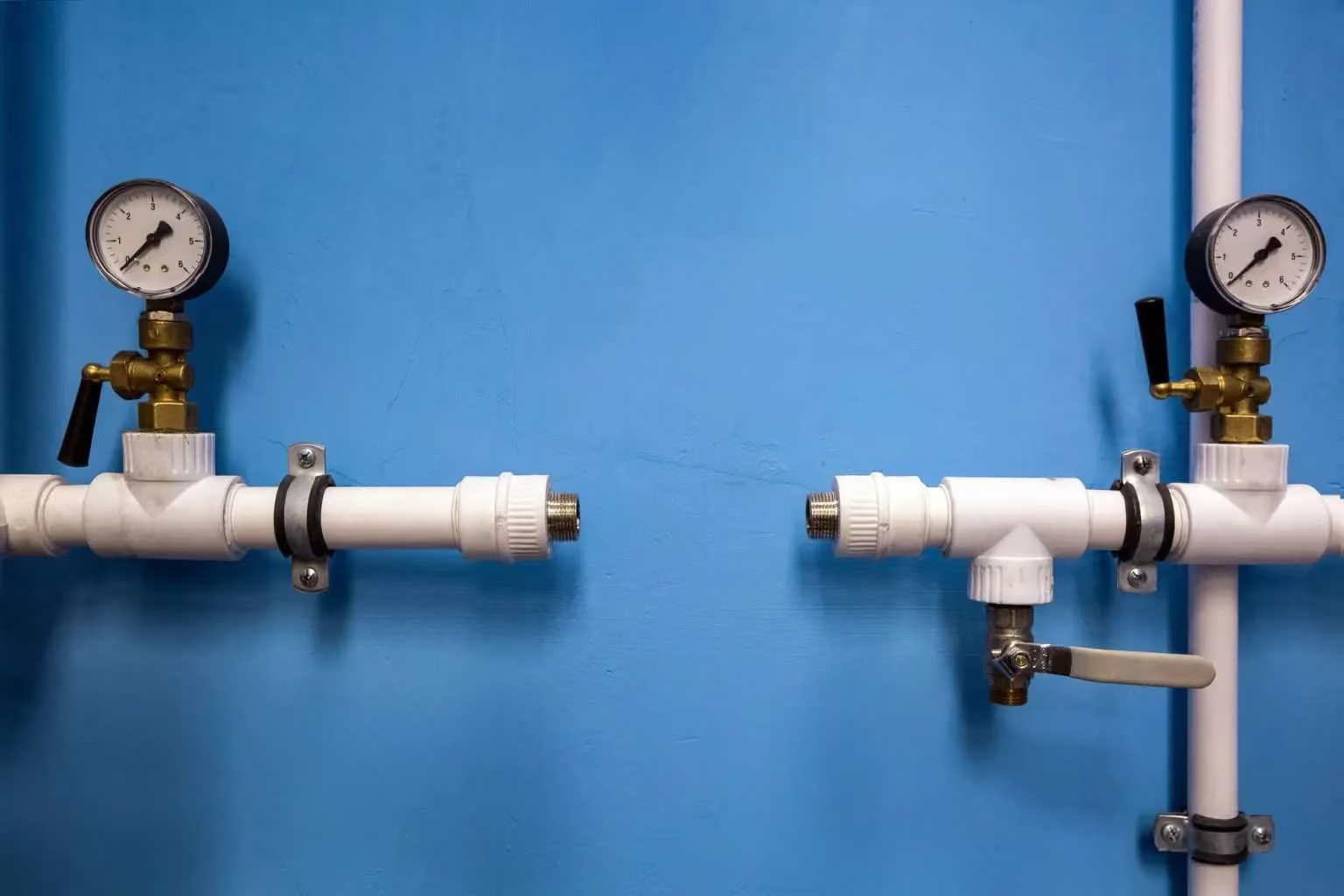
One of the more specific details Gordon shared was the dead leg problem in hospital plumbing. A dead leg is a section of plumbing pipe that branches off a live water line and ends with no outlet. It usually forms during refurbishment work, when a fixture is removed, and the supply pipe is capped at the wall. Water in that capped section stops circulating.
On a commercial construction project, that's standard practice. In a hospital, the same capped pipe becomes a Legionella reservoir. Stagnant warm water is the textbook environment for Legionella pneumophila to multiply, and a contaminated hospital water system can cause Legionnaires' disease in immunocompromised patients.
In a hospital environment, there is a risk of Legionella. So you can't leave dead legs in a hospital build. You've got to bring it all the way back to completely remove those elements.
- Gordon Grover
Australian hospital plumbing standards, including AS/NZS 3500 and the enHealth water hygiene guidelines, treat dead legs as a clinical hazard. The pipe has to be traced back to a live line and removed entirely. Capping is not an option.
A generic refurbishment contractor won't know this. The requirement sits in hydraulic engineering guidance and clinical water safety practice, not in standard building codes.
8. Delivering Hospital Projects Requires Specialist Project Managers
Hospital projects can't be delivered without specialist PMs. The risks they manage aren't theoretical, and managing them takes pattern recognition that only builds through prior hospital work.
It's also why hospital PM is a small, specialist market. Generic commercial PM firms typically can't cross over. The decisions they would need to make on a CSSD or an ICU sit too far outside their experience to learn on the job. And on a hospital project, the consequences of getting it wrong are clinical.
Having experience is a key requirement. You can't just walk in the door and expect to pick up complex projects like ICUs or theaters. It's not something you can drag experience from a fit-out project or an industrial project. Working for a business that's done it before, working for people that have done it before, that's how you build up the experience and knowledge.
- Gordon Grover
On a hospital project, the cheapest PM is rarely the right one. The right one has actually delivered the type of clinical space being built and can point to specific previous projects where the approach worked. As Gordon puts it, his team wouldn't have a job if anybody could do it.
The Bottom Line on Delivering Hospital Projects
Hospital project delivery is a clinical risk management problem expressed through construction. The patient is the silent stakeholder on every hospital project, and every decision the project team makes either protects clinical safety or compromises it.
For owners and program managers, the implication is to treat hospital project delivery as a specialist discipline from the outset. The cost of cutting corners on PM appointments doesn't land on the construction invoice. It lands later, in operational disruption, change orders, and clinical risk.
.avif)
Written by
Doug Vincent
Doug Vincent is the co-founder and CEO of Mastt, the AI capital-project management platform used by governments, Fortune 500 companies, and consultancies across APAC, North America, and MENA. Before founding Mastt in 2019, he spent a decade at RPS delivering more than $2 billion in capital works, including the $2.1B Defence Navy Infrastructure program, and holds a CPSPM certification with the AIPM. He contributes content and speaks on AI in capital project delivery at Mastt.


Contributions by
Gordon Grover
Gordon Grover is Managing Director of Specialised Property Consulting, a Toowoomba-based firm delivering project, development, and superintendency services across Queensland. A QBCC-licensed Builder Project Manager, he has delivered projects from $20 million regional health clinics to the $235 million InterLinkSQ freight terminal, and founded the health-infrastructure advisory Specialised Health Advisory. He contributes content on capital planning and project delivery at Mastt.
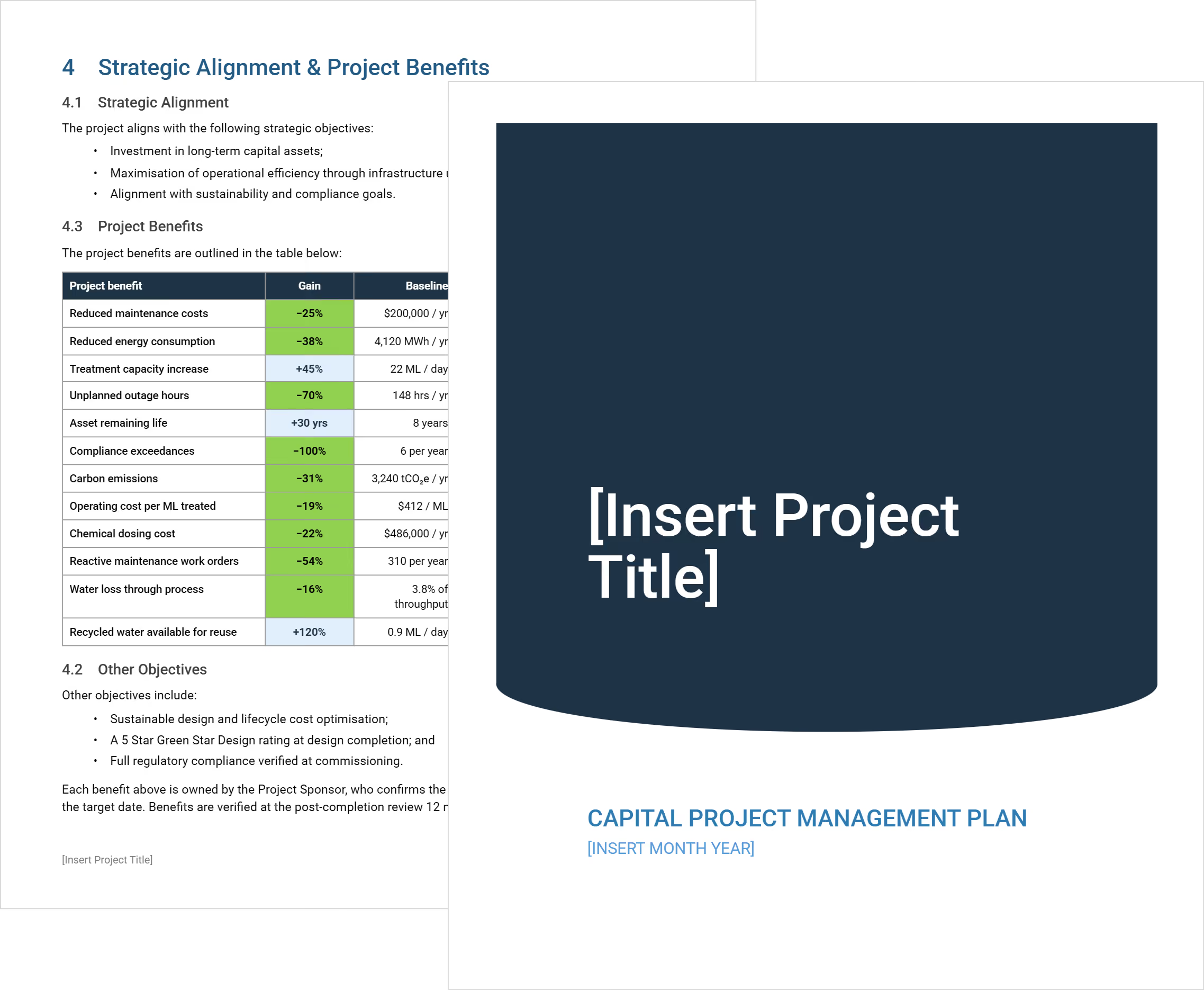
Capital Project Management Plan Template
FREE capital project management plan template in Word. Eighteen ready-to-edit sections built for CapEx control, funding governance, and asset handover.

Walk Into Every Meeting With Confidence, Clarity, and Control
No one wants to look unprepared, blindsided, or uncertain in front of stakeholders — but that’s exactly what happens without Mastt.
Start for FreeTrusted by the bold, the brave, and the brilliant across governments, Fortune 500s, and the world’s best in delivering the future