
Acuity Project Management is a project management consultancy with offices in Sydney, Brisbane, and Melbourne. Luke Ackland, a Brisbane-based director, works across clients, development teams, cost plans, and procurement strategies.
Luke ran Acuity’s Queensland office from Brisbane. He described its annual workload as 40-plus projects, with work across South-East Queensland and as far north as Cairns.
Our time is now spent solving problems and freeing up roadblocks, making projects run quicker.
Luke Ackland, Director
Acuity had strong quality assurance processes in place. Maintaining those standards required substantial data entry and repeated checks across spreadsheets that differed between projects, with different templates and ways of presenting information.
Claire Ellison, an assistant project manager at Acuity, worked across the team, preparing cost reports and handling contractor and consultant payment information.
The reporting cycle involved entering and checking data, updating the project manager, and passing the information through Luke’s review. Luke described this reporting workload as almost a full-time job for Claire.
“You would spend a lot of time reviewing everything, going through every line, and it was almost a duplication of effort.”
- Luke Ackland
If a review identified a formula error or another issue, the checking cycle could start again before the information went to clients. Luke described the potential for errors as a source of anxiety, even with those checks in place.
Maintaining reporting quality took time from both Claire and the people reviewing her work. Claire wanted to learn more about project management and contribute to solving project problems, but data entry occupied much of her time.
Luke introduced Mastt to Claire after having tried the product himself. He described her introduction to it as a light-bulb moment, explaining that spending less time in spreadsheets made her work easier and created room for other tasks.
Acuity initially used Mastt for contractor payment certificates while keeping its internal cost report. The team then expanded into consultant payment certificates and cost reporting, followed by dashboards for weekly and monthly project updates.
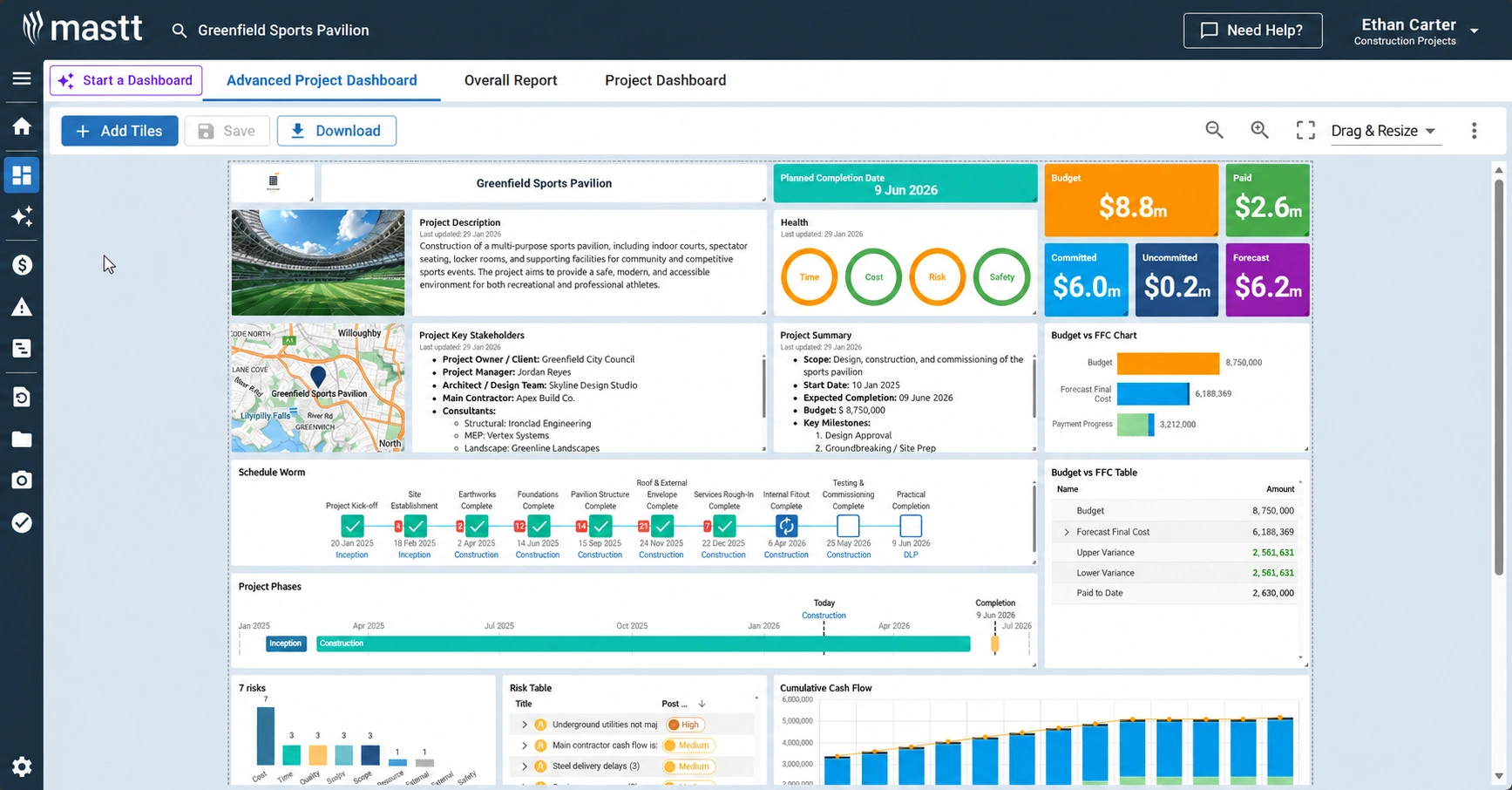
For monthly PCG reporting, Luke said Mastt had largely replaced the team’s spreadsheets and PowerPoint presentations. The dashboard became the basis for presenting project information in those meetings.
Luke described presenting a project to partners at a legal firm through the Mastt dashboard. The view brought together the critical project information, drawn directly from the source data.
“I could see all the critical things I needed to see on one page.”
- Luke Ackland
The team could also explore individual items in the dashboard if the partners wanted more detail. Reflecting on that presentation, Luke said:
“Everyone trusted it. Everyone knew what they were looking at.”
- Luke Ackland
One clear improvement is how quickly Acuity can respond when a client requests a cost plan update or snapshot.
“The speed it would be from a client asking us for a cost plan update or a snapshot to getting them something over the line was days, where now it can be an hour or minutes.”
- Luke Ackland
Luke linked that turnaround to having live information available and retaining a quick QA check. The team spent less time checking spreadsheet versions and investigating formula issues before sending an update.
He also reported fewer errors and more consistent reporting across the business. Clients with multiple Acuity projects could work with a familiar reporting format, without encountering a different spreadsheet or cost report for each project.
“It’s given us a high level of confidence in our reporting.”
- Luke Ackland
Luke felt clients could see that confidence and were questioning the reporting less.
The change also affected how Claire spent her time. Data entry became a smaller part of her role, while problem-solving and other project management tasks took a larger share. With more capacity to learn and contribute, Luke saw her skills develop:
“Her growth in just her own skill set just really took off.”
- Luke Ackland
For Luke, the value of reducing administration extends to how Acuity works with project teams. More time outside spreadsheets and presentations means more time talking to people and resolving design, cost, and construction problems.
“They’re paying us to deliver a project for them on time and on budget and with confidence and to de-risk their projects.”
- Luke Ackland
He connects that greater focus on project delivery with better client outcomes and repeat work.
Asked whether Acuity could return to its previous workflow, Luke was clear:
“Not a chance. I think there’d be mutiny in the office if that was the case.”
- Luke Ackland

Cut the stress of showing up unprepared
Start for FreeTrusted by the bold, the brave, and the brilliant to deliver the future