We use cookies to improve site navigation, analyse site usage. You can opt out of cookies by clicking reject below. See our Cookie Policy for more details.



CHEO is a pediatric health care and research organization in Ottawa, founded in 1974. It provides specialized pediatric care to children from eastern and northern Ontario, western Quebec, and Nunavut.
Faraz Ahmed Mushtaq is CHEO’s Director of Capital Projects. Current projects include the new Integrated Treatment Centre, a renovation of about 25,000 square feet to house laboratories for CHEO’s newborn screening partners, and a NAPRA-compliant hazardous compounding suite. The program runs from jobs starting at $50,000 up to projects worth hundreds of millions.
The facilities team uses Mastt to manage costs, risks, and schedule milestones, and to report to CHEO’s executives and board. Faraz joined CHEO as Mastt was being implemented and now manages access as the project admin.

Definitely I feel confident when I’m reviewing Mastt that it has captured the information that I was expecting it to.
Faraz Ahmed Mushtaq, Director of Capital Projects
Before Mastt, CHEO’s board saw the capital program through one big Excel worksheet. Each project had a tab, and one or two people updated the capital project reporting by hand before it was presented.
The first concern was what those reports could show. Faraz said they were very limited in communicating actual needs, status, risks, project health, and where the finances were. He called the approach one-dimensional.
The second was that the data lived in separate places. Project managers kept an Excel log of costs and a separate Microsoft Project schedule, and somebody had to put them together by hand in a third Excel sheet that didn’t talk to the others.
“There were either misses or one of the documents wasn’t up to date, and the cross-communication between the reporting and the actual state would get missed sometimes.”
- Faraz Ahmed Mushtaq
Risk logs had the same gap. They were usually updated at the end and didn’t talk to costs or the schedule. Faraz said a risk updated after the reporting slide was done could miss the board, which meets on a set cadence, and that impacts the credibility of the people presenting and managing the project.
Invoices sat apart as well. In Excel the team only had figures, so checking an invoice meant going into SharePoint or a document control system and through layers of folders.
The third concern was consistency. People used different Excel sheets, and each new project manager had to be trained separately on the worksheet, which was a draw on resources.
CHEO moved that reporting into Mastt. Faraz said Mastt is not just reporting software, since it also helps the team manage costs, risks, and the schedule.
For executives and the board, Mastt adds a level of reporting between a detailed Microsoft Project schedule and a one-line status in an Excel cell. Dashboards show milestones rather than every task, and the team often uses the schedule worm feature.
“It gives you a snapshot of the project. We can include pictures.”
- Faraz Ahmed Mushtaq
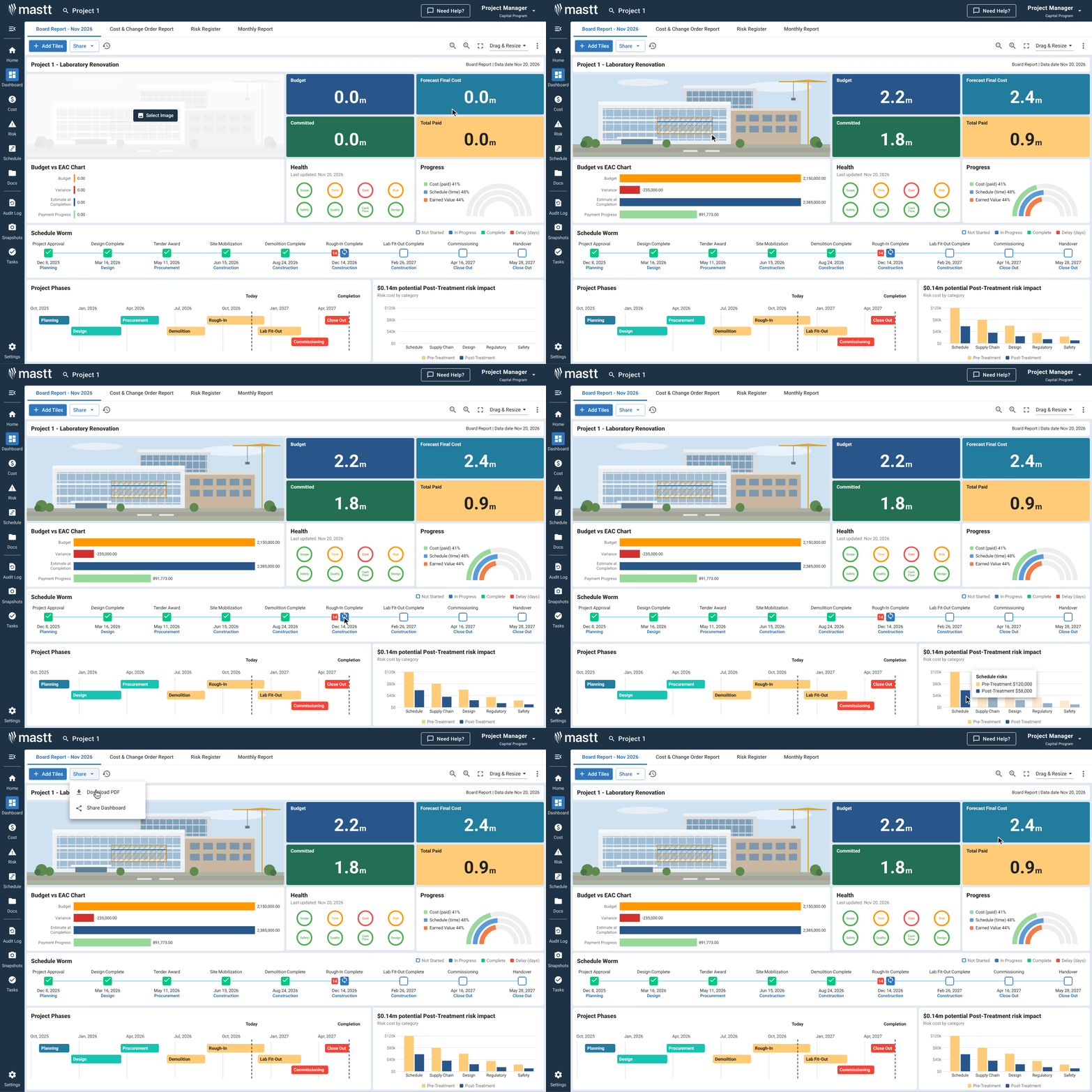
On the cost management side, any invoice approved through CHEO’s ERP now has to be updated into Mastt instead of an Excel file. Updating is drag and drop, with an AI module that does the reading.
Detailed task schedules stay in Microsoft Project, and a project schedule can be dragged into Mastt to update those tasks. Risks sit alongside costs and the schedule, each with a pre and post risk rating and a risk cost, which Faraz said adds accountability and more realistic planning.
“So the board knows that this risk has been identified and it adds a value to that risk. It’s not just a risk, it is a real number that can be tracked.”
- Faraz Ahmed Mushtaq
Asked what Mastt has made easier in cost management, Faraz put one change first.
“The biggest thing would have been having an invoice tied to the entry. So I can just click on the PDF right there.”
- Faraz Ahmed Mushtaq
He said CHEO didn’t have that before. If a contract is missing, he can run a quick audit and ask for it to be added.
For consistency, ready visibility into Mastt lets Faraz set processes and expectations for the whole team instead of having individual conversations. When a process isn’t clear, he sends one email that explains it to everyone.
Faraz said the first round of Mastt dashboards CHEO presented was taken quite well.
“Our executives loved the presentation. It just raised the bar from an Excel-based report to something that has visuals, graphs, Gantt charts, all in one page.”
- Faraz Ahmed Mushtaq
It wasn’t a one-off.
“It basically has become the standard here at CHEO. Now this is what is expected.”
- Faraz Ahmed Mushtaq
Asked about measurable outcomes, he named stakeholder confidence first, especially with the executives and board CHEO reports to. He sees the same when he reviews projects himself.
“Definitely I feel confident when I’m reviewing Mastt that it has captured the information that I was expecting it to.”
- Faraz Ahmed Mushtaq
Asked what feelings come to mind when he uses Mastt, Faraz said it was “very exciting” at first. That has faded with time, but he said the UI and functionality still make it exciting.
He compared it with Excel, which he called crude. CHEO is publicly funded and can’t spend money on expensive software, so it had relied on basic Microsoft tools.
“It’s really cool to use Mastt instead of Excel.”
- Faraz Ahmed Mushtaq
The team also spends less time on the work behind the reports.
“There’s the AI module that reads, so it has cut down on the time it would take for our team to update financials.”
- Faraz Ahmed Mushtaq
Faraz said there is less time spent keeping things organized and hunting for documents. Everyone now follows the same process, with common language and common terms.
Faraz’s clearest example is a program of rooftop unit work. CHEO is upgrading or replacing 12 rooftop units that are reaching end of life. When a renovation covers an area served by one of those units, it makes sense to replace the unit while the area is offline.
CHEO then transfers budget from project to project in Mastt, which also tracks the overall budget for the program.
“It makes it quite easy to track transfers and definitely helps teams to get insight into other teams’ projects just at the click of a button.”
- Faraz Ahmed Mushtaq
Faraz said Mastt takes a little getting used to when switching systems. Once the initial learning curve is over, the patterns start to emerge and things begin to make sense.
The table below compares CHEO’s earlier approach with Mastt.
Mastt stays within CHEO’s facilities team, and Faraz manages who has access. Anyone outside the team who needs to see a project gets a printed dashboard, which he said is pretty self-explanatory.
Microsoft Project still holds task-level schedules, and invoices are approved in the ERP before they are updated into Mastt.
Asked if he could ever go back to a world without Mastt, Faraz was clear.
“No, absolutely not.”
- Faraz Ahmed Mushtaq
His pitch to a fellow project owner was about the reporting.
“It’s easy to work with, and it elevates the reporting, so even your bosses will love it.”
- Faraz Ahmed Mushtaq
He said those bosses would see a marked uplift in their confidence in the information being provided to them.

Cut the stress of showing up unprepared
Start for FreeTrusted by the bold, the brave, and the brilliant to deliver the future
Get access to Mastt instantly and start automating work in minutes